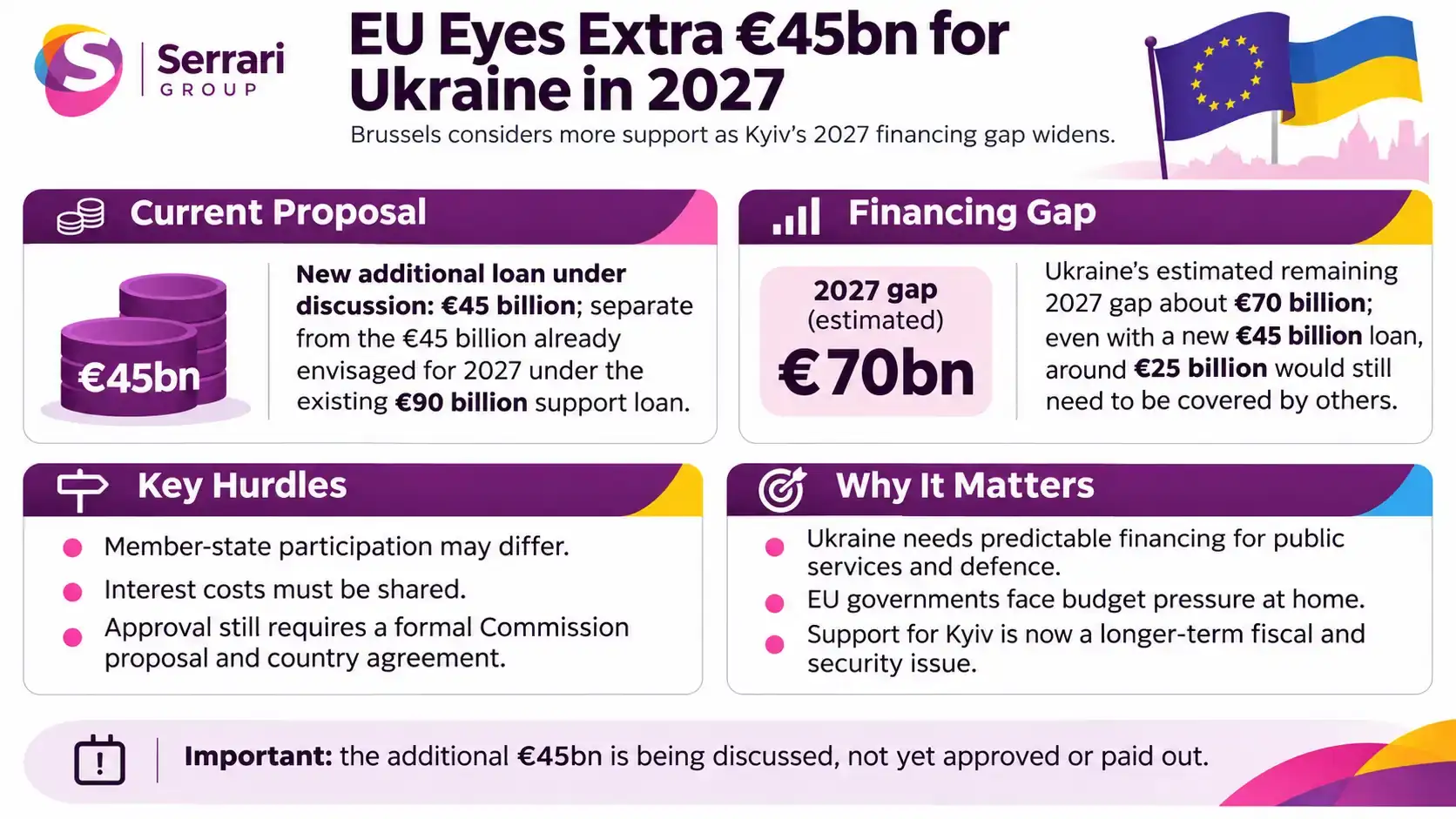
The European Union is examining a further €45 billion loan for Ukraine in 2027 after Kyiv’s remaining financing needs rose to approximately €70 billion despite support already expected from international partners. Economy Commissioner Valdis Dombrovskis outlined the possibility on November 9, 2026, but the plan has not yet been formally approved. Crucially, the proposed loan would come on top of the €45 billion already envisaged for 2027 under the EU’s existing €90 billion Ukraine Support Loan. For Ukraine, the issue is whether promised aid will arrive predictably enough to finance public services and defence during a prolonged war. For EU governments, it is whether they can agree on more joint borrowing and its associated interest costs while facing pressure on their own budgets.
Key Overview
- New proposal: The European Commission is exploring an additional €45 billion loan for Ukraine in 2027, with detailed options still to be presented to member states.
- Existing support is separate: Another €45 billion is already envisaged for 2027 under the previously established €90 billion Ukraine Support Loan covering 2026–2027.
- Uncovered need: Ukrainian and European officials estimate a roughly €70 billion remaining financing gap for 2027 after taking account of existing support commitments.
- Other donors remain essential: Even if a new €45 billion EU loan proceeds, roughly €25 billion would still require additional financing or adjustments, before accounting for any new commitments.
- Two political obstacles: Governments must decide who participates and how the borrowing’s interest and related costs will be paid.
- No payment authorised yet: The newly discussed €45 billion is a financing option, not a disbursement already agreed by all EU members.
Why Ukraine Needs Another €45 Billion Despite Existing EU Support
The proposed additional loan reflects a growing mismatch between the cost of sustaining Ukraine through another year of war and the money already committed by its international backers. In remarks on November 9, Dombrovskis said the financing gap was larger than previously expected and that Brussels was exploring how to cover approximately two-thirds of the additional €70 billion requirement.
An important distinction is that the €70 billion figure is not Ukraine’s entire state budget or its total gross financing requirement. It is the estimated amount still uncovered after previously anticipated contributions, including the EU’s planned support for 2027. Nor is the proposed €45 billion a replacement for existing assistance. The Commission has already advanced the allocation of the remaining €45 billion from its €90 billion support facility, subject to the relevant approval and implementation steps.
Ukraine’s problem is larger than replacing lost tax revenue. War creates extraordinary defence spending while weakening the economy from which those revenues must be raised. Repeated attacks on energy infrastructure and businesses disrupt production, reduce economic activity and increase the cost of maintaining essential services. The government must also pay public employees, support social programmes and repair vital infrastructure while allocating substantial resources to defence.
The strain is apparent in Ukraine’s November funding discussions, which separated the uncovered €70 billion into roughly €30 billion for budget support and €40 billion for defence needs outside the ordinary budget. That distinction matters: external assistance is required not just to keep government accounts balanced but also to sustain the military capacity on which the country’s security depends.
How the New Proposal Differs From the €90 Billion Loan
The EU’s existing Ukraine Support Loan framework covers 2026 and 2027 and is financed by borrowing on capital markets backed by the EU budget. Its indicative allocation is €60 billion for defence capabilities and defence industry, with €30 billion for economic and budget support. The package was agreed in 2026, with up to €45 billion assigned to that year and the other €45 billion intended for 2027.
The Commission took a further implementation step on October 30 by proposing Council approval for the 2027 portion. That was a step within an existing facility, whereas the additional €45 billion discussed in November would require a separate political and financial arrangement. Treating the two amounts as one announcement would understate both the scale of Europe’s potential assistance and the amount that still needs approval.
If the new proposal is agreed in full, the EU could have up to €90 billion in support planned for Ukraine in 2027 across the existing allocation and new loan. That does not mean €90 billion would automatically be transferred into Kyiv’s treasury: some assistance is tied to defence procurement, funding channels have different conditions, and payment schedules depend on approvals and implementation. The proposed extra loan would nevertheless materially reduce uncertainty surrounding the country’s financing outlook.
Context is everything. Stay ahead of shifting trends with today’s market updates, and uncover emerging opportunities using the Serrari Group Market Index and Marketplace. Then, take control of your own financial future by exploring our Money & Life Reset Transformation Blueprint ™ to build stronger habits, create better systems, and design a path toward lasting wealth.
Why Member States May Disagree Over Who Pays
The biggest obstacle may be less about whether Ukraine needs help than about how to distribute the financial burden within Europe. The original loan agreement was structured through enhanced cooperation, allowing participating EU countries to proceed without imposing the same financial obligations on Czechia, Hungary and Slovakia. That compromise demonstrated both the EU’s ability to act and the limits of political consensus.
Diplomats now expect participation and possible opt-outs to become contentious again. The original report also points to Bulgaria as a possible non-participant under its changed political leadership, but that remains a reported expectation rather than an agreed exemption for any new instrument. Until a formal proposal is published, neither the final group of participating states nor the mechanism for assigning costs can be treated as settled.
These disagreements matter because the political price of common borrowing is not shared equally. Governments with greater fiscal capacity may face demands to contribute more, while others argue that domestic defence spending, debt servicing and public services already constrain their budgets. A scheme that excludes certain governments could make agreement more achievable but concentrate the costs among those remaining.
Negotiations are also taking place against the backdrop of the EU’s next long-term budget. Leaders are expected to address Ukraine’s financing needs at a November 26–27 summit, alongside discussions of future EU spending priorities. The longer the conflict continues, the harder it becomes to describe support for Ukraine as an exceptional, short-lived expenditure rather than a recurring fiscal commitment.
Why Interest Costs Could Become a Bigger Dispute
The term loan can make the proposal appear less expensive to European taxpayers than a grant, but borrowing still has a cost. Investors who buy EU-issued debt expect interest, and someone must cover it while Ukraine remains unable to repay principal on normal commercial terms. Under the existing financing structure, the EU budget is intended to subsidise interest and related borrowing expenses.
That distinction shifts part of the immediate burden away from Kyiv but creates obligations for European budgets. An assessment of the original facility cited estimated debt-service costs of around €1 billion in 2027 and €3 billion annually from 2028 for that existing loan. Those estimates should not be presented as the price of the new proposal, whose terms and borrowing costs have not yet been established.
For EU policymakers, the question is whether additional interest subsidies can be accommodated without squeezing other programmes or reopening difficult budget negotiations. Interest rates, repayment arrangements and the timetable for issuing debt all affect the ultimate cost. For Ukraine, favourable financing can reduce near-term fiscal pressure, but it does not make the underlying economic damage of the war disappear.
What Other Donors and Russian Assets Could Contribute
Brussels does not intend to fund the remaining gap alone. On a simple comparison, €45 billion in additional EU support against an uncovered €70 billion requirement leaves approximately €25 billion to be found elsewhere, assuming the figures and other commitments remain unchanged. That residual is a planning estimate, not a final cash shortfall after every future donor decision.
Norway has outlined plans for approximately €9 billion in support for 2027 under its Nansen programme. The United Kingdom, Canada and other partners are also important to the financing discussions. However, publicly announced intentions need to be distinguished from legally committed funds and actual disbursements, particularly when different estimates of the funding gap already incorporate anticipated aid.
Another issue is whether immobilised Russian sovereign assets could support Ukraine’s financing. The EU’s existing framework envisages repayment of the loan principal once Ukraine receives reparations from Russia, while Russian assets remain immobilised. That is not equivalent to an immediate transfer of the underlying frozen assets to Ukraine. Proposals to use them more directly have raised legal, financial and political concerns, making ordinary joint borrowing a more readily available, though still contested, option.
For international partners, the challenge is providing assistance that is timely as well as sufficiently large. Funding agreed late in the year, or disbursed only after extensive conditions have been met, can leave governments struggling to plan salaries, procurement and essential programmes even when headline pledges appear substantial.
Why the Decision Matters for Ukraine’s Economy and Europe’s Security
Without predictable external support, Ukraine would face harder choices between financing public services, maintaining economic stability and meeting wartime security needs. Cutting essential spending could weaken households and economic activity, while relying excessively on monetary financing could increase inflation and currency instability. A credible multi-year financing arrangement reduces some of those risks by allowing ministries and businesses to plan with greater confidence.
The timing also intersects with the country’s ongoing economic reform commitments. Existing EU budget assistance is linked to conditions involving public financial management, revenue mobilisation and governance. External financing can therefore support both immediate state operations and longer-term institutional reform, though attaching conditions can complicate the pace of disbursements during an emergency.
For Europe, this is simultaneously a security decision and a budget decision. Supporters argue that sustaining Ukraine’s defence reduces broader security risks for the continent. Governments wary of new financial obligations point to constrained national budgets, uncertain repayment prospects and the need for democratic oversight. Both considerations explain why even a proposal backed by strong strategic arguments may require difficult negotiations before it becomes law.
The next decisive steps are a formal Commission proposal, negotiations over participation and interest costs, and confirmation of complementary financing from non-EU partners. Until then, the additional €45 billion remains under consideration, not approved or paid out. The central question is whether Europe can translate its commitment to Ukraine into a predictable financial structure before another year of war places further strain on the Ukrainian state.
Sources: European Commission / Council of the European Union / European Parliament / Ukrainian Government Portal / Ministry of Finance of Ukraine / European Pravda / Reuters / Kyiv Independent
Your financial future isn’t something you wait for—it’s something you build.
The real question is: when do you begin?
Move beyond simply staying informed.
Navigate the markets with clarity—track trends through the Serrari Group Market Index, uncover opportunities in the Serrari Marketplace, and build practical knowledge with our Curated Wealth Builder Platform.
Stay connected to what truly matters.
Get daily insights on macro trends and financial movements across Kenya, Africa, and global markets—delivered through the Serrari Newsletter.
Growth opens doors.
Advance your career through professional programs including ACCA, HESI A2, ATI TEAS 7 , HESI EXIT , NCLEX – RN and NCLEX – PN, Financial Literacy!🌟—designed to move you forward with confidence.
See where money is flowing—clearly and in real time.
Track Money Market Funds, Treasury Bills, Treasury Bonds, Green Bonds, and Fixed Deposits, alongside global and African indexes, key economic indicators, and the evolving Crypto and stablecoin landscape—all within Serrari’s Market Index.