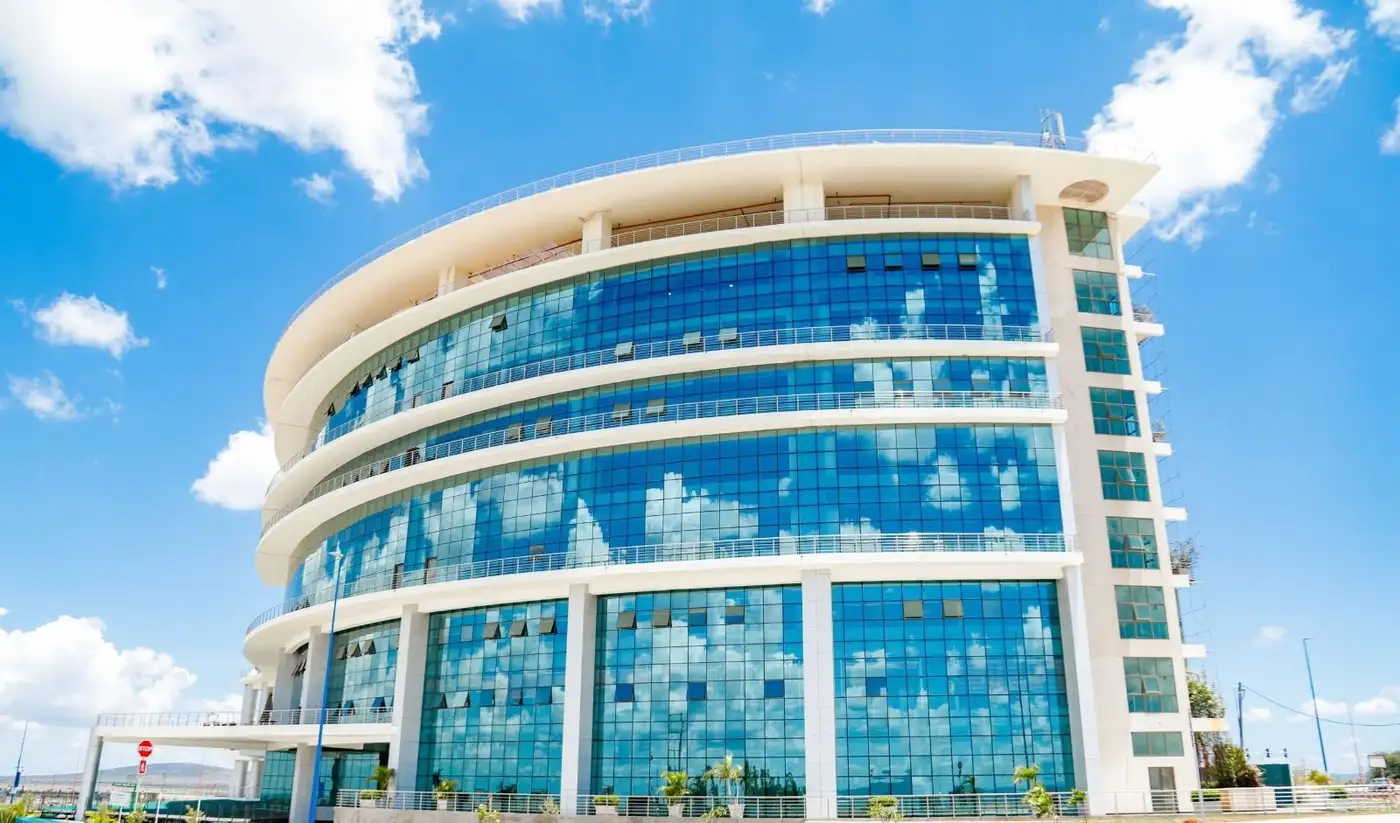
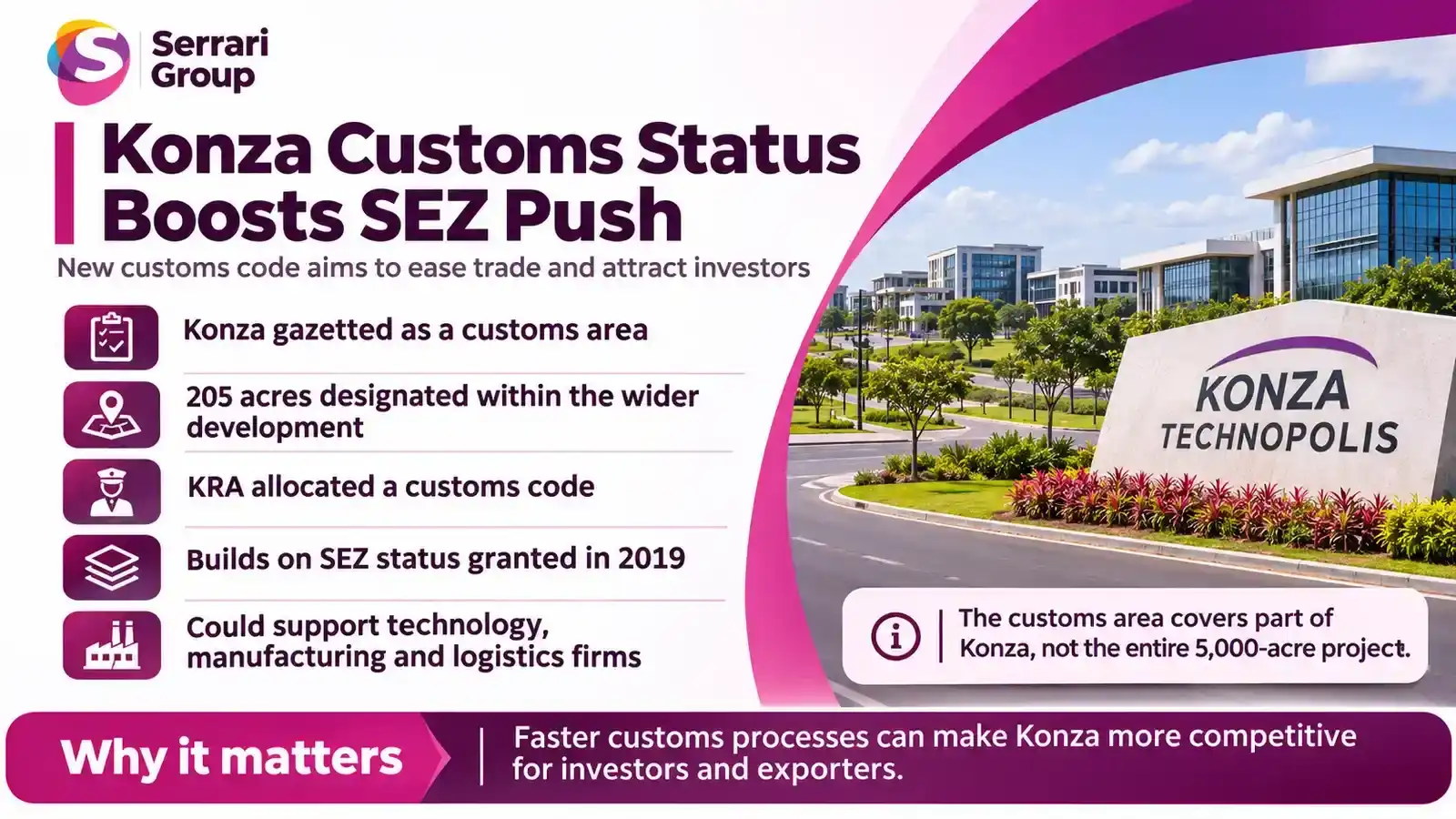
Konza Technopolis has secured customs area designation and a dedicated customs code from the Kenya Revenue Authority, advancing the operationalisation of Kenya’s flagship smart city as a Special Economic Zone (SEZ). The designation covers 205 acres within the wider 5,000-acre development, establishing a defined framework for the movement of goods under customs supervision. Coming seven years after Konza received SEZ status, the milestone addresses an important regulatory requirement for attracting manufacturers, technology companies and international investors. However, the project’s long-term economic success will depend on translating regulatory incentives and infrastructure investment into productive businesses, sustainable employment and export earnings.
Key Overview
- Konza Technopolis has received customs area status and a dedicated customs code from the Kenya Revenue Authority.
- Gazette Notice No. 17446, published on November 5, 2026, designates 205 acres (83 hectares) as a customs area.
- The designated customs area represents approximately 4.1% of the wider 5,000-acre Konza development.
- The development advances the operationalisation of Konza as an SEZ following its initial designation in July 2019.
- Qualifying businesses can benefit from preferential taxation, import duty exemptions and streamlined regulatory processes, subject to applicable legislation.
- Technology manufacturing, electronics assembly, industrial production and international trade could benefit from improved customs administration.
- The designation complements the Technopolis Act, 2026, which establishes a broader framework for developing technology-driven economic hubs across Kenya.
Why Konza’s Customs Area Designation Matters
Kenya’s ambition to transform Konza Technopolis into a globally competitive investment destination has received an important regulatory boost following its designation as a customs area and the allocation of a dedicated customs code.
Under Gazette Notice No. 17446, published on November 5, 2026, the Commissioner of Customs and Border Control appointed 83 hectares within Konza as a customs area pursuant to Section 12 of the East African Community Customs Management Act, 2004.
The designation also establishes defined entry and exit arrangements for the movement of goods under customs supervision.
This distinction is important because declaring a location a Special Economic Zone does not automatically establish all the administrative systems needed to manage goods entering and leaving that zone.
Investors require clarity on how machinery, raw materials, manufacturing equipment and finished products will be treated for customs purposes before committing substantial capital.
Konza received SEZ status in July 2019, but its latest customs designation addresses a further operational requirement necessary to make the investment framework commercially practical.
For a manufacturer considering establishing a production facility, uncertainty over import taxes, clearance procedures and inventory management can delay investment decisions or make competing locations more attractive.
A dedicated customs code provides an administrative mechanism for identifying and processing transactions associated with the designated area.
Although the development does not eliminate every regulatory requirement, it strengthens the institutional foundation needed to convert Konza from a predominantly infrastructure development project into an active commercial and industrial centre.
How SEZ Incentives Could Improve Business Profitability
One of the principal economic advantages of operating within a Special Economic Zone is the potential reduction in the cost of establishing and running a business.
Kenya’s preferential SEZ tax framework provides eligible enterprises with reduced corporate taxation and exemptions on qualifying imports, subject to applicable tax legislation and licensing requirements.
Under the published incentive framework, qualifying enterprises generally benefit from a corporate income tax rate of 10% during their first ten years of operation and 15% during the subsequent ten years.
For comparison, Kenya’s standard resident corporate income tax rate is generally 30%.
Consider an illustrative manufacturing company generating KSh100 million in annual taxable profits.
At a corporate tax rate of 30%, its tax liability would amount to KSh30 million, leaving KSh70 million in after-tax profits. At a preferential rate of 10%, the equivalent liability would be KSh10 million, leaving KSh90 million.
The difference represents KSh20 million in additional retained earnings that could potentially finance equipment purchases, research, workforce expansion or debt repayments.
Import-related incentives could also improve investment economics by reducing the upfront cost of acquiring qualifying machinery and production inputs.
For capital-intensive businesses, these benefits can influence the projected payback period and expected return on investment, making previously marginal projects more commercially viable.
Nevertheless, preferential taxation alone cannot guarantee profitability. Investors must also consider electricity costs, labour productivity, transportation expenses, financing charges and access to customers.
Konza’s competitiveness will therefore depend on whether its combined operating environment offers meaningful financial advantages over alternative industrial and technology locations.
Faster Customs Processes Could Release Business Working Capital
The financial implications of customs administration extend beyond the taxes paid when goods enter or leave a country.
Businesses also incur costs when equipment, components and finished products remain in storage while awaiting clearance.
Manufacturers may face production interruptions if critical inputs arrive late, while exporters can incur additional warehousing and transportation expenses when shipments miss scheduled departures.
These delays can increase the amount of working capital required to maintain normal operations.
For example, a company importing KSh120 million worth of production inputs annually could have approximately KSh3.29 million in additional inventory financing tied up by ten extra days in its procurement cycle.
At an illustrative annual financing cost of 15%, that additional working capital would cost approximately KSh493,000 annually to finance.
This calculation excludes potential storage charges, production losses and contractual penalties associated with delayed deliveries.
Konza’s customs designation, combined with the SEZ programme’s administrative support framework, could help businesses manage these expenses more effectively by improving coordination between investors and regulatory agencies.
However, actual savings will depend on operational efficiency, staffing, digital customs systems and coordination with other agencies involved in import and export clearance.
The allocation of a customs code does not, by itself, establish how quickly shipments will be cleared.
The practical measure of success will be whether businesses experience shorter and more predictable clearance times once the systems are fully implemented.
Context is everything. Stay ahead of shifting trends with today’s market updates, and uncover emerging opportunities using the Serrari Group Market Index and Marketplace. Then, take control of your own financial future by exploring our Money & Life Reset Transformation Blueprint ™ to build stronger habits, create better systems, and design a path toward lasting wealth.
Kenya Wants to Move Beyond Technology Consumption
Konza’s broader economic significance lies in Kenya’s ambition to develop technology-driven industries rather than remain predominantly a consumer of imported technology products.
The development’s investment framework targets activities including technology services, research, light manufacturing and other knowledge-intensive industries.
Kenya has established a strong reputation in digital financial services, particularly mobile payments and financial technology. However, developing a more diversified technology economy requires additional capabilities in hardware production, engineering, data infrastructure and industrial research.
Konza could provide an environment in which technology businesses, manufacturers and research institutions operate within a shared economic ecosystem.
An electronics assembly company, for instance, could import qualifying components, assemble products locally and distribute them to international markets. Research institutions could support product development, while software companies could provide complementary digital services.
Such industrial clustering can reduce coordination costs and encourage businesses to establish commercial relationships with nearby suppliers.
The potential benefits extend beyond individual companies. A functioning technology manufacturing ecosystem could create opportunities for engineering graduates, technicians, logistics providers and local component suppliers.
Konza’s existing infrastructure includes the national data centre and facilities associated with the Kenya Advanced Institute of Science and Technology, as highlighted in recent assessments of the project’s development, although attracting substantial private commercial activity remains a critical challenge.
The customs designation strengthens the conditions required for that transition, but it does not confirm that particular manufacturers have committed to establishing operations.
The Technopolis Act Signals a Broader Industrial Strategy
Konza’s latest development follows significant legislative reforms intended to strengthen Kenya’s investment and technology ecosystem.
On May 11, 2026, President William Ruto signed the Technopolis Bill, the Special Economic Zones Amendment Bill and the Income Tax Bill into law.
The 2026 legislative reforms established a broader framework for technology-oriented economic hubs while expanding the scope of Kenya’s SEZ programme to accommodate additional strategic industries.
The Technopolis Act established the Technopolis Development Authority as the successor to the Konza Technopolis Development Authority, with responsibilities extending to the development and management of technopolises in Kenya.
This institutional transition suggests that the government wants to establish a replicable framework for technology-led economic development rather than concentrate its entire strategy within one smart city.
Konza could consequently serve as a practical demonstration of how infrastructure, investment incentives, research institutions and regulatory coordination can support industrial development.
However, replicating the model elsewhere would require evidence that the original development can attract commercially sustainable businesses.
Building multiple technology hubs without sufficient investor demand could leave the government maintaining expensive infrastructure that generates limited economic returns.
The success of Konza will therefore influence the credibility and financial justification of Kenya’s wider technopolis strategy.
Regional Trade Opportunities Come With Important Limitations
Konza’s location within Kenya provides a potential gateway to regional markets across East Africa and the wider continent.
Manufacturers establishing operations within the zone could potentially benefit from Kenya’s transportation networks, regional commercial relationships and access to international shipping services.
Nevertheless, investors should not interpret SEZ status as unrestricted duty-free access to Kenya or neighbouring markets.
Under the applicable SEZ customs guidelines, goods entering the East African Community domestic customs territory from special economic zones may attract applicable import duties and taxes.
This means that a manufacturer primarily targeting Kenyan consumers may face a different financial outcome from one producing goods for export outside the region.
The treatment of individual products depends on applicable customs legislation, product classification and relevant trade arrangements.
For domestic manufacturers operating outside SEZs, these provisions are important because they help prevent preferential treatment within designated zones from creating an unrestricted competitive advantage in the ordinary domestic market.
Konza’s investment proposition will consequently be strongest where businesses can combine qualifying incentives with competitive production costs, reliable logistics and commercially attractive market access.
The Real Test Is Investment, Employment and Economic Returns
Konza’s customs designation marks a meaningful institutional milestone, but it also highlights the lengthy process of transforming major public infrastructure projects into functioning economic centres.
Seven years after its initial SEZ designation, the project continues to establish the regulatory and commercial conditions required to attract large-scale investment.
The immediate priority is now translating those conditions into operational businesses rather than relying solely on announcements, investment expressions of interest or future development projections.
For Kenyan taxpayers, the economic justification for Konza will depend on whether public investment generates sufficient long-term benefits through employment, export earnings, technological advancement and private capital mobilisation.
The government must also consider the fiscal cost of preferential taxation. Incentives are most economically defensible when they attract genuinely additional investment rather than simply encourage existing businesses to relocate to obtain lower tax rates.
Successful implementation should therefore be assessed through actual capital deployed, operational enterprises, permanent employment, export volumes, customs processing times and the participation of local suppliers.
The designation of 205 acres as a customs area provides an important foundation for that transformation. It does not mean the entire smart city has become commercially operational.
Ultimately, Konza’s success will be determined not by the scale of its infrastructure or the generosity of its incentives, but by its ability to become a productive, internationally competitive economic centre that generates measurable returns for Kenya.
Sources Used
KBC Digital / Kenya Revenue Authority / Kenya Gazette / Special Economic Zones Authority / Konza Technopolis / Techpoint Africa / Office of the President of Kenya
Your financial future isn’t something you wait for—it’s something you build.
The real question is: when do you begin?
Move beyond simply staying informed.
Navigate the markets with clarity—track trends through the Serrari Group Market Index, uncover opportunities in the Serrari Marketplace, and build practical knowledge with our Curated Wealth Builder Platform.
Stay connected to what truly matters.
Get daily insights on macro trends and financial movements across Kenya, Africa, and global markets—delivered through the Serrari Newsletter.
Growth opens doors.
Advance your career through professional programs including ACCA, HESI A2, ATI TEAS 7 , HESI EXIT , NCLEX – RN and NCLEX – PN, Financial Literacy!🌟—designed to move you forward with confidence.
See where money is flowing—clearly and in real time.
Track Money Market Funds, Treasury Bills, Treasury Bonds, Green Bonds, and Fixed Deposits, alongside global and African indexes, key economic indicators, and the evolving Crypto and stablecoin landscape—all within Serrari’s Market Index.