




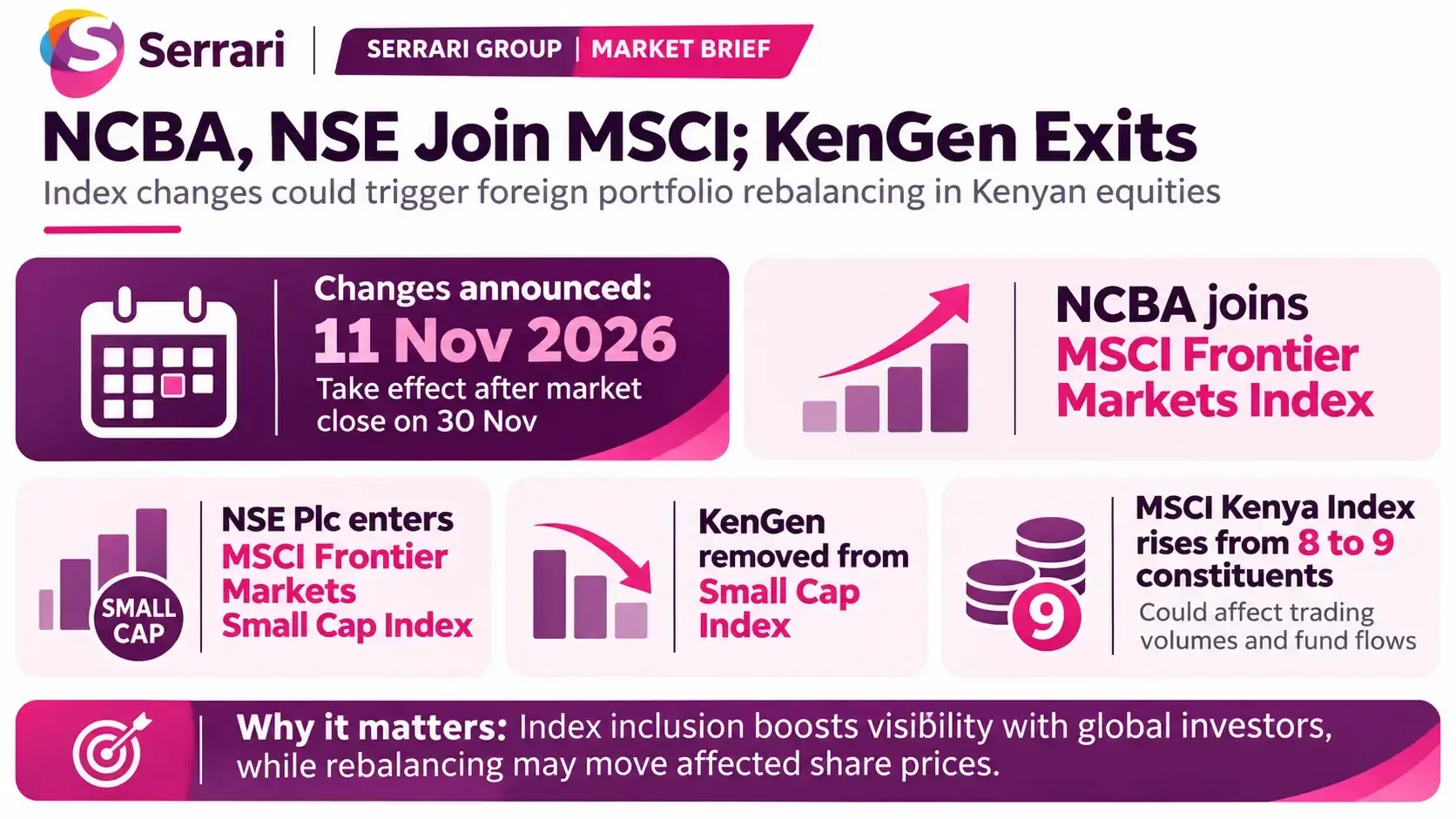
Kenya’s international equity-market profile is changing after MSCI selected NCBA Group for its main Frontier Markets Index and Nairobi Securities Exchange Plc for its Frontier Markets Small Cap Index, while removing electricity producer KenGen from the latter benchmark. Announced on November 11, 2026, the changes are scheduled to take effect after market close on November 30. The immediate significance is not a guaranteed influx of foreign money but the prospect of benchmark-linked trading as funds adjust portfolios. More fundamentally, the review highlights the importance of investable market size, available shares and liquidity in determining which Kenyan companies appear on international investors’ screens—and why a stronger stock market needs more than index recognition.
LIVENSE market summarySee NSE data →Key Overview
- NCBA included: The lender joins the main MSCI Frontier Markets Index and was one of its three largest additions globally by full company market capitalisation.
- NSE Plc added: The listed operator of Kenya’s securities exchange enters the separate MSCI Frontier Markets Small Cap Index.
- KenGen removed: The electricity generator exits the small-cap benchmark but remains listed and tradable in Nairobi.
- Effective date: Changes announced on November 11 are due to be implemented after trading closes on November 30, 2026.
- Global reshuffle: The main frontier index adds 12 securities and removes 10; the small-cap index adds 100 and removes 21.
- Investor implications: Passive portfolio rebalancing could affect trading volumes and prices, while enduring foreign participation depends on liquidity, valuations and company fundamentals.
Why NCBA Earned a Place in the Main Frontier Index
NCBA’s inclusion is significant because the main frontier benchmark is intended to represent the larger, more investable listed businesses across economies classified as frontier markets. Its selection gives the Kenyan lender a place in the reference universe used by international portfolio managers comparing opportunities across multiple countries. The November 2026 index review announcement identifies NCBA among the three largest additions worldwide by full company market capitalisation, alongside Oman Arab Bank and Bangladesh’s BRAC Bank.
That distinction should not be mistaken for a ranking of future returns or a claim that NCBA is one of the world’s largest banks. It describes the company’s size relative to other new entrants in this particular frontier index review. The selection is also not a fresh stock-market listing: NCBA shares were already trading on the Nairobi Securities Exchange.
Why does a company enter such a benchmark? Index construction generally considers market size, the proportion of shares accessible to investors and trading accessibility, rather than simply picking firms with the fastest profit growth. The review identifies the outcome, but the public announcement does not isolate a single triggering factor that explains NCBA’s entry. Attributing it exclusively to one earnings result, ownership event or share-price increase would therefore overstate what is known.
For the bank, the practical opportunity is improved visibility among institutions with mandates to invest in frontier equities. That may enlarge the pool of potential shareholders and increase scrutiny of its financial performance, governance and disclosures. Whether it translates into lasting share-price gains will depend on the price investors are prepared to pay and the bank’s subsequent operating results.
Why NSE Plc’s Inclusion Is Different—and Important
Nairobi Securities Exchange Plc is the company that operates the exchange, but its own shares are separately listed. Its addition to the small-cap benchmark concerns those shares, not an upgrade of every company trading on the Nairobi market. The review of Kenyan small-cap changes identifies NSE Plc as the addition and KenGen as the deletion, making clear that this is a different index from the one NCBA is joining.
That difference matters for the size and nature of potential investment demand. A fund following the main frontier index is not necessarily invested in the small-cap version, and the two benchmarks can have different constituent weights and tracking assets. Simply combining the additions and treating them as identical upgrades would produce a misleading picture of expected capital flows.
For the exchange operator, index inclusion arrives as management is trying to build a more internationally connected marketplace. In a November 22 interview on the bourse’s expansion plans, the exchange outlined ambitions to attract overseas technology issuers and develop regulated virtual-asset services, subject to approvals. Benchmark recognition can support that international visibility, but it does not grant regulatory permission for those initiatives or guarantee that prospective issuers will list.
There is a wider commercial connection: an exchange operator may benefit when trading activity and listings expand, because market participation supports its core business. Yet the value of NSE Plc shares still depends on its financial performance, competitive position and costs. The symbolic importance of inclusion cannot substitute for those fundamentals.
Context is everything. Stay ahead of shifting trends with today’s market updates, and uncover emerging opportunities using the Serrari Group Market Index and Marketplace. Then, take control of your own financial future by exploring our Money & Life Reset Transformation Blueprint ™ to build stronger habits, create better systems, and design a path toward lasting wealth.
Why KenGen’s Removal Is Not a Delisting
KenGen’s deletion from the MSCI Frontier Markets Small Cap Index may look like a negative judgment on the electricity generator, but an index removal is not the same as a stock-exchange delisting, a downgrade of creditworthiness or proof of deteriorating operations. The company will remain listed in Nairobi and shareholders will still be able to trade its shares.
Index membership is periodically adjusted to reflect eligibility and the desired coverage of a benchmark. Market capitalisation, free float, accessibility and other methodology factors can affect which companies qualify. The announcement establishes that KenGen is being deleted, but it does not provide a company-specific explanation sufficient to identify a precise underlying cause. It would therefore be speculative to present the removal as evidence of weak profits, poor governance or a particular operational failure.
There can nevertheless be a short-term market consequence. Portfolios mechanically replicating the affected index may need to sell KenGen shares when they rebalance. If buying interest is insufficient at prevailing prices, that can create downward pressure; if other investors absorb the shares, the impact may be limited. The final outcome depends on the stock’s index weight, the assets tracking the benchmark and market liquidity—figures that should not be invented from the headline announcement alone.
For individual shareholders, the useful distinction is between a change in who may hold the stock and a change in the company’s underlying ability to generate electricity, earn revenue and pay dividends. The former may influence short-term trading; the latter remains central to a longer-term valuation.
How the November 30 Rebalance Could Move Share Prices
Benchmark providers set common reference portfolios, and asset managers use them in different ways. A fully passive fund tries to track an index closely, while an active fund may use it as a comparison point without copying every holding. New additions can therefore create buying needs among some investors, and deletions can create selling needs, but the direction and scale of net flows are not guaranteed.
LIVENSE market summarySee NSE data →The November 30 implementation date creates a known deadline. Some traders may buy anticipated additions or sell expected deletions ahead of it; others may trade at the closing auction to minimise tracking differences. This can temporarily increase turnover or volatility, particularly in markets where the available volume of shares is modest relative to the order size.
A crowded trade can also reverse. If an inclusion is widely anticipated and the share price rises before implementation, the final rebalance need not trigger a further rally. Conversely, a deleted stock may recover after forced selling has passed. The important lesson is that index entry is neither an automatic buy signal nor a promise of sustained gains.
MSCI’s global review statement reports 12 additions and 10 deletions in the main frontier index and 100 additions against 21 deletions in the small-cap index. Those totals underline that Kenya’s changes are part of a broader rules-based international reconstitution rather than a standalone endorsement of the country’s entire equity market.
Why Kenya’s Bank-Heavy Market Remains a Bigger Issue
NCBA joins a Kenyan market in which financial institutions already account for a substantial share of internationally represented equities. That concentration matters because a portfolio presented as diversified Kenyan exposure may, in practice, be heavily influenced by the performance of a relatively small group of banks and other large companies.
Bank shares are sensitive to credit demand, non-performing loans, interest margins, capital requirements and government securities markets. When global investors increase exposure to several Kenyan banks at once, they may also be increasing exposure to similar domestic economic risks. Additional bank representation improves the range of securities visible to overseas managers, but does not necessarily deliver broader sector diversification.
An index’s free-float-adjusted weight also differs from a company’s full market value. Shares held by strategic or controlling investors may not count as fully investable, meaning a large company can have a smaller benchmark influence than its headline market capitalisation implies. Changes in share ownership, liquidity and prices can further alter weights over time. For this reason, investors should not project NCBA’s eventual index weight from its ranking among the largest new additions.
The Bigger Test: Can Kenya Convert Visibility Into Lasting Capital?
Kenya’s capital-market ambitions go beyond this single review. The exchange is seeking deeper trading activity and a wider range of listings and products, while market intermediaries argue that international recognition could improve the country’s appeal. The reported plans to attract cross-border listings illustrate why such visibility is strategically useful: companies and funds are more likely to investigate a market that appears in widely followed investment universes.
But stronger index representation does not solve structural barriers on its own. Foreign investors still assess whether they can trade meaningful volumes without moving prices excessively, access reliable financial information, repatriate proceeds and operate within predictable rules. Companies must also offer convincing earnings prospects and governance. More listings across sectors would help reduce concentration and make the market a better reflection of Kenya’s wider economy.
The November review therefore creates an opportunity, not a completed transformation. NCBA gains access to a larger international benchmarking audience, NSE Plc receives recognition in the small-cap segment, and KenGen faces the possibility of index-related selling despite remaining a publicly traded power producer. The decisive question after November 30 will be whether initial portfolio adjustments translate into deeper, more sustained participation in Kenyan equities. That is what would turn a technical index reshuffle into a meaningful advance for the country’s capital markets.
Sources: MSCI / Business Radar / The EastAfrican
Your financial future isn’t something you wait for—it’s something you build.
The real question is: when do you begin?
Move beyond simply staying informed.
Navigate the markets with clarity—track trends through the Serrari Group Market Index, uncover opportunities in the Serrari Marketplace, and build practical knowledge with our Curated Wealth Builder Platform.
Stay connected to what truly matters.
Get daily insights on macro trends and financial movements across Kenya, Africa, and global markets—delivered through the Serrari Newsletter.
Growth opens doors.
Advance your career through professional programs including ACCA, HESI A2, ATI TEAS 7 , HESI EXIT , NCLEX – RN and NCLEX – PN, Financial Literacy!🌟—designed to move you forward with confidence.
See where money is flowing—clearly and in real time.
Track Money Market Funds, Treasury Bills, Treasury Bonds, Green Bonds, and Fixed Deposits, alongside global and African indexes, key economic indicators, and the evolving Crypto and stablecoin landscape—all within Serrari’s Market Index.