



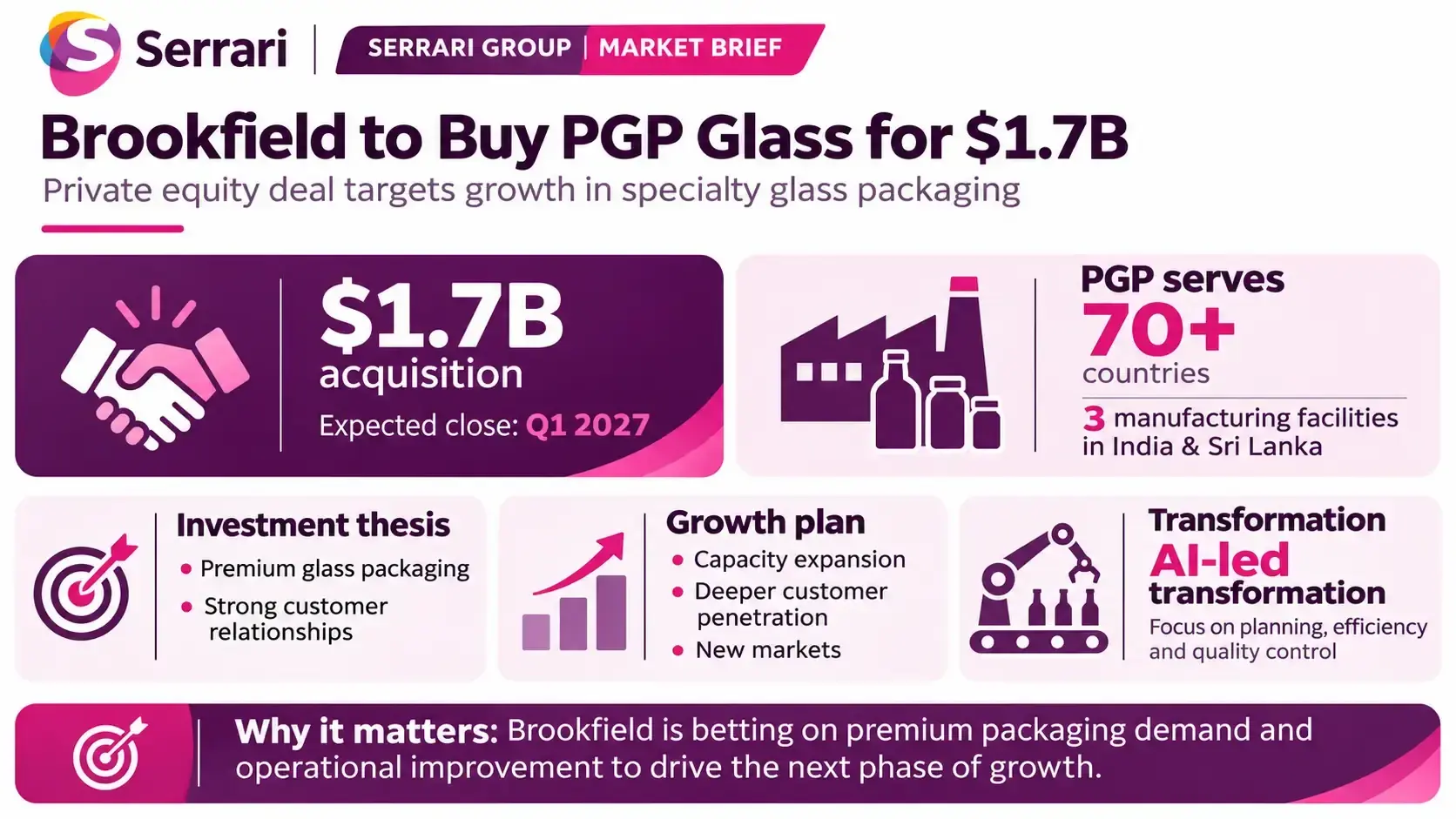
Brookfield Asset Management has agreed to acquire specialty packaging manufacturer PGP Glass from Blackstone-managed funds for $1.7 billion, positioning the industrial business for another phase of expansion under a new private-equity owner. Announced on November 23, 2026, the transaction covers a manufacturer serving global cosmetics, fragrance, pharmaceutical and premium food and beverage brands from facilities in India and Sri Lanka. For Blackstone, the agreement represents an opportunity to exit a business it acquired from the Piramal Group and subsequently expanded. For Brookfield, the attraction lies in combining relatively cost-competitive production, established international customer relationships and opportunities to improve manufacturing performance using artificial intelligence. The deal also illustrates why global investors are increasingly pursuing established industrial exporters rather than relying only on fast-growing technology businesses.
Key Overview
- $1.7 billion agreed acquisition: Brookfield plans to acquire PGP Glass from Blackstone-managed private-equity funds; the purchase has not yet closed.
- Global manufacturing platform: PGP operates three manufacturing facilities in India and Sri Lanka, with 13 furnaces and capacity exceeding 1,800 tonnes of glass per day.
- International demand: The company serves brands in more than 70 countries, with overseas markets accounting for more than 70% of sales.
- Blackstone exit: The sale follows its acquisition of the former Piramal Glass business, completed in 2021, and subsequent operational and capacity investments.
- Brookfield’s investment thesis: Expansion in premium glass packaging, selective capacity investment and AI-enabled improvements in planning, production and quality control.
- Regulatory approvals pending: Funding will involve Brookfield Capital Partners and Brookfield Business Corporation, with closing targeted for the first quarter of 2027.
Why Brookfield Is Paying $1.7 Billion for a Glass Manufacturer
Brookfield’s decision is driven by the economics of a specialised industrial supplier rather than a bet that glass consumption alone will surge. PGP makes glass containers for products where the package is part of the customer’s branding, including fragrances, cosmetics and premium spirits. Customers in these categories often require distinctive shapes, precise finishing, decorative capabilities and reliable quality. The manufacturing relationship can consequently involve more than supplying a standard bottle at the lowest possible price.
The November 23 transaction announcement identifies PGP’s integrated design, mould-making, manufacturing and decoration services as central to the investment case. Bringing these processes together can shorten coordination between a brand and its supplier and make the manufacturer more valuable to customers introducing new products or redesigning existing lines.
The company’s scale also matters. PGP reports 13 furnaces, daily capacity above 1,800 tonnes and customers in more than 70 countries. More than 70% of sales come from overseas markets. That makes the acquisition an investment in an existing export platform, not simply a plan to build a new factory and wait for international customers to arrive.
There are qualifications. Glass production requires substantial energy and capital, and furnaces need maintenance and periodic rebuilding. A strong customer roster does not automatically guarantee margins if energy, freight or financing costs rise. Brookfield therefore needs both sales expansion and disciplined operational management to justify its purchase price.
Why Blackstone Is Exiting After Building the Business
Blackstone’s sale represents a typical private-equity transition: acquire a company, develop its operations and eventually sell it to a new owner with a different plan for growth. The business was previously known as Piramal Glass. Blackstone agreed to acquire it from the Piramal Group in 2020, with the transaction completed in 2021 before the PGP Glass name was adopted.
In the years that followed, PGP expanded capacity and strengthened its manufacturing and sustainability initiatives, according to statements from its leadership in the joint acquisition disclosure. That operating progress makes a sale more plausible: a buyer can purchase a functioning global supply chain with established customers and production capabilities rather than fund the entire transformation itself.
The exit also follows a period in which several paths were reportedly considered. Earlier reporting on the sale process described discussions with buyers alongside preparations for a possible public listing. A negotiated sale can offer an investor a more defined route to liquidity than an initial public offering, whose valuation and timing depend on stock-market conditions.
It would nevertheless be misleading to equate the $1.7 billion headline with Blackstone’s profit. The amount of equity proceeds depends on transaction debt, cash, fees and the precise ownership structure. Historical purchase-price figures also vary depending on how contingent consideration is treated. Without full capital-contribution and distribution details, Blackstone’s realised return cannot be established reliably from public headlines.
Context is everything. Stay ahead of shifting trends with today’s market updates, and uncover emerging opportunities using the Serrari Group Market Index and Marketplace. Then, take control of your own financial future by exploring our Money & Life Reset Transformation Blueprint ™ to build stronger habits, create better systems, and design a path toward lasting wealth.
Why Premium Packaging Offers an Industrial Advantage
The wider investment logic depends on the distinction between basic container glass and premium specialty packaging. A mass-produced bottle may compete heavily on price and delivery. A fragrance bottle with intricate design, consistent colour, decoration and tight quality requirements becomes part of the consumer product itself. Suppliers capable of meeting those specifications at scale may be harder to replace quickly.
That does not make substitution impossible. Some consumer brands can switch materials, simplify designs or negotiate aggressively when demand weakens. But high-end glass retains advantages in appearance, product compatibility and the ability to convey a premium identity. Brookfield is seeking exposure to the portions of the market where these characteristics support customer relationships and differentiated manufacturing services.
Manufacturing geography adds another dimension. Brookfield’s investment rationale specifically points to cost pressure and capacity rationalisation among producers in Europe and North America. If higher-cost factories reduce output or exit certain product categories, efficient exporters may find openings with international brands seeking dependable alternative suppliers.
PGP’s facilities in India and Sri Lanka could benefit from that shift, provided any manufacturing-cost advantage survives energy bills, transport expenses, tariffs and currency changes. Its extensive warehousing and distribution network is therefore strategically important: proximity to customers through inventory and logistics can help offset the distance between manufacturing sites and end markets.
How AI Could Change the Economics of Glass Production
Brookfield has placed an AI-led transformation programme at the centre of its plans, but the practical opportunity is less about replacing furnaces with software than about making complex industrial operations more predictable. Glass manufacturing combines long production runs, energy-intensive equipment, demanding specifications and high costs when quality problems are detected too late.
Better sales and operations planning could help PGP align production schedules with customer orders, reducing costly changes and excess inventory. Predictive analytics could support maintenance decisions by flagging unusual equipment behaviour before breakdowns disrupt output. Computer-vision systems may improve inspection of defects, while more consistent process control could reduce scrap and rework.
These are opportunities, not reported savings. The announced growth strategy does not disclose a quantified AI investment budget, implementation timetable or forecast earnings uplift. The business case will have to be tested against real operating results, including yields, downtime, energy use, delivery reliability and customer satisfaction.
For employees, this type of transformation can change the skills demanded on factory floors. Digital inspection, equipment data and automated scheduling may increase the importance of technicians and staff able to interpret production information. Management will also need to ensure that new systems reinforce established safety and quality procedures instead of creating operational disruption.
What the Acquisition Means for India and Global Investors
The transaction is also notable for the flow of international private-equity capital through an Indian-headquartered industrial business. Instead of leaving the sector, investment ownership is passing from one major alternative asset manager to another. That supports the view that established manufacturing platforms can remain attractive even after an initial private-equity owner has completed a significant improvement programme.
For India, the implications are broader than the headline purchase price. A successful expansion could support export activity, supplier relationships and investment in industrial capacity. Sri Lanka is also directly involved through PGP’s manufacturing footprint. Yet those benefits remain conditional on the buyer’s actual investment decisions, market demand and the terms of future operating plans; the agreement itself is not a commitment to a specific number of jobs or factories.
For competitors, the deal underlines the importance of scale, technical design, decoration and reliable international distribution. A producer that competes only on the initial price of a bottle may face pressure from manufacturers capable of offering a complete product-development and packaging service. For customers, stronger supplier capabilities could improve product development and resilience, although ownership concentration and the need to earn investment returns may also influence pricing negotiations.
Investors should distinguish the interests of the buyer, seller and operating company. Brookfield wants future growth and efficiency; Blackstone wants an orderly exit; PGP’s customers need continuing quality and supply. Those objectives overlap, but they are not identical, particularly if aggressive cost reduction were ever to conflict with service standards or long-term capital spending.
What Happens Before the Expected 2027 Closing
The transaction is expected to close in the first quarter of 2027, subject to customary conditions, including regulatory and government approvals. Brookfield says the investment will be funded through its Brookfield Capital Partners strategy and affiliate Brookfield Business Corporation. Until those approvals and other closing steps are completed, PGP has not formally changed hands under the announced agreement.
The most meaningful indicators after closing will be whether Brookfield deepens existing customer relationships, enters new markets and invests in production capacity without undermining returns. Execution of its AI programme will also matter, particularly if operational savings can finance expansion or counter higher energy and logistics expenses.
The larger message is that private equity increasingly views industrial competitiveness as a combination of physical assets, customer relationships and better use of data. Brookfield is buying a manufacturer with established global reach, while Blackstone is moving to realise value from an earlier ownership phase. The $1.7 billion price captures today’s agreement; the ultimate success of the deal will depend on how much additional value the next owner can create.
Sources: GlobeNewswire / Reuters / Moneycontrol / The Economic Times / PGP Glass
Your financial future isn’t something you wait for—it’s something you build.
The real question is: when do you begin?
Move beyond simply staying informed.
Navigate the markets with clarity—track trends through the Serrari Group Market Index, uncover opportunities in the Serrari Marketplace, and build practical knowledge with our Curated Wealth Builder Platform.
Stay connected to what truly matters.
Get daily insights on macro trends and financial movements across Kenya, Africa, and global markets—delivered through the Serrari Newsletter.
Growth opens doors.
Advance your career through professional programs including ACCA, HESI A2, ATI TEAS 7 , HESI EXIT , NCLEX – RN and NCLEX – PN, Financial Literacy!🌟—designed to move you forward with confidence.
See where money is flowing—clearly and in real time.
Track Money Market Funds, Treasury Bills, Treasury Bonds, Green Bonds, and Fixed Deposits, alongside global and African indexes, key economic indicators, and the evolving Crypto and stablecoin landscape—all within Serrari’s Market Index.