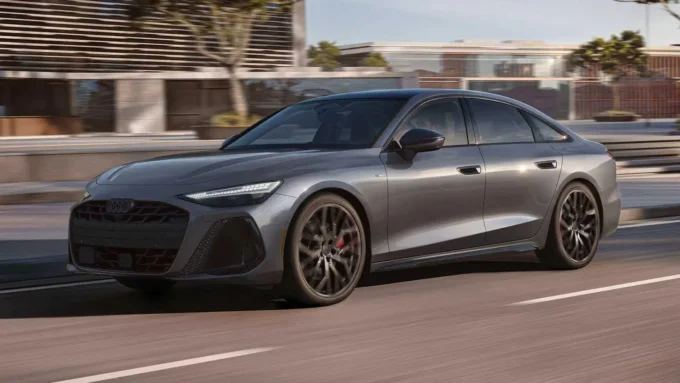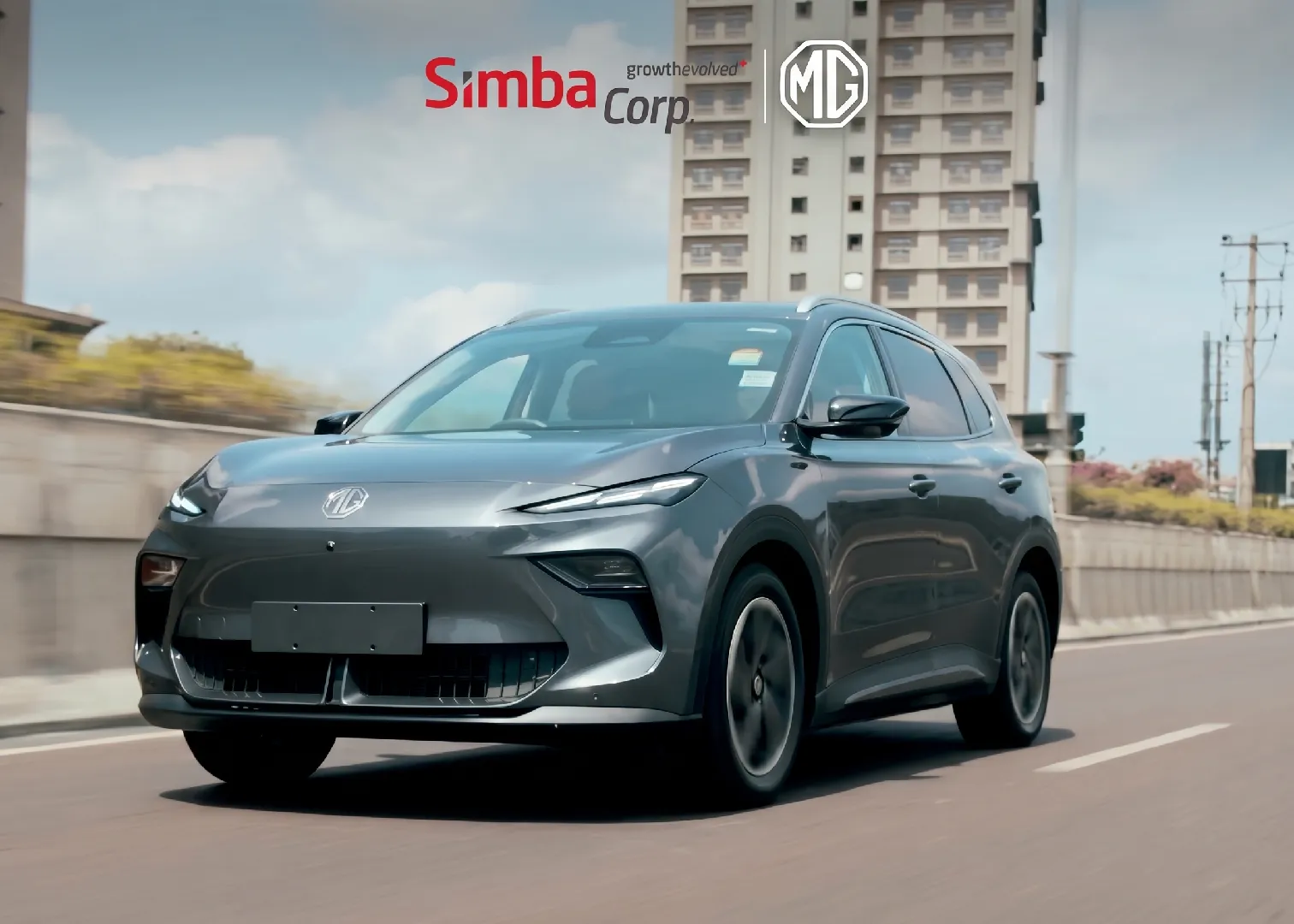
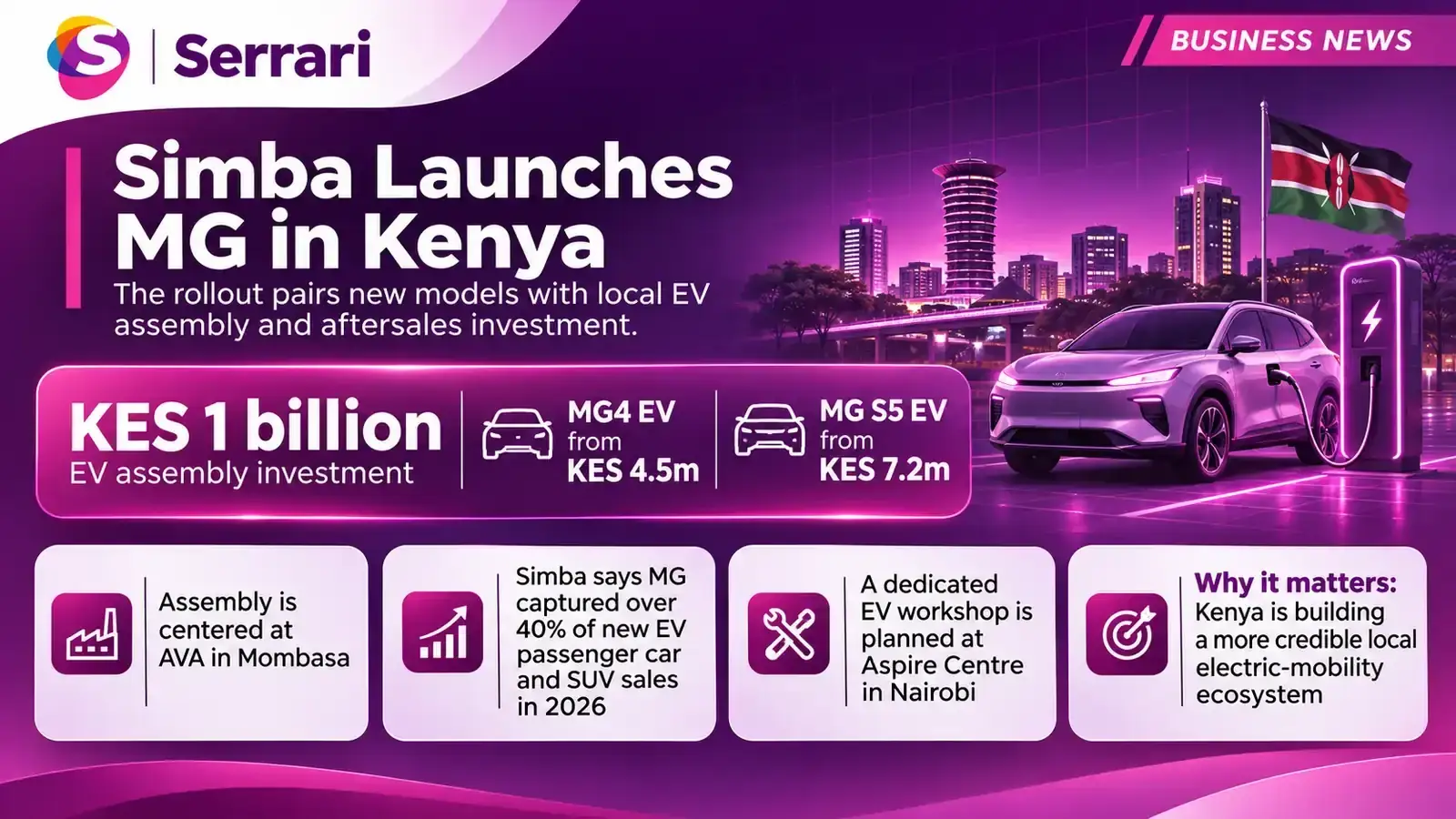
Simba Corporation officially launched MG in Kenya on November 21, 2026, becoming the automotive brand’s exclusive local distributor. The rollout builds on a previously announced KES 1 billion electric-vehicle assembly investment at Associated Vehicle Assemblers (AVA) in Mombasa, with new cars priced from KES 4.5 million. By combining local production, fleet partnerships and specialised servicing, Simba is seeking to address the financial and practical barriers that have constrained electric passenger-car adoption. The initiative also tests whether Kenya can turn growing demand for electric transport into a sustainable domestic manufacturing industry.
Key Overview
- Simba is leveraging a KES 1 billion dedicated EV assembly investment in Mombasa.
- The assembly line has 60 technicians trained in battery handling and electrical systems.
- The MG4 EV Urban starts at KES 4.5 million, while the MG S5 EV starts at KES 7.2 million.
- Simba claims MG captured more than 40% of new electric passenger-car and SUV sales in Kenya in 2026 before the official launch.
- Drive Electric purchased 25 vehicles as an inaugural fleet customer, while Kenya Power received four MG electric cars.
- A specialist EV workshop is planned in Westlands, Nairobi, and another electric SUV is expected in 2027.
Why Simba is investing in local assembly instead of relying on imports
Simba Corporation’s MG launch is more than an expansion of its dealership portfolio. It represents an attempt to compete across several parts of the automotive value chain, from vehicle assembly and distribution to maintenance and customer support. For an established distributor, this creates opportunities to earn revenue throughout the ownership cycle rather than primarily at the point of sale.
The company’s assembly investment announcement on November 2 confirmed that AVA would fund dedicated electric-vehicle production capability rather than require each manufacturing partner to establish separate infrastructure. The MG launch builds on that commitment; it is not an additional KES 1 billion investment.
A shared production line can spread capital costs across multiple vehicle programmes. This matters in a relatively young market where individual brands may not yet sell enough units to justify dedicated factories. Contract assembly could improve equipment utilisation and allow manufacturers to enter Kenya with lower initial capital commitments.
The approach nevertheless carries risk. Assembly facilities incur costs even when production is below capacity. If demand grows more slowly than expected, the investment may take longer to recover. The commercial test will be the volume of vehicles assembled, the fees or margins earned on production and the ability to attract additional manufacturing partners.
Local assembly should also be distinguished from full vehicle manufacturing. Imported battery cells, power electronics and other components may remain essential. The immediate opportunity lies in retaining more assembly and technical work domestically, while deeper industrial integration would require reliable suppliers, adequate production volumes and investment in component manufacturing.
The KES 4.5 million challenge to Kenya’s used-car market
Simba’s pricing strategy targets a difficult segment of the Kenyan automotive market: motorists who might ordinarily purchase imported second-hand vehicles rather than new cars. Its initial model lineup includes both electric and conventional vehicles, allowing the distributor to pursue customers with different budgets and charging requirements.
The MG4 EV Urban electric hatchback and MG ZS turbo-petrol SUV both start at KES 4.5 million. The MG S5 EV, a five-seat electric SUV with a stated WLTP range of up to 450 kilometres, starts at KES 7.2 million. The larger seven-seat D90, available with petrol or diesel power, starts at KES 8.3 million. A promotional offer covers the first 100 vehicles, while the MG S6 EV AWD is expected in 2027 with a stated range of up to 500 kilometres.
Offering an electric hatchback at the same starting price as a new petrol SUV is significant, although the vehicles are not directly equivalent in size or specifications. It creates an opportunity for buyers to assess electric mobility without automatically accepting a higher purchase price than every conventional alternative.
Yet KES 4.5 million remains a substantial financial commitment. A buyer comparing an MG with a cheaper used vehicle must evaluate financing costs, depreciation, insurance and resale prospects alongside fuel savings. Local assembly does not automatically guarantee lower retail prices, particularly where imported components remain expensive or exchange rates fluctuate.
The inclusion of petrol and diesel models is therefore commercially pragmatic. It allows Simba to build its customer base without depending entirely on the speed of electric-car adoption, while offering motorists who lack reliable charging access an alternative within the same brand.
Context is everything. Stay ahead of shifting trends with today’s market updates, and uncover emerging opportunities using the Serrari Group Market Index and Marketplace. Then, take control of your own financial future by exploring our Money & Life Reset Transformation Blueprint ™ to build stronger habits, create better systems, and design a path toward lasting wealth.
Why fleet customers may accelerate electric-car adoption
The early fleet purchases include 25 vehicles bought by Drive Electric and four received by Kenya Power. Such orders matter because commercial users can accumulate mileage more rapidly than many private motorists, giving them a stronger incentive to reduce running costs.
Consider an illustrative vehicle travelling 30,000 kilometres annually. A petrol car consuming seven litres per 100 kilometres would require 2,100 litres of fuel. At a hypothetical KES 180 per litre, annual fuel expenditure would reach KES 378,000. An electric car consuming 17 kWh per 100 kilometres would require 5,100 kWh before charging losses. At an assumed all-in electricity price of KES 30 per kWh, its annual electricity expenditure would be KES 153,000.
That implies illustrative energy savings of KES 225,000 annually. These are not current tariff quotations or verified MG consumption figures, and they exclude charging losses, financing, maintenance, depreciation and charger installation. Actual savings will depend heavily on driving patterns and electricity prices.
The example explains why high-mileage operators can find electrification commercially attractive even when acquisition costs are substantial. Fleet operators can also centralise charging and collect operational data, making it easier to assess real-world performance before expanding their electric fleets.
Simba’s reported market share exceeding 40% is an early indicator of its position in the new electric passenger-car and SUV category. However, the company has not provided the underlying unit-sales denominator in the reviewed reporting. The figure should not be interpreted as 40% of all electric vehicles or all new cars sold in Kenya.
Charging and aftersales support are the next competitive battleground
A vehicle’s purchase price is only one factor in the decision to switch to electricity. Drivers also need confidence that they can recharge conveniently, obtain replacement parts and access qualified technicians when faults occur. A breakdown that cannot be resolved locally can undermine the financial benefits of lower running costs.
Simba’s planned specialist workshop at Aspire Centre in Westlands seeks to address this concern through charging, diagnostics and maintenance services. The investment in 60 trained assembly technicians also creates a foundation for specialised industrial skills, although assembly expertise and a nationwide servicing network are distinct capabilities.
The government’s November policy implementation update reported more than 50,000 registered electric vehicles by June 2026, with motorcycles forming the majority. This demonstrates growing adoption but also highlights how much smaller the electric passenger-car segment remains.
Charging economics are evolving alongside demand. The regulator’s September tariff changes removed the previous 15,000 kWh monthly consumption ceiling for the special electric-mobility tariff, improving the opportunity for charging operators to serve larger customer volumes. The change does not guarantee that every motorist will receive the same retail charging price.
For private buyers, reliable home or workplace charging could be decisive. For intercity motorists, dependable public stations, compatible connectors and predictable charging times will matter more than advertised driving range alone. Laboratory range estimates are not guarantees of real-world distance under every road, weather and loading condition.
What the investment means for Kenya’s industrial ambitions
Kenya’s National Electric Mobility Policy, launched in February 2026, links electrification to energy security, cleaner transport and domestic industrial development. The MG initiative fits that direction by combining imported automotive technology with local assembly capacity and technical training.
Replacing some petroleum consumption with electricity could reduce exposure to imported fuel prices, particularly given Kenya’s renewable electricity resources. However, importing electric vehicles and battery components also requires foreign exchange. The net economic benefit depends on lifetime fuel savings, the imported content of vehicles and the value created by domestic suppliers.
MG’s British heritage and ownership by China’s SAIC Motor also illustrate a broader shift in global automotive competition. Kenyan distributors can access established international brands alongside Chinese manufacturing capabilities, creating additional pressure on incumbents to improve pricing, technology and aftersales services.
The ultimate measure of Simba’s investment will not be the launch ceremony or the number of models announced. It will be whether local assembly reaches commercially sustainable volumes, customers obtain dependable support, and electric vehicles offer credible lifetime ownership economics. If those conditions are met, Mombasa could retain a larger share of automotive value creation and Kenya could build a stronger foundation for regional electric-mobility production.
Sources: Associated Vehicle Assemblers / Tech-ish / Business Today / TechArena / Ministry of Roads and Transport / Business Daily
Your financial future isn’t something you wait for—it’s something you build.
The real question is: when do you begin?
Move beyond simply staying informed.
Navigate the markets with clarity—track trends through the Serrari Group Market Index, uncover opportunities in the Serrari Marketplace, and build practical knowledge with our Curated Wealth Builder Platform.
Stay connected to what truly matters.
Get daily insights on macro trends and financial movements across Kenya, Africa, and global markets—delivered through the Serrari Newsletter.
Growth opens doors.
Advance your career through professional programs including ACCA, HESI A2, ATI TEAS 7 , HESI EXIT , NCLEX – RN and NCLEX – PN, Financial Literacy!🌟—designed to move you forward with confidence.
See where money is flowing—clearly and in real time.
Track Money Market Funds, Treasury Bills, Treasury Bonds, Green Bonds, and Fixed Deposits, alongside global and African indexes, key economic indicators, and the evolving Crypto and stablecoin landscape—all within Serrari’s Market Index.