Nigeria’s revenue authority has introduced an Investment and Tax Advisory Hub and a Creative Economy Tax and Investment Initiative to help artists, filmmakers, musicians, designers and digital entrepreneurs navigate a changing tax system. Announced at Creative Africa Nexus Weekend in Lagos on November 5, 2026, the measures come as reforms effective this year alter small-company relief, investment incentives and tax administration. The government wants creative talent to become more investable, enduring businesses, while widening participation in the formal economy. But the initiatives are primarily advisory and engagement mechanisms, not blanket tax exemptions or a newly announced financing fund. Their success will be measured by whether clearer rules lead to better record-keeping, greater investment and simpler compliance without overwhelming small operators.
Key Overview
- New initiatives: The Nigeria Revenue Service introduced an Investment and Tax Advisory Hub and a Creative Economy Tax and Investment Initiative at CANEX Weekend 2026.
- Timing: The dialogue occurred on November 5; coverage appeared throughout November, including the supplied November 19 report.
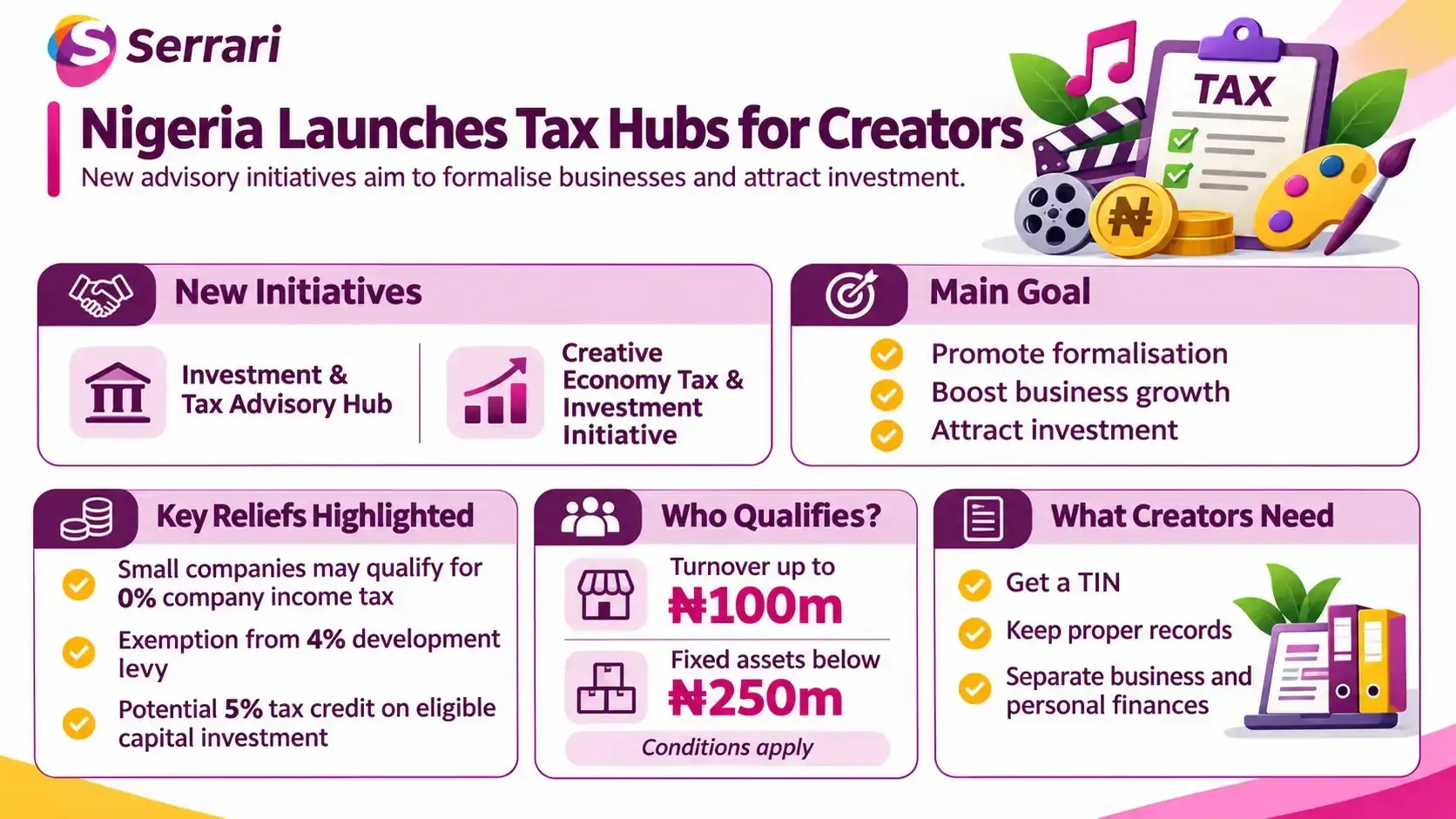
- Small-company relief: Qualifying companies with annual turnover of up to ₦100 million and fixed assets not exceeding ₦250 million may pay zero company income tax and avoid the 4% development levy, subject to the statutory definition and exclusions.
- Investment support: Eligible priority-sector projects may qualify for a 5% credit linked to qualifying capital expenditure, but approval, minimum investment thresholds and other rules matter.
- Formalisation: Tax registration, separate business accounts and properly documented costs can strengthen eligibility for relief and access to finance.
- Critical distinction: A tax advisory initiative does not automatically make every creator tax-exempt, remove VAT on purchases or guarantee funding.
Why Nigeria Is Bringing Tax Advice to the Creative Industry
The immediate reason is an information and trust gap. Nigeria has a globally visible cultural industry, yet many operators remain individual freelancers or loosely organised businesses whose revenues, rights and expenses are not always recorded in ways that investors, banks and tax authorities can evaluate. An artist may earn substantial money from streaming, sponsorships or licensing without maintaining accounts that separate the business from personal spending. That can make a successful creative career difficult to finance or transfer into a company that survives its founder.
At the tax-policy discussion held during CANEX Weekend, officials urged creators to obtain tax identification numbers and keep invoices, receipts and ledgers. The message was more than a demand for compliance: tax uncertainty itself can discourage business registration. Entrepreneurs who cannot predict what they owe, or which reliefs they can legally claim, may prefer to remain informal even when that limits access to bigger contracts.
The timing also reflects the 2025 tax reforms that took effect in January 2026. Changes to company income taxation, administration and investment incentives mean businesses need fresh guidance rather than assuming older rules still apply. The advisory hub is intended to help translate complex legislation into practical decisions; the creative-economy initiative is designed to sustain conversations with the industry beyond a single festival.
That second mechanism remains particularly important. The initial announcement of both support platforms described advice, collaboration and possible future policy adjustments. It did not establish that every proposed incentive had become a new entitlement or that a dedicated pool of grant money had been launched.
What the New Tax Thresholds Actually Mean
A potentially significant benefit is the treatment of small companies. Under the current framework, a qualifying company with annual gross turnover of ₦100 million or less and fixed assets not exceeding ₦250 million can fall within the zero-rate company income tax category and be excluded from the 4% development levy. The government’s tax and investment guidance confirms the general thresholds and stresses that exemptions depend on the legal requirements.
The relief is not based on turnover alone. The fixed-asset test also matters, and businesses providing professional services are excluded from the statutory definition of a small company. A creative agency, production house or self-employed professional therefore needs to establish how its activities are classified before claiming the benefit. The exemption also concerns company-level taxes; it does not mean that an individual has no personal income tax obligations or that a business is free of payroll, withholding or other applicable responsibilities.
For a growing music label or film-production company, this distinction affects cash flow. Paying less company income tax, where genuinely eligible, can leave more money available for equipment, staff and working capital. But the business must still preserve records showing that it meets the relevant tests. Registration and filing requirements do not necessarily disappear when the amount of tax payable is zero.
A second incentive targets larger capital investment. Officials highlighted a 5% tax credit for eligible expenditure in designated sectors, subject to conditions that include a ₦250 million minimum investment described during the event. The broader Economic Development Tax Incentive framework links credits to qualifying capital expenditure, approvals and specified periods. A creator buying a laptop should not assume that an ordinary purchase automatically generates the credit; the incentive is designed for qualifying investments under statutory rules.
Why Formalisation Could Unlock Private Investment
The economic objective extends well beyond collecting tax. Investors assessing a production studio, events company or game developer need to know who owns the intellectual property, how revenue arrives, what debts exist and whether financial statements can be trusted. Unrecorded cash flows or rights held personally by founders can make even popular businesses difficult to value.
Proper incorporation, contracts and accounting can improve those conditions. A business that documents music royalties, licensing agreements, client receivables and production costs is better placed to negotiate with lenders and strategic investors. Clear accounts also help management decide whether a new tour, film or digital product is actually profitable after marketing, distribution and tax expenses.
Formalisation nevertheless has costs. Professional accounting, compliance software and legal advice may be difficult for early-stage creators to afford. An advisory hub becomes useful only if it can provide accessible guidance proportionate to the size of the business, rather than treating a solo designer like a large production company. Otherwise, the prospect of extra paperwork could undermine the effort to bring activity into the formal economy.
The stakes are large because the creative industry connects with tourism, advertising, telecommunications and digital exports. Ahead of the event, the government identified cultural exports and investment partnerships as economic diversification priorities. That ambition will not be realised through tax policy alone, but predictable rules can remove one obstacle between artistic success and long-term enterprise growth.
Context is everything. Stay ahead of shifting trends with today’s market updates, and uncover emerging opportunities using the Serrari Group Market Index and Marketplace. Then, take control of your own financial future by exploring our Money & Life Reset Transformation Blueprint ™ to build stronger habits, create better systems, and design a path toward lasting wealth.
VAT, Foreign Earnings and the Risks of Misunderstanding Relief
Several issues discussed at CANEX have immediate practical consequences for creators. First, relief from acting as a VAT collection agent does not necessarily mean an operator avoids VAT on goods and services bought from suppliers. Production equipment, advertising, professional services and other purchases may still carry tax depending on the nature of the supply and applicable exemptions.
Officials also described a streamlined process under which eligible VAT refunds could be processed within 30 days without a mandatory prior audit, with subsequent verification still possible. That is a procedural opportunity, not a guarantee that every refund claim will be approved or paid automatically. Businesses need accurate invoices and evidence to support any request.
Second, overseas earnings complicate tax planning. A Nigerian musician earning streaming revenue abroad or a filmmaker licensing content internationally may encounter foreign withholding taxes, domestic reporting rules and possible relief under tax treaties. The investor guidance on double-taxation agreements makes clear that treaty benefits depend on the relevant jurisdiction, income type and documentation. Earning abroad does not itself create an automatic credit against Nigerian tax.
The same logic applies to expenses. Personal rent, family travel or unrelated purchases cannot become deductible merely because a creator has a registered company. Where an expense serves both business and private purposes, only the allowable business element should be claimed. The requirement protects tax revenue but also makes accurate expense tracking indispensable.
Where the Advisory Hubs Fit in Nigeria’s Broader Strategy
Nigeria wants its cultural success to translate into formal businesses, jobs and international sales, rather than remaining concentrated in individual stars. CANEX Weekend was organised as a platform for financing, partnerships and cross-border trade, with official plans for investor connections and market access spanning music, film, fashion and other creative sectors.
The tax authority’s participation signals that investment promotion and revenue administration are increasingly being discussed together. An expanding creative economy can eventually broaden the tax base, but aggressive compliance demands too early may discourage entrepreneurs from entering it. Offering guidance and targeted relief is an attempt to balance those objectives: make formal participation worthwhile first, then build a more sustainable system of reporting and taxation.
The policy also responds to the international nature of creative commerce. Digital creators can sell subscriptions, content and licensing rights across borders without traditional storefronts. As that market grows, questions about royalties, intellectual property ownership, tax residency and double taxation become more consequential. A specialist dialogue with the sector can identify problems that broad company-tax rules do not fully anticipate.
Still, policy promises must be distinguished from outcomes. There is not yet evidence in the cited launch coverage showing how many businesses the initiatives have helped, how much investment has followed or whether compliance costs have fallen. Those figures will be essential to judging whether the programme changes business behaviour or remains largely informational.
What Will Determine Whether the Initiatives Succeed
Three practical outcomes will matter. The first is clarity: can a small creator determine which authority to register with, what records to keep and whether an incentive applies without expensive professional assistance? The second is access: will tax-compliant companies find it easier to secure finance, enforce contracts and reach overseas buyers? The third is accountability: will the revenue authority publish clear guidance and measurable results, including service timelines and uptake among eligible businesses?
For creators, the immediate benefit is an opportunity to organise revenue streams and make better-informed decisions before expanding. For investors, more transparent financial records can reduce the uncertainty involved in funding projects whose value often rests on intellectual property and future royalties. For the government, a more resilient creative sector could generate employment and taxable income over time without relying entirely on oil or conventional industries.
The November reporting therefore marks more than a tax-administration announcement. It reflects a choice about how Nigeria wants to develop an industry already capable of reaching global audiences. If rules become simpler and predictable, formalisation could strengthen rather than constrain creative entrepreneurship. If reliefs prove difficult to access and compliance remains confusing, the gap between cultural visibility and investable businesses will persist.
Sources: Nigerian Tribune / Punch / Voice of Nigeria / Federal Ministry of Finance Nigeria / Federal Ministry of Information and National Orientation / Nigeria Revenue Service
Your financial future isn’t something you wait for—it’s something you build.
The real question is: when do you begin?
Move beyond simply staying informed.
Navigate the markets with clarity—track trends through the Serrari Group Market Index, uncover opportunities in the Serrari Marketplace, and build practical knowledge with our Curated Wealth Builder Platform.
Stay connected to what truly matters.
Get daily insights on macro trends and financial movements across Kenya, Africa, and global markets—delivered through the Serrari Newsletter.
Growth opens doors.
Advance your career through professional programs including ACCA, HESI A2, ATI TEAS 7 , HESI EXIT , NCLEX – RN and NCLEX – PN, Financial Literacy!🌟—designed to move you forward with confidence.
See where money is flowing—clearly and in real time.
Track Money Market Funds, Treasury Bills, Treasury Bonds, Green Bonds, and Fixed Deposits, alongside global and African indexes, key economic indicators, and the evolving Crypto and stablecoin landscape—all within Serrari’s Market Index.