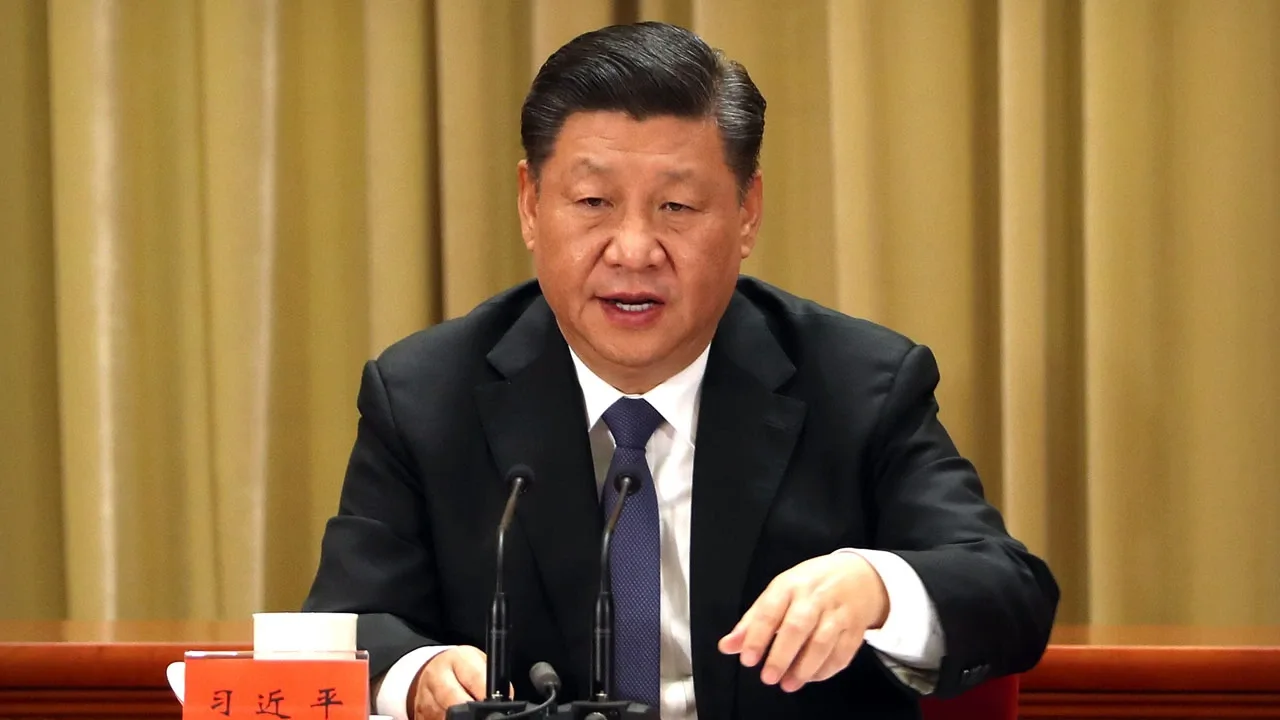
Chinese President Xi Jinping used the November 18, 2026 APEC CEO Summit in Shenzhen to cast China as a defender of open commerce at a time when U.S. tariffs, technology restrictions and geopolitical rivalries are making cross-border business harder to predict. He urged governments to protect a rules-based trading system, remove barriers and cooperate on digital trade and artificial intelligence, while promising a more welcoming environment for foreign companies. The speech was also strategic: as Washington tightens controls on China’s access to advanced computing, Beijing wants trading partners to see its economy as a dependable source of demand, manufacturing capacity and technological cooperation. Whether that message resonates will depend on tangible market-opening reforms, not diplomatic language alone.
Key Overview
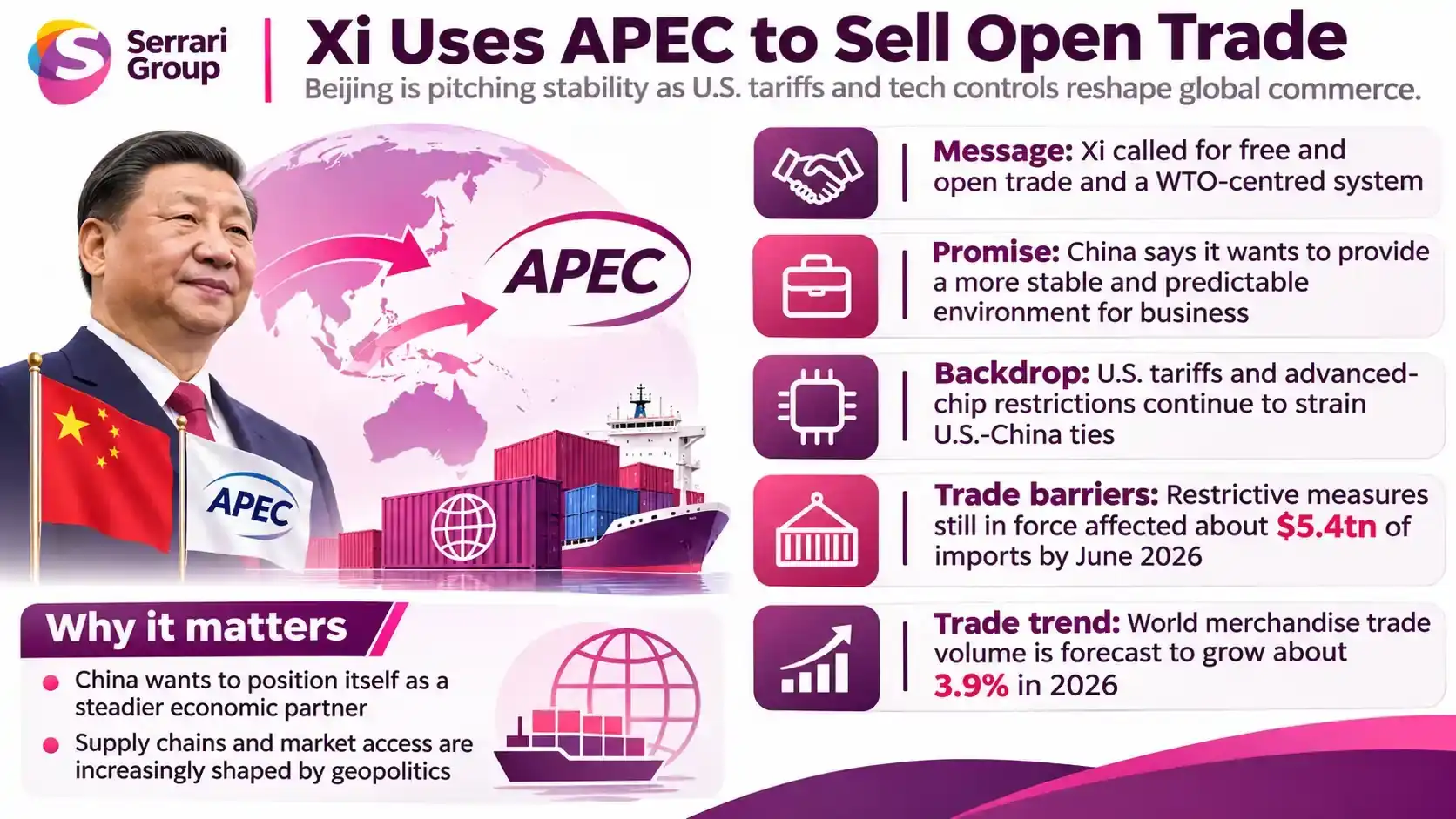
- Trade message: Xi called for freer trade and investment at the APEC CEO Summit in Shenzhen on November 18.
- U.S. policy backdrop: New American controls on remote access to advanced computing added to longstanding tariffs and semiconductor restrictions.
- Global stakes: Trade restrictions accumulated since 2009 covered $5.4 trillion in imports as of June 2026, according to international trade monitoring.
- Growth remains resilient: World merchandise trade volume is forecast to expand 3.9% in 2026, helped by AI-related investment and adapting supply chains.
- China’s commitments: Xi pledged greater market access, regulatory reform and regional cooperation, but did not announce a detailed implementation timetable.
- Diplomatic test: Talks involving Xi, Donald Trump and Vladimir Putin were scheduled for November 19, with outcomes still uncertain at the time of the speech.
Why Xi Is Selling China as a Defender of Free Trade
Xi’s message was shaped by a striking reversal in economic diplomacy. For decades, Washington presented itself as a leading advocate of open global markets while regularly criticising Chinese industrial subsidies and restricted access to domestic industries. At Shenzhen, Xi sought to occupy the language of openness, portraying protectionism and unilateral barriers as threats to prosperity without naming the United States directly.
In his November 18 keynote address, Xi called for stable supply chains, cooperation and progress toward a Free Trade Area of the Asia-Pacific. He also promoted more efficient customs processes, cross-border e-commerce and closer technology partnerships. The location strengthened the symbolism: Shenzhen’s transformation into a technology and manufacturing centre is one of Beijing’s preferred examples of the gains possible through investment and international commerce.
The immediate trigger is the strain caused by U.S. trade and technology policy. President Donald Trump’s tariff-focused approach creates uncertainty for businesses trading with America, while restrictions on advanced semiconductors seek to prevent China from acquiring capabilities Washington considers strategically sensitive. Xi’s speech offered regional partners an alternative message: rather than forcing an exclusive alignment with one power, China says it can provide a predictable commercial relationship.
This pitch serves China’s own interests. As a major exporter and manufacturing hub, China depends on overseas customers, imported inputs and reliable maritime routes. Presenting itself as an anchor of stability can help defend those relationships, especially when other economies are rethinking dependence on individual markets. It can also strengthen Beijing’s standing among developing countries that worry about being caught between competing technology and trade systems.
Why Protectionism Matters Even as Trade Keeps Growing
The scale of new trade barriers gives Xi’s remarks their economic weight. A November 17 trade-monitoring assessment found that import-related restrictive and other non-facilitating measures introduced since 2009 and still in force affected $5.4 trillion in trade by June 2026, equivalent to 21.3% of world imports. That is the stock of accumulated measures, not the value of fresh tariffs imposed in 2026 alone.
The same assessment recorded 333 new restrictive or otherwise non-facilitating measures during the first half of 2026, compared with 300 during all of 2025. Those figures illustrate how frequently governments are intervening in cross-border commerce, from tariffs to other market-access conditions. For companies, each measure can raise compliance costs, change sourcing plans or undermine the economics of an investment made under earlier rules.
Yet the international economy has not simply stopped trading. The October global trade outlook projected merchandise trade-volume growth of 3.9% for 2026, up from an earlier 1.9% forecast, with 4.1% growth expected in 2027. Demand for equipment used in artificial intelligence and the ability of supply chains to adapt to energy and transport disruptions have supported that resilience.
The apparent contradiction is important. Global trade can expand while becoming more costly and fragmented. Businesses may reroute shipments through third countries, duplicate production facilities or build larger inventories to protect against policy changes. Those responses keep goods moving but can tie up capital and reduce efficiency. Consumers may eventually face higher prices, while smaller exporters can struggle with the fixed costs of meeting divergent rules.
For governments, the choice is therefore not simply between free trade and no trade. It is between predictable rules that allow businesses to invest confidently and a more fragmented system in which commercial decisions depend increasingly on political risk.
Context is everything. Stay ahead of shifting trends with today’s market updates, and uncover emerging opportunities using the Serrari Group Market Index and Marketplace. Then, take control of your own financial future by exploring our Money & Life Reset Transformation Blueprint ™ to build stronger habits, create better systems, and design a path toward lasting wealth.
AI Chip Restrictions Expose the Limits of Economic Cooperation
Technology is where the contradiction between openness and national security is sharpest. Just two days before Xi’s speech, the Trump administration introduced new restrictions on access to advanced U.S. computing. The measures targeted arrangements allowing restricted entities to use American-designed chips through data centres in third countries, even when the physical hardware was not shipped directly to China.
The rationale from Washington is national security: advanced computing can support both civilian AI products and sensitive military or intelligence applications. From Beijing’s perspective, such controls constrain domestic technology development and complicate commercial relationships with global hardware and cloud providers. Countries hosting data centres may also face additional due-diligence obligations and investment uncertainty.
Xi urged APEC economies to deepen cooperation in the digital economy, AI and green technologies. The message may appeal to governments seeking access to both Chinese and American innovations, but his speech did not resolve the central dispute over who may use the most advanced computing infrastructure. Tariff negotiations alone cannot necessarily settle that question because U.S. officials view technology access through a security lens as well as an economic one.
This also limits how far companies can rely on diplomatic reassurances. A manufacturer may benefit from lower import duties while still being unable to source a restricted processor or provide a controlled service to a customer. The distinction matters to investors evaluating semiconductor producers, cloud infrastructure operators and businesses building cross-border AI products.
Can China’s Market-Opening Promises Persuade Businesses?
Xi told executives that China would expand opportunities in manufacturing and services and pursue reform of tariffs, access requirements and regulatory standards. Those commitments outlined in the summit speech are significant in direction, but they were not accompanied by a comprehensive list of immediately effective tariff changes, sector-by-sector openings or enforceable deadlines.
That distinction is central to judging credibility. Foreign companies often care less about the tone of an address than whether they can obtain licences, protect intellectual property, transfer information lawfully and compete on consistent terms. Investors will also weigh China’s support for domestic manufacturers, market-access rules and the risk that future geopolitical disputes interrupt operations.
China’s critics argue that its economy is not as open as its free-trade rhetoric suggests, citing industrial support, barriers in selected sectors and uneven conditions for foreign firms. Beijing, in turn, contends that U.S. tariffs and technology curbs undermine the multilateral trading order. Both positions illuminate genuine sources of friction, but neither substitutes for examining specific rules and their practical effects.
The most convincing evidence of change would be published reforms that lower costs for imported goods and services, provide consistent treatment for foreign businesses and improve the resolution of commercial disputes. Until then, Xi’s appeal remains partly a contest over international confidence.
Why Smaller Economies and African Exporters Should Pay Attention
APEC’s 21 economies represent a substantial share of global production and trade, giving the forum influence beyond the Pacific Rim. Its members account for roughly 60% of world GDP and half of global trade. Decisions made by major players in the bloc can therefore alter shipping patterns, investment flows and the prices paid for manufactured imports worldwide.
African economies are not members of APEC, but many trade extensively with China, the United States and Asian manufacturing hubs. Changes to tariffs or supply-chain rules can affect demand for minerals and agricultural exports, the cost of imported machinery and the availability of equipment for local factories. If companies diversify production out of major trade-dispute corridors, some African locations may attract investment, provided infrastructure, skills and policy stability make them competitive.
There are risks as well. Countries that depend heavily on a small number of export markets may find themselves exposed when powerful economies impose restrictions or redirect sourcing. Smaller businesses rarely have the capacity to establish multiple overseas subsidiaries or absorb prolonged customs delays. For them, transparent trade rules and reliable logistics can matter as much as the headline tariff rate.
Xi’s language about cooperation with developing economies consequently offers a potential opening, but benefits will depend on actual market access and investment terms. Governments should evaluate whether new partnerships create export opportunities and local capabilities rather than merely increasing dependence on imported goods or external financing.
What the Shenzhen Summit Will Really Test
The next diplomatic focus is the anticipated November 19 talks involving Xi, Trump and Russian President Vladimir Putin. Reports ahead of the planned three-leader meeting indicated that discussions would cover strategic stability alongside difficult bilateral issues. At the time of Xi’s November 18 speech, no trilateral outcome had been established, and a meeting itself would not guarantee an agreement on tariffs or technology controls.
APEC’s longer-term challenge is to translate broad commitments to openness into practical improvements. The forum promotes cooperation and the eventual possibility of a region-wide free-trade area, but it does not automatically override national laws or settle disputes between major powers. Progress will be visible in lower barriers, smoother customs procedures, compatible digital-trade rules and fewer interruptions to critical supply chains.
Xi’s speech matters now because the struggle over global economic leadership increasingly concerns who can offer businesses the most dependable rules, not simply who has the largest market. China’s case for openness is commercially appealing at a time of rising restrictions, but it will be judged against Beijing’s own policies. For companies and governments across the world, the real question is whether competition between major powers leaves more routes open for commerce or forces everyone to operate within narrower, competing economic blocs.
Sources: Ministry of Foreign Affairs of China / State Council of China / World Trade Organization / Associated Press / Reuters / Ministry of Foreign Affairs of Japan
Your financial future isn’t something you wait for—it’s something you build.
The real question is: when do you begin?
Move beyond simply staying informed.
Navigate the markets with clarity—track trends through the Serrari Group Market Index, uncover opportunities in the Serrari Marketplace, and build practical knowledge with our Curated Wealth Builder Platform.
Stay connected to what truly matters.
Get daily insights on macro trends and financial movements across Kenya, Africa, and global markets—delivered through the Serrari Newsletter.
Growth opens doors.
Advance your career through professional programs including ACCA, HESI A2, ATI TEAS 7 , HESI EXIT , NCLEX – RN and NCLEX – PN, Financial Literacy!🌟—designed to move you forward with confidence.
See where money is flowing—clearly and in real time.
Track Money Market Funds, Treasury Bills, Treasury Bonds, Green Bonds, and Fixed Deposits, alongside global and African indexes, key economic indicators, and the evolving Crypto and stablecoin landscape—all within Serrari’s Market Index.