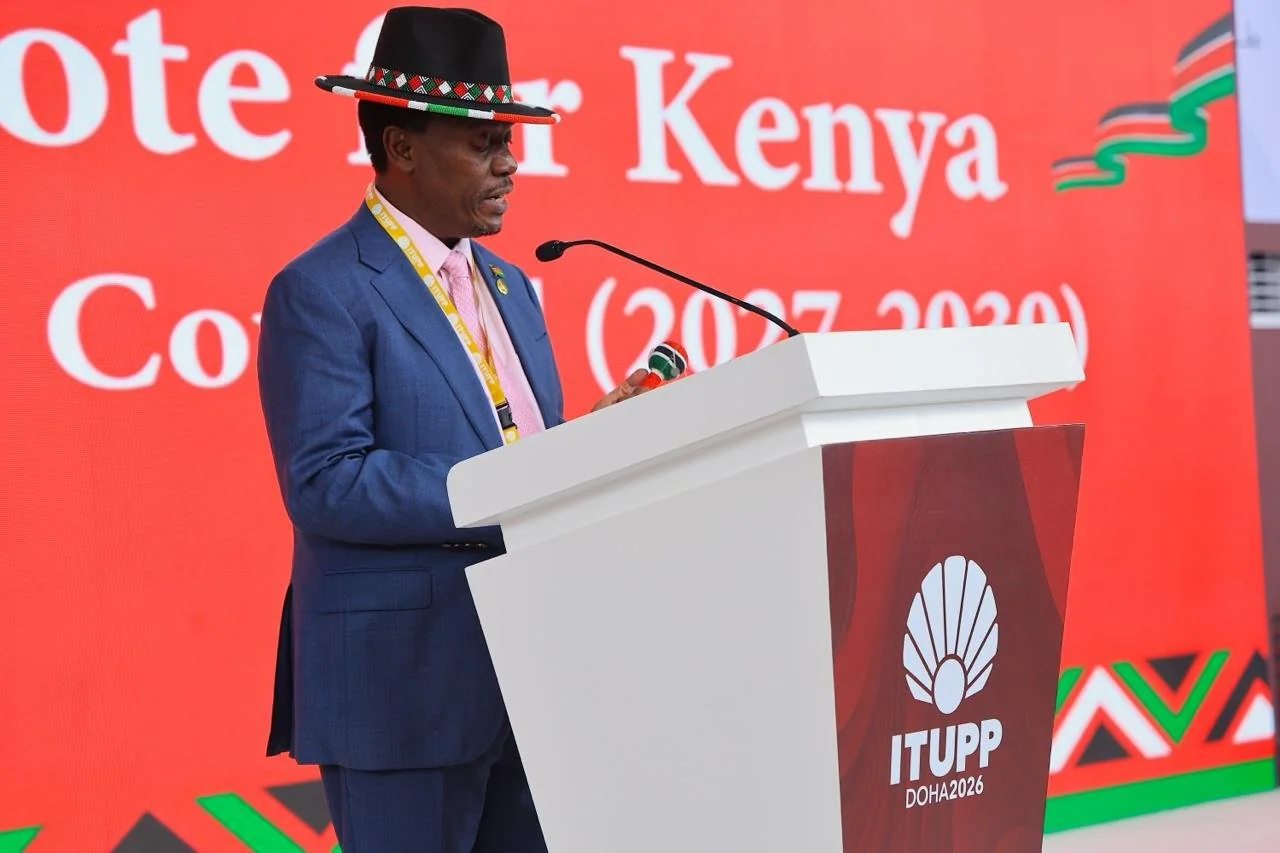
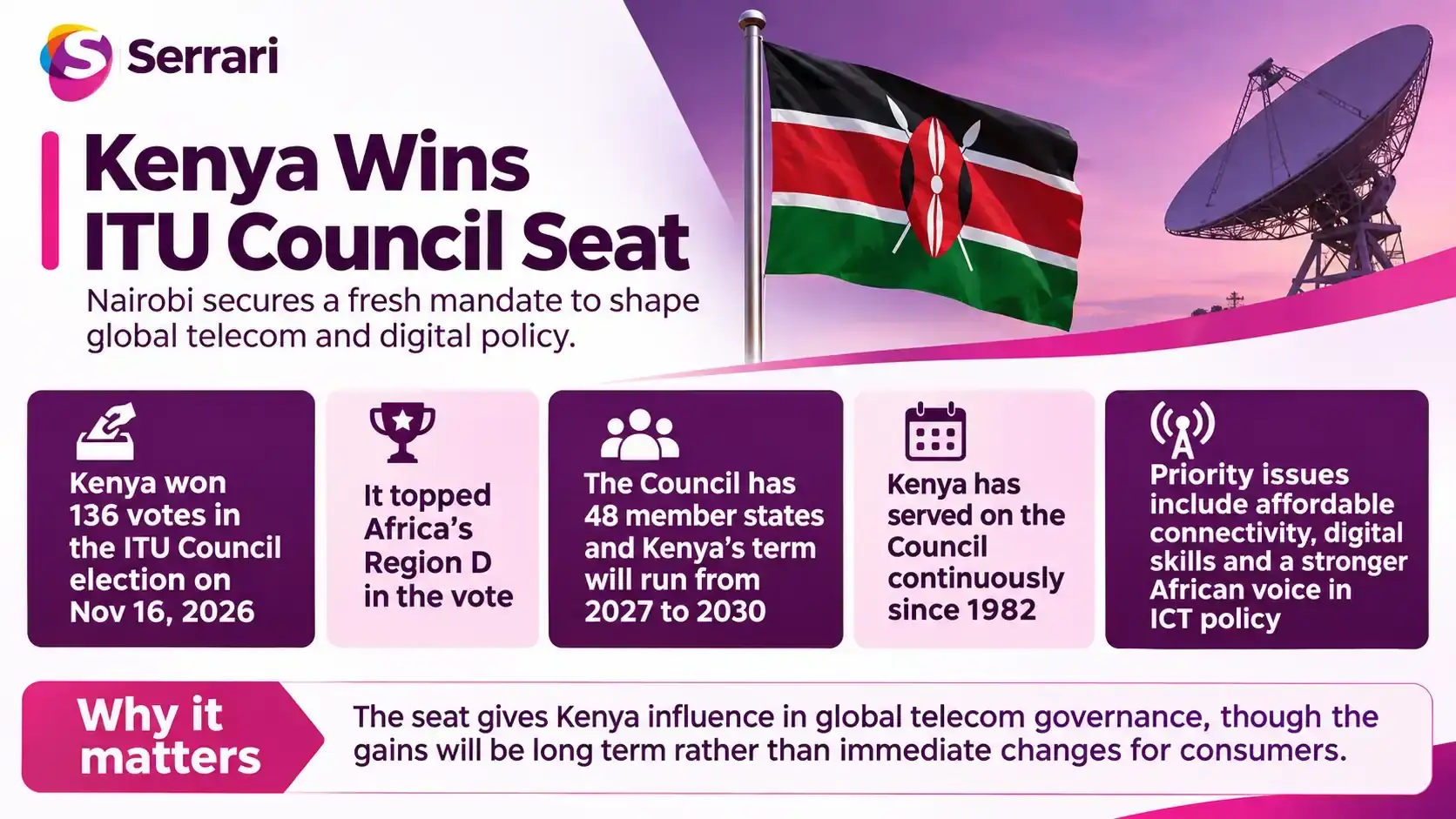
Kenya secured the highest vote among African contenders in the November 16, 2026 election to the International Telecommunication Union (ITU) Council, winning 136 votes and retaining a seat for 2027–2030. Nineteen African states competed for 13 positions, making the outcome both a diplomatic victory and a renewal of Kenya’s long-standing role in global telecommunications governance. The Council helps supervise the UN agency’s strategy, finances and work between its four-yearly conferences. But the vote does not immediately lower Kenyan mobile-data prices or award the country control over international spectrum decisions. Its value lies in whether Nairobi can turn influence into practical cooperation on affordable internet, resilient cables, digital skills and emerging technologies.
Key Overview
- Africa’s highest tally: Kenya received 136 votes in the Region D election, ahead of Côte d’Ivoire with 135 and Senegal with 134.
- Competitive contest: 19 African candidates sought 13 Council seats within the ITU’s 48-member governing body.
- Four-year mandate: Kenya will serve in 2027–2030, extending its uninterrupted Council representation dating to 1982.
- Policy priorities: Kenya is pushing affordable connectivity, stronger submarine-cable and fibre resilience, fair access to spectrum and greater African participation in AI.
- Limited immediate effect: Council membership gives Kenya a voice in governance and policy but does not automatically cut data prices, expand network coverage or change national licensing conditions.
- Next test: Kenya must turn its campaign agenda into specific proposals, partnerships and measurable digital-development results.
Why Kenya’s 136 Votes Matter Beyond a Diplomatic Win
Kenya’s official election result placed it first among African candidates during the ITU Plenipotentiary Conference in Doha, Qatar, on November 16. Côte d’Ivoire followed with 135 votes and Senegal with 134, while Tanzania secured 131. All four obtained seats, but Kenya’s narrow lead illustrates how competitive the contest was: one vote separated the top two candidates. The election was not a direct ranking of which country has Africa’s fastest or cheapest internet; it was a vote by participating ITU member states for representation on the Council.
The distinction matters because Kenya’s success is best understood as an endorsement of its candidacy and diplomatic engagement, not proof that domestic digital challenges have been solved. According to the Kenyan regulator’s election statement, Information, Communications and the Digital Economy Cabinet Secretary William Kabogo led the campaign and used the conference to seek support from other governments. Kenya secured 136 votes out of a possible 173, while six African candidates did not win Council places.
Kenya has held a Council seat continuously since 1982. Re-election therefore preserves an established role rather than introducing the country to the institution for the first time. Losing that position would have meant relinquishing a regular place in the body that guides the organisation between its main conferences. Retaining it provides continuity in conversations where policies and projects often take years to develop.
What the ITU Council Actually Controls
The ITU is the United Nations specialised agency for digital technologies and telecommunications. Its work includes international coordination of radio-frequency spectrum and satellite orbits, development of technical standards and support for expanding connectivity. Its Plenipotentiary Conference is the highest policy-making gathering, held every four years, while the Council handles governance between those meetings.
Under the Council’s defined responsibilities, member states supervise implementation of agreed policy, approve budgets, monitor expenditure and coordinate work programmes. They can also participate in working groups that explore evolving telecommunications priorities. The Council thus matters not because its members directly manage every telecom network, but because they help determine how the ITU allocates institutional attention, funding and administrative resources.
A key boundary is often lost in headlines. The Council does not independently assign a Kenyan mobile operator its licence or determine retail internet prices. International spectrum rules are developed through specialised radiocommunication processes, including World Radiocommunication Conferences, while national authorities remain responsible for domestic licensing and implementation. Similarly, technical standards emerge through sector-specific processes involving governments and other stakeholders, not simply by a Council vote.
Kenya’s position can nevertheless matter indirectly. By influencing priorities and building coalitions, it can help elevate African concerns before decisions are made elsewhere in the organisation. That is the practical value of being consistently represented in a global institution where technical choices eventually affect infrastructure investment and service availability.
Why Affordable Internet Is Still Kenya’s Biggest Test
Kenya’s campaign emphasised meaningful and affordable connectivity rather than coverage statistics alone. Meaningful access means consumers can pay for connectivity, depend on its quality, obtain suitable devices and use digital services safely. A network signal is of limited economic value to someone who cannot afford sufficient data or lacks the skills to complete useful tasks online.
The underlying regional gap remains significant. In the ITU’s 2025 internet-use estimates, only 36% of Africa’s population used the internet, underscoring how much of the continent remained offline even as mobile networks expanded. This is an Africa-wide estimate, not a Kenyan internet penetration rate. Kenya’s own communications statistics provide a more detailed picture of mobile, fixed broadband and technology uptake, but subscription counts should not automatically be equated with unique individuals using the internet.
For households, improving affordability depends on several factors: competition among operators, network construction costs, electricity reliability, device prices, taxes and the economics of reaching sparsely populated areas. An ITU Council seat cannot remove those constraints by itself. It may, however, help Kenya advocate for affordable-device programmes, share solutions with peers and connect national initiatives with technical assistance and development partnerships.
For smaller businesses, the stakes are tangible. Intermittent or expensive connections can limit digital payments, online sales, remote work and access to public services. Better connectivity is therefore an economic-development question as much as a telecommunications one. The value of Kenya’s renewed mandate should eventually be visible in domestic implementation, not just in statements delivered abroad.
Context is everything. Stay ahead of shifting trends with today’s market updates, and uncover emerging opportunities using the Serrari Group Market Index and Marketplace. Then, take control of your own financial future by exploring our Money & Life Reset Transformation Blueprint ™ to build stronger habits, create better systems, and design a path toward lasting wealth.
Submarine Cables, Satellite Spectrum and Network Resilience
Another priority is the resilience of the infrastructure that connects African users to the rest of the world. Kenya has called for stronger coordination on submarine cables and cross-border fibre networks. Cable damage or other network failures can disrupt payments, e-government platforms and the operations of firms that rely on international data links. Multiple routes, coordinated maintenance and effective contingency plans can reduce the severity of such interruptions.
The country’s published policy priorities also identify fair access to spectrum and satellite resources. These are scarce and internationally coordinated resources. Their allocation and technical use influence which services can operate without harmful interference, including mobile broadband, broadcasting, aircraft communications and satellite links.
For network operators and investors, more predictable technical rules can reduce uncertainty about equipment and infrastructure decisions. Harmonised spectrum arrangements may also support economies of scale in compatible devices and systems. Yet lower equipment costs or improved 5G deployment are potential downstream gains, not automatic results of Kenya’s election.
The policy challenge is to connect international coordination with practical infrastructure investment. A country can campaign effectively for resilience while still needing domestic financing, regulatory implementation, private-sector cooperation and maintenance planning to deliver it.
Why African AI and Digital Governance Are Entering the Debate
Kenya’s agenda extends beyond traditional telecommunications. It includes regional data centres, African-language AI models and approaches to data governance that reflect African interests. These issues matter because AI infrastructure and digital services are increasingly shaped by decisions about computing capacity, connectivity, standards and the ability of different populations to participate.
If AI systems mainly serve larger language markets, users of Kiswahili and other African languages may face poorer access or lower-quality services. Local expertise and better language representation can help, but outcomes depend on datasets, funding, skills and responsible deployment. International forums may bring visibility and collaboration; they do not replace the hard work of developing and testing systems.
The wider question is whether African economies will primarily consume technologies designed elsewhere or participate in shaping their architecture and governance. Through the Council, Kenya can promote those concerns within a wider coalition. However, it holds one of 48 seats, so advancing proposals will require negotiation and support from other member states rather than unilateral action.
Africa’s Representation Is Wider Than Kenya Alone
The elected African Council membership includes Algeria, Côte d’Ivoire, Egypt, Ghana, Kenya, Mauritius, Morocco, Nigeria, Rwanda, Senegal, South Africa, Tanzania and Tunisia. Those 13 countries represent different telecommunications markets and policy priorities. Their combined influence will depend on how effectively they identify common interests while accommodating differences in infrastructure, regulation and resources.
There was also a separate election for the 12-member Radio Regulations Board, with three members chosen from Africa. That technical board is distinct from the 48-member Council; winning a Council seat does not mean Kenya won an individual position on the Radio Regulations Board. This separation is important when assessing which decisions Kenyan representatives will directly participate in.
The results give African governments a defined place in global governance, but representation is not the same as a single regional position. Sustained coordination on connectivity, standards, satellite access and digital inclusion will be needed if the continent is to have greater practical influence.
What Kenya Must Deliver After Doha
The November 16 official announcement confirmed the Council election while the Plenipotentiary Conference continued through November 27. That conference is considering the ITU’s strategic and financial roadmap for 2028–2031. The new Council will then oversee the organisation’s work through the 2027–2030 term, making it important to distinguish the membership cycle from the years covered by the next strategic plan.
Kenya has also identified the planned Internet Governance Forum in Nairobi in December 2026 as another opportunity to advance work on cable resilience, AI and inclusive digital governance. Such events provide platforms, but progress will require concrete outcomes: proposals taken forward, partnerships formed, technical support secured and reforms implemented at home.
The re-election should be judged on those outcomes. For consumers, successful diplomacy may eventually contribute to more reliable and affordable internet, though domestic policy and investment remain decisive. For telecom companies, it may offer stronger avenues into international policy discussions. For the wider region, Kenya’s role offers another opportunity to keep African priorities visible in a fast-changing digital economy.
Kenya’s 136 votes are therefore a starting point, not the final achievement. The election confirms international support for its continued representation; the lasting test is whether that influence helps deliver connectivity, resilience and useful digital services beyond the conference hall.
Sources: International Telecommunication Union / Communications Authority of Kenya / Kenya News Agency / Kenya Broadcasting Corporation
Your financial future isn’t something you wait for—it’s something you build.
The real question is: when do you begin?
Move beyond simply staying informed.
Navigate the markets with clarity—track trends through the Serrari Group Market Index, uncover opportunities in the Serrari Marketplace, and build practical knowledge with our Curated Wealth Builder Platform.
Stay connected to what truly matters.
Get daily insights on macro trends and financial movements across Kenya, Africa, and global markets—delivered through the Serrari Newsletter.
Growth opens doors.
Advance your career through professional programs including ACCA, HESI A2, ATI TEAS 7 , HESI EXIT , NCLEX – RN and NCLEX – PN, Financial Literacy!🌟—designed to move you forward with confidence.
See where money is flowing—clearly and in real time.
Track Money Market Funds, Treasury Bills, Treasury Bonds, Green Bonds, and Fixed Deposits, alongside global and African indexes, key economic indicators, and the evolving Crypto and stablecoin landscape—all within Serrari’s Market Index.