




The US dollar eased from a 19-month high in Asian trading on November 23, 2026, as a fragile recovery in risk appetite and reduced expectations for an unusually large Federal Reserve rate increase reversed part of the previous week’s rush into the greenback. The dollar index slipped to 103.72, even as the currency strengthened against the Japanese yen, highlighting how interest-rate differences and demand for safe havens can pull exchange rates in opposite directions. Investors still overwhelmingly expected a quarter-point Fed increase in December. The real question was whether persistent US inflation would justify further tightening even as falling share prices raised concerns about the economic outlook.
Key Overview
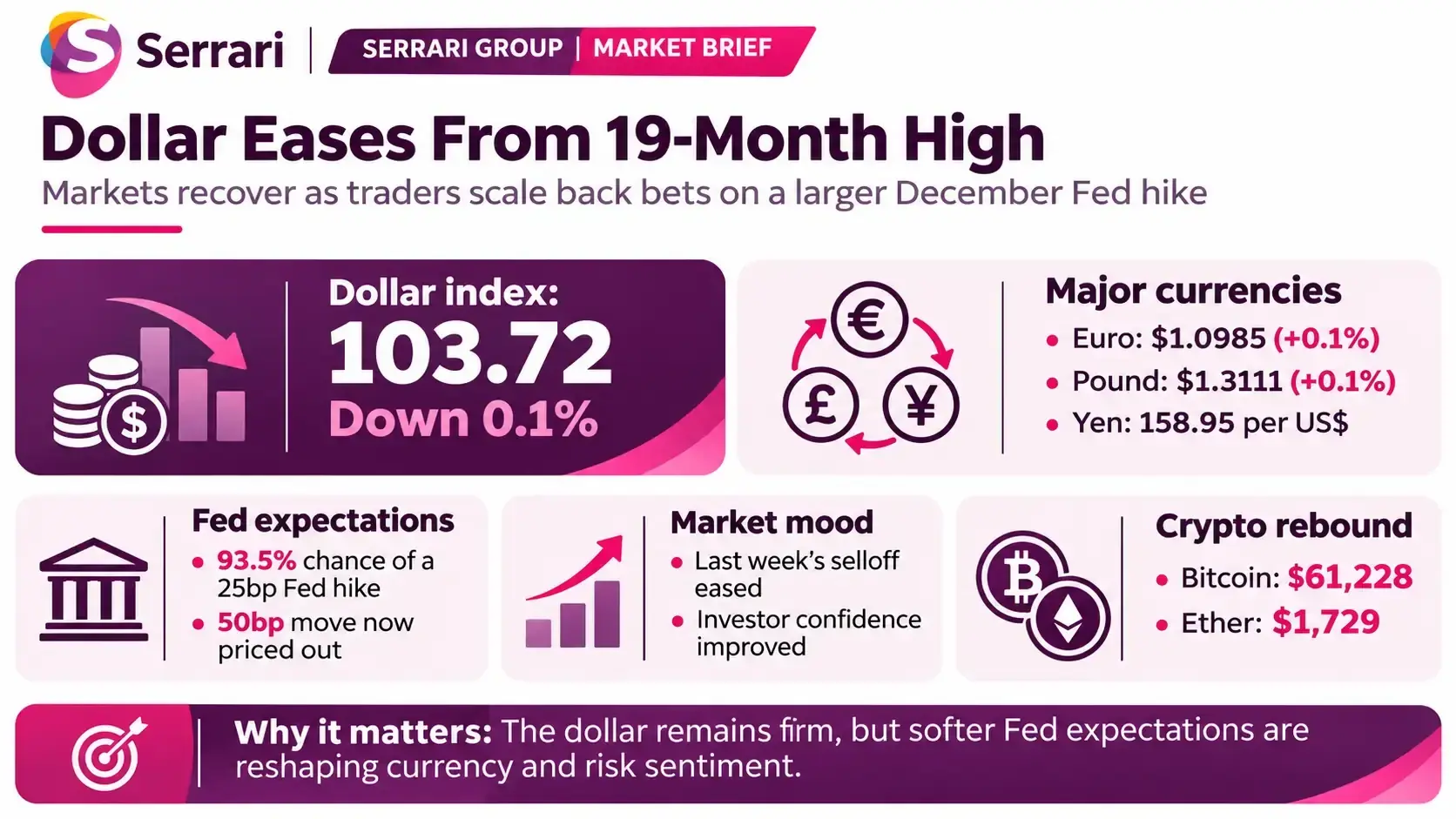
- Dollar loses momentum: The dollar index fell 0.1% to 103.72 after reaching its strongest level since April 2025.
- Yen remains vulnerable: The dollar rose 0.3% to ¥158.95 as defensive demand for the Japanese currency eased during a Japanese market holiday.
- Modest recovery elsewhere: The euro gained to $1.0985 and sterling to $1.3111, while the Australian dollar rebounded after nine days of losses.
- Fed expectations recalibrate: Futures implied a 93.5% probability of a 25-basis-point increase at the December 8–9 meeting, with a 50-basis-point move no longer priced in.
- New inflation test: October US personal consumption expenditures data, scheduled for November 25, could change rate expectations and currency prices.
- Wider stakes: Dollar strength can tighten financing conditions for importers, dollar borrowers and emerging economies, even when the dollar briefly retreats.
Why the Dollar’s Rally Suddenly Lost Momentum
The dollar’s decline was less a dramatic shift in the US economy than a change in how traders interpreted the previous week’s market turmoil. Earlier hawkish signals from Federal Reserve officials had pushed US yields higher, increasing the appeal of dollar-denominated assets. Investors seeking higher returns generally favour currencies whose short-term interest rates are expected to remain above those of other major economies, all else equal.
But a sharp equity selloff complicated that calculation. When rising bond yields begin to threaten company valuations, borrowing costs and economic activity, traders must weigh the prospect of higher interest income against the possibility that tighter monetary conditions will damage growth. The November 23 currency-market report described how an initial interest-rate shock had increasingly become a growth concern.
This is why the dollar could slip while expectations of a December rate increase remained strong. Traders were not suddenly anticipating easy monetary policy. Rather, they were removing the most aggressive outcome from the likely scenarios. The distinction matters because exchange rates react to changes in expected policy, not merely to whether central banks are raising or lowering rates.
A November 23 market assessment put the dollar index’s Friday close near 103.81 and noted that the S&P 500 had fallen 3.7% in the preceding selloff. That equity weakness helps explain why market participants began questioning how much additional tightening financial markets could absorb.
The dollar index’s 0.1% decline to 103.72 should therefore be understood as a limited pullback from elevated levels, not evidence that the broader dollar uptrend had ended. A relatively small daily movement can nevertheless signal a major adjustment in expectations when it follows an extended rally and a sharp reduction in bets on larger interest-rate increases.
Why the Federal Reserve Still Dominates Currency Markets
At the heart of the adjustment was the Federal Reserve’s December 8–9 policy meeting. Futures markets indicated a 93.5% probability of a 25-basis-point rate rise and a 6.5% probability of no change. A 50-basis-point increase, which had carried an estimated 11.5% probability one week earlier, was no longer assigned a meaningful probability in that particular pricing snapshot.
The Fed had already held its target rate at 3.75%–4.00% in October. Its October meeting minutes showed that most officials considered further increases likely to be appropriate because inflation remained above the central bank’s 2% objective, although some believed a larger move might be warranted if inflation data proved unfavourable.
That policy backdrop makes the latest currency moves easier to interpret. The market was adjusting the size of expected tightening rather than rejecting the case for higher rates. If the Fed raises borrowing costs more slowly than previously assumed, the incremental yield advantage of US assets may narrow. That can temporarily support currencies whose central banks are expected to follow a less aggressive path.
The next critical test is the October personal consumption expenditures price index, due November 25 under the official economic release schedule. PCE inflation matters because it is the price measure used by the Fed to assess progress towards its inflation target. Core PCE, which excludes food and energy, can provide additional insight into underlying price pressures.
A softer reading could strengthen the argument for gradual tightening and reduce upward pressure on Treasury yields. An upside surprise could revive expectations that the Fed must keep rates restrictive for longer, potentially restoring dollar demand. Neither outcome is automatic: market reactions will depend on how the figures compare with forecasts and how investors interpret the implications for growth.
Context is everything. Stay ahead of shifting trends with today’s market updates, and uncover emerging opportunities using the Serrari Group Market Index and Marketplace. Then, take control of your own financial future by exploring our Money & Life Reset Transformation Blueprint ™ to build stronger habits, create better systems, and design a path toward lasting wealth.
Why the Yen Weakened While the Dollar Fell Elsewhere
The yen’s performance illustrates that there is no single explanation for every foreign-exchange movement. Despite the softer dollar index, the greenback rose 0.3% against Japan’s currency to ¥158.95. Japanese markets were closed for a public holiday, which reduced local participation and could have amplified price movements in relatively thin trading.
The immediate trigger was a decline in demand for the yen as a defensive asset after the previous week’s rout. In periods of severe risk aversion, investors may unwind leveraged strategies financed in lower-yielding currencies, including the yen. When the market stabilises, some of those flows can reverse, allowing the dollar to recover against Japan’s currency.
The longer-term influence is the US–Japan interest-rate gap. Higher dollar yields make holding dollar assets relatively attractive, while a lower-yielding yen can be used to finance positions elsewhere. The same-day foreign-exchange outlook highlighted this yield difference as a continuing influence on the dollar-yen pair, even while noting that renewed risk aversion could help the Japanese currency.
This creates a difficult balance for Japanese authorities. A weak yen can improve the local-currency value of overseas earnings for exporters, but it also increases the domestic cost of imported energy, food and industrial inputs. Persistent depreciation may squeeze household purchasing power and complicate inflation management. For global traders, the yen remains especially sensitive to any sudden shift in US yields or risk sentiment.
Why Commodity Currencies Sent Conflicting Signals
The Australian and New Zealand dollars also diverged, showing that a broad dollar retreat does not automatically rescue currencies exposed to global growth. The Australian dollar gained 0.4% to $0.66415, interrupting a nine-day losing streak, while the New Zealand dollar slipped 0.1% to $0.5468, marking a tenth consecutive daily decline.
Both economies are sensitive to external demand and shifts in investors’ appetite for risk. But their currencies also respond to different domestic growth prospects, central-bank expectations and trade exposures. The kiwi’s extended losses reflected a combination of unfavourable interest-rate differentials and the more recent rush away from risky assets during the equity selloff.
The Australian dollar’s bounce, by contrast, appeared to be a partial recovery after a prolonged run of declines. Such a rebound is not necessarily evidence of improving fundamentals. Traders covering short positions or reducing defensive exposures can lift a currency temporarily even when the underlying outlook remains uncertain.
For exporters, importers and companies managing foreign-currency invoices, the distinction is practical. A business that assumes every currency will strengthen whenever the dollar weakens risks misjudging its future cash needs. Bilateral exchange rates reflect conditions on both sides of the pair, not just movements in the US currency.
What the Dollar Shift Means for Emerging Economies
The dollar’s global role means its movements extend well beyond foreign-exchange dealing rooms. Many commodities, cross-border loans and international invoices are denominated in dollars. When the greenback strengthens, buyers using weaker domestic currencies may face higher import bills, while borrowers with unhedged dollar liabilities may need more local currency to service the same debt.
That transmission can be especially important for emerging economies already managing inflation, current-account pressures or expensive external financing. A retreat in the dollar may offer some immediate relief by lowering the local-currency cost of dollar payments. But a 0.1% movement in the dollar index is far too small to assume a meaningful or lasting reduction in import inflation or debt-service burdens.
The US interest-rate outlook also influences global portfolio flows. Higher Treasury yields can draw capital towards dollar assets, potentially making it harder or more costly for emerging-market issuers to attract investment. A more gradual Fed tightening path may ease some of that pressure, provided fears about weaker global growth do not simultaneously trigger another broad flight from risk.
Crypto assets reflected a modest improvement in sentiment as well. Bitcoin rose 0.6% to about $61,229 and ether climbed 0.7% to roughly $1,730 in the November 23 trading snapshot. Those gains followed a sharp Friday decline, but their scale did not establish that risk appetite had fully recovered. Digital assets remain vulnerable to changes in liquidity, leverage and speculative positioning.
Why the Next Two Weeks Matter More Than One Trading Session
The immediate question is not whether the dollar declined on Monday, but what could make investors sustain or reverse that move. November 25’s inflation report will help determine whether markets continue to favour a modest December increase or revive the possibility of tighter policy ahead. The December 8–9 decision will then test whether the Fed shares the market’s interpretation of inflation and growth risks.
A reassuring inflation reading and stable equity markets could encourage a broader recovery in currencies battered by the dollar’s rally. A stronger inflation reading, another sharp equity selloff or renewed geopolitical anxiety could restore demand for dollar liquidity and safe assets. The dollar could even strengthen during a growth scare despite lower Treasury yields if investors prioritise liquidity over return.
The central lesson is that foreign-exchange markets are responding to two competing forces: the attraction of relatively high US interest rates and the growing cost of those rates for financial markets and the economy. The yen’s weakness and the mixed performance of commodity currencies demonstrate why this tension produces uneven results across currency pairs.
The dollar has stepped back from a 19-month high, but the forces that drove it there have not disappeared. Whether the move develops into a lasting correction will depend less on Monday’s rebound in investor confidence than on incoming inflation data, the Fed’s response and the resilience of global markets to continued monetary tightening.
Sources: Reuters / Federal Reserve / Bureau of Economic Analysis / Standard Chartered
Your financial future isn’t something you wait for—it’s something you build.
The real question is: when do you begin?
Move beyond simply staying informed.
Navigate the markets with clarity—track trends through the Serrari Group Market Index, uncover opportunities in the Serrari Marketplace, and build practical knowledge with our Curated Wealth Builder Platform.
Stay connected to what truly matters.
Get daily insights on macro trends and financial movements across Kenya, Africa, and global markets—delivered through the Serrari Newsletter.
Growth opens doors.
Advance your career through professional programs including ACCA, HESI A2, ATI TEAS 7 , HESI EXIT , NCLEX – RN and NCLEX – PN, Financial Literacy!🌟—designed to move you forward with confidence.
See where money is flowing—clearly and in real time.
Track Money Market Funds, Treasury Bills, Treasury Bonds, Green Bonds, and Fixed Deposits, alongside global and African indexes, key economic indicators, and the evolving Crypto and stablecoin landscape—all within Serrari’s Market Index.