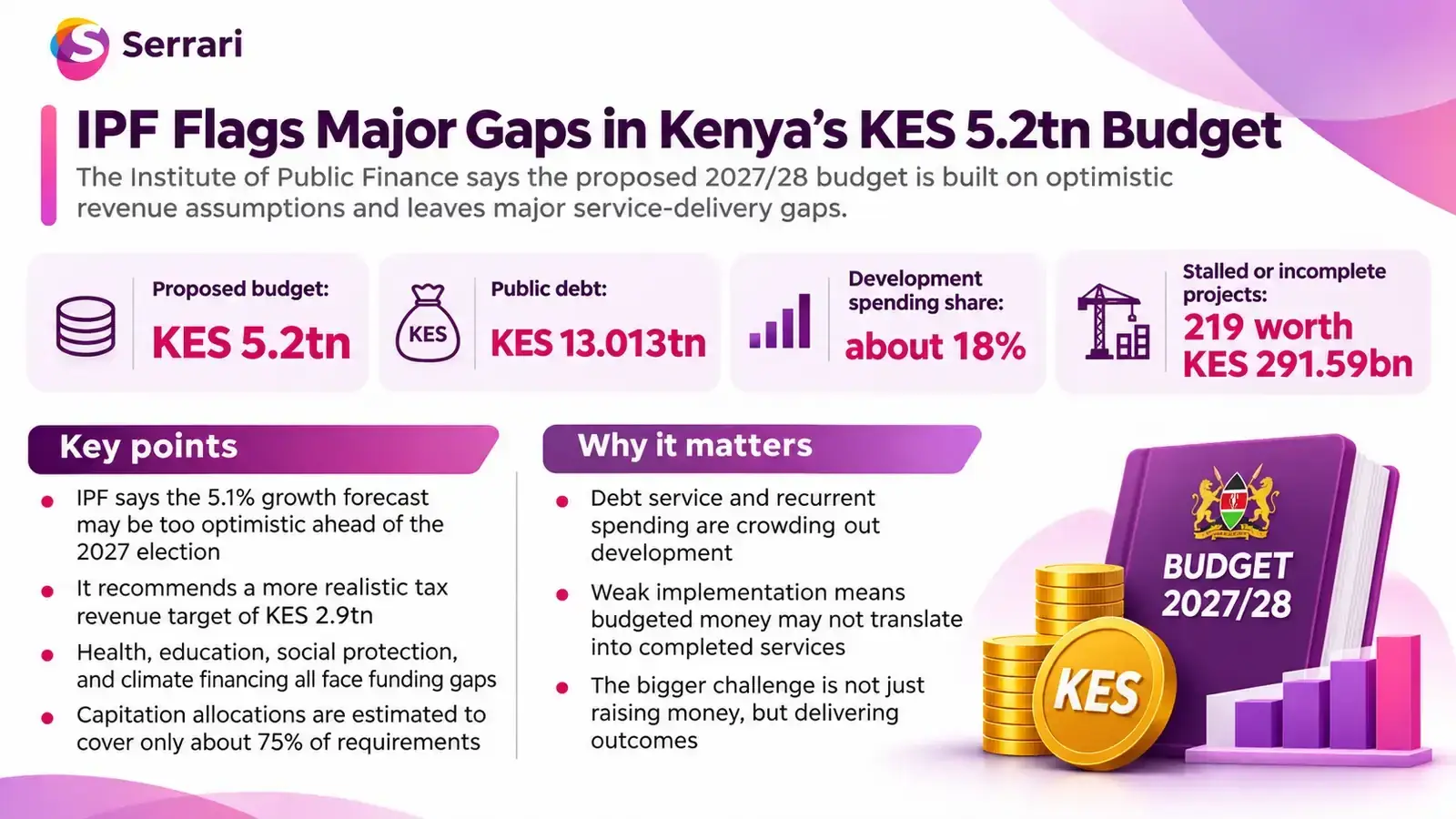
Kenya’s proposed KES 5.2 trillion budget for the 2027/28 financial year faces mounting scrutiny following the release of the Institute of Public Finance’s (IPF) seventh Annual National Shadow Budget on November 25, 2026. The institute warns that ambitious economic growth and revenue projections, rising debt servicing obligations, inadequate development expenditure and persistent project implementation failures could undermine public service delivery ahead of the 2027 General Election. IPF recommends lowering the government’s economic growth forecast from 5.1% to between 4.4% and 4.7%, alongside reducing projected tax revenue from KES 3.139 trillion to KES 2.9 trillion. With public debt reaching KES 13.013 trillion and significant funding gaps across healthcare, education, social protection and climate adaptation, the report raises fundamental questions about whether Kenya’s expanding national budget is translating into meaningful economic and social outcomes.
Key Overview
- Kenya’s proposed FY2027/28 budget stands at approximately KES 5.236 trillion.
- IPF recommends reducing projected economic growth from 5.1% to between 4.4% and 4.7%, reflecting election-related economic uncertainties.
- The proposed tax revenue target of KES 3.139 trillion could be overstated by approximately KES 239 billion.
- Kenya’s projected fiscal deficit stands at approximately KES 1.35 trillion, with weaker revenue collection potentially increasing borrowing requirements.
- Public debt reached KES 13.013 trillion in June 2026, equivalent to approximately 70.4% of GDP.
- Development expenditure accounts for approximately 18% of proposed spending, against the statutory medium-term benchmark of 30%.
- At least 219 government projects valued at KES 291.59 billion were identified as stalled or incomplete during FY2024/25.
- Proposed education capitation funding covers approximately 75% of estimated requirements, while significant financing gaps persist in healthcare, social protection and climate adaptation.
Kenya’s Election-Year Budget Faces a Credibility Test
Kenya is approaching the 2027 General Election with an increasingly constrained fiscal position, raising concerns about the government’s ability to finance essential public services while maintaining economic stability.
The Institute of Public Finance’s latest Annual National Shadow Budget, titled From Budget Allocations to Public Outcomes: Closing Kenya’s Fiscal and Delivery Gaps, challenges the economic assumptions underpinning the government’s proposed expenditure framework.
According to the latest budget credibility assessment, IPF recommends revising projected economic growth for 2027 from 5.1% to between 4.4% and 4.7%.
The recommendation reflects Kenya’s historical experience of economic slowdowns surrounding general elections.
The institute cites the decline in economic growth from 5.9% in 2016 to 4.9% in 2017, alongside a similar slowdown between 2021 and 2022.
Election periods can introduce uncertainty that influences corporate investment decisions, household expenditure and government revenue collection. However, elections are not necessarily the sole cause of these slowdowns, as global economic conditions, weather-related shocks and domestic policy developments can also influence growth.
The immediate concern is that government expenditure commitments are being established using revenue assumptions that may prove difficult to achieve.
If economic activity underperforms, the government could face pressure to increase borrowing, reduce expenditure or introduce additional revenue mobilisation measures.
Each option carries economic consequences for businesses and households already facing considerable financial pressures.
Ambitious Revenue Targets Could Create a KES 239 Billion Tax Shortfall
The National Treasury expects to collect approximately KES 3.923 trillion in total revenue during FY2027/28, including KES 3.139 trillion in tax revenue.
However, IPF argues that the proposed tax collection target does not adequately reflect prevailing economic conditions.
The institute’s alternative revenue projections recommend a tax revenue target of approximately KES 2.9 trillion and total revenue of around KES 3.7 trillion.
Fiscal Indicator
Treasury Projection
IPF Recommendation
Economic Growth
5.1%
4.4%–4.7%
Tax Revenue
KES 3.139 trillion
KES 2.9 trillion
Total Revenue
KES 3.923 trillion
Approximately KES 3.7 trillion
Tax Revenue Adjustment
—
KES 239 billion
Total Revenue Adjustment
—
Approximately KES 223 billion
The recommended tax revenue adjustment represents approximately 7.6% of the government’s projected collections.
IPF has also highlighted a projected fiscal deficit of KES 1.35 trillion, underscoring the government’s continuing dependence on borrowing to finance its expenditure commitments.
If revenue falls below expectations without corresponding expenditure adjustments, borrowing requirements could increase further.
This matters because higher government borrowing can absorb domestic financial resources that would otherwise be available to private businesses.
Increased demand for government financing may also place upward pressure on domestic interest rates, depending on prevailing liquidity and investor demand.
For small and medium-sized enterprises, such conditions could translate into more expensive credit, weaker investment and slower employment creation.
The wider fiscal challenge is therefore not simply whether the Kenya Revenue Authority can achieve its collection targets. It is whether government expenditure plans are based on realistic assessments of the economy’s revenue-generating capacity.
Kenya’s KES 13 Trillion Public Debt Restricts Development Spending
Public debt remains one of the most significant structural constraints affecting Kenya’s expenditure priorities.
According to IPF’s public debt assessment, Kenya’s debt burden could approach 71% of GDP during FY2027/28.
Outstanding public debt already stood at KES 13.013 trillion in June 2026, representing approximately 70.4% of GDP.
More concerning is the proportion of government revenue required to meet existing financial obligations.
Domestic debt servicing consumed approximately 41% of ordinary revenue during FY2025/26, substantially restricting the resources available for other government programmes.
Unlike discretionary expenditure, debt obligations cannot easily be postponed without potentially damaging investor confidence or increasing future financing costs.
As a result, development projects and public services can become particularly vulnerable when revenue collections disappoint.
The proposed budget allocates approximately 18% of expenditure towards development, compared with the 30% benchmark established under Kenya’s public finance management framework, which applies over the medium term.
The difference illustrates the difficulty of balancing immediate financial obligations with investments necessary to support future economic growth.
Insufficient development expenditure can weaken infrastructure quality, industrial competitiveness and agricultural productivity, potentially constraining the same economic growth required to improve government revenues.
Kenya consequently faces a fiscal cycle in which high debt servicing costs restrict productive investment, while weaker investment can limit future revenue growth and complicate debt reduction.
Breaking that cycle requires both disciplined borrowing and greater efficiency in the use of existing public resources.
Context is everything. Stay ahead of shifting trends with today’s market updates, and uncover emerging opportunities using the Serrari Group Market Index and Marketplace. Then, take control of your own financial future by exploring our Money & Life Reset Transformation Blueprint ™ to build stronger habits, create better systems, and design a path toward lasting wealth.
Stalled Government Projects Expose a KES 291 Billion Delivery Problem
Beyond the size of Kenya’s budget, IPF questions whether government expenditure is producing the infrastructure and services for which public resources were allocated.
The institute’s analysis of government project implementation identifies extensive delays, incomplete developments and abandoned projects during FY2024/25.
Project Implementation Indicator
Number of Projects
Reported Value
Stalled or Incomplete Projects
219
KES 291.59 billion
Delayed Projects
77
KES 136.8 billion
Abandoned Projects
18
KES 1.9 billion
Payments Towards Projects Yet to Deliver Services
—
KES 113.5 billion
The reported categories should not automatically be aggregated because their classification and potential overlap require further examination.
Nevertheless, the figures demonstrate a substantial disconnect between public expenditure and completed infrastructure.
When a government-financed project remains incomplete, citizens cannot fully benefit from the services it was intended to provide.
Meanwhile, financing costs may continue accumulating, contractors may face payment delays and deteriorating unfinished infrastructure may require additional expenditure.
This creates an opportunity cost because resources already committed to incomplete projects cannot simultaneously finance alternative public priorities.
IPF’s recommendation to prioritise ongoing projects before initiating additional developments is therefore particularly important ahead of an election, when pressure to announce new infrastructure programmes may increase.
Improved project appraisal, contract management, procurement oversight and completion monitoring could enhance public investment outcomes without necessarily requiring a larger national budget.
Healthcare Funding Gaps Threaten Universal Health Coverage
Kenya’s transition towards its Social Health Insurance framework continues to face substantial financing challenges.
IPF identifies inadequate funding across several mechanisms intended to support affordable healthcare access.
Healthcare Financing Programme
Reported Funding Position
Primary Healthcare Fund
31% of required funding
Emergency, Chronic and Critical Illness Fund
4% of required funding
Health Insurance Subsidy Programme
KES 310 million allocated
Estimated Subsidy Requirement
KES 37–39 billion
The Health Insurance Subsidy Programme’s allocation represents less than 1% of its estimated funding requirement.
Based on IPF’s estimates, the programme faces an indicative financing gap of between KES 36.69 billion and KES 38.69 billion.
This shortfall threatens the government’s ability to extend meaningful healthcare protection to vulnerable households unable to afford regular insurance contributions.
Underfunding can also place pressure on healthcare providers through delayed reimbursements, restricted service availability and difficulties financing essential medical supplies.
For households, the consequences may include increased out-of-pocket expenditure, delayed treatment or greater dependence on personal borrowing to finance medical emergencies.
Such financial pressures can undermine broader economic objectives because healthcare expenses reduce disposable income and untreated illnesses can weaken workforce productivity.
IPF recommends greater transparency from the Social Health Authority, including regular publication of financial statements, claims information and service delivery indicators.
The underlying challenge is ensuring that healthcare coverage commitments are supported by credible financing arrangements rather than merely expanding formal registration.
Education Capitation Shortfalls Shift Costs to Households
Kenya’s proposed education expenditure also raises questions about the sustainability of publicly funded basic education.
IPF estimates that FY2027/28 capitation allocations will cover approximately 75% of required financing.
The institute further identifies cumulative funding reductions of KES 32.4 billion across Free Primary Education and Free Day Secondary Education between FY2023/24 and FY2025/26.
When capitation funding is inadequate or delayed, schools must continue meeting expenses associated with learning materials, utilities, maintenance and administrative operations.
The resulting financial pressure can indirectly transfer education costs to parents through additional contributions or reduced access to essential learning resources.
Lower-income households are particularly vulnerable because they have limited capacity to absorb unexpected education expenses.
Persistent underfunding could therefore widen educational inequalities, with schools serving wealthier communities better positioned to mobilise supplementary resources.
IPF recommends reviewing capitation rates to reflect inflation, verifying enrolment figures regularly and distributing funds according to learners’ needs.
The economic importance of these recommendations extends beyond school operations. Inadequate education investment can weaken skills development, labour productivity and Kenya’s long-term competitiveness.
Social Protection and Climate Programmes Face Persistent Underfunding
The National Safety Net Programme requires more than KES 44 billion annually, against a projected FY2027/28 allocation of KES 27.9 billion.
This represents a financing gap exceeding KES 16.1 billion, with proposed funding covering less than 63.4% of the estimated requirement.
The Women Enterprise Fund has also experienced significant implementation challenges.
During FY2024/25, only 12,538 women received financing against a target of 200,000, representing approximately 6.3% achievement following the suspension of digital lending.
These outcomes demonstrate that allocating funds does not necessarily guarantee that intended beneficiaries receive financial assistance.
Climate financing presents another challenge, with proposed allocations covering approximately 49.6% of identified requirements.
Inadequate climate adaptation financing could increase Kenya’s vulnerability to droughts, floods and agricultural production disruptions, ultimately creating additional fiscal pressures through emergency interventions and humanitarian assistance.
The wider challenge is connecting budget allocations with measurable improvements in household resilience, income generation and protection against economic shocks.
Why Kenya Needs a Credible Budget Rather Than a Bigger Budget
Kenya’s fiscal difficulties reflect a longstanding problem involving the relationship between budget projections and actual implementation.
An earlier IPF assessment of FY2025/26 budget performance identified significant differences between approved fiscal targets and actual outcomes, with revenue underperformance occurring alongside higher-than-planned expenditure.
This historical pattern reinforces concerns about relying on ambitious revenue projections to justify new spending commitments.
As Parliament scrutinises the proposed FY2027/28 budget, the priority should be establishing realistic economic assumptions, protecting essential public services and ensuring existing development projects are completed.
Reducing unnecessary expenditure, improving procurement efficiency and strengthening public financial oversight could create fiscal space without placing additional pressure on taxpayers.
However, meaningful fiscal consolidation requires difficult decisions about expenditure priorities and the government’s capacity to sustain existing commitments.
Kenya’s KES 5.2 trillion budget should ultimately be judged not by its headline size but by whether it delivers functioning hospitals, adequately funded schools, completed infrastructure and effective support for vulnerable households.
Ahead of the 2027 elections, the difference between ambitious budget announcements and measurable public outcomes could become one of the country’s most significant economic and political challenges.
Sources: Bizna Kenya / Citizen Digital / The Star / Business.co.ke / People Daily / Ubutabera / Institute of Public Finance
Your financial future isn’t something you wait for—it’s something you build.
The real question is: when do you begin?
Move beyond simply staying informed.
Navigate the markets with clarity—track trends through the Serrari Group Market Index, uncover opportunities in the Serrari Marketplace, and build practical knowledge with our Curated Wealth Builder Platform.
Stay connected to what truly matters.
Get daily insights on macro trends and financial movements across Kenya, Africa, and global markets—delivered through the Serrari Newsletter.
Growth opens doors.
Advance your career through professional programs including ACCA, HESI A2, ATI TEAS 7 , HESI EXIT , NCLEX – RN and NCLEX – PN, Financial Literacy!🌟—designed to move you forward with confidence.
See where money is flowing—clearly and in real time.
Track Money Market Funds, Treasury Bills, Treasury Bonds, Green Bonds, and Fixed Deposits, alongside global and African indexes, key economic indicators, and the evolving Crypto and stablecoin landscape—all within Serrari’s Market Index.