Singapore-based OCBC Bank and stablecoin payment provider StraitsX have launched a pilot allowing businesses to receive cross-border payments in stablecoins directly into their existing bank accounts. The arrangement combines StraitsX’s blockchain-based payment infrastructure with OCBC’s banking services and fiat conversion capabilities. NTT DOCOMO ASIA is the first corporate participant. In the initial pilot transaction, a payment originating from Japan was completed on the same day despite arriving after the conventional Japanese yen processing cut-off time. The initiative aims to reduce reliance on traditional banking hours, simplify cross-border collections and improve business access to funds. It forms part of Singapore’s wider efforts to explore tokenised money and digital payment infrastructure through the Monetary Authority of Singapore’s BLOOM initiative.
Key Takeaways
- OCBC and StraitsX launched a cross-border business-to-business (B2B) stablecoin payment pilot on 23 November 2026.
- The arrangement allows participating businesses to receive payments into their existing OCBC bank accounts without directly managing stablecoins or separate crypto wallets.
- StraitsX handles stablecoin collection, payment identification, on-chain compliance, reconciliation and settlement, while OCBC provides banking services and converts digital assets into fiat currency.
- NTT DOCOMO ASIA is the first corporate participant in the pilot.
- An initial payment originating from Japan was completed on the same day, despite arriving after the normal Japanese yen processing cut-off.
- The initiative aligns with the Monetary Authority of Singapore’s BLOOM programme, which explores the use of tokenised deposits and stablecoins in financial infrastructure.
OCBC and StraitsX Bring Stablecoin Payments Into Traditional Banking
OCBC Bank and Singapore-based payment company StraitsX have launched a pilot to explore how businesses can use stablecoins for cross-border payments while continuing to receive funds through their existing bank accounts.
Announced on 23 November 2026, the collaboration connects StraitsX’s stablecoin payment and settlement infrastructure with OCBC’s traditional banking services.
The arrangement is designed to allow companies to receive cross-border payments through their existing OCBC bank accounts without directly managing the underlying stablecoin payment process.
This addresses a practical challenge in the use of digital currencies for business payments. Although stablecoins can move value across borders, companies still need ways to receive funds, manage cash and reconcile transactions through their established financial systems.
Under the pilot, StraitsX manages the digital payment process, while OCBC handles the recipient’s banking relationship and the conversion of digital assets into traditional currency.
NTT DOCOMO ASIA, a Singapore-based entity of Japanese telecommunications company NTT DOCOMO, is the first business participating in the trial.
The pilot will initially focus on selected cross-border B2B payment flows, with further development dependent on regulatory, compliance and operational requirements.
How the Stablecoin Payment System Works
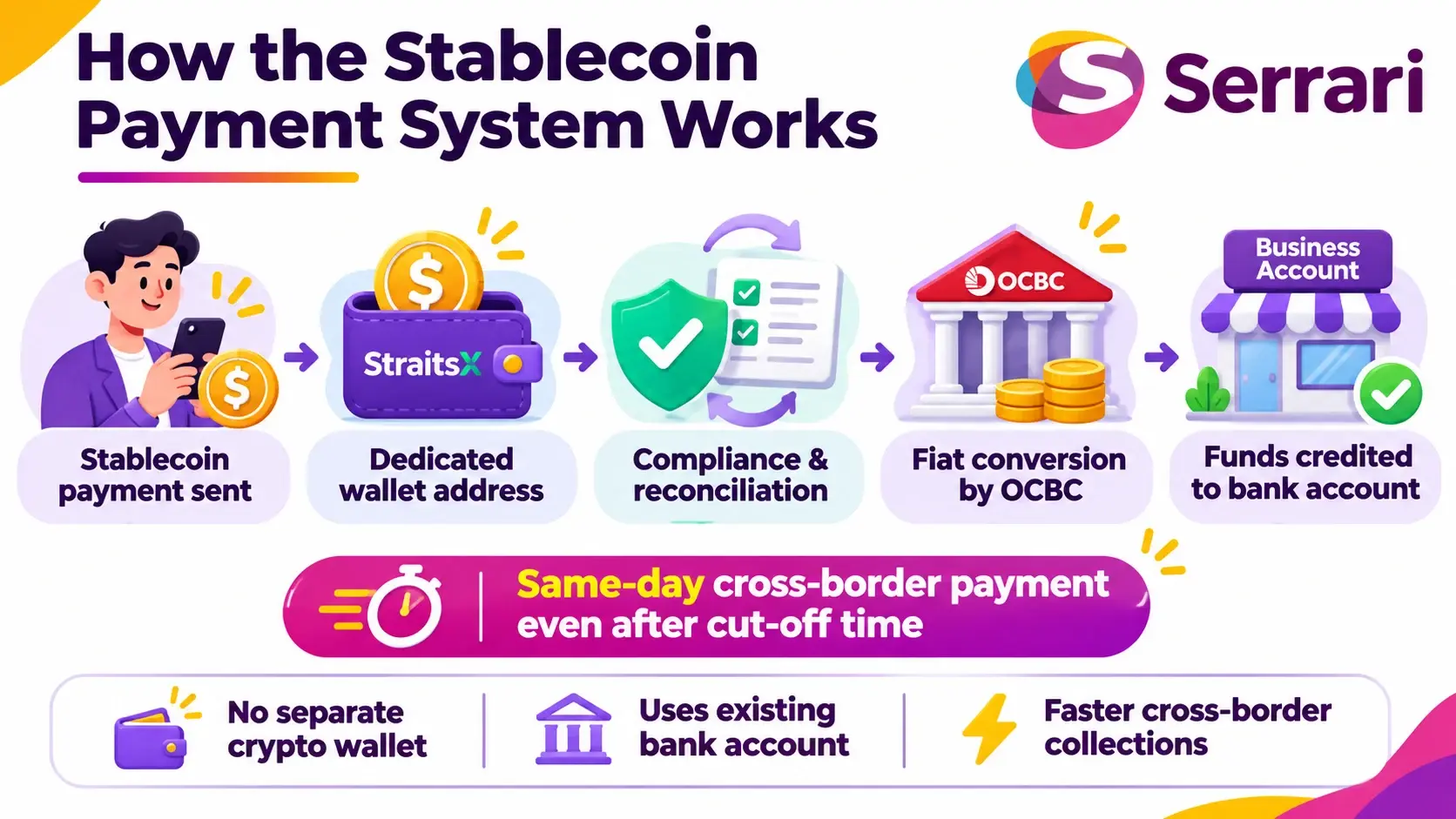
The arrangement brings together two separate functions: blockchain-based payment processing and conventional bank account settlement.
At the centre of the system is StraitsX’s Dedicated Wallet Address (DWA) infrastructure.
Each participating business receives a dedicated wallet address that helps identify incoming stablecoin payments and link them to the correct recipient.
StraitsX provides the infrastructure for:
- Stablecoin collection and payment identification.
- On-chain compliance checks, including anti-money laundering screening.
- Payment reconciliation.
- Settlement of funds into the recipient’s banking environment.
OCBC provides the banking services and fiat off-ramp, converting the digital assets into traditional currency before the funds are credited to the recipient’s bank account.
This means businesses do not need to independently manage stablecoin wallets, integrate separate blockchain payment systems or arrange their own conversion into fiat currency.
The model is designed to keep the technology largely behind the scenes while companies continue using familiar banking relationships.
For businesses, this could reduce the operational complexity associated with receiving digital currency payments. For banks, it offers a way to connect stablecoin infrastructure with existing payment and treasury services while maintaining the customer-facing banking relationship.
First Japan-to-Singapore Payment Completed After Currency Cut-Off
One of the most significant features demonstrated during the pilot was the ability to complete a cross-border payment outside conventional foreign currency processing hours.
In the initial transaction, a payment originating from Japan was completed after the normal Japanese yen processing cut-off time, with the beneficiary receiving funds in its OCBC account on the same day.
This is important because traditional cross-border payments can be affected by currency processing windows, banking hours and settlement arrangements between financial institutions.
When a payment misses a conventional cut-off time, it may have to wait until the next business day to be processed. This can delay access to funds, particularly for companies operating across different time zones.
The pilot demonstrated how stablecoin-based settlement could reduce dependence on these traditional processing windows.
By connecting blockchain payment infrastructure with an existing bank account, the arrangement could allow businesses to receive funds sooner and gain greater certainty over payment timing.
The companies also see potential for transactions that would otherwise roll into the next business day to receive same-day value dating, potentially extending to weekends and public holidays.
However, the completed Japan-originating transaction is a pilot demonstration. It does not establish that all cross-border payments under the arrangement will automatically settle instantly or that the service is already available across every currency corridor.
Why Businesses Could Benefit From Stablecoin-Based Payments
For businesses, the main attraction is not necessarily holding or using cryptocurrency. It is the possibility of receiving cross-border payments more efficiently without changing how they manage their everyday finances.
Companies involved in international trade and services regularly receive payments from customers, partners and business entities in other countries. Delays in receiving funds can affect working capital, cash-flow planning and the ability to meet financial obligations.
The OCBC and StraitsX model is designed to address some of these challenges by reducing reliance on traditional currency processing windows.
The potential benefits include:
Faster access to funds: Payments that might otherwise wait until the next banking day could potentially reach the recipient’s account on the same day.
Improved working capital management: Earlier access to incoming payments could help businesses manage operational expenses and short-term cash requirements.
Greater certainty over payment timing: Businesses could have better visibility over when cross-border payments are received.
Simpler payment operations: Companies can receive the proceeds through existing bank accounts without having to manage stablecoin wallets and separate conversion arrangements.
These potential benefits are particularly relevant to companies handling international collections across different time zones.
StraitsX CEO and Co-Founder Tianwei Liu said:
“Stablecoins can move value efficiently across borders, but businesses still need a straightforward way to receive and manage those payments within their existing financial operations.”
He added that the collaboration demonstrates how stablecoin infrastructure can operate behind the scenes while businesses continue using the banking relationships and accounts they already rely on.
OCBC’s Deputy Head of Global Transaction Banking, Carmen Chan, also highlighted the importance of integrating new forms of digital money into existing financial operations without adding complexity for businesses.
“As new forms of digital money emerge, businesses are looking for ways to harness their benefits without adding complexity to their day-to-day financial operations.”
She said the collaboration allows the bank to explore how stablecoin-based payments can be integrated with established banking services while keeping the customer experience seamless.
Context is everything. Stay ahead of shifting trends with today’s market updates, and uncover emerging opportunities using the Serrari Group Market Index and Marketplace. Then, take control of your own financial future by exploring our Money & Life Reset Transformation Blueprint ™ to build stronger habits, create better systems, and design a path toward lasting wealth.
The Pilot Builds on Singapore’s Wider Digital Money Experiments
The OCBC and StraitsX collaboration is part of a wider effort by Singapore’s financial institutions to explore the use of tokenised assets, stablecoins and blockchain-based settlement systems.
Both companies participate in the Monetary Authority of Singapore’s (MAS) BLOOM initiative, launched in October 2025 to develop use cases for tokenised bank deposits and stablecoins.
The latest pilot aligns with frameworks established under BLOOM and explores how stablecoin settlement can connect with existing banking infrastructure.
It also follows another digital money experiment involving OCBC, StraitsX and Standard Chartered.
On 19 November 2026, the three institutions announced the successful completion of cross-border tokenised deposit trials under Project BLOOM.
Those trials examined interoperability between tokenised deposit networks issued by different banks and the ability to conduct US dollar payments outside standard settlement hours.
The tests demonstrated that transfers between different banking infrastructures could take just minutes without requiring banks to pre-reserve liquidity between each pair of institutions.
The new OCBC and StraitsX pilot uses a different approach. Instead of relying on tokenised bank deposits, it uses stablecoins processed through StraitsX’s infrastructure and converted into funds in the recipient’s bank account.
The distinction is important: tokenised deposits represent bank deposits on blockchain infrastructure, while stablecoins are digital tokens designed to maintain a stable value relative to a reference currency or asset.
Both approaches are being explored as ways to improve how money moves between financial institutions and across borders.
Other Banks Are Also Developing Around-the-Clock Digital Payments
The OCBC and StraitsX initiative comes amid growing activity among financial institutions developing blockchain-based payment and settlement services.
On 16 November 2026, DBS Bank launched a cross-border tokenised deposit transfer service with Kinexys, JPMorgan’s blockchain business.
The service allows institutional clients to transfer US dollars between blockchain accounts in Singapore and the United States around the clock.
The development illustrates how banks are exploring different forms of digital money to improve cross-border payment infrastructure.
OCBC has also been involved in experiments involving tokenised deposits, while the latest pilot with StraitsX extends its work into stablecoin-based settlement.
These developments suggest that the financial industry is exploring multiple models rather than relying on a single technology.
For businesses, the important question is whether these systems can make international payments faster, more predictable and easier to manage without requiring them to change their existing financial operations.
Who Is StraitsX?
StraitsX is a Singapore-based stablecoin payment and settlement provider operating under a Major Payment Institution licence from the Monetary Authority of Singapore.
The company provides infrastructure for stablecoin-based payments and issues two stablecoins:
- XSGD, pegged to the Singapore dollar.
- XUSD, pegged to the US dollar.
Its role in the OCBC pilot is to provide the digital payment infrastructure, including dedicated wallet addresses, payment identification, compliance checks and settlement.
OCBC, meanwhile, provides the recipient banking relationship and fiat conversion services.
The partnership brings together the payment infrastructure of a stablecoin provider and the established banking services of a major financial institution.
The Bigger Picture: Stablecoins Are Moving Beyond Crypto Trading
The OCBC and StraitsX pilot reflects a broader shift in how stablecoins are being explored within financial services.
Stablecoins have traditionally been associated with cryptocurrency exchanges and digital asset trading. However, financial institutions and payment companies are increasingly exploring their potential for practical financial activities, including cross-border payments, settlements and corporate cash management.
The attraction is the ability to transfer digital value across blockchain networks without being restricted entirely by conventional banking processing windows.
But businesses still need reliable ways to receive funds, reconcile payments and manage their finances through established banking systems.
The OCBC and StraitsX collaboration addresses this connection by allowing stablecoin payments to be processed through blockchain infrastructure before reaching a traditional bank account.
It also reflects a wider industry effort to make digital money useful without requiring every business to become directly involved in cryptocurrency operations.
The broader direction is not simply about replacing traditional banking. It is about exploring how blockchain-based payment systems can complement existing financial infrastructure.
However, the practical impact will depend on regulatory approval, operational reliability, compliance requirements, currency coverage and whether businesses adopt these services at scale.
Why Does This Matter Now?
The timing is important because cross-border payment providers and banks are actively testing ways to reduce delays associated with traditional currency processing and settlement arrangements.
For businesses, a payment arriving after a foreign currency cut-off can mean waiting until the next business day to access funds. That delay can affect working capital, payment scheduling and cash-flow management.
The Japan-to-Singapore transaction demonstrated that stablecoin infrastructure could help overcome at least some of these timing limitations while still delivering funds into a conventional bank account.
The pilot also comes shortly after OCBC, StraitsX and Standard Chartered completed tokenised deposit trials, showing that Singapore’s financial institutions are testing multiple digital money models.
For the banking industry, the question is increasingly how to integrate stablecoins and tokenised deposits into existing financial services while maintaining compliance and operational safeguards.
For businesses, the potential value lies in faster access to money without having to manage the underlying blockchain technology themselves.
Outlook
OCBC and StraitsX will initially focus on selected cross-border B2B payment flows, with further development subject to applicable regulatory, compliance and operational requirements.
The next stage will be to determine whether the model can support more businesses, payment corridors and transaction types while maintaining reliable settlement and compliance processes.
Businesses will also be watching whether the service can extend the benefits demonstrated in the initial Japan-to-Singapore transaction to additional currencies and payment routes.
The pilot represents a practical test of how stablecoins can connect with traditional banking services. If expanded successfully, the model could offer companies another way to receive international payments while continuing to use their existing bank accounts.
For now, it remains a limited pilot rather than a fully established cross-border payment service available to all businesses.
Frequently Asked Questions
1. What are OCBC and StraitsX testing?
They are testing a cross-border B2B payment arrangement that allows businesses to receive stablecoin payments directly into their existing OCBC bank accounts after the digital assets are converted into fiat currency.
2. How does the OCBC and StraitsX payment pilot work?
StraitsX provides dedicated wallet addresses for receiving stablecoins, identifies payments, performs on-chain compliance checks and handles reconciliation and settlement. OCBC provides the banking services and converts the stablecoins into traditional currency for the recipient.
3. Which company is the first participant in the pilot?
NTT DOCOMO ASIA, a Singapore-based entity of Japanese telecommunications company NTT DOCOMO, is the first corporate participant.
4. Does the pilot mean businesses can receive instant payments at any time?
Not necessarily. The initial transaction demonstrated same-day settlement after the conventional Japanese yen cut-off time. However, the pilot is limited to selected payment flows, and wider availability remains subject to regulatory, compliance and operational requirements.
Your financial future isn’t something you wait for—it’s something you build.
The real question is: when do you begin?
Move beyond simply staying informed.
Navigate the markets with clarity—track trends through the Serrari Group Market Index, uncover opportunities in the Serrari Marketplace, and build practical knowledge with our Curated Wealth Builder Platform.
Stay connected to what truly matters.
Get daily insights on macro trends and financial movements across Kenya, Africa, and global markets—delivered through the Serrari Newsletter.
Growth opens doors.
Advance your career through professional programs including ACCA, HESI A2, ATI TEAS 7 , HESI EXIT , NCLEX – RN and NCLEX – PN, Financial Literacy!🌟—designed to move you forward with confidence.
See where money is flowing—clearly and in real time.
Track Money Market Funds, Treasury Bills, Treasury Bonds, Green Bonds, and Fixed Deposits, alongside global and African indexes, key economic indicators, and the evolving Crypto and stablecoin landscape—all within Serrari’s Market Index.