Franklin Templeton has launched the Franklin OnChain Euro Liquidity Fund, a euro-denominated money market fund that uses blockchain technology to record share ownership and transfers. Domiciled in Luxembourg as part of Franklin Templeton OnChain Funds, the fund is structured as a low-volatility net asset value (LVNAV) money market fund and aims to maintain a value of €1 per unit while generating returns in line with euro money market rates. Through the company’s Benji platform, eligible investors can transfer fund units directly between authorised digital wallets, including outside normal trading hours. The fund is available to retail investors in seven European countries and institutional investors in Italy and Switzerland.
Key Takeaways
- Franklin Templeton announced the launch of the Franklin OnChain Euro Liquidity Fund on 23 November 2026.
- The fund is denominated in euros, domiciled in Luxembourg and structured as a low-volatility net asset value (LVNAV) money market fund.
- It aims to maintain a relatively stable net asset value of €1 per unit and offer returns in line with euro money market rates.
- Investors can transfer units between authorised digital wallets through Franklin Templeton’s blockchain-based Benji platform.
- The fund provides for daily income distribution and reinvestment throughout the year, including weekends and holidays.
- Retail investors in Austria, France, Germany, Luxembourg, the Netherlands, Portugal and Spain can access the fund, while institutional investors are targeted in Italy and Switzerland.
Franklin Templeton Expands Tokenised Money Market Funds to the Euro
Franklin Templeton has expanded its range of tokenised money market funds with the launch of the Franklin OnChain Euro Liquidity Fund, a new euro-denominated investment vehicle built on blockchain technology.
Announced on Monday, 23 November 2026, the fund is domiciled in Luxembourg and forms part of the company’s Franklin Templeton OnChain Funds range, which specialises in tokenised assets.
The launch extends Franklin Templeton’s blockchain-based money market offering beyond its existing fund invested in US government securities, which was launched in Luxembourg in February 2025.
The new fund is designed for investors seeking capital preservation, liquidity and returns consistent with euro money market rates. It is structured as a low-volatility net asset value (LVNAV) fund, aiming to maintain a relatively stable value of €1 per unit.
Unlike a conventional money market fund structure, the new vehicle uses blockchain infrastructure to record share ownership and transfers. This allows eligible investors to move fund units directly between approved digital wallets, including outside normal trading hours.
The launch also expands Franklin Templeton’s Benji offering into the euro, giving European investors another option for managing liquidity in their local currency.
How the Euro Money Market Fund Will Invest
The Franklin OnChain Euro Liquidity Fund will invest in a diversified portfolio of eligible money market instruments denominated in euros or fully hedged against the euro.
Its investments will include:
- Short-term debt securities.
- Commercial paper and corporate notes.
- Certificates of deposit.
- Eligible bank deposits.
- Temporary asset acquisition transactions, including reverse repos.
These instruments are commonly used in money market funds because they have short maturities and are intended to support liquidity and capital preservation.
The fund’s LVNAV classification means it aims to maintain a relatively stable net asset value of €1 per unit. Its investment objective is to offer returns in line with euro money market rates while seeking to preserve investors’ capital.
However, the objective of maintaining a stable net asset value does not mean that capital is guaranteed or that the fund is free from investment risk.
The fund’s performance will depend on the underlying money market instruments and prevailing euro interest-rate conditions.
Blockchain Technology Allows Transfers Between Digital Wallets
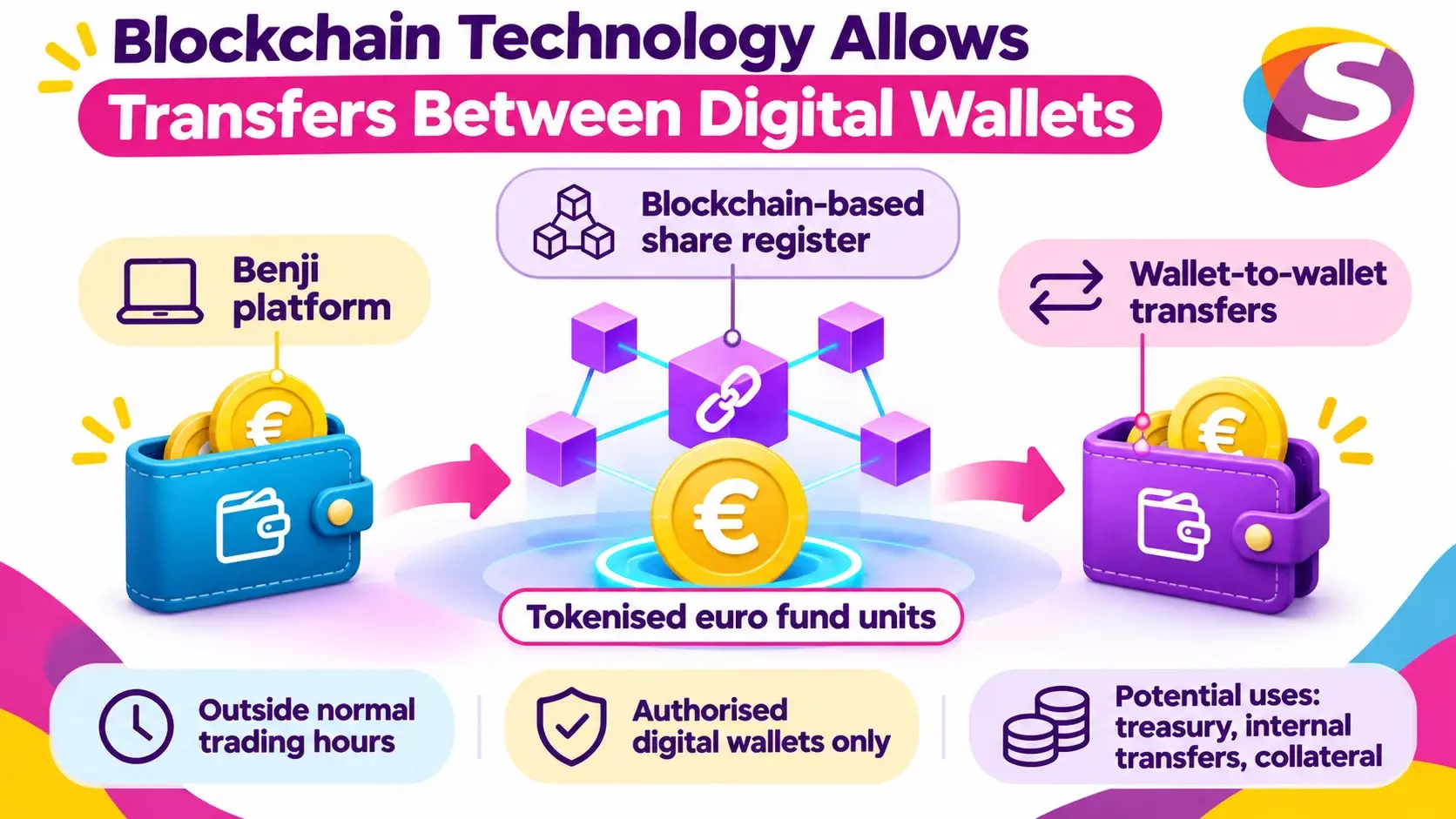
One of the fund’s defining features is the use of blockchain technology to maintain its share register.
Through its Benji platform, Franklin Templeton uses a blockchain-based infrastructure to record share ownership and transfers. Eligible investors can therefore trade shares directly between approved digital wallets, including outside normal trading hours.
This changes how ownership of fund units is recorded and transferred. Rather than relying solely on conventional share-register processes, the blockchain infrastructure records ownership and transactions digitally.
The arrangement is designed to make fund units transferable between authorised portfolios, potentially supporting uses such as corporate cash management and transfers between entities within the same corporate group.
Franklin Templeton also identifies possible applications in certain collateral and settlement transactions, subject to regulatory and operational conditions.
The launch reflects the company’s continued development of tokenised investment products, bringing traditional financial instruments onto blockchain-based infrastructure.
Context is everything. Stay ahead of shifting trends with today’s market updates, and uncover emerging opportunities using the Serrari Group Market Index and Marketplace. Then, take control of your own financial future by exploring our Money & Life Reset Transformation Blueprint ™ to build stronger habits, create better systems, and design a path toward lasting wealth.
Daily Income Distribution and Reinvestment Throughout the Year
Another feature of the fund is its approach to income calculation and reinvestment.
Franklin Templeton provides for the daily distribution and reinvestment of income, 365 days a year. This includes weekends and holidays, rather than limiting income calculations to conventional business days.
The fund also accounts for income accrued when ownership changes during a net asset value calculation cycle.
Where a unit changes hands during the cycle, the accrued income must be allocated according to how long each investor has held it, accurate to the second.
This means that when an eligible investor transfers a position during the day, the income accrued up to the transfer point can be attributed to the relevant holder.
The arrangement is intended to connect the transfer of tokenised fund units with the calculation of income earned during the holding period.
Franklin Templeton’s head for Iberia and Latin America, Javier Villegas, said:
“European investors are looking for more options when it comes to accessing and managing their liquidity. The launch of the Franklin OnChain Euro Liquidity Fund expands our Benji offering to the euro and brings our experience in money markets closer to investors in their local currency.”
The company’s EMEA and Americas leadership also described the product as combining established regulated euro money market fund methods with tokenised assets.
Which Investors Can Access the Fund?
The fund is being made available to retail and institutional investors across selected European markets.
Retail investors in the following countries are eligible to access the fund:
- Austria
- France
- Germany
- Luxembourg
- The Netherlands
- Portugal
- Spain
In Italy and Switzerland, the fund will be available to institutional investors.
The distribution arrangements mean that access is not identical across all European markets. Retail participation is limited to the seven specified countries, while Italy and Switzerland are included for institutional investors.
The fund’s Luxembourg domicile also places it within a regulated European fund structure, with the second source identifying it as a UCITS product.
24-Hour Transfers Do Not Mean Instant Withdrawals
Although blockchain technology allows eligible investors to transfer units between authorised digital wallets outside normal trading hours, this does not automatically mean that subscriptions and redemptions happen instantly.
This distinction is important when assessing the fund’s liquidity.
The European Central Bank has highlighted in its analysis of tokenised money market funds that cut-off times and off-chain processes may still apply. Tokenisation does not remove the underlying liquidity risks associated with money market funds.
In practice, the ability to transfer ownership of a fund unit and the process of subscribing to or redeeming units are separate activities.
The blockchain infrastructure may allow investors to transfer units around the clock, but the fund’s operational and regulatory processes can still determine when subscriptions and redemptions are processed.
Investors should therefore distinguish between 24-hour transferability and immediate access to cash.
The fund also remains exposed to the risks associated with its underlying money market investments. Its LVNAV structure and target value of €1 per unit should not be interpreted as a guarantee against losses.
The Bigger Picture: Traditional Money Market Funds Meet Tokenisation
Franklin Templeton’s launch reflects the growing intersection between traditional investment products and blockchain technology.
Money market funds are commonly used by investors and institutions seeking to manage short-term cash while earning returns linked to prevailing money market rates. Tokenisation introduces a digital ownership and transfer layer to these existing investment structures.
By using blockchain infrastructure to record ownership and transfers, Franklin Templeton is seeking to make fund units more adaptable to digital financial environments.
The ability to transfer units between authorised wallets could support corporate cash management, transfers between related entities and certain collateral or settlement arrangements.
However, tokenisation does not change every feature of the underlying investment. The fund still invests in money market instruments, operates within a regulated fund structure and remains subject to liquidity and investment risks.
The launch also extends Franklin Templeton’s existing OnChain Funds range into the euro market, potentially giving investors another way to access tokenised money market exposure in their local currency.
Why Does This Matter Now?
The launch comes as asset managers continue exploring how blockchain infrastructure can be applied to traditional financial products.
By introducing a euro-denominated fund to its Benji platform, Franklin Templeton is extending its tokenised money market offering to investors who want exposure to euro money market rates rather than US dollar-denominated assets.
For eligible investors, the product combines a traditional money market investment strategy with blockchain-based ownership records and transfers between authorised digital wallets.
For the wider fund management industry, the launch demonstrates how tokenisation can be applied to an existing investment product without removing its underlying investment structure.
The important question for investors is whether the additional transfer flexibility and year-round income calculation offer practical benefits while preserving the liquidity and regulatory safeguards expected of a money market fund.
Outlook
The Franklin OnChain Euro Liquidity Fund adds a euro-denominated product to Franklin Templeton’s existing tokenised fund range.
Its adoption will depend on investor demand, the practical usefulness of wallet-to-wallet transfers and how effectively the product fits into corporate cash management and other institutional applications.
Investors will also need to understand the distinction between transferring tokenised units and redeeming them for cash, particularly where cut-off times and off-chain processes remain applicable.
The launch represents another development in the use of blockchain technology within regulated investment products. However, tokenisation does not eliminate the liquidity risks of money market funds or guarantee immediate access to cash.
Frequently Asked Questions
1. What is the Franklin OnChain Euro Liquidity Fund?
It is a euro-denominated money market fund launched by Franklin Templeton and domiciled in Luxembourg. It uses blockchain technology to record ownership and transfers of fund units.
2. How does the fund maintain its value?
The fund is structured as a low-volatility net asset value (LVNAV) money market fund and aims to maintain a relatively stable net asset value of €1 per unit while generating returns in line with euro money market rates.
3. Can investors transfer fund units at any time?
Eligible investors can transfer units directly between authorised digital wallets outside normal trading hours through the Benji platform. However, this does not mean subscriptions and redemptions are processed instantly.
4. Which countries can access the fund?
Retail investors can access it in Austria, France, Germany, Luxembourg, the Netherlands, Portugal and Spain. Institutional investors are targeted in Italy and Switzerland.
Your financial future isn’t something you wait for—it’s something you build.
The real question is: when do you begin?
Move beyond simply staying informed.
Navigate the markets with clarity—track trends through the Serrari Group Market Index, uncover opportunities in the Serrari Marketplace, and build practical knowledge with our Curated Wealth Builder Platform.
Stay connected to what truly matters.
Get daily insights on macro trends and financial movements across Kenya, Africa, and global markets—delivered through the Serrari Newsletter.
Growth opens doors.
Advance your career through professional programs including ACCA, HESI A2, ATI TEAS 7 , HESI EXIT , NCLEX – RN and NCLEX – PN, Financial Literacy!🌟—designed to move you forward with confidence.
See where money is flowing—clearly and in real time.
Track Money Market Funds, Treasury Bills, Treasury Bonds, Green Bonds, and Fixed Deposits, alongside global and African indexes, key economic indicators, and the evolving Crypto and stablecoin landscape—all within Serrari’s Market Index.