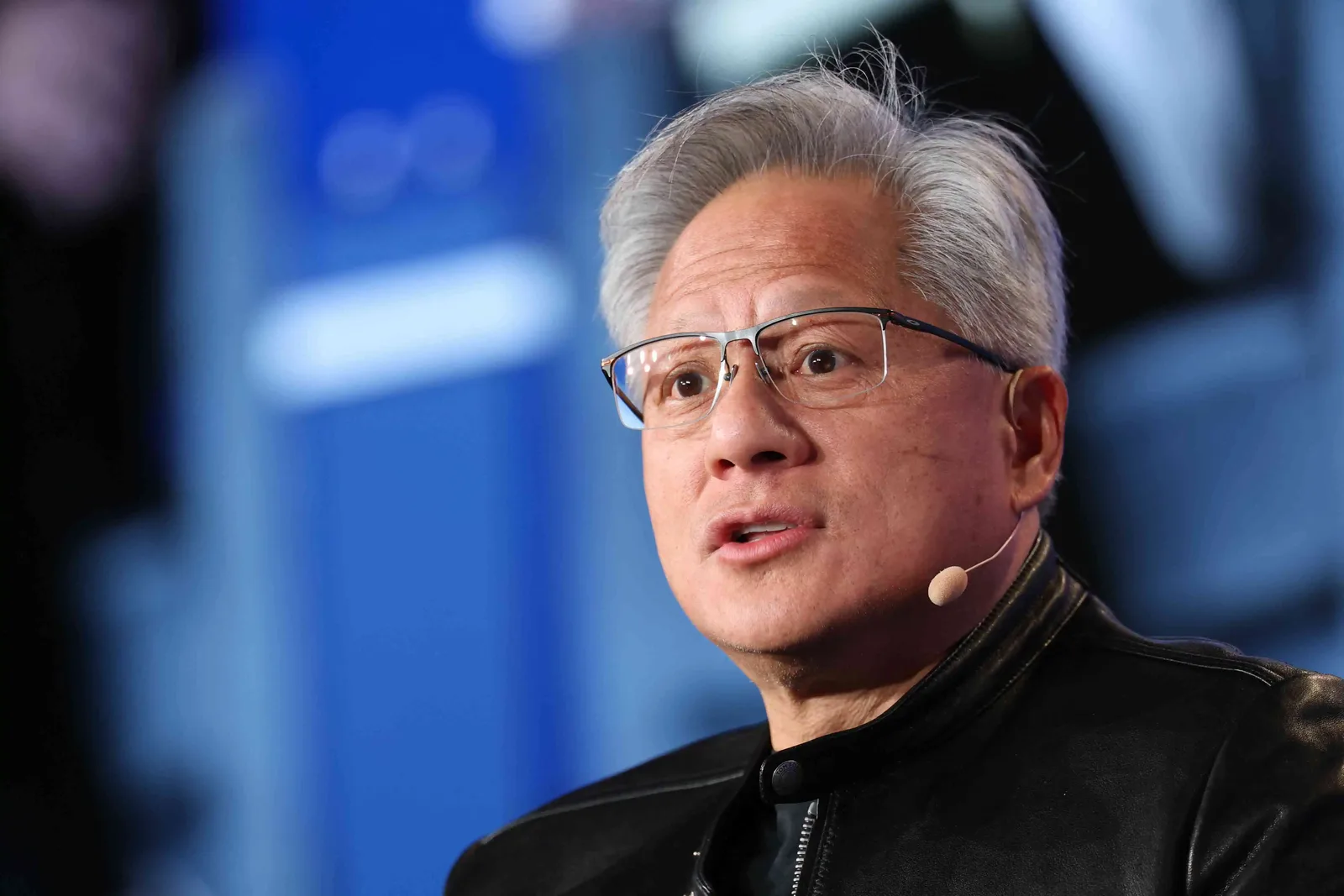
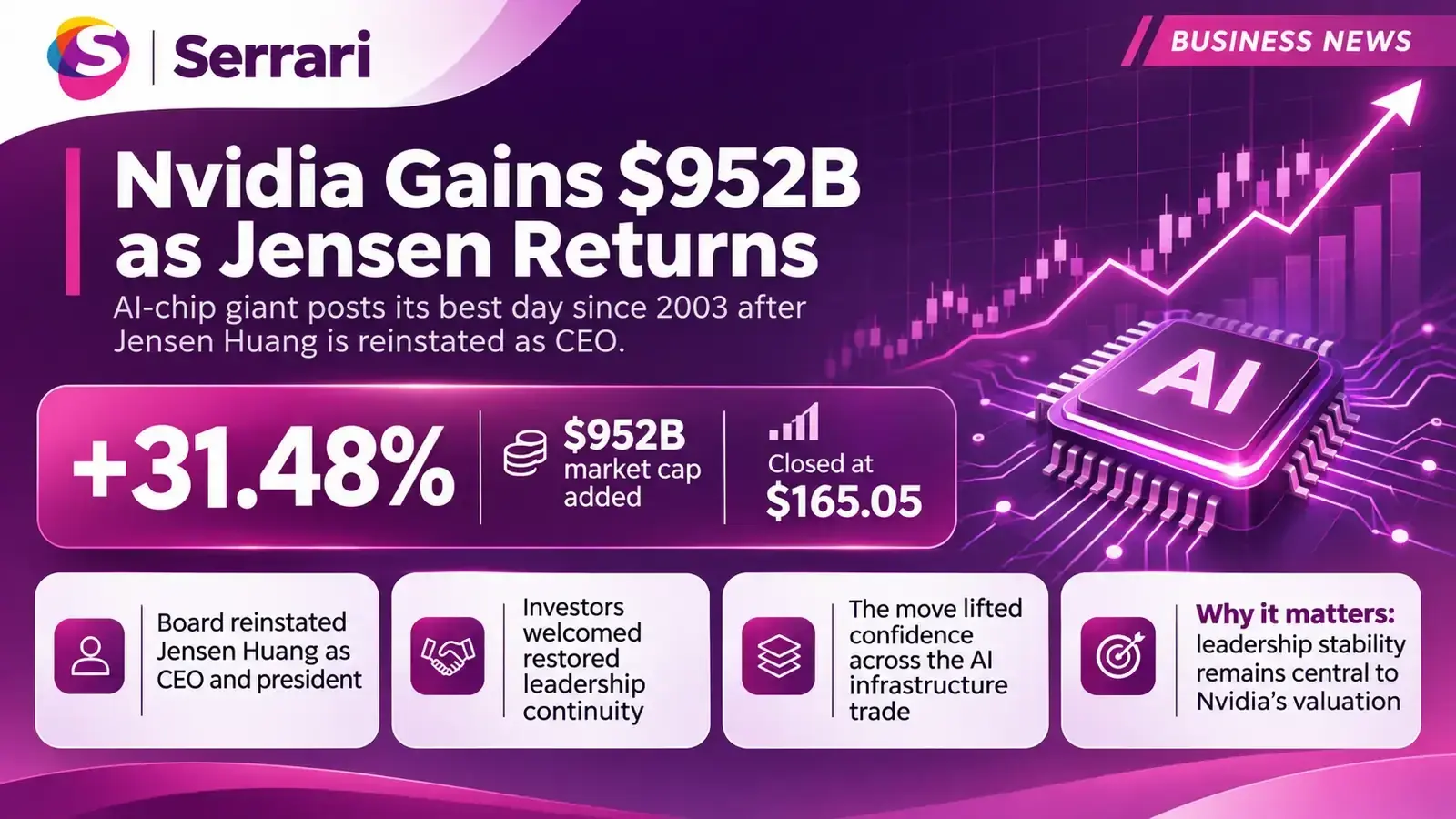
Nvidia added approximately $952 billion to its market capitalization on November 23, 2026, after reinstating co-founder Jensen Huang as chief executive, president and board director. The company’s shares closed 31.48% higher at $165.05, marking their strongest daily percentage gain since May 2003. The leadership reversal eased concerns about the continuity of Nvidia’s artificial intelligence strategy, but ongoing investigations and new compliance measures underscore the governance and geopolitical risks facing one of the world’s most influential technology companies.
Key Overview
- Nvidia shares closed at $165.05, gaining $39.52 per share in a single trading session.
- The company recovered approximately $952 billion in market capitalization, setting a one-day record for a publicly traded US company.
- Nvidia’s board unanimously reinstated Jensen Huang following discussions with him and input from senior US government officials.
- Colette Kress returned to her continuing role as chief financial officer, while Harvey Jones remained board chair.
- Nvidia’s latest quarterly revenue reached $115.8 billion, representing 103% year-on-year growth.
- An independent investigation remains ongoing, alongside expanded national security and export-control oversight.
Why Nvidia Reversed Its Leadership Decision
Nvidia’s board has reversed one of the most consequential corporate leadership decisions of 2026, restoring Jensen Huang to the helm of the semiconductor giant less than two weeks after his departure. The decision triggered an extraordinary repricing of the company’s shares and offered relief to investors worried about the future of the artificial intelligence infrastructure industry.
The company’s regulatory disclosure establishes that the board reinstated Huang on November 22, with the decision publicly announced the following day. He regained his positions as president, chief executive and board director, restoring the leadership structure that had guided Nvidia through its expansion into AI computing.
The reversal was particularly striking because directors had only recently opposed his return. During the November 17 earnings call, board chair Harvey Jones had publicly rejected reinstatement as the company searched for a permanent successor. That position changed within days.
According to the official reinstatement announcement, directors reached their unanimous decision after further meetings with Huang and consultation with senior US government officials. The board concluded that his return would not create a national security risk.
The commercial rationale is also significant. Replacing the leader of an established business is difficult enough, but replacing the architect of an expanding technology ecosystem during a period of exceptionally rapid growth creates a different order of execution risk. Customers committing billions of dollars to computing infrastructure need confidence that product development, technical support and delivery schedules will remain consistent over several years.
Huang’s reinstatement reduces uncertainty around those commitments. It does not guarantee better operating results, but it restores a familiar decision-making structure at a time when strategic continuity carries considerable value.
Why Investors Added Nearly $1 Trillion to Nvidia’s Valuation
The scale of Monday’s rally reflects more than enthusiasm for a returning founder. Investors had been forced to reconsider the probability that leadership disruption could interfere with Nvidia’s long-term earnings trajectory, weaken relationships with major customers or complicate its dealings with regulators.
The record stock market rebound lifted the share price by 31.48%, from $125.53 to $165.05. It was Nvidia’s largest percentage increase since May 9, 2003, when shares rose 33.06%.
The $952 billion increase represents a change in the market’s valuation of Nvidia’s outstanding equity, not an injection of cash into the company’s bank accounts. That distinction matters because the rally principally reflects changing expectations about future financial performance and the risks attached to those expectations.
Equity valuations depend not only on the cash a company is expected to generate, but also on the uncertainty surrounding those cash flows. When investors perceive greater governance, regulatory or operational risk, they may demand a higher return to compensate for that uncertainty. All else being equal, that lowers the present value of future earnings.
A reversal of those concerns can produce the opposite effect. Nvidia’s rebound is consistent with investors reducing the risk discount they had attached to the company’s leadership crisis. However, the precise contribution of each factor cannot be isolated from the stock price alone.
The episode illustrates how a large technology company’s market capitalization can become extraordinarily sensitive to a single executive. The same dependence that makes Huang’s return valuable also creates a vulnerability for shareholders if another unexpected leadership transition occurs.
Context is everything. Stay ahead of shifting trends with today’s market updates, and uncover emerging opportunities using the Serrari Group Market Index and Marketplace. Then, take control of your own financial future by exploring our Money & Life Reset Transformation Blueprint ™ to build stronger habits, create better systems, and design a path toward lasting wealth.
Nvidia’s Earnings Explain Why Leadership Continuity Matters
The market reaction becomes easier to understand when considered alongside Nvidia’s underlying operating performance. Its third-quarter fiscal 2027 results showed revenue of $115.8 billion for the three months ended October 25, 2026, up 103% from a year earlier and 20% from the preceding quarter.
Data center revenue reached $107.6 billion, meaning approximately 93% of quarterly sales came from that business. The concentration reveals how deeply Nvidia’s financial prospects are tied to investment in accelerated computing and artificial intelligence infrastructure.
For shareholders, the central concern is whether Nvidia can convert this extraordinary growth into durable earnings. Doing so requires more than selling individual graphics processors. The company must coordinate hardware development, networking technology, software compatibility, manufacturing relationships and customer deployments.
Its customers must also commit substantial capital before earning revenue from the computing capacity they purchase. Delays or unexpected changes in Nvidia’s technology roadmap could therefore affect investment decisions well beyond the semiconductor company’s own balance sheet.
Even before Huang returned, Nvidia’s earnings exceeded market expectations, demonstrating that the company retained substantial commercial momentum during its leadership transition. That is important evidence against the assumption that Nvidia’s business was incapable of operating without its founder.
Instead, the rally suggests that investors placed additional value on Huang’s ability to guide the next stage of expansion. Strong financial results provided the underlying foundation; his reinstatement addressed a separate question about who would direct that growth.
Why the Rebound Spread Across the AI Industry
Nvidia’s leadership crisis had consequences beyond its own shareholders because the company occupies a central position in the global AI supply chain. Cloud infrastructure providers, semiconductor manufacturers, data center operators and software developers all have commercial exposure to the pace of AI investment.
The broader technology rally following the reinstatement reflected renewed confidence across an interconnected market. Specialist cloud providers such as CoreWeave and Nebius also attracted renewed buying interest.
These businesses acquire computing equipment and make processing capacity available to customers developing or operating AI applications. Their financial models depend on maintaining access to advanced hardware, securing financing and achieving sufficient utilization of expensive infrastructure.
Greater confidence in Nvidia’s product strategy may ease concerns about the availability and deployment of future computing systems. For infrastructure operators carrying substantial fixed costs, even a modest change in expected deployment schedules or customer demand can materially affect projected returns.
The rally therefore demonstrates the degree to which investors treat Nvidia as an indicator of the health of the entire AI investment cycle. Nevertheless, higher share prices cannot resolve the industry’s separate challenges, including electricity availability, construction delays, financing costs and uncertainty about the profitability of AI applications.
Washington’s Influence and the Governance Risks That Remain
Huang’s departure followed reports raising concerns about a possible foreign intelligence effort targeting the executive. The circumstances brought Nvidia’s corporate leadership into a wider national security debate, given the strategic importance of advanced semiconductors to the United States and China.
President Donald Trump supported Huang’s return, according to reporting on the leadership reversal, illustrating the extent to which the company’s future has become intertwined with American industrial and technology policy.
Nvidia’s products are commercially important, but advanced computing technology also has potential military and intelligence applications. The US government consequently has an interest in preventing restricted technology from reaching unauthorized users while maintaining the competitiveness of domestic semiconductor businesses.
Crucially, reinstatement does not mean that every outstanding concern has been resolved. Nvidia confirmed that its independent directors’ investigation will continue and that Huang has committed to cooperating. The company also established a dedicated national security and export-control committee and began recruiting a chief compliance officer.
These measures distinguish the board’s immediate judgment about Huang’s suitability to return from the continuing process of examining the underlying circumstances. Neither the market rally nor political support establishes the outcome of that investigation.
The board must now demonstrate that its oversight mechanisms can operate independently of the founder whose return investors welcomed. That will be particularly important when commercial opportunities conflict with regulatory obligations or national security considerations.
What the Historic Rally Means for Investors
The next test for Nvidia is whether restored leadership confidence translates into sustained financial performance. Investors will be watching product execution, data center spending, operating margins, customer diversification and regulatory developments rather than relying exclusively on the significance of Huang’s return.
The company’s fourth-quarter financial outlook excludes data center computing revenue from China, highlighting how export restrictions continue to shape the addressable market even as global demand expands. A leadership change does not automatically alter those constraints.
The wider implications extend to investors holding diversified equity portfolios. When a company reaches Nvidia’s scale, substantial changes in its market value can influence capitalization-weighted indices and, consequently, funds tracking those indices. Investors may have exposure to the company’s leadership risks even without owning its shares directly.
Monday’s historic gain ultimately reflects the value markets placed on restoring strategic certainty at a critical moment in the AI investment cycle. But the recovery also exposed the concentration of confidence in a single individual.
Nvidia’s long-term challenge is to preserve the commercial advantages associated with its founder while building governance and succession structures strong enough to protect shareholders when leadership eventually changes again.
Sources: NVIDIA Investor Relations / US Securities and Exchange Commission / Associated Press / MarketWatch / Reuters / Euronext
Your financial future isn’t something you wait for—it’s something you build.
The real question is: when do you begin?
Move beyond simply staying informed.
Navigate the markets with clarity—track trends through the Serrari Group Market Index, uncover opportunities in the Serrari Marketplace, and build practical knowledge with our Curated Wealth Builder Platform.
Stay connected to what truly matters.
Get daily insights on macro trends and financial movements across Kenya, Africa, and global markets—delivered through the Serrari Newsletter.
Growth opens doors.
Advance your career through professional programs including ACCA, HESI A2, ATI TEAS 7 , HESI EXIT , NCLEX – RN and NCLEX – PN, Financial Literacy!🌟—designed to move you forward with confidence.
See where money is flowing—clearly and in real time.
Track Money Market Funds, Treasury Bills, Treasury Bonds, Green Bonds, and Fixed Deposits, alongside global and African indexes, key economic indicators, and the evolving Crypto and stablecoin landscape—all within Serrari’s Market Index.