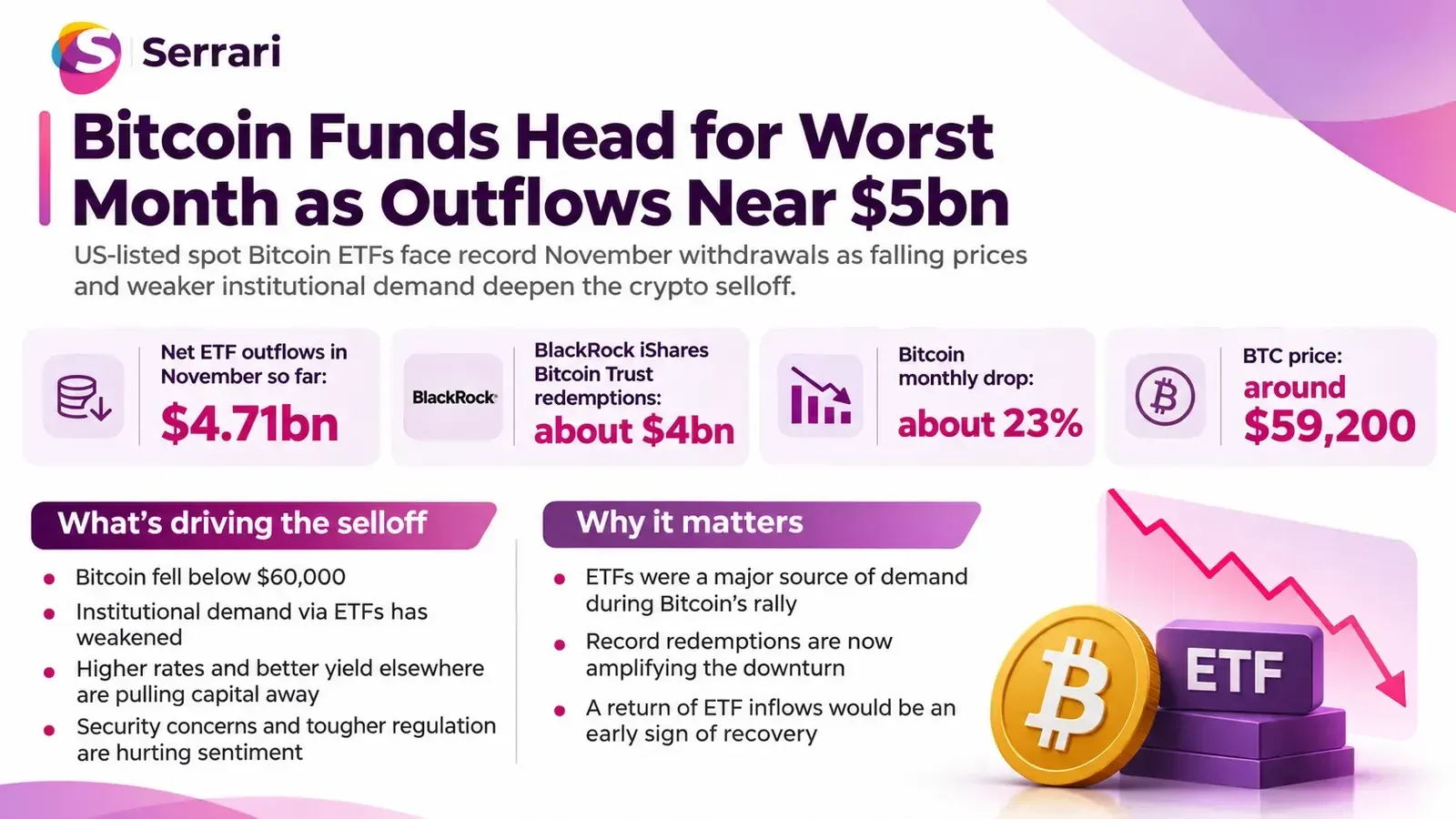
US-listed spot Bitcoin exchange-traded funds (ETFs) are heading towards their worst month since launching in January 2024, with net withdrawals reaching $4.71 billion through November 23, 2026. BlackRock’s iShares Bitcoin Trust accounts for approximately 85% of the outflows, highlighting a significant reversal in investor demand. Bitcoin has fallen approximately 23% during November, slipping below $60,000 as elevated interest rate expectations, security concerns, regulatory uncertainty and competition from income-generating investments undermine investor confidence. The withdrawals expose a growing vulnerability in Bitcoin’s institutional adoption story, with the investment vehicles that previously supported its rally now amplifying its downturn.
Key Overview
- US spot Bitcoin ETFs recorded $4.71 billion in net outflows through November 23, 2026, exceeding the previous monthly withdrawal record.
- BlackRock’s iShares Bitcoin Trust experienced approximately $4 billion in net withdrawals, accounting for nearly 85% of total Bitcoin ETF outflows.
- Bitcoin declined approximately 23% during November, trading around $59,200 on November 25.
- US spot Ethereum ETFs also experienced approximately $1.15 billion in net withdrawals, bringing combined Bitcoin and Ethereum ETF outflows to $5.86 billion.
- Elevated interest rate expectations, cybersecurity concerns and regulatory uncertainty are weakening investor appetite for cryptocurrencies.
- Bitcoin faces increasing competition from equities, government securities and other income-generating investments.
- Sustained ETF inflows and renewed demand from US investors could provide early indications of a broader market recovery.
Bitcoin ETFs Experience Unprecedented Capital Withdrawals
The cryptocurrency market is confronting one of its most significant tests since Bitcoin became more accessible through mainstream financial markets, with billions of dollars leaving investment products that previously supported institutional adoption.
US-listed spot Bitcoin ETFs recorded approximately $4.71 billion in net withdrawals through November 23, surpassing the previous monthly record of approximately $4.51 billion established in June 2026.
According to historical ETF flow data, the withdrawals reflect a sustained deterioration in investor demand rather than an isolated trading session. The magnitude of the redemptions is particularly significant because November had not yet concluded when the previous monthly record was surpassed.
The reversal demonstrates how quickly institutional investment channels can transmit changes in global risk appetite into cryptocurrency markets. While ETFs simplified access to Bitcoin for traditional investors, they also made reducing exposure considerably easier.
On November 23 alone, US spot Bitcoin ETFs experienced approximately $569.7 million in net withdrawals, further intensifying selling pressure.
Bitcoin subsequently traded around $59,200 on November 25, following a monthly decline of approximately 23%, according to reported cryptocurrency market data, placing the cryptocurrency on course for its weakest monthly performance since June 2022.
However, unlike the cryptocurrency downturn of 2022, when corporate failures and liquidity crises dominated the market, the current selloff increasingly reflects Bitcoin’s exposure to traditional portfolio allocation decisions.
The distinction matters because a recovery may depend not only on developments within the cryptocurrency industry but also on broader improvements in financial market conditions.
BlackRock Becomes the Centre of Bitcoin’s ETF Selloff
BlackRock’s iShares Bitcoin Trust, commonly identified by its trading ticker IBIT, has emerged as the largest contributor to November’s withdrawals.
The investment product recorded approximately $4 billion in net redemptions through November 23, representing nearly 85% of the combined withdrawals from US spot Bitcoin ETFs.
According to fund-level redemption figures, the concentration of withdrawals highlights the growing importance of a relatively small number of investment vehicles in determining institutional cryptocurrency demand.
BlackRock’s entry into the cryptocurrency industry was previously regarded as a milestone for Bitcoin’s acceptance within conventional financial markets. Its reputation, distribution capabilities and institutional relationships helped reduce barriers that had historically prevented some investors from accessing digital assets.
The current withdrawals demonstrate that institutional accessibility does not necessarily translate into permanent institutional commitment.
Professional investors regularly adjust portfolio allocations according to volatility, liquidity requirements, expected returns and changing economic conditions. Bitcoin is increasingly subject to these same investment considerations.
When investors perceive greater downside risk or identify more attractive opportunities elsewhere, cryptocurrency allocations can be reduced through conventional brokerage accounts without the complexities associated with directly holding digital assets.
Importantly, withdrawals from IBIT do not necessarily represent BlackRock selling its own corporate Bitcoin investments. They primarily reflect net redemptions from the investment product by market participants.
Nevertheless, the concentration of withdrawals creates a vulnerability for Bitcoin’s demand structure. When its largest investment vehicles experience substantial redemptions simultaneously, other sources of demand must absorb the resulting supply or reduced buying activity.
Without sufficient replacement demand, prices may remain under pressure.
How Bitcoin ETFs Are Amplifying the Cryptocurrency Downturn
The January 2024 introduction of US spot Bitcoin investment products fundamentally changed the cryptocurrency’s relationship with traditional financial markets.
The regulatory approval of spot Bitcoin products allowed investors to obtain exposure through familiar investment infrastructure, opening additional distribution channels for financial advisers, institutional investors and retail brokerage customers.
Previously, many investors seeking direct cryptocurrency exposure needed specialised trading platforms, digital wallets and custody arrangements.
Exchange-traded products reduced several of these operational barriers, allowing Bitcoin exposure to become more easily incorporated into conventional investment portfolios.
However, the same infrastructure that strengthened demand during favourable market conditions can accelerate withdrawals when sentiment deteriorates.
When spot Bitcoin investment products experience net share redemptions, their underlying Bitcoin holdings may decline. Depending on whether redemptions are processed using cash or Bitcoin, this can generate direct selling or transfer Bitcoin to market participants who may subsequently sell it.
The resulting pressure can create a negative feedback loop.
Falling Bitcoin prices reduce the value of cryptocurrency investments, prompting some investors to rebalance their portfolios. Further withdrawals weaken demand, potentially encouraging additional price declines and renewed redemptions.
The structure of spot cryptocurrency investment products simplifies access but does not eliminate exposure to the underlying asset’s volatility.
This is why November’s withdrawals are particularly significant. Bitcoin’s integration into conventional financial markets has improved accessibility without removing the economic forces that make speculative assets vulnerable during periods of uncertainty.
Context is everything. Stay ahead of shifting trends with today’s market updates, and uncover emerging opportunities using the Serrari Group Market Index and Marketplace. Then, take control of your own financial future by exploring our Money & Life Reset Transformation Blueprint ™ to build stronger habits, create better systems, and design a path toward lasting wealth.
Rising Interest Rate Expectations Weaken Bitcoin’s Appeal
One of the most significant challenges facing Bitcoin is the changing opportunity cost of holding an asset that does not inherently generate income.
During periods of low interest rates, investors often become more willing to allocate capital towards assets whose returns depend primarily on price appreciation. Limited returns from conventional savings and fixed-income instruments can encourage investors to pursue alternative opportunities.
However, when interest rates remain elevated or expectations of tighter monetary policy strengthen, that calculation changes.
Government securities, money market instruments, corporate bonds and other income-generating investments become more competitive because investors can earn returns without relying entirely on future price appreciation.
Bitcoin does not provide contractual interest payments, dividends or predictable operating cash flows. Its investment performance depends substantially on changes in market demand and the price at which investors can eventually sell.
Recent financial market analysis identified elevated US Treasury yields and expectations of restrictive monetary policy as factors complicating Bitcoin’s attempts to sustain a recovery.
Higher interest rates can also support the US dollar, tighten financial conditions and reduce the willingness of investors to maintain speculative positions.
For institutional portfolio managers, Bitcoin must therefore compete against an expanding range of investments offering potentially more predictable returns or different risk characteristics.
Its scarcity alone may not be sufficient to attract capital when competing assets offer compelling income opportunities.
The challenge facing cryptocurrency markets is not simply restoring confidence in Bitcoin but demonstrating why investors should allocate additional capital to it under prevailing economic conditions.
Security Concerns and Regulatory Uncertainty Compound Investor Caution
The cryptocurrency industry continues to face confidence challenges associated with cybersecurity breaches, custody risks and evolving regulatory frameworks.
Although regulated exchange-traded products can reduce some operational risks associated with directly owning cryptocurrencies, they cannot fully insulate investors from developments affecting the broader digital asset ecosystem.
Security breaches involving exchanges, decentralised finance platforms or cryptocurrency service providers can weaken market confidence and discourage additional investment.
BlackRock’s explanation of institutional cryptocurrency custody arrangements distinguishes investment product custody infrastructure from the operating requirements of conventional cryptocurrency exchanges.
However, even robust custody arrangements cannot protect investors from losses caused by declining Bitcoin prices.
Regulatory uncertainty creates a separate challenge. Institutional investors generally require clarity regarding compliance obligations, taxation, custody standards and the legal treatment of financial assets.
Uncertainty surrounding future US cryptocurrency regulations following the November 2026 midterm elections could encourage some investors to postpone additional allocations until the policy environment becomes clearer.
These concerns do not necessarily explain every individual ETF redemption. Nevertheless, they create conditions under which investors may demand greater potential returns before accepting additional cryptocurrency exposure.
Ethereum Withdrawals Signal Broader Cryptocurrency Weakness
Bitcoin is not the only digital asset experiencing significant reductions in investor demand.
US spot Ethereum ETFs recorded approximately $1.15 billion in net withdrawals through November 23, taking combined Bitcoin and Ethereum ETF redemptions to approximately $5.86 billion.
The Ethereum ETF capital movements suggest that investors are reassessing exposure across multiple segments of the cryptocurrency market rather than responding exclusively to Bitcoin-specific developments.
Ethereum supports a broader ecosystem encompassing decentralised financial applications, smart contracts and blockchain-based services. Nevertheless, these applications have not prevented its investment products from experiencing substantial withdrawals.
The simultaneous weakness of Bitcoin and Ethereum highlights the importance of broader financial conditions in determining cryptocurrency valuations.
When institutional investors reduce allocations to digital assets collectively, the effects can extend beyond investment products.
Persistent declines in cryptocurrency valuations may weaken blockchain-related fundraising, discourage speculative activity and reduce revenues for trading platforms that depend on transaction volumes.
Cryptocurrency businesses may consequently face tighter financing conditions, particularly if investors become increasingly selective about providing capital to emerging digital asset ventures.
What Could Trigger a Sustainable Bitcoin Recovery?
Bitcoin’s immediate challenge is establishing a sufficiently compelling reason for investors to return after the investment catalysts that supported previous rallies have weakened.
A sustained reversal in ETF flows would provide an important indication that traditional investment demand is recovering.
However, isolated sessions of positive inflows would not necessarily establish a broader change in market direction. Consistent accumulation across several investment products would provide stronger evidence that institutional and retail investors are rebuilding cryptocurrency exposure.
Improving global liquidity conditions, declining interest rate expectations and greater regulatory clarity could also strengthen investor appetite.
At the same time, the cryptocurrency industry may need new developments capable of attracting capital beyond the investment accessibility delivered by the original ETF launches.
Potential catalysts include broader commercial adoption, improved financial infrastructure and greater integration of blockchain technology into conventional financial services.
Nevertheless, these developments would need to translate into measurable investment demand rather than temporary speculative enthusiasm.
November’s record withdrawals do not necessarily mean that institutional cryptocurrency adoption has permanently reversed. Instead, they demonstrate that institutional participation is conditional on Bitcoin’s ability to remain competitive within diversified investment portfolios.
The long-term significance of the current selloff lies in this changing relationship.
Bitcoin is no longer operating predominantly outside conventional financial markets. Its increasing integration means that monetary policy, portfolio rebalancing, competing investment opportunities and institutional risk management are becoming increasingly influential in determining its valuation.
The ETFs that once helped drive Bitcoin’s expansion are now exposing it to the same capital allocation pressures that govern other financial assets.
Whether Bitcoin can recover sustainably will depend on its ability to attract renewed demand in an environment where investors have numerous alternative destinations for their capital.
Sources: Bloomberg / Moneyweb / Farside Investors / CryptoSlate / The Block / US Securities and Exchange Commission / Investor.gov / BlackRock iShares
Your financial future isn’t something you wait for—it’s something you build.
The real question is: when do you begin?
Move beyond simply staying informed.
Navigate the markets with clarity—track trends through the Serrari Group Market Index, uncover opportunities in the Serrari Marketplace, and build practical knowledge with our Curated Wealth Builder Platform.
Stay connected to what truly matters.
Get daily insights on macro trends and financial movements across Kenya, Africa, and global markets—delivered through the Serrari Newsletter.
Growth opens doors.
Advance your career through professional programs including ACCA, HESI A2, ATI TEAS 7 , HESI EXIT , NCLEX – RN and NCLEX – PN, Financial Literacy!🌟—designed to move you forward with confidence.
See where money is flowing—clearly and in real time.
Track Money Market Funds, Treasury Bills, Treasury Bonds, Green Bonds, and Fixed Deposits, alongside global and African indexes, key economic indicators, and the evolving Crypto and stablecoin landscape—all within Serrari’s Market Index.