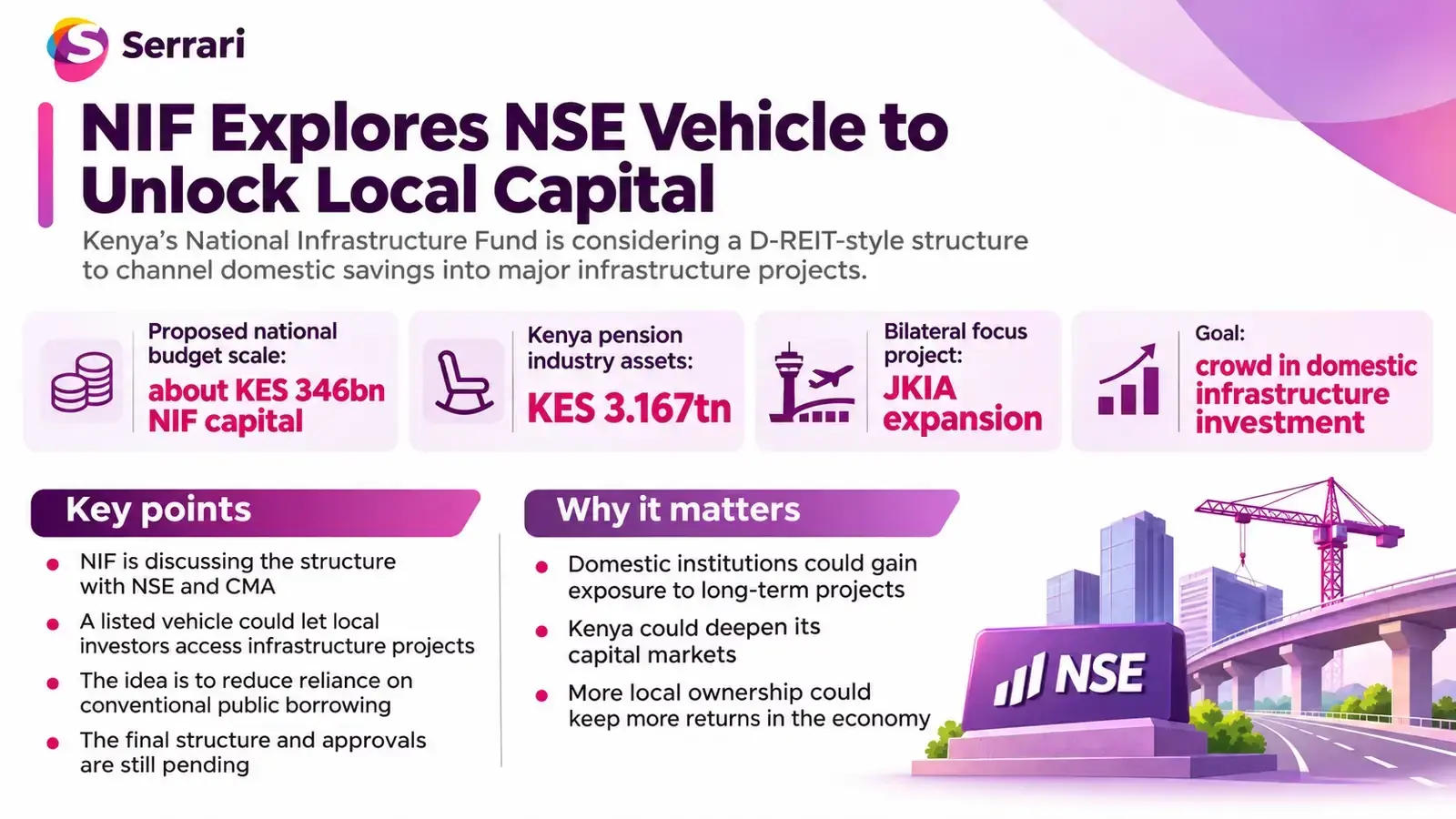
Kenya’s National Infrastructure Fund (NIF) is exploring the creation of a development real estate investment trust (D-REIT)-style vehicle on the Nairobi Securities Exchange (NSE) to mobilise domestic capital for major infrastructure projects. The fund, which has approximately KES 346 billion in capital, is engaging the Capital Markets Authority (CMA) and the NSE to establish a regulated investment structure that could enable pension schemes and other eligible investors to participate in commercially viable infrastructure projects. With Kenya’s retirement benefits industry holding KES 3.167 trillion in assets, the initiative could unlock a significant source of long-term financing for roads, airports, energy facilities and other strategic developments while reducing reliance on conventional government borrowing.
LIVENSE market summarySee NSE data →Key Overview
- The National Infrastructure Fund is exploring an NSE-listed investment vehicle modelled on the existing D-REIT regulatory framework.
- NIF Chief Executive Officer James Mworia is engaging the NSE and CMA to expand the scope of existing investment structures to accommodate infrastructure projects.
- Kenya’s retirement benefits industry held KES 3.167 trillion in assets as of June 2026, representing a substantial pool of potential investment capital.
- The NIF has accumulated approximately KES 346 billion in capital, supported by government divestiture proceeds and investment income.
- The fund intends to preserve its seed capital through government securities investments while deploying investment income into infrastructure projects.
- The proposed vehicle could facilitate domestic participation in projects such as the Jomo Kenyatta International Airport expansion.
- The initiative could deepen Kenya’s capital markets, diversify institutional investment portfolios and reduce infrastructure financing pressures on the government.
- Regulatory approvals, investment eligibility, fundraising targets and the listing timeline remain outstanding.
National Infrastructure Fund Seeks Alternative Financing Through the NSE
Kenya’s National Infrastructure Fund is seeking to fundamentally change how the country finances major infrastructure developments by creating an investment vehicle that connects domestic savings with commercially viable national projects.
The proposed instrument would draw on the existing development real estate investment trust framework, adapting a structure traditionally associated with property development to accommodate a wider range of infrastructure investments.
According to ongoing capital-market discussions, NIF Chief Executive Officer James Mworia has identified the existing D-REIT framework as a potential starting point for attracting private capital into infrastructure.
The initiative addresses a structural financing challenge facing Kenya. Although the country has accumulated substantial domestic institutional savings, relatively few accessible investment structures connect these funds directly with large infrastructure projects.
Infrastructure developments typically require substantial upfront capital, extended construction periods and long investment horizons. These characteristics make them difficult to finance exclusively through commercial bank lending or annual government budget allocations.
The proposed vehicle could bridge this gap by pooling investment capital and deploying it across multiple projects rather than requiring individual investors to finance entire developments independently.
The significance extends beyond fundraising. Kenya is attempting to establish a financing ecosystem in which domestic investors participate in infrastructure ownership and potentially benefit from the economic returns generated by national development.
Why Kenya’s KES 3.167 Trillion Pension Industry Is Central to the Strategy
Kenya’s retirement benefits industry represents one of the most significant potential sources of long-term domestic infrastructure financing.
According to the June 2026 retirement benefits industry assessment, pension assets reached KES 3.167 trillion, equivalent to approximately 17.64% of Kenya’s gross domestic product.
The industry’s expansion creates an opportunity to redirect a portion of institutional savings towards productive infrastructure investments without relying exclusively on external financiers.
For illustrative purposes, an allocation of just 1% of existing pension assets towards infrastructure would represent approximately KES 31.67 billion. A 3% allocation would translate into KES 95.01 billion, while a 5% allocation would represent KES 158.35 billion.
These figures are illustrative rather than confirmed fundraising commitments, but they demonstrate the scale of capital potentially available within Kenya’s domestic financial system.
Pension schemes are natural prospective infrastructure investors because their liabilities often extend over several decades. Infrastructure assets, particularly operational projects generating predictable cash flows, can provide investment characteristics that complement long-term retirement obligations.
However, the relationship is not automatically suitable for every pension scheme.
Trustees must ensure that investments comply with regulatory limits, liquidity requirements, diversification policies and the interests of beneficiaries.
Development-stage infrastructure projects may not generate income for several years, while pension schemes must continue meeting retirement payments and other member obligations.
A listed vehicle could help address this challenge by creating a mechanism through which institutional investors may sell their investment units without requiring the underlying infrastructure assets to be liquidated.
Nevertheless, actual liquidity would depend on secondary-market participation and the availability of willing buyers. Listing alone would not guarantee that investors can immediately exit their positions.
How a D-REIT-Style Infrastructure Investment Vehicle Could Work
Kenya’s existing capital markets framework distinguishes between development-oriented real estate investment trusts and income-generating real estate investment trusts.
Under the existing REIT investment framework, a D-REIT primarily mobilises funds for property construction and development, while an income REIT generally holds assets capable of generating rental income.
An infrastructure investment vehicle could adapt similar principles to projects that require substantial development financing before generating commercial revenues.
Eligible investors would acquire units in the investment vehicle, which could subsequently deploy pooled capital into a diversified portfolio of infrastructure projects alongside the National Infrastructure Fund.
Potential underlying investments could include toll roads, airports, logistics facilities, power generation infrastructure, water projects and commercially viable digital infrastructure.
During construction, investors would primarily be exposed to development risks and potential changes in the underlying value of their investments.
Once projects become operational, investment returns could potentially arise from infrastructure user charges, concession income, contractual payments, asset disposals or other commercial revenue arrangements.
The structure would therefore allow investors to participate in infrastructure development without directly managing construction activities or operational responsibilities.
However, infrastructure cannot automatically be accommodated under existing D-REIT rules.
The ongoing review of REIT regulations provides a relevant regulatory context for discussions surrounding broader investment eligibility, although it does not constitute approval of the proposed NIF vehicle.
Regulators would need to establish appropriate requirements covering eligible assets, valuation methodologies, governance, investor protection, financial disclosures, leverage and distribution policies.
The final regulatory framework would also determine whether participation is restricted to professional investors or extended to eligible retail investors.
Context is everything. Stay ahead of shifting trends with today’s market updates, and uncover emerging opportunities using the Serrari Group Market Index and Marketplace. Then, take control of your own financial future by exploring our Money & Life Reset Transformation Blueprint ™ to build stronger habits, create better systems, and design a path toward lasting wealth.
How the NIF’s KES 346 Billion Capital Base Supports Infrastructure Investment
The National Infrastructure Fund is developing a financing strategy that seeks to preserve its initial capital while generating recurring investment income to support infrastructure development.
Established in 2026, the fund is intended to mobilise alternative sources of capital for strategic projects and reduce exclusive dependence on traditional public financing.
According to recent updates on the fund’s capital position, its available capital had increased to approximately KES 346 billion by November 24, 2026.
The fund’s financing base has been supported by proceeds associated with government divestitures involving Safaricom and Kenya Pipeline Company, alongside investment earnings.
Its strategy involves investing seed capital in government securities and subsequently using the generated income to finance equity participation in infrastructure projects.
Recent government securities investment disclosures indicate that the fund had earned approximately KES 6 billion from Treasury investments as it developed its capital preservation strategy.
At an illustrative annual return of 10%, a KES 346 billion investment portfolio could generate KES 34.6 billion in gross investment income before operating expenses and other costs.
LIVENSE market summarySee NSE data →This approach is intended to create a recurring source of project financing instead of exhausting the initial capital through direct infrastructure expenditure.
However, the strategy also exposes the fund to changes in government securities yields, reinvestment conditions and sovereign credit risk.
Furthermore, investment income generated from government securities ultimately represents a financing obligation for the government. Consequently, preserving the NIF’s capital through Treasury investments does not independently eliminate the broader fiscal cost of infrastructure development.
The proposed NSE-listed instrument could complement this strategy by bringing additional private equity into projects and expanding financing capacity beyond the fund’s internally generated resources.
JKIA Expansion Highlights the Importance of Domestic Infrastructure Ownership
The proposed expansion of Jomo Kenyatta International Airport provides an example of how alternative financing structures could influence ownership and investment participation in strategic infrastructure.
The National Infrastructure Fund has been exploring equity participation in the airport expansion while examining opportunities for domestic institutional investors to participate.
According to updates on the airport financing strategy, international investors have demonstrated substantial interest, prompting efforts to establish appropriate mechanisms for local capital participation.
Foreign investment remains important because infrastructure projects frequently require financing, technical expertise and operational capabilities that may not be readily available domestically.
However, excessive dependence on foreign capital can limit the proportion of infrastructure-generated investment returns retained within the domestic economy.
A regulated infrastructure investment vehicle could create opportunities for Kenyan institutions to participate alongside foreign investors, potentially allowing a greater share of investment income to accrue to domestic beneficiaries.
For pension contributors, this could establish an indirect economic interest in infrastructure assets through their retirement schemes.
Nevertheless, local participation should not come at the expense of commercial viability or prudent investment management.
Airport expansion projects remain exposed to passenger demand, construction costs, operational efficiency, financing arrangements and regulatory decisions. These risks must be reflected in investment valuations and expected returns.
Can Infrastructure Investment Reduce Kenya’s Public Debt Burden?
One of the broader objectives of the National Infrastructure Fund is to diversify infrastructure financing away from conventional government borrowing.
Kenya’s reliance on public debt to support development has increased the importance of alternative financing mechanisms that can attract private capital without placing the entire upfront financing requirement on the national budget.
Through equity participation, commercially viable infrastructure projects could mobilise resources from investors who accept investment risks in exchange for potential future returns.
The NIF’s long-term capital mobilisation strategy includes a reported target of KES 3.6 trillion over a decade through a combination of co-investment and debt financing.
If successfully implemented, such a structure could expand infrastructure investment capacity while distributing financing risks across public and private participants.
However, private infrastructure financing does not automatically eliminate government liabilities.
Projects supported by government guarantees, minimum revenue commitments or public availability payments can create future fiscal obligations even when their initial financing comes from private investors.
The economic benefit therefore depends on whether the financing structure achieves genuine risk transfer, competitive financing costs and sustainable commercial performance.
Projects that cannot generate sufficient independent revenues may still require direct public support.
Transparent disclosure of contractual commitments and contingent liabilities will be essential to ensure that alternative infrastructure financing does not simply shift public debt obligations into less visible structures.
A Potential Turning Point for Kenya’s Capital Markets
The proposed infrastructure investment vehicle could also address longstanding limitations within Kenya’s capital markets by expanding the range of available investment products.
Domestic investors have historically relied heavily on government securities, listed equities, property and conventional collective investment schemes.
Infrastructure investment products could introduce an additional asset class with distinct investment characteristics and potential exposure to long-term economic development.
For the Nairobi Securities Exchange, a successful infrastructure listing could attract institutional participation, encourage additional investment product development and strengthen its role in financing the real economy.
However, the success of the initiative will ultimately depend on the quality of underlying projects rather than the existence of a listed investment structure alone.
Investors will require credible financial projections, independent project valuations, transparent procurement processes, sound governance and clearly defined exit mechanisms.
The proposed vehicle must also demonstrate that its expected risk-adjusted returns are competitive with existing investment alternatives.
Kenya’s challenge is not simply a shortage of domestic capital. It is the limited availability of sufficiently attractive, transparent and investable infrastructure opportunities capable of mobilising that capital.
If the National Infrastructure Fund can establish a credible mechanism for connecting long-term savings with commercially viable projects, it could transform the relationship between Kenya’s capital markets and national development.
The ultimate opportunity is to move beyond financing infrastructure predominantly through taxation and government borrowing towards a model in which eligible domestic investors can participate in its ownership, development and economic returns.
Sources: Mjengo Hub / Business Daily Africa / Retirement Benefits Authority / Capital Markets Authority / TechTrendsKE / People Daily / Reuters
Your financial future isn’t something you wait for—it’s something you build.
The real question is: when do you begin?
Move beyond simply staying informed.
Navigate the markets with clarity—track trends through the Serrari Group Market Index, uncover opportunities in the Serrari Marketplace, and build practical knowledge with our Curated Wealth Builder Platform.
Stay connected to what truly matters.
Get daily insights on macro trends and financial movements across Kenya, Africa, and global markets—delivered through the Serrari Newsletter.
Growth opens doors.
Advance your career through professional programs including ACCA, HESI A2, ATI TEAS 7 , HESI EXIT , NCLEX – RN and NCLEX – PN, Financial Literacy!🌟—designed to move you forward with confidence.
See where money is flowing—clearly and in real time.
Track Money Market Funds, Treasury Bills, Treasury Bonds, Green Bonds, and Fixed Deposits, alongside global and African indexes, key economic indicators, and the evolving Crypto and stablecoin landscape—all within Serrari’s Market Index.