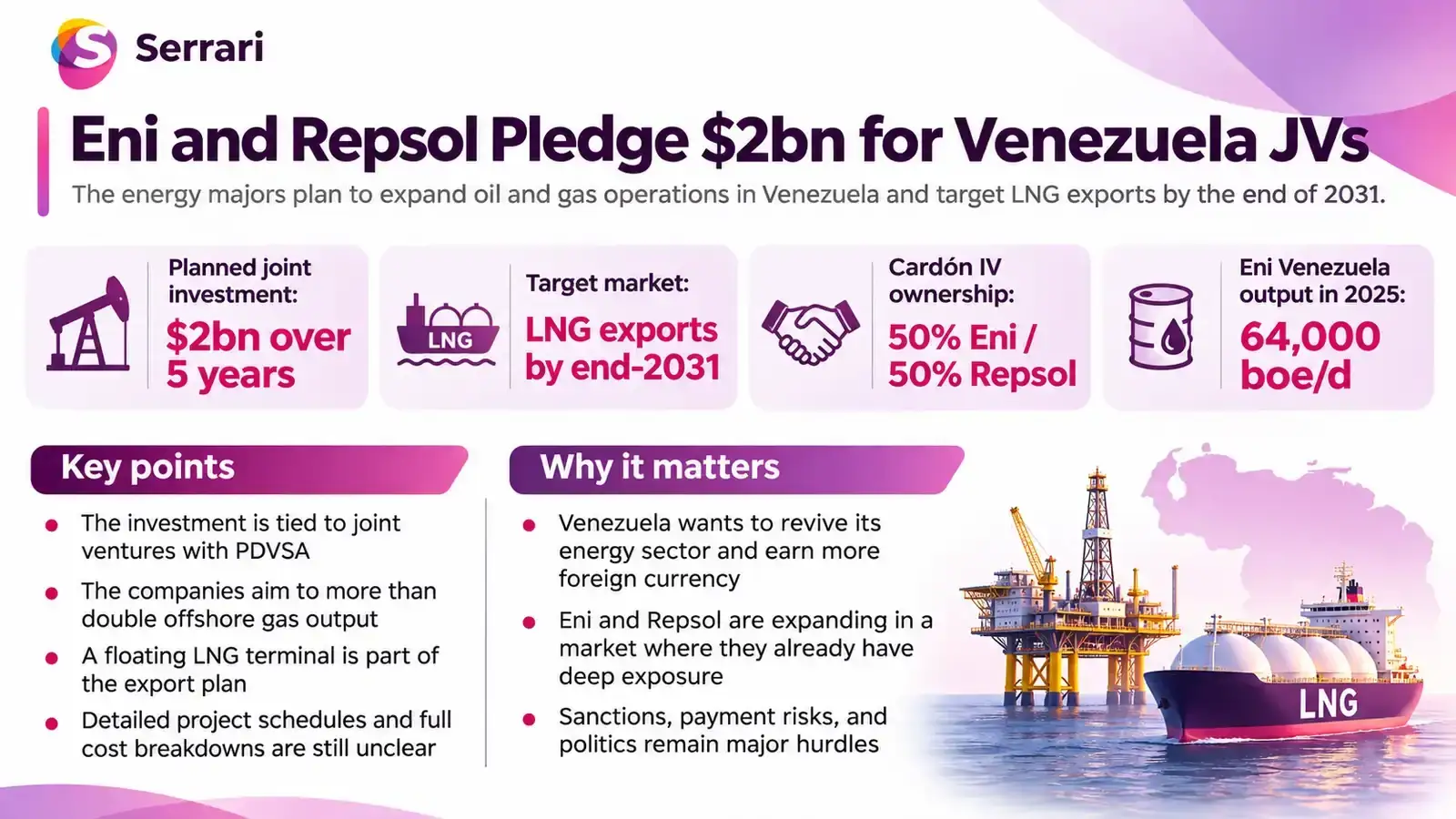
Italian energy giant Eni and Spain’s Repsol have committed to jointly investing $2 billion over five years in their Venezuelan joint ventures with state-owned energy company Petróleos de Venezuela (PDVSA), according to a newly published government macroeconomic framework. The companies are also pursuing agreements to more than double offshore natural gas production at the Cardón IV project and commence liquefied natural gas (LNG) exports through a floating terminal by the end of 2031. The investment represents a significant development in Venezuela’s efforts to rebuild its energy industry following years of sanctions, underinvestment and economic instability. For Eni and Repsol, expanding production and establishing international gas export channels could unlock additional revenue streams, improve investment recovery prospects and strengthen their positions within the evolving global LNG market.
Key Overview
- Eni and Repsol have committed to jointly investing $2 billion over five years in their Venezuelan joint ventures with PDVSA, according to the Venezuelan government.
- The companies have reached agreements aimed at more than doubling offshore natural gas production at Cardón IV.
- Venezuela is targeting the commencement of LNG exports through a floating terminal by the end of 2031.
- Eni and Repsol each hold a 50% interest in Cardón IV, which operates the Perla offshore gas field.
- Eni’s Venezuelan hydrocarbon production reached 64,000 barrels of oil equivalent per day in 2025, predominantly from Perla.
- The investment could help Venezuela diversify its energy exports, attract foreign currency and rebuild production capacity.
- International sanctions, historical payment arrears, infrastructure requirements and political uncertainty remain significant investment risks.
- Detailed investment schedules, project-level capital allocations and LNG terminal specifications have not yet been publicly disclosed.
Eni and Repsol Expand Their Investment in Venezuela’s Energy Recovery
Venezuela’s efforts to rebuild its energy industry are gaining momentum following a reported $2 billion investment commitment from two of Europe’s largest energy companies.
Italy’s Eni and Spain’s Repsol are expected to deploy the capital over five years into their joint ventures with Venezuelan state-owned energy company PDVSA, according to a macroeconomic framework published by the Venezuelan government on November 24, 2026.
The reported investment commitment comes as both companies seek to expand their existing operations following decades of exposure to Venezuela’s increasingly challenging business environment.
The decision is particularly significant because Venezuela has historically struggled to convert its enormous hydrocarbon resources into sustainable production and export earnings.
Political instability, international sanctions, insufficient capital expenditure and deterioration in energy infrastructure have constrained the country’s ability to exploit its resources commercially.
Rather than entering an entirely unfamiliar market, Eni and Repsol are expanding operations where they already possess technical expertise, established infrastructure and longstanding commercial relationships.
This reduces some of the geological and operational uncertainties associated with developing new energy projects.
However, their commitment also reflects a broader commercial calculation. Both companies have substantial historical exposure to Venezuela, including unpaid obligations accumulated over previous years. Increasing production and establishing more reliable revenue channels could improve the economic prospects of their existing investments.
The opportunity is therefore not simply to produce additional hydrocarbons. It is to establish a commercially sustainable framework through which companies can recover capital and generate future returns.
Why Venezuela Is Turning to Natural Gas to Rebuild Its Economy
Venezuela possesses some of the world’s largest hydrocarbon resources, but its economy has historically depended heavily on crude oil exports.
That concentration has exposed government revenues, foreign currency availability and domestic economic activity to fluctuations in oil production and international prices.
Expanding natural gas production could provide an additional source of energy export revenues while strengthening domestic electricity generation and industrial activity.
According to an assessment of Venezuela’s energy resources, the country’s natural gas reserves remain substantially underutilised, with considerable volumes of production historically associated with crude oil extraction.
Developing commercially viable offshore gas resources could help Venezuela overcome some of the limitations associated with its existing energy production structure.
Unlike natural gas produced as a by-product of oil extraction, dedicated gas fields can support production strategies focused specifically on electricity generation, industrial consumption and international gas markets.
For Venezuela, this creates an opportunity to diversify its energy economy without abandoning the petroleum industry that remains central to its financial system.
Additional export revenues could strengthen foreign currency availability, support essential imports and provide financing for infrastructure rehabilitation.
However, the extent of these benefits would depend on the allocation of export proceeds, contractual arrangements with foreign investors and the government’s broader economic management.
Increased production alone cannot resolve Venezuela’s structural economic challenges unless the additional revenues translate into productive investment and improved public services.
Perla Gas Field Becomes Central to Venezuela’s LNG Ambitions
The Perla offshore gas field, located within the Cardón IV licence in the Gulf of Venezuela, is central to the country’s ambitions to become an LNG exporter.
Eni and Repsol each own 50% of Cardón IV, distinguishing the gas venture from their separate oil partnerships involving PDVSA.
According to Eni’s April 2026 operational disclosure, Perla is the largest offshore gas field discovered in Latin America.
Eni’s Venezuelan hydrocarbon production amounted to approximately 64,000 barrels of oil equivalent per day in 2025, primarily attributable to Perla, which supplied gas equivalent to approximately 35% of Venezuela’s total consumption.
These figures highlight the project’s existing importance to the domestic economy.
Unlike a completely undeveloped gas discovery, Perla already operates within Venezuela’s energy supply network. This provides an established foundation from which production could be expanded.
The proposed increase would nevertheless require substantial investment in offshore production infrastructure, processing capacity and supporting facilities.
More importantly, Venezuela would need to balance international export ambitions against domestic energy requirements.
Natural gas supports electricity generation, industrial operations and other economically important activities. Diverting existing supplies towards international markets without sufficient production expansion could create shortages or increase domestic energy costs.
The objective of more than doubling production is therefore strategically important. It could potentially create exportable surpluses while preserving supplies for domestic consumption.
For Eni and Repsol, expanding an established offshore field may also provide a more commercially attractive pathway than pursuing entirely new exploration projects, where geological uncertainty and development timelines can be substantially greater.
Context is everything. Stay ahead of shifting trends with today’s market updates, and uncover emerging opportunities using the Serrari Group Market Index and Marketplace. Then, take control of your own financial future by exploring our Money & Life Reset Transformation Blueprint ™ to build stronger habits, create better systems, and design a path toward lasting wealth.
Why a Floating LNG Terminal Could Transform Venezuela’s Export Potential
The Venezuelan government’s proposed export strategy involves the development of a floating LNG terminal, with shipments targeted to commence by the end of 2031.
Floating LNG technology enables natural gas to be processed, liquefied, stored and transferred to specialised carriers through offshore infrastructure.
Liquefaction significantly reduces the volume occupied by natural gas, allowing it to be transported internationally without relying exclusively on cross-border pipelines.
For Venezuela, this could provide access to a considerably wider range of customers.
Pipeline infrastructure generally connects producers with geographically accessible markets. LNG exports, by contrast, allow shipments to reach customers across multiple regions, subject to commercial contracts, shipping availability and regulatory requirements.
A floating facility may also reduce the need for certain types of large-scale onshore construction. However, offshore liquefaction projects remain technically complex and capital intensive.
Their development requires specialised engineering, reliable upstream gas supplies, marine infrastructure, environmental approvals and long-term commercial arrangements.
The targeted 2031 launch therefore represents an ambitious development timetable rather than a guaranteed commencement date.
The companies have not publicly disclosed the terminal’s expected liquefaction capacity, engineering contractor, financing structure or prospective customers.
It also remains unclear whether the full cost of the LNG infrastructure is included within the reported $2 billion investment commitment or would require separate financing.
These details will be critical in assessing the commercial feasibility of Venezuela’s export ambitions.
European Energy Companies Seek Greater Supply Diversification
Eni and Repsol’s expansion in Venezuela comes amid an ongoing transformation in international energy markets.
European energy companies have increasingly sought geographically diversified supplies following disruptions to traditional energy trading relationships and heightened geopolitical risks.
LNG has become particularly important because it provides importing countries with greater flexibility to source natural gas from different producers.
Additional production in Venezuela could complement the companies’ existing energy portfolios across Europe, Africa, the Middle East and other regions.
However, Venezuelan LNG would not necessarily be destined exclusively for European customers. Its eventual markets would depend on shipping economics, contractual agreements, regulatory restrictions and prevailing international gas prices.
For multinational energy producers, geographical diversification can reduce dependence on any individual production region while creating opportunities to allocate supplies according to market conditions.
Venezuela’s proximity to Atlantic shipping routes could offer commercial advantages when serving certain international destinations.
Nevertheless, those advantages must be weighed against political uncertainty, financing constraints and the costs of establishing new export infrastructure.
The investment is therefore best understood as an effort to establish additional long-term supply optionality rather than an immediate solution to global energy shortages.
Sanctions and Unpaid Bills Remain Major Investment Risks
Despite the commercial opportunities, Venezuela remains a challenging jurisdiction for international energy companies.
Eni and Repsol have maintained operations in the country through years of political instability and economic deterioration, accumulating substantial unpaid obligations along the way.
Historical payment difficulties demonstrate that production volumes alone do not guarantee successful investment outcomes.
Companies must also be able to receive payments, repatriate earnings and access the international financial infrastructure required to operate complex energy projects.
An analysis of Venezuela’s natural gas opportunities highlights how restrictions affecting PDVSA and Venezuela’s energy sector have contributed to the underdevelopment of natural gas resources.
Changes in sanctions policy and domestic investment regulations could influence the companies’ ability to mobilise financing, procure equipment and establish international commercial arrangements.
There are indications that Venezuela is attempting to create a more accommodating framework for international energy investment.
In September 2026, Eni announced a new contractual arrangement for Junín-5, transitioning the oil project towards a new operating model established under Venezuela’s revised hydrocarbons legislation.
The company subsequently confirmed the resumption of production at Junín-5 in October, demonstrating that changes to investment arrangements are beginning to translate into operational activity.
Nevertheless, successful implementation of individual projects does not eliminate wider political or regulatory risks.
Long-term LNG developments require contractual stability extending across multiple political and economic cycles. Unexpected changes in operating conditions could delay development, increase financing costs or undermine expected returns.
Venezuela Faces Growing Competition in the Global LNG Market
Although the proposed LNG terminal could open new commercial opportunities, Venezuela would enter an increasingly competitive international gas market.
According to global LNG capacity projections, more than 330 billion cubic metres of annual export capacity associated with projects already under construction as of 2025 is scheduled to enter operation between 2025 and 2030.
This unprecedented expansion could substantially alter international supply conditions by the time Venezuela targets its first shipments.
However, geopolitical disruptions and infrastructure damage have complicated those projections.
The Global Gas Security Review 2026 estimates cumulative LNG supply losses of approximately 150 billion cubic metres between 2026 and 2030, reflecting production disruptions and longer-term damage to export infrastructure.
These competing developments create both opportunities and risks for new LNG producers.
Supply disruptions strengthen the strategic importance of geographically diversified production, while expanding liquefaction capacity could increase competition and place downward pressure on prices.
Venezuela would therefore need to demonstrate that its LNG can compete commercially with established producers offering reliable infrastructure, attractive financing terms and longstanding customer relationships.
Securing credible long-term purchase agreements could become particularly important in supporting project financing and reducing exposure to volatile spot market prices.
A Potential Turning Point for Venezuela’s Energy Economy
The $2 billion investment commitment represents an opportunity for Venezuela to move beyond dependence on its traditional oil export model and establish a more diversified energy industry.
For Eni and Repsol, the proposed expansion could strengthen existing operations, improve capital recovery prospects and provide access to additional international gas revenues.
For Venezuela, successful implementation could attract further foreign investment, generate employment, expand foreign currency earnings and strengthen the country’s participation in global energy markets.
However, the investment’s ultimate significance will depend on execution rather than the headline commitment.
Construction milestones, regulatory approvals, production expansion, commercial agreements and the establishment of reliable payment arrangements will determine whether Venezuela can convert its abundant natural resources into sustainable economic value.
The targeted commencement of LNG exports by 2031 provides an important benchmark, but substantial financial, technical and political challenges must first be addressed.
If those conditions are met, Venezuela could gradually emerge as an additional participant in the international LNG market, strengthening its economic diversification and providing Eni and Repsol with a new commercial foundation for their longstanding investments in the country.
Sources: Reuters / Global Banking & Finance Review / Eni / US Energy Information Administration / Congressional Research Service / International Energy Agency
Your financial future isn’t something you wait for—it’s something you build.
The real question is: when do you begin?
Move beyond simply staying informed.
Navigate the markets with clarity—track trends through the Serrari Group Market Index, uncover opportunities in the Serrari Marketplace, and build practical knowledge with our Curated Wealth Builder Platform.
Stay connected to what truly matters.
Get daily insights on macro trends and financial movements across Kenya, Africa, and global markets—delivered through the Serrari Newsletter.
Growth opens doors.
Advance your career through professional programs including ACCA, HESI A2, ATI TEAS 7 , HESI EXIT , NCLEX – RN and NCLEX – PN, Financial Literacy!🌟—designed to move you forward with confidence.
See where money is flowing—clearly and in real time.
Track Money Market Funds, Treasury Bills, Treasury Bonds, Green Bonds, and Fixed Deposits, alongside global and African indexes, key economic indicators, and the evolving Crypto and stablecoin landscape—all within Serrari’s Market Index.