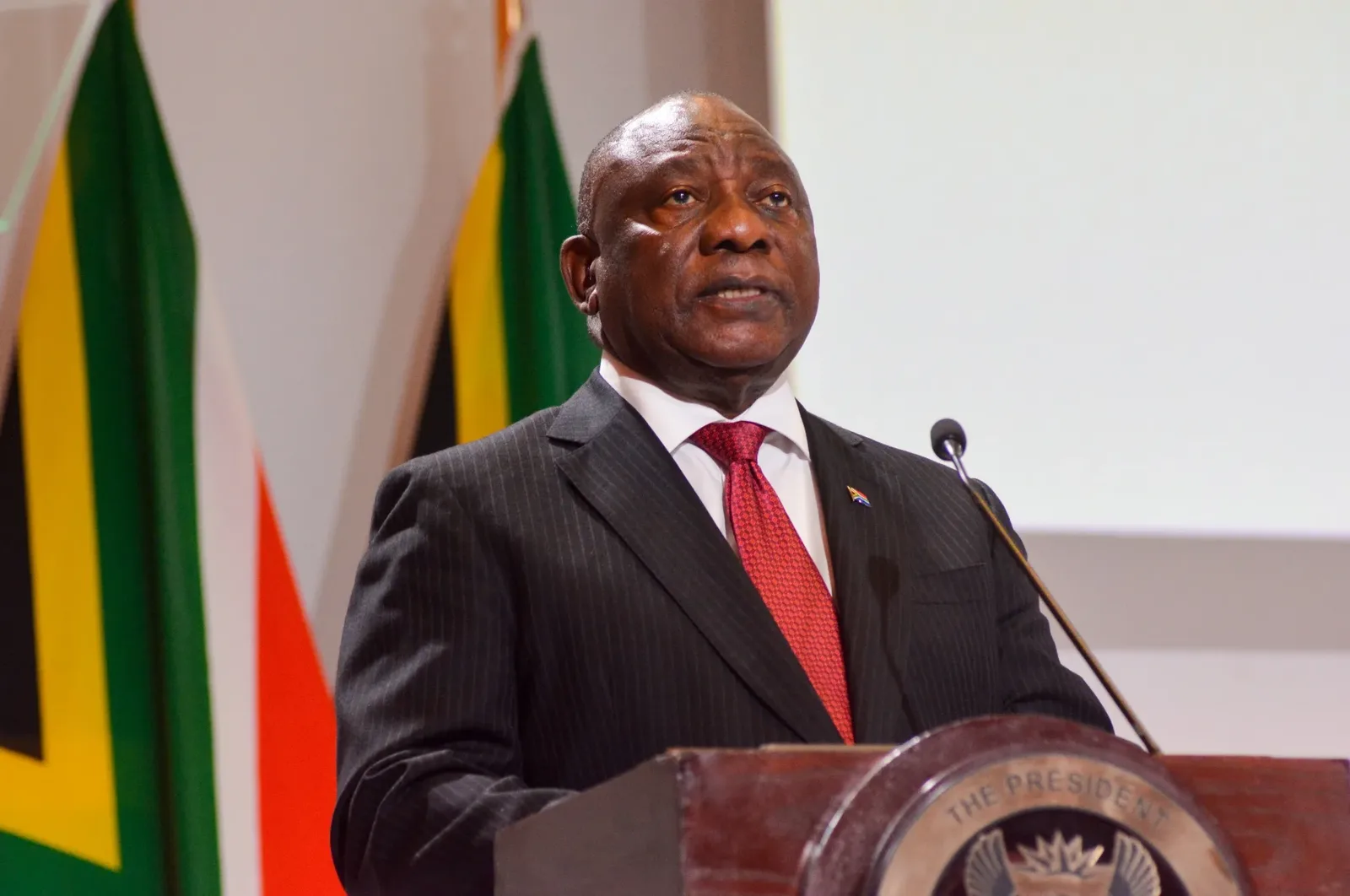
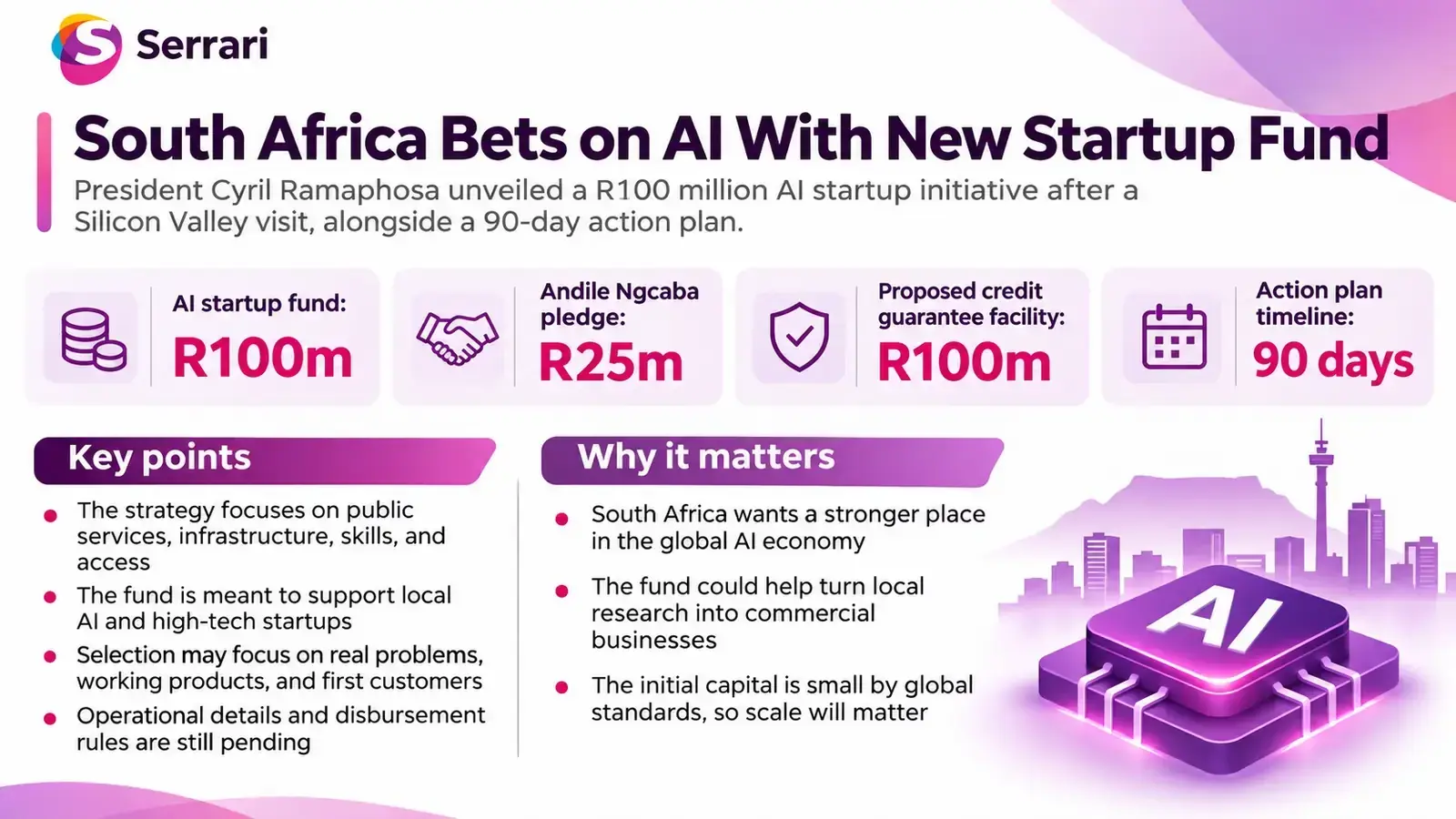
South Africa has announced plans to establish a R100 million ($5.9 million) venture capital fund to support artificial intelligence startups following President Cyril Ramaphosa’s November 2026 working visit to Silicon Valley. Supported by public and private sector commitments, including a R25 million pledge from technology investor Andile Ngcaba, the initiative forms part of a broader 90-day national AI action plan. The government is also proposing a similarly sized credit guarantee facility, potentially bringing the combined financing package to R200 million. Although the initial funding remains modest relative to global AI investment, the initiative could address early-stage financing constraints, accelerate commercialisation of university research, improve public service delivery and strengthen South Africa’s position within Africa’s emerging AI economy.
Key Overview
- South Africa plans to establish a R100 million ($5.9 million) venture capital fund targeting local AI and high-technology startups.
- Technology investor Andile Ngcaba has pledged R25 million, representing 25% of the proposed venture capital fund.
- A proposed R100 million credit guarantee facility could complement the venture capital initiative, bringing the combined financing package to R200 million.
- President Cyril Ramaphosa has directed the government to develop a national AI action plan within 90 days.
- The strategy prioritises public service delivery, infrastructure investment, domestic AI capabilities and management of technological risks.
- US private AI investment reached $285.9 billion in 2025, highlighting the substantial financing gap between South Africa and established technology markets.
- Commercial viability, functional prototypes and access to initial customers could become important considerations when selecting startups.
- The proposed fund’s management structure, formal investment criteria and disbursement timeline remain outstanding.
South Africa Seeks a Position in the Global AI Economy
South Africa is attempting to accelerate its participation in the global artificial intelligence economy through a combination of startup financing, infrastructure development and government-led technology adoption.
President Cyril Ramaphosa announced the proposed R100 million venture capital fund following a working visit to Silicon Valley, where a South African delegation of approximately 300 academics, entrepreneurs, technology specialists and government officials examined opportunities within the global AI industry.
The proposed startup financing initiative emerged from discussions between government and business leaders concerning the financial and technological barriers preventing South African entrepreneurs from developing competitive AI solutions.
The initiative addresses a growing economic concern. As artificial intelligence transforms industries ranging from financial services and healthcare to manufacturing and education, countries without domestic technological capabilities risk becoming consumers of foreign innovations rather than participants in their development.
For South Africa, this could translate into greater dependence on imported technology, recurring payments to international software providers and limited participation in the economic value generated by AI.
Establishing domestic AI businesses could help retain intellectual property, technical expertise and commercial revenues within the country.
The government is therefore attempting to create conditions under which South African entrepreneurs can develop technology locally while accessing international markets.
However, the fund represents an initial intervention rather than a comprehensive solution to the country’s technological financing requirements.
Why R100 Million Is Only the Beginning
The proposed fund highlights the considerable difference between South Africa’s emerging AI ecosystem and the financial resources available to established technology companies in major international markets.
According to global AI investment statistics, private investment in artificial intelligence reached approximately $344.7 billion globally in 2025, with the United States accounting for $285.9 billion.
Europe attracted approximately $20.9 billion, while China recorded $12.4 billion in private AI investment during the same period.
These figures illustrate the scale of capital supporting technological development elsewhere and the difficulties facing emerging economies seeking to compete directly.
South Africa’s proposed $5.9 million fund represents a fraction of the annual financing available within established technology ecosystems. Nevertheless, its effectiveness should not be evaluated exclusively against the investment budgets of multinational AI developers.
South Africa does not necessarily need to replicate the infrastructure or expenditure of companies developing the world’s largest foundational AI models.
Instead, its opportunity could lie in developing specialised applications that address commercially significant problems within African markets.
Startups could use existing models, open-source technologies and cloud infrastructure to develop products without independently financing the entire process of building advanced AI systems.
For example, a startup developing agricultural forecasting tools, automated insurance claims processing or multilingual customer service applications may require considerably less capital than a company training a foundational AI model.
The fund could therefore generate meaningful economic value if capital is allocated towards commercially viable businesses with achievable technical requirements.
Its long-term effectiveness, however, will depend on whether successful companies can subsequently access larger financing rounds to expand their operations.
How the R200 Million Financing Package Could Mobilise Private Capital
The venture capital fund forms part of a broader proposed financing package that also includes a credit guarantee facility of approximately R100 million.
According to government financing announcements, the combined initiative could provide approximately R200 million in startup support through different financing mechanisms.
The distinction between venture capital and credit guarantees is important.
Venture capital typically involves investors providing funding in exchange for ownership interests in businesses. It is particularly relevant for early-stage technology companies that may lack sufficient revenues or assets to qualify for conventional bank financing.
Credit guarantees, by contrast, can encourage lenders to provide financing by covering an agreed portion of potential losses if borrowers default.
The proposed guarantee facility would therefore not necessarily represent an additional R100 million in cash distributed directly to startups. Its purpose would be to reduce financing risks and potentially mobilise lending that might otherwise be unavailable.
Andile Ngcaba’s R25 million commitment represents an initial private-sector contribution to the venture capital initiative.
The government’s intention to match entrepreneurial commitments could also help encourage additional participation from investors who may otherwise be reluctant to finance early-stage technology businesses.
However, important details remain unresolved.
The proposed initiative has not yet publicly established its fund manager, final investment mandate, application procedures or confirmed disbursement schedule.
According to reporting on the fund’s implementation, the institutional arrangements required to convert the announcement into accessible startup financing still need to be established.
Transparent governance will be particularly important because the initiative combines public policy objectives with commercial investment decisions.
Context is everything. Stay ahead of shifting trends with today’s market updates, and uncover emerging opportunities using the Serrari Group Market Index and Marketplace. Then, take control of your own financial future by exploring our Money & Life Reset Transformation Blueprint ™ to build stronger habits, create better systems, and design a path toward lasting wealth.
Bridging the Gap Between University Research and Commercial Businesses
One of the most important lessons South Africa could draw from Silicon Valley concerns the relationship between academic research, entrepreneurship, investment and commercial demand.
Universities can produce technological innovations, but research does not automatically translate into commercially sustainable businesses.
Entrepreneurs must establish whether potential customers are willing to purchase their products, develop scalable business models and secure sufficient funding to support product development.
In comments on startup selection, Wits University professor Abejide Ade-Ibijola identified practical considerations including the relevance of the problem being addressed, evidence that the proposed technology works and the availability of potential customers willing to test it.
These considerations highlight the importance of funding businesses based on commercial and technical merit rather than technological ambition alone.
A startup with a functional prototype and a prospective customer may offer a clearer pathway towards commercialisation than a business proposing an ambitious AI system without demonstrated demand.
The approach could also improve opportunities for entrepreneurs outside established technology centres.
Founders operating in townships, rural communities and smaller towns could potentially develop products addressing local challenges that larger technology companies overlook.
However, inclusive participation requires more than establishing eligibility criteria.
Entrepreneurs also need reliable internet connectivity, computing resources, technical mentorship, legal support and access to potential customers.
Without these complementary resources, the funding initiative risks disproportionately benefiting startups already connected to established investment and technology networks.
South Africa’s 90-Day AI Action Plan
President Ramaphosa has instructed the government to develop a concrete national AI action plan within 90 days, reflecting an effort to move beyond general policy commitments towards measurable implementation.
The national AI action plan is expected to focus on four immediate priorities: modernising government services, attracting investment in computing infrastructure, expanding domestic technological capabilities and addressing risks associated with AI adoption.
These priorities reflect the interconnected requirements of a competitive technology economy.
Funding startups without expanding computing infrastructure could leave entrepreneurs dependent on expensive international services.
Similarly, investing in infrastructure without developing technical skills could limit domestic businesses’ ability to use available resources productively.
The government must therefore coordinate its investments across infrastructure, education, innovation financing and commercial development.
The initiative also follows earlier difficulties in establishing a comprehensive national AI policy.
In June 2026, Cabinet confirmed the withdrawal of the draft AI policy to allow further development of the framework.
The new action plan provides an opportunity to restore confidence in the policy process and establish clearer implementation responsibilities.
However, the government’s 90-day deadline concerns the development of the plan, rather than the completion of every infrastructure or startup financing initiative.
Computing Infrastructure Could Determine South Africa’s AI Competitiveness
Access to computing power remains one of the most significant barriers facing emerging AI businesses.
Developing and deploying sophisticated applications can require specialised processors, cloud services, data storage and high-performance computing infrastructure.
These resources can be expensive, particularly for startups generating revenues in local currencies while purchasing international computing services priced in US dollars.
Exchange rate fluctuations can consequently increase development costs and shorten the period during which a startup can operate before requiring additional funding.
During his Silicon Valley investment address, Ramaphosa identified the attraction of AI computing infrastructure as an opportunity to serve South Africa and the wider African market.
Developing local computing capacity could reduce certain infrastructure constraints and support businesses requiring secure access to domestic data processing facilities.
However, data centre development introduces additional challenges.
AI infrastructure requires dependable electricity supplies, cooling systems, telecommunications networks and substantial capital expenditure.
For South Africa, improving electricity reliability and expanding digital connectivity are therefore closely connected to its broader technological ambitions.
An effective infrastructure strategy must consider not only the construction of data centres but also whether domestic researchers and startups can afford to access them.
Otherwise, expanding infrastructure could primarily benefit large international companies without sufficiently strengthening the local innovation ecosystem.
Artificial Intelligence as a Tool for Economic Development
South Africa’s AI strategy is not exclusively focused on building technology companies. It also seeks to address longstanding economic and public service delivery challenges.
Potential applications include improving administrative efficiency, identifying infrastructure maintenance requirements, strengthening healthcare diagnostics and supporting agricultural productivity.
Government institutions could also become important initial customers for domestic AI businesses.
Public procurement arrangements that enable qualified startups to pilot technological solutions could help businesses establish commercial credibility while addressing service delivery challenges.
However, public sector adoption must include safeguards governing data protection, cybersecurity, accuracy and accountability.
AI systems used in sensitive areas such as healthcare, financial services or social protection can produce harmful outcomes if they rely on inaccurate or unrepresentative data.
South Africa’s existing AI policy framework recognises the importance of responsible technology development alongside innovation, skills expansion and infrastructure investment.
The challenge will be translating these principles into operational standards that protect citizens without creating excessive barriers for emerging businesses.
AI adoption could also reshape employment patterns by automating certain tasks while creating demand for new technical and professional capabilities.
Consequently, the country’s technology strategy must incorporate workforce training and education to ensure that productivity improvements generate broadly distributed economic benefits.
Can South Africa Become an African AI Innovation Hub?
South Africa’s established universities, financial institutions, telecommunications networks and technology businesses provide a foundation for developing an internationally competitive AI ecosystem.
Its opportunity lies in creating products that address the economic and operational realities of African markets, including multilingual communication, financial inclusion, agricultural development and resource-constrained public services.
Solutions designed around these challenges could eventually find customers beyond South Africa, allowing domestic startups to expand into other emerging markets.
Nevertheless, achieving that objective will require substantially more than an initial R100 million venture capital fund.
Successful businesses will need access to follow-on financing, reliable infrastructure, skilled employees and regulatory environments that support cross-border commercial activity.
The government must also demonstrate that public-private investment programmes can allocate capital transparently and generate measurable results.
The initiative’s success should ultimately be assessed through the number of commercially sustainable businesses created, private investment mobilised, technologies adopted and employment opportunities generated.
South Africa’s initial funding commitment is modest relative to the global AI economy, but its strategic importance lies in whether it can create an ecosystem capable of attracting progressively larger investments.
If the government can connect researchers, entrepreneurs, infrastructure providers, investors and customers, the country could develop a distinctive position within Africa’s AI economy rather than simply attempting to replicate Silicon Valley.
Sources: Forbes Africa / SAnews / South African Government / Stanford Institute for Human-Centered Artificial Intelligence / StartupNews Africa / OECD.AI
Your financial future isn’t something you wait for—it’s something you build.
The real question is: when do you begin?
Move beyond simply staying informed.
Navigate the markets with clarity—track trends through the Serrari Group Market Index, uncover opportunities in the Serrari Marketplace, and build practical knowledge with our Curated Wealth Builder Platform.
Stay connected to what truly matters.
Get daily insights on macro trends and financial movements across Kenya, Africa, and global markets—delivered through the Serrari Newsletter.
Growth opens doors.
Advance your career through professional programs including ACCA, HESI A2, ATI TEAS 7 , HESI EXIT , NCLEX – RN and NCLEX – PN, Financial Literacy!🌟—designed to move you forward with confidence.
See where money is flowing—clearly and in real time.
Track Money Market Funds, Treasury Bills, Treasury Bonds, Green Bonds, and Fixed Deposits, alongside global and African indexes, key economic indicators, and the evolving Crypto and stablecoin landscape—all within Serrari’s Market Index.