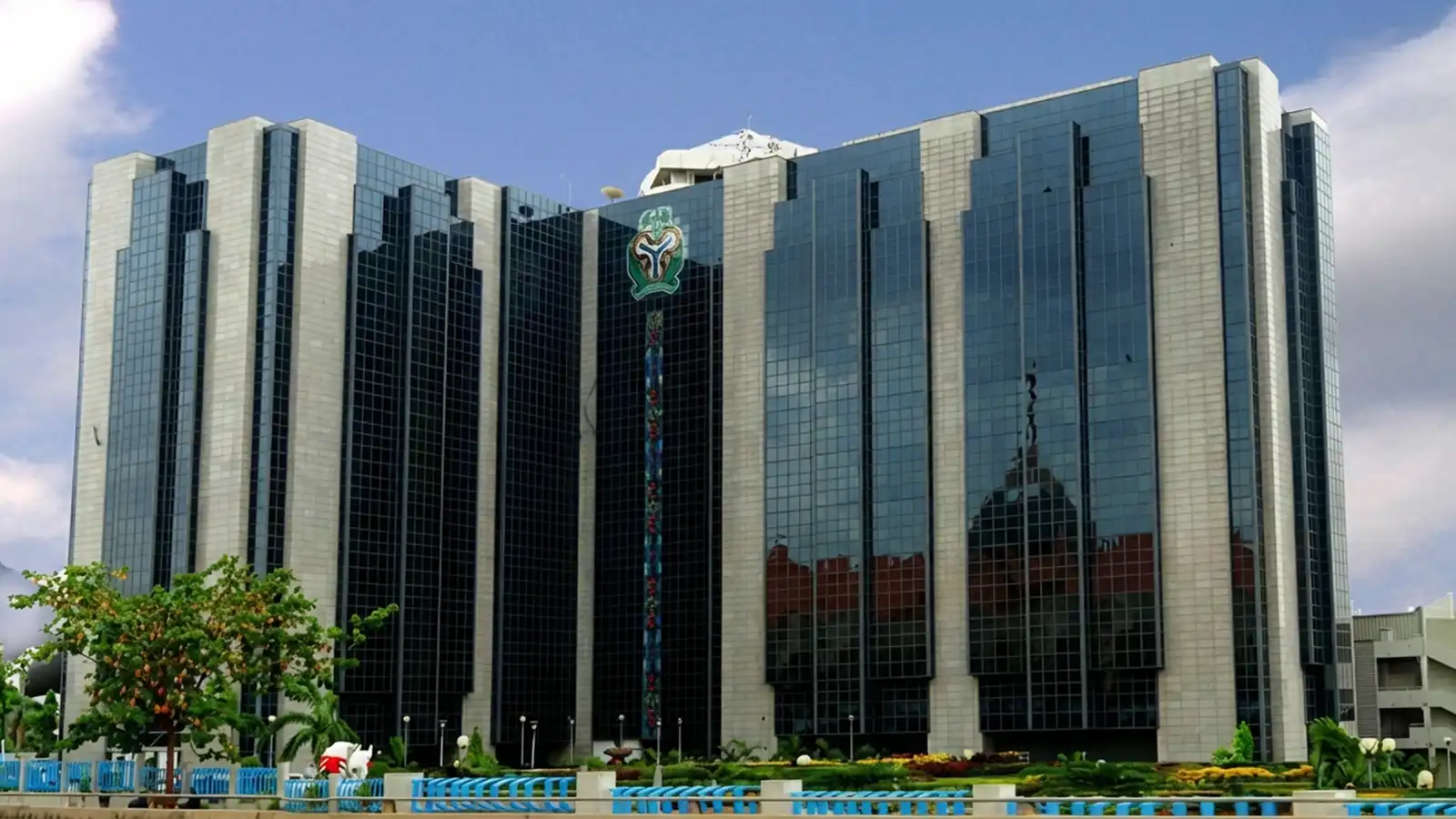
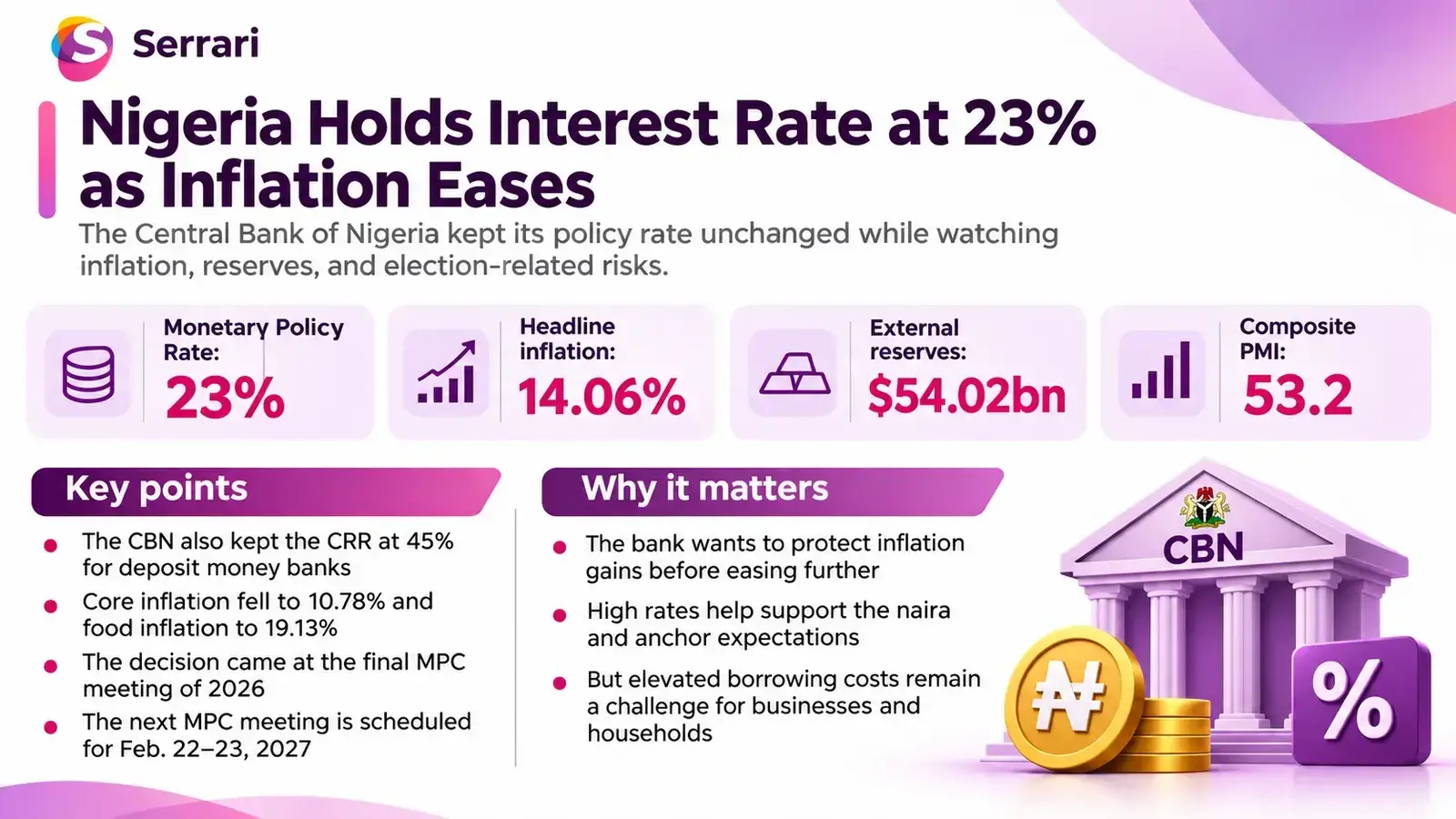
The Central Bank of Nigeria (CBN) has retained its benchmark Monetary Policy Rate (MPR) at 23% following its 308th Monetary Policy Committee (MPC) meeting held on November 23–24, 2026, despite headline inflation declining for a fifth consecutive month to 14.06% in October. The decision follows September’s substantial 350-basis-point rate reduction and reflects concerns about rising global energy costs, festive-season expenditure and election-related spending ahead of Nigeria’s January 2027 national elections. With gross external reserves standing at $54.02 billion and business activity continuing to expand, Nigeria’s monetary authorities are prioritising sustained disinflation and exchange rate stability over accelerated monetary easing. However, elevated borrowing costs and persistent food inflation remain significant challenges for households and businesses.
Key Overview
- The Central Bank of Nigeria retained its benchmark interest rate at 23% during its final scheduled monetary policy meeting of 2026.
- Headline inflation declined for a fifth consecutive month to 14.06% in October, from 14.63% in September.
- Core inflation decreased from 12.95% to 10.78%, while food inflation moderated from 19.59% to 19.13%.
- Monthly inflation accelerated from 0.06% in September to 0.43% in October, highlighting persistent underlying price pressures.
- Gross external reserves stood at $54.02 billion on November 17, sufficient to cover 10.26 months of goods and services imports.
- Nigeria’s composite Purchasing Managers’ Index increased from 53.0 to 53.2 points, indicating continued business activity expansion.
- The CBN and Nigerian National Petroleum Company Limited signed an agreement to strengthen foreign exchange inflows and energy project financing.
- The next MPC meeting is scheduled for February 22–23, 2027, following Nigeria’s national elections.
Nigeria Pauses Monetary Easing to Protect Inflation Gains
The Central Bank of Nigeria has opted to maintain its restrictive monetary policy stance as the country attempts to consolidate recent improvements in inflation and broader macroeconomic stability.
Announcing the outcome of the Monetary Policy Committee meeting on November 24, CBN Governor Olayemi Cardoso confirmed that the benchmark interest rate would remain at 23%.
Under the official November monetary policy communiqué, the committee also retained its existing liquidity management parameters, reflecting a preference for policy continuity amid domestic and international economic uncertainties.
Monetary Policy Indicator
Previous Rate
November 2026 Rate
Monetary Policy Rate
23.00%
23.00%
Standing Lending Facility Rate
23.50%
23.50%
Standing Deposit Facility Rate
20.00%
20.00%
Cash Reserve Requirement – Deposit Money Banks
45.00%
45.00%
Cash Reserve Requirement – Merchant Banks
16.00%
16.00%
Cash Reserve Requirement – Non-TSA Public Sector Deposits
75.00%
75.00%
The decision follows the CBN’s 350-basis-point interest rate reduction in September 2026, when the benchmark rate was lowered from 26.5% to 23%.
That substantial adjustment marked an important shift in Nigeria’s monetary policy cycle following an extended period of aggressive tightening.
However, monetary policy operates with a time lag. Changes in benchmark interest rates can take several months to influence commercial lending, household consumption, business investment and inflation.
Maintaining the current rate provides policymakers with additional time to assess whether September’s reduction is generating the intended economic benefits without destabilising prices or the foreign exchange market.
The CBN’s decision therefore represents a consolidation of its earlier monetary easing rather than an abandonment of the broader interest rate reduction cycle.
Why Falling Inflation Has Not Triggered Another Rate Cut
Nigeria’s inflation outlook has improved considerably, but the underlying data suggest that price pressures remain insufficiently contained to justify another immediate interest rate reduction.
According to October consumer price data, annual headline inflation declined from 14.63% in September to 14.06% in October, representing a reduction of 0.57 percentage points.
The improvement was supported by easing food and core inflation.
Inflation Indicator
September 2026
October 2026
Change
Headline Inflation
14.63%
14.06%
-0.57 pp
Core Inflation
12.95%
10.78%
-2.17 pp
Food Inflation
19.59%
19.13%
-0.46 pp
Monthly Headline Inflation
0.06%
0.43%
+0.37 pp
However, the increase in monthly inflation provides an important qualification to the improving annual figures.
The month-on-month inflation assessment indicates that consumer prices increased by 0.43% in October, compared with 0.06% in September.
This means that although prices were rising more slowly than they were a year earlier, the pace of monthly price increases accelerated.
Annual inflation can decline because of favourable base effects even when immediate price pressures begin strengthening. Consequently, policymakers must examine both measures before concluding that inflation has been sustainably controlled.
At 23%, Nigeria’s benchmark interest rate remains 8.94 percentage points above the current headline inflation rate. This positive nominal policy-rate spread illustrates the restrictive nature of monetary policy, although it should not be interpreted as a forward-looking real investment return.
Reducing interest rates prematurely could stimulate borrowing and consumption at a time when seasonal expenditure and external energy shocks threaten to renew inflationary pressures.
The CBN is therefore prioritising the durability of disinflation over the speed of monetary easing.
Food Inflation Remains a Major Challenge for Nigerian Households
Despite improvements in Nigeria’s overall inflation outlook, food prices continue to impose substantial financial pressure on households.
Food inflation stood at 19.13% in October, exceeding headline inflation by 5.07 percentage points.
According to the latest food inflation figures, improved agricultural supply associated with the harvest season contributed to moderating price pressures, although food inflation remained elevated.
For lower-income households, food inflation can be considerably more economically significant than the headline consumer price index because essential goods account for a substantial proportion of household expenditure.
Declining inflation also does not mean that food has become cheaper. It means that prices are generally increasing at a slower annual rate.
Households continue to experience the cumulative effects of earlier price increases, particularly where wages have failed to keep pace with living costs.
Monetary policy can help contain demand-driven inflation, but it cannot independently resolve agricultural production constraints, transportation costs, insecurity, storage deficiencies or supply-chain disruptions.
Sustainable reductions in food inflation will therefore require improvements in agricultural productivity, distribution infrastructure and domestic food supply.
Without these complementary interventions, the CBN may face continued pressure to maintain elevated interest rates even when the primary drivers of inflation originate outside the financial system.
Election Spending and Energy Costs Threaten Nigeria’s Inflation Outlook
The timing of November’s monetary policy decision is particularly significant because Nigeria is approaching its January 2027 national elections.
The November meeting was the final scheduled MPC gathering before the elections, making policy stability especially important during the intervening period.
Election campaigns and year-end festivities can increase expenditure across transportation, hospitality, advertising, consumer goods and other economic activities.
If additional demand grows faster than the economy’s capacity to supply goods and services, businesses may respond by increasing prices.
Nigeria also remains exposed to international energy market disruptions arising from the ongoing Middle East conflict.
Although Nigeria is a major crude oil producer, higher international energy prices do not automatically translate into lower domestic inflation.
Rising petroleum prices can increase transportation expenses, electricity generation costs and manufacturing expenditure, particularly where businesses depend on fuel-powered equipment.
Higher crude oil prices may simultaneously strengthen Nigeria’s export earnings and foreign exchange availability, creating competing economic effects.
The ultimate impact depends on domestic refining capacity, production volumes, exchange rate movements and the extent to which higher international prices are transmitted into local markets.
Maintaining restrictive monetary conditions provides the CBN with a buffer against the possibility that these pressures reverse recent inflation improvements.
Context is everything. Stay ahead of shifting trends with today’s market updates, and uncover emerging opportunities using the Serrari Group Market Index and Marketplace. Then, take control of your own financial future by exploring our Money & Life Reset Transformation Blueprint ™ to build stronger habits, create better systems, and design a path toward lasting wealth.
Nigeria’s $54.02 Billion External Reserves Support the Naira
Nigeria’s foreign exchange reserves remain an important component of the country’s macroeconomic stabilisation strategy.
According to November external reserve disclosures, gross reserves stood at $54.02 billion on November 17, sufficient to finance approximately 10.26 months of goods and services imports.
This represents a substantial external liquidity buffer, although reserves have declined from the $55.25 billion reported on September 18.
The difference amounts to approximately $1.23 billion, or 2.23%, over the two reporting dates.
Foreign exchange reserves are important because they strengthen a central bank’s capacity to manage external payment requirements and respond to disorderly currency market conditions.
For Nigeria, exchange rate stability has direct implications for inflation because imported fuel, machinery, pharmaceuticals, industrial components and other goods are affected by the naira’s purchasing power.
A depreciating currency can increase import costs even when international commodity prices remain unchanged.
The International Monetary Fund’s 2026 assessment of Nigeria’s economic reforms emphasised the importance of maintaining restrictive monetary conditions until inflation expectations become sufficiently anchored.
However, gross external reserves should not be interpreted as resources that are entirely available for discretionary spending or unrestricted currency intervention.
Their effectiveness also depends on foreign currency liabilities, capital flows, import demand and the sustainability of export earnings.
CBN–NNPC Partnership Seeks to Strengthen Foreign Exchange Inflows
The Central Bank of Nigeria’s collaboration with the Nigerian National Petroleum Company Limited represents an additional effort to strengthen the country’s external financial position.
On November 18, 2026, the institutions signed a foreign exchange and energy financing agreement intended to improve coordination between monetary authorities and Nigeria’s petroleum industry.
The initiative could strengthen the management of foreign currency revenues generated through oil and gas activities while supporting financing arrangements for energy projects.
Nigeria’s dependence on petroleum export earnings makes the performance of its energy sector particularly important to exchange rate stability.
When crude oil production declines or export revenues weaken, foreign currency availability can deteriorate, placing pressure on the naira and increasing import-related inflation.
Improved coordination between the CBN and NNPC could help strengthen transparency, improve foreign exchange liquidity and support reserve accumulation.
However, the agreement does not automatically guarantee additional dollar inflows. Its effectiveness will depend on implementation, petroleum production performance, revenue collection and the underlying commercial arrangements.
Elevated Interest Rates Continue to Reshape Nigeria’s Financial Markets
The decision to maintain the benchmark interest rate at 23% has contrasting implications for savers, borrowers, businesses and financial institutions.
Restrictive monetary policy can support demand for Treasury bills, government bonds and other fixed-income instruments by sustaining relatively attractive nominal yields.
For banks, however, the 45% Cash Reserve Requirement continues to constrain the proportion of eligible deposits available for lending and other activities.
Higher financing costs can discourage business expansion, particularly among small and medium-sized enterprises that rely on bank credit for working capital.
Commercial borrowers must also contend with lending margins and other financing charges that can result in effective borrowing costs exceeding the benchmark policy rate.
Despite these constraints, business activity continues to expand.
Nigeria’s October business activity indicators showed that the composite Purchasing Managers’ Index increased to 53.2 points from 53.0 in September.
A reading above 50 generally indicates expanding business activity, suggesting that economic conditions remain sufficiently resilient to withstand the current monetary policy stance.
Nevertheless, a sustained period of elevated interest rates could eventually restrict investment and employment growth if businesses struggle to obtain affordable financing.
What Could Trigger Nigeria’s Next Interest Rate Cut?
With the next MPC meeting scheduled for February 22–23, 2027, Nigeria’s monetary authorities will have several months to assess developments in inflation, exchange rates and economic activity.
The central bank will need to determine whether annual and monthly inflation are consistently moderating, whether festive-season and election expenditure has generated additional price pressures, and whether foreign exchange reserves remain sufficiently robust.
An earlier analysis of Nigeria’s inflation dynamics found that recent economic reforms had reduced inflation persistence and strengthened the economy’s responsiveness to monetary policy.
Continued progress could create room for further interest rate reductions in 2027.
However, renewed currency depreciation, energy price shocks or persistent food inflation could delay monetary easing.
The broader significance of November’s decision is that Nigeria is attempting to transition from emergency inflation control towards more sustainable macroeconomic management.
The central bank must now balance the need to preserve economic stability against the growing demand for affordable credit and stronger private-sector investment.
Nigeria’s ability to achieve sustained disinflation without undermining economic growth will ultimately determine whether its monetary policy reforms translate into meaningful improvements in household purchasing power, business profitability and long-term investment.
Sources: Nigerian Tribune / Zawya / Central Bank of Nigeria / Reuters / Channels Television / Voice of Nigeria / Punch / DMarketForces / International Monetary Fund / ThisDay
Your financial future isn’t something you wait for—it’s something you build.
The real question is: when do you begin?
Move beyond simply staying informed.
Navigate the markets with clarity—track trends through the Serrari Group Market Index, uncover opportunities in the Serrari Marketplace, and build practical knowledge with our Curated Wealth Builder Platform.
Stay connected to what truly matters.
Get daily insights on macro trends and financial movements across Kenya, Africa, and global markets—delivered through the Serrari Newsletter.
Growth opens doors.
Advance your career through professional programs including ACCA, HESI A2, ATI TEAS 7 , HESI EXIT , NCLEX – RN and NCLEX – PN, Financial Literacy!🌟—designed to move you forward with confidence.
See where money is flowing—clearly and in real time.
Track Money Market Funds, Treasury Bills, Treasury Bonds, Green Bonds, and Fixed Deposits, alongside global and African indexes, key economic indicators, and the evolving Crypto and stablecoin landscape—all within Serrari’s Market Index.