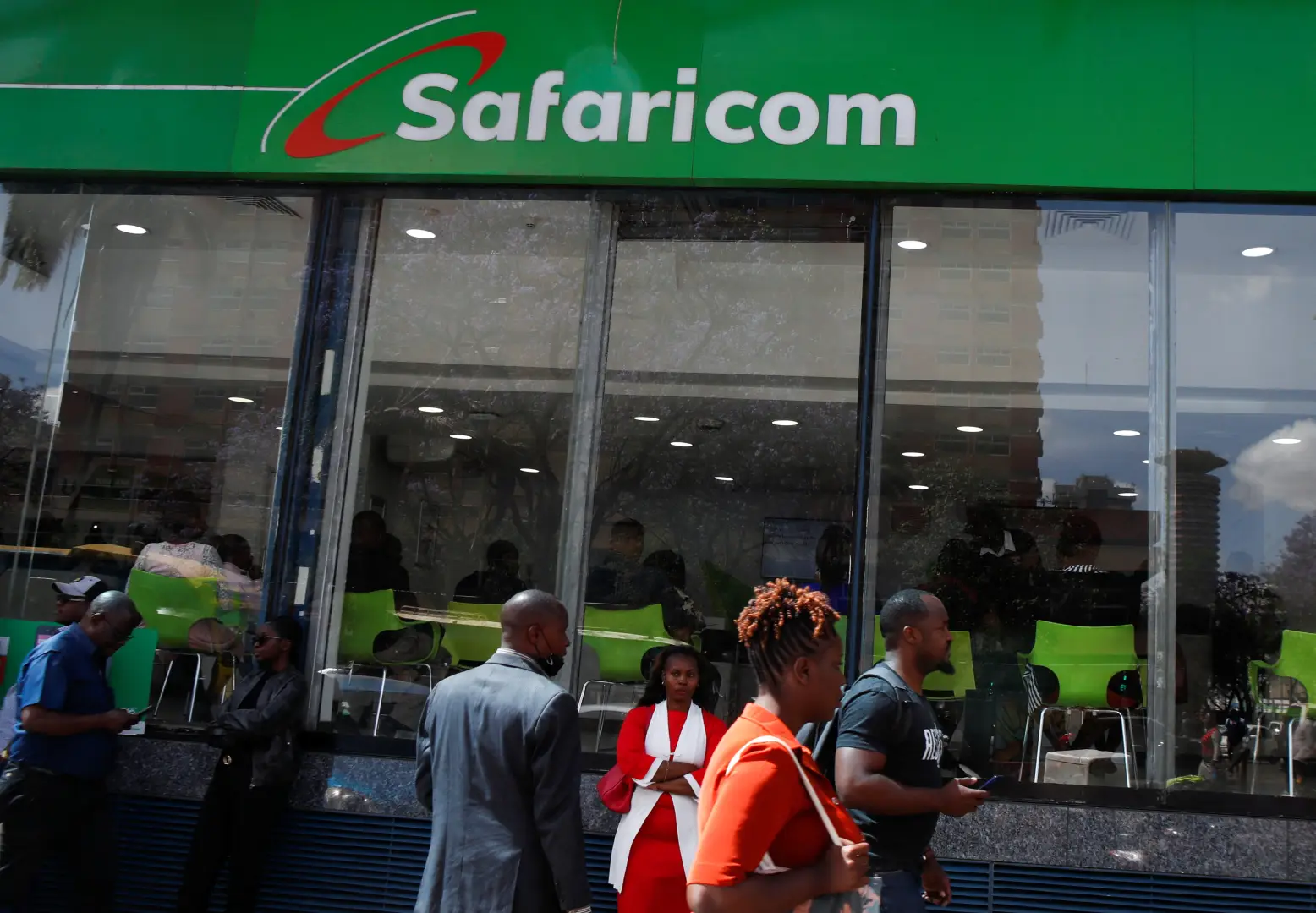
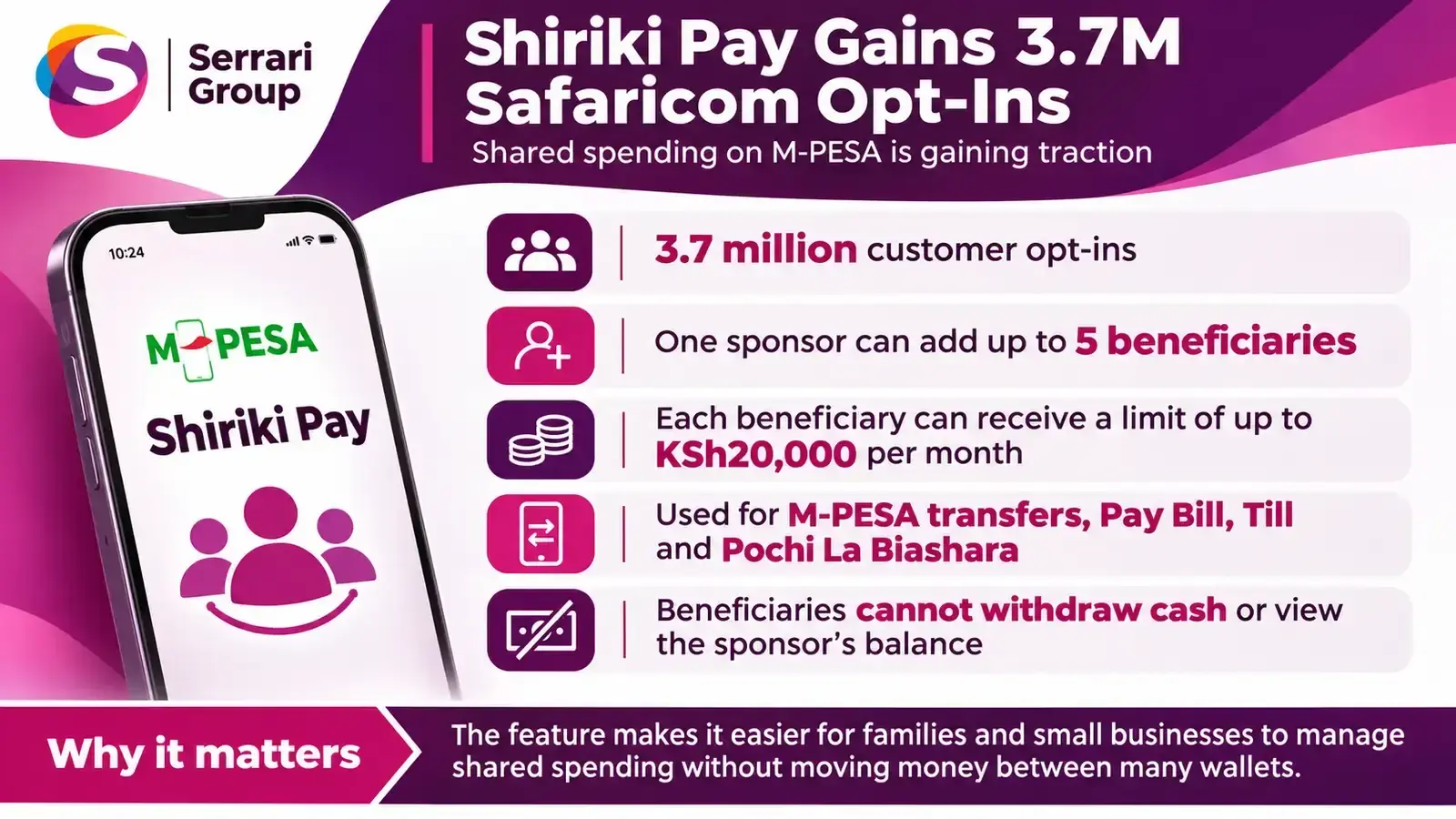
Safaricom has reported more than 3.7 million customer opt-ins for Shiriki Pay, a service allowing M-PESA account holders to authorise trusted individuals to spend directly from their wallets. Officially launched on November 24, 2026, the feature addresses the difficulty of coordinating household and business expenses across separate mobile money accounts. Its emergence reflects a wider shift in Kenya’s digital payments industry from transferring money towards managing how it is spent. For Safaricom, the opportunity lies in increasing customer engagement and strengthening M-PESA’s role in everyday commerce, although sustained usage, transaction costs and consumer protection will determine its long-term commercial value.
Key Overview
- Shiriki Pay has attracted more than 3.7 million customer opt-ins since becoming publicly available.
- A sponsor can nominate five beneficiaries, each with a monthly limit of up to KSh20,000.
- The combined maximum allocation is KSh100,000 monthly, subject to available funds and applicable transaction limits.
- Beneficiaries cannot withdraw cash or inspect the sponsor’s wallet balance or transaction history.
- M-PESA revenue reached KSh100.1 billion in the six months ended September 2026, growing 13.6% year on year.
- Opt-ins do not establish how many customers transact regularly or how much incremental revenue Shiriki Pay generates.
Why Safaricom Is Targeting Shared Financial Responsibilities
Safaricom’s latest mobile money innovation addresses a mismatch between the way people own financial accounts and the way they organise economic activity. Although an M-PESA wallet belongs to an individual account holder, responsibility for household expenditure is frequently distributed among several people.
The November 24 launch announcement highlights the company’s attempt to reduce the need for repeated transfers whenever another person must pay for goods or services on behalf of the account holder.
Consider a household in which one person receives the principal income while another purchases groceries, pays service providers or handles routine errands. The conventional mobile money arrangement requires the income earner to transfer funds before those payments can be completed, unless the other person already has sufficient money.
This process can create unnecessary coordination, particularly when expenditure occurs frequently or the person responsible for funding purchases is unavailable. It can also leave unused money distributed across multiple wallets, making it harder to establish how much remains available for other household obligations.
Delegated spending changes that arrangement. Rather than transferring ownership of money before a purchase, the account holder grants another person permission to initiate certain transactions using funds that remain in the original wallet until spent.
The distinction is commercially important because it introduces an additional reason to retain money within M-PESA. Customers can use one funding source to support several people’s payments without necessarily maintaining separate prepaid balances for every participant.
How Spending Limits Change Household Cash Management
Under the sponsor-beneficiary arrangement, customers establish individual permissions through My OneApp or the *334# menu. Permitted activities include person-to-person transfers and payments through Pay Bill, Till and Pochi La Biashara channels.
The limits are spending permissions rather than deposits into separate accounts. Consequently, authorising several beneficiaries does not increase the amount of money available to the household.
Suppose a household has KSh35,000 available for monthly expenses. It could assign KSh12,000 for groceries, KSh8,000 for a dependant’s expenses and KSh5,000 for routine household purchases, leaving KSh10,000 unallocated within its budget.
If the three beneficiaries collectively spend KSh18,000, the sponsor would retain KSh17,000 before applicable charges and any other transactions. The remaining permissions would not represent additional money independent of that balance.
This example illustrates a potential budgeting advantage: unused allowances need not sit in separate accounts. However, the spending limits do not themselves reserve the sponsor’s funds for a particular obligation. The sponsor’s own purchases can reduce the money available to beneficiaries, and competing authorised payments can draw down the same balance.
Households therefore still need to establish spending priorities and preserve sufficient liquidity for rent, school fees, utilities and emergencies. Delegated access can improve coordination, but it cannot replace a realistic budget.
Context is everything. Stay ahead of shifting trends with today’s market updates, and uncover emerging opportunities using the Serrari Group Market Index and Marketplace. Then, take control of your own financial future by exploring our Money & Life Reset Transformation Blueprint ™ to build stronger habits, create better systems, and design a path toward lasting wealth.
Small Businesses Could Reduce the Cost of Managing Petty Cash
The product also addresses a common operational problem for small enterprises that rely on owners to approve and finance routine purchases.
A shop manager may need to replenish packaging materials, pay a local supplier or settle an urgent transport expense while the owner is away. Requiring a separate transfer for every purchase can delay transactions and consume management time.
A controlled allowance can reduce that dependence by enabling an employee to complete eligible payments within a predetermined limit. The owner can retain oversight without having to personally initiate every transaction.
For example, a small enterprise could authorise two employees to spend up to KSh10,000 each per month. That would establish a combined ceiling of KSh20,000 without requiring the business to hand over that amount in cash at the beginning of the month.
Nevertheless, a monetary limit is not the same as a comprehensive procurement control. The published product descriptions do not establish that sponsors can restrict every transaction to a specific supplier, require multiple approvals or automatically reconcile payments against invoices.
Businesses would still need receipts, expense classifications and procedures for reviewing transactions. Larger organisations with complex accounting and approval requirements may need dedicated corporate payment systems instead.
For microenterprises, the commercial benefit is likely to come from simpler routine administration rather than replacing formal treasury management systems.
Why Shiriki Pay Matters to Safaricom’s Revenue Strategy
M-PESA has become increasingly important to Safaricom’s financial performance. The company’s half-year results reported in November 2026 show that mobile financial services revenue crossed KSh100 billion for the first time in a six-month reporting period.
The KSh100.1 billion figure represented year-on-year growth of 13.6%. The scale of the business explains why developing additional uses for existing wallets is strategically important.
In a mature payments market, growth cannot depend indefinitely on registering people who have never used mobile money. A provider must also persuade existing customers to use its services for more of their economic activities.
Shiriki Pay could contribute by making M-PESA more useful to households and businesses with shared financial responsibilities. It could also increase the likelihood that a payment is completed digitally instead of through cash or another payment provider.
However, the financial effect is not straightforward. If delegated payments replace an initial person-to-person transfer followed by a merchant payment, some existing fee-generating transactions could disappear. Additional merchant activity and stronger customer retention might offset that effect, but the net outcome depends on pricing and actual usage patterns.
The reported 3.7 million opt-ins demonstrate initial interest in the product, not verified incremental earnings. Investors would need product-level transaction volumes, active usage and revenue information to assess the financial contribution independently.
Financial Inclusion Is Moving Beyond Account Ownership
The 2024 FinAccess Household Survey findings placed formal financial access in Kenya at 84.8%, compared with 83.7% in 2021. Mobile money has played a central role in extending access to regulated financial services.
As access becomes more widespread, the next challenge is improving the usefulness of those services. Opening an account does not automatically enable a person to manage irregular income, coordinate family expenses or withstand financial shocks.
Shared payment permissions could help people who depend on financial support from relatives by reducing the need to request individual transfers for routine expenses. They could also allow income earners to provide support while retaining visibility over payments made using their funds.
There are important limitations. A beneficiary’s ability to transact remains dependent on the sponsor’s permission and available resources. The arrangement does not create independent income, savings or financial autonomy for the beneficiary.
Nor should it be confused with a joint bank account in which multiple holders may have ownership rights under the account agreement. Shiriki Pay is a delegated spending feature attached to an individual wallet.
Consumer Protection Will Determine Long-Term Trust
The service incorporates restrictions on beneficiary access designed to protect the sponsor’s financial information. Account holders can review activity, change permissions and remove beneficiaries without disclosing their own PINs.
Nevertheless, a trusted person can make a permitted transaction that the sponsor considers inappropriate. In particular, the ability to send money to another mobile wallet means that preventing direct cash withdrawals is not equivalent to eliminating every possible misuse of funds.
Sponsors should understand what transactions their beneficiaries can initiate, establish realistic limits and remove permissions when an arrangement ends. Clear dispute-resolution procedures and accessible customer support will be important when transactions are contested.
The launch coverage does not establish a complete product-specific tariff schedule or quantify fee savings. Customers should therefore check applicable charges rather than assume every delegated payment is free.
For Safaricom, the longer-term test will be whether customers continue using Shiriki Pay after opting in, whether payments become easier to manage and whether the service maintains consumer trust as usage expands. The commercial significance of the innovation is not simply that more people can spend from one wallet, but that mobile money is increasingly becoming a tool for coordinating financial decisions rather than merely moving funds between accounts.
Sources Used
Bizna Kenya / Pulse Kenya / Kenya News Agency / TechTrendsKE / Central Bank of Kenya / People Daily
Your financial future isn’t something you wait for—it’s something you build.
The real question is: when do you begin?
Move beyond simply staying informed.
Navigate the markets with clarity—track trends through the Serrari Group Market Index, uncover opportunities in the Serrari Marketplace, and build practical knowledge with our Curated Wealth Builder Platform.
Stay connected to what truly matters.
Get daily insights on macro trends and financial movements across Kenya, Africa, and global markets—delivered through the Serrari Newsletter.
Growth opens doors.
Advance your career through professional programs including ACCA, HESI A2, ATI TEAS 7 , HESI EXIT , NCLEX – RN and NCLEX – PN, Financial Literacy!🌟—designed to move you forward with confidence.
See where money is flowing—clearly and in real time.
Track Money Market Funds, Treasury Bills, Treasury Bonds, Green Bonds, and Fixed Deposits, alongside global and African indexes, key economic indicators, and the evolving Crypto and stablecoin landscape—all within Serrari’s Market Index.