US stock markets retreated on Tuesday, November 24, 2026, as the initial enthusiasm surrounding Jensen Huang’s reinstatement as Nvidia’s chief executive gave way to renewed concerns about artificial intelligence valuations, corporate governance and rising borrowing costs. Anthropic’s shares slipped below their initial public offering price, reinforcing doubts about the profitability of AI investments. Meanwhile, the dollar weakened ahead of crucial US inflation data, despite financial markets anticipating another Federal Reserve interest rate increase in December. The developments highlight growing investor scrutiny of the financial sustainability of the AI infrastructure boom.
Key Overview
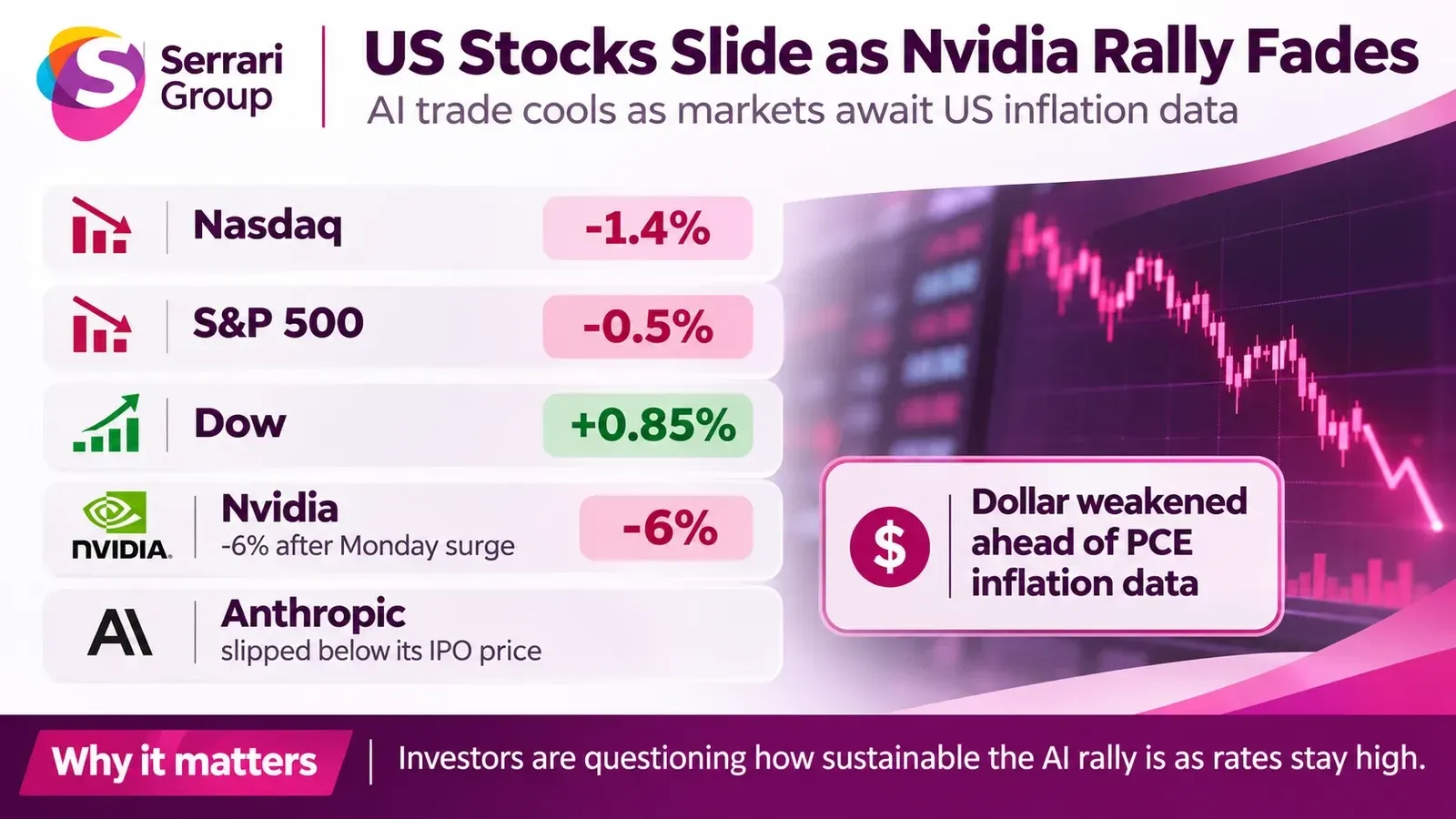
- Nvidia shares declined 5.9% at Tuesday’s close after surging 31.5% on Monday following Jensen Huang’s reinstatement as CEO.
- Anthropic shares fell 6.5% to $81.90, below their $83 initial public offering price.
- The Nasdaq Composite declined 1.48%, while the S&P 500 fell 0.50% and the Dow Jones Industrial Average gained 0.85%.
- Investors rotated towards selected defensive stocks and established businesses amid concerns about AI profitability.
- Financial markets priced in approximately a 97–98% probability of a December Federal Reserve interest rate increase.
- The US dollar retreated from a 20-month high ahead of key inflation data.
- Brent crude rose to $91.40 per barrel following renewed security concerns around the Strait of Hormuz.
Nvidia’s Comeback Rally Exposes Deeper Market Vulnerabilities
Wall Street’s spectacular recovery proved short-lived on Tuesday as investors reconsidered whether Jensen Huang’s return to Nvidia fundamentally changed the investment outlook for the artificial intelligence industry.
The Nasdaq Composite closed at 23,733.54 points, while the S&P 500 finished at 7,201.09. The Dow Jones Industrial Average bucked the broader technology sell-off, closing above 50,000 points.
Nvidia’s sharp share price reversal demonstrated how quickly confidence can deteriorate when market valuations depend heavily on expectations of future growth rather than improvements in underlying financial performance.
On November 23, Nvidia officially announced the reinstatement of Jensen Huang as president, chief executive officer and board director, reversing an earlier leadership transition that had unsettled technology investors.
His return initially reassured investors because of his extensive relationships with technology companies, semiconductor manufacturers, infrastructure developers and policymakers.
However, restoring an experienced executive does not automatically resolve concerns about the financial viability of the investments supporting the industry’s expansion.
Nvidia occupies a strategically important position in the AI economy. Its processors underpin many of the computing systems used to train and operate advanced AI models. Consequently, uncertainty surrounding its leadership can affect investment decisions across multiple industries.
The problem for investors is that Nvidia’s importance has also created significant concentration risk.
When a substantial portion of technology-sector growth depends on one company’s products, leadership and commercial relationships, company-specific developments can quickly become broader financial market concerns.
Furthermore, reported political pressure surrounding Huang’s reinstatement introduces questions about board independence and corporate governance that investors must consider alongside the company’s earnings potential.
The challenge facing Nvidia is therefore twofold: maintaining confidence in its technological leadership while demonstrating that its governance framework can withstand political and commercial pressures.
Anthropic’s IPO Retreat Intensifies Concerns Over AI Profitability
Anthropic’s performance provided another indication that investors are becoming increasingly selective about artificial intelligence investments.
The developer of Claude fell below its $83 IPO price just days after entering public markets, undermining expectations that its listing would provide a fresh catalyst for technology stocks.
The broader decline in AI-related equities also affected cloud computing infrastructure providers, illustrating how closely interconnected the financial prospects of different participants in the AI ecosystem have become.
For Anthropic, the transition from private to public ownership introduces a different level of financial scrutiny.
Private technology companies can attract investment based on long-term growth prospects, technological breakthroughs and expectations of future market dominance. Publicly traded companies, however, face continuous valuation assessments and greater pressure to demonstrate credible paths towards profitability.
AI developers require enormous computing resources to train advanced models and serve customers. These expenditures include semiconductor purchases, cloud computing contracts, electricity consumption, data centre capacity and specialised engineering talent.
While growing adoption can generate substantial revenue, the associated operating expenses may also increase as more customers use computationally intensive services.
This creates a fundamental challenge: revenue growth does not necessarily translate into improving profit margins.
Investors must determine whether AI developers can charge customers enough to recover their infrastructure and operating costs while competing against alternative platforms that may offer similar capabilities at lower prices.
Anthropic’s decline below its listing price does not establish that its business model is unsustainable. However, it suggests that public investors are unwilling to assign unlimited value to anticipated growth without sufficient evidence of future cash generation.
The implications extend beyond Anthropic itself. Other AI companies considering public listings could face more demanding valuation expectations, while private investors may reconsider the prices they are willing to pay during future fundraising rounds.
Rising Interest Rates Threaten the Economics of AI Expansion
The technology sell-off is occurring against an increasingly challenging monetary policy backdrop.
Investors entered Wednesday’s inflation release anticipating another increase in US interest rates, with futures markets assigning a near-certain probability to a December rate hike.
In his November 23 monetary policy remarks, New York Federal Reserve President John Williams emphasised the importance of underlying inflation trends and economic conditions in determining the future direction of monetary policy.
Persistent inflation presents a significant obstacle for highly valued growth companies because their valuations frequently depend on profits expected several years into the future.
As interest rates increase, those future earnings become less valuable in present-value terms. Consequently, technology stocks can experience declining valuations even when their revenue forecasts remain unchanged.
Higher interest rates also increase the financing costs associated with infrastructure development.
Data centres require substantial upfront investment, while the revenues generated from their operation accumulate over extended periods. Developers relying on debt financing may therefore encounter increasing interest expenses before their facilities generate sufficient operating cash flows.
The transmission of monetary policy through credit markets means that tighter financial conditions can influence corporate borrowing, household spending and investment decisions simultaneously.
This is particularly important for the AI industry because its expansion involves an interconnected network of companies making long-term financial commitments.
Semiconductor manufacturers need customers to maintain equipment orders. Data centre operators require sufficient utilisation to recover construction costs. AI developers need profitable commercial applications to justify computing expenditure.
If higher borrowing costs undermine the economics of one part of this network, the consequences can spread throughout the industry.
The AI investment boom must therefore demonstrate that it can generate economic returns even when access to inexpensive capital becomes more restricted.
Context is everything. Stay ahead of shifting trends with today’s market updates, and uncover emerging opportunities using the Serrari Group Market Index and Marketplace. Then, take control of your own financial future by exploring our Money & Life Reset Transformation Blueprint ™ to build stronger habits, create better systems, and design a path toward lasting wealth.
Investors Rotate Towards Businesses With Visible Earnings
Tuesday’s divergence between the Dow Jones Industrial Average and the Nasdaq suggests that investors were not abandoning equities indiscriminately.
Instead, capital moved selectively towards companies offering more immediate earnings visibility or less exposure to uncertainty surrounding AI investments.
Healthcare and selected consumer businesses attracted interest, with Dollar Tree and Abercrombie & Fitch benefiting from stronger corporate profit expectations.
Such market rotation is significant because it indicates that investors are differentiating between businesses according to the reliability of their anticipated financial returns.
During periods of technological enthusiasm, companies associated with emerging industries can attract considerable investment regardless of their current profitability.
However, when borrowing costs rise and economic uncertainty increases, established earnings and cash flows become comparatively more attractive.
The market’s performance also reveals the limitations of using headline stock indices as a measure of overall economic confidence.
A technology-heavy index can decline sharply because of weaknesses among its largest constituents, even while businesses in other sectors experience improving conditions.
This distinction matters for investors holding broad-market funds because exposure to an index does not necessarily eliminate concentration risk. The largest companies can still exert disproportionate influence over portfolio performance.
For the wider US economy, a sustained shift away from speculative technology investments could also affect how businesses allocate capital, with greater emphasis on projects capable of delivering measurable financial returns.
Dollar Weakness Reflects Uncertainty Ahead of Inflation Data
The US dollar declined by approximately 0.44% against major currencies after reaching a 20-month high earlier in Tuesday’s trading session.
Ordinarily, expectations of rising US interest rates provide support for the dollar by increasing the relative attractiveness of dollar-denominated assets.
However, currency markets also respond to investor positioning, changing economic expectations and the extent to which anticipated monetary policy decisions have already been reflected in asset prices.
With a December rate increase largely anticipated, investors may have limited incentive to increase dollar exposure before receiving additional inflation information.
The upcoming Personal Consumption Expenditures Price Index is particularly important because it measures price changes across consumer expenditure and is closely monitored by Federal Reserve policymakers.
A stronger-than-expected inflation reading could reinforce expectations of further monetary tightening. Conversely, weaker inflation could reduce the likelihood of additional increases beyond December.
Interest rate expectations derived from federal funds futures pricing are continuously revised as investors incorporate new economic information, meaning that current probabilities should not be interpreted as guaranteed policy decisions.
Meanwhile, the benchmark 10-year US Treasury yield stood near 4.93%, providing a relatively attractive alternative to equities whose valuations depend heavily on uncertain future earnings.
For international economies, elevated US borrowing costs can also increase pressure on external debt servicing and influence capital flows towards emerging markets.
A temporary decline in the dollar therefore does not necessarily indicate that global financial conditions are becoming more accommodative.
Oil Prices Introduce Another Inflation Risk
While technology shares and precious metals weakened, Brent crude settled at $91.40 per barrel, rising 2.27% following reports of attacks on vessels around the Strait of Hormuz.
The divergence across global asset markets illustrates the competing economic and geopolitical pressures currently influencing investor decisions.
Higher oil prices can increase transportation, manufacturing and electricity generation costs, potentially complicating efforts to contain inflation.
For the AI industry, energy costs are especially relevant because large-scale computing infrastructure requires substantial and reliable electricity supplies.
Although crude oil prices do not translate directly into data centre electricity costs in every market, sustained energy inflation can increase broader infrastructure development expenses.
For oil-importing economies, including Kenya, a combination of expensive crude and elevated international financing costs could also place pressure on import expenditure, domestic fuel prices and external balances.
The AI Boom Enters a More Demanding Investment Phase
The most important implication of Tuesday’s market reversal is that investor confidence in artificial intelligence is becoming increasingly conditional.
The industry’s technological potential remains considerable, but financial markets are demanding stronger evidence that infrastructure spending can produce sustainable earnings.
Nvidia’s leadership restoration may reduce immediate operational uncertainty, while Anthropic’s listing creates another avenue for public participation in AI growth. Neither development, however, removes the need for disciplined capital allocation and credible profitability.
The next phase of the AI investment cycle will likely be determined less by the scale of announced infrastructure spending and more by the revenues, margins and cash flows generated from that expenditure.
With interest rates elevated, inflation risks persisting and corporate governance receiving closer scrutiny, investors are increasingly distinguishing technological progress from financial performance.
The central question facing Wall Street is no longer simply whether artificial intelligence will transform the global economy. It is whether the companies financing that transformation can generate sufficient returns to justify the extraordinary amounts of capital committed to it.
Sources Used
Reuters / Associated Press / Nvidia / Federal Reserve Bank of New York / Federal Reserve / Bureau of Economic Analysis / CME Group
Your financial future isn’t something you wait for—it’s something you build.
The real question is: when do you begin?
Move beyond simply staying informed.
Navigate the markets with clarity—track trends through the Serrari Group Market Index, uncover opportunities in the Serrari Marketplace, and build practical knowledge with our Curated Wealth Builder Platform.
Stay connected to what truly matters.
Get daily insights on macro trends and financial movements across Kenya, Africa, and global markets—delivered through the Serrari Newsletter.
Growth opens doors.
Advance your career through professional programs including ACCA, HESI A2, ATI TEAS 7 , HESI EXIT , NCLEX – RN and NCLEX – PN, Financial Literacy!🌟—designed to move you forward with confidence.
See where money is flowing—clearly and in real time.
Track Money Market Funds, Treasury Bills, Treasury Bonds, Green Bonds, and Fixed Deposits, alongside global and African indexes, key economic indicators, and the evolving Crypto and stablecoin landscape—all within Serrari’s Market Index.