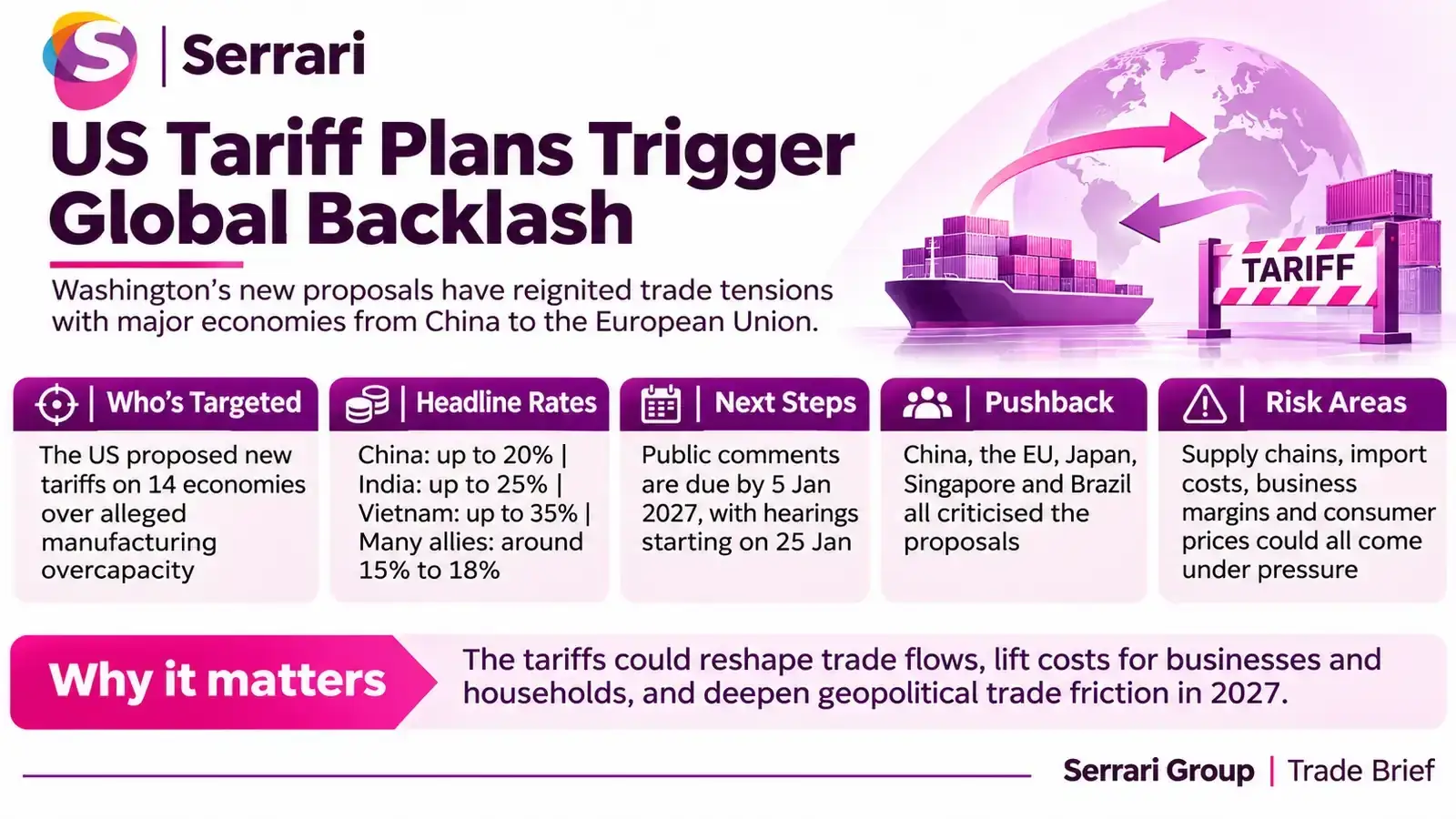
The United States has proposed a new round of tariffs targeting 14 major trading partners after an investigation into alleged structural excess manufacturing capacity. Announced on November 25, 2026, the measures have drawn objections from China, the European Union, Japan and Singapore, raising the prospect of renewed trade tensions in 2027. Although several proposed rates range between 15% and 20%, official notices establish potentially higher ceilings for India and Vietnam, subject to negotiations and adjustments. The proposals reveal Washington’s determination to protect domestic manufacturing despite legal setbacks to earlier tariffs, while exposing businesses and consumers to renewed uncertainty over production costs, international supply chains and inflation.
Key Overview
- Washington has proposed trade restrictions against 14 economies following investigations under Section 301 of the Trade Act of 1974.
- China faces proposed duties of up to 20%, while several US trade partners face rates of around 15% or 18%.
- India and Vietnam face potential ceilings of 25% and 35%, with conditional rates of 17% and 20%, respectively.
- Written submissions are due on January 5, 2027, ahead of public hearings beginning January 25.
- China, the European Union, Japan and Singapore dispute Washington’s findings or proposed remedies.
- The measures could increase import costs and complicate efforts to contain inflation.
Why Washington Is Targeting Manufacturing Overcapacity
The latest tariff proposals reflect a shift in the legal and economic justification behind American trade restrictions. Rather than relying exclusively on broad emergency powers, Washington is targeting industrial policies that it considers harmful to domestic manufacturing.
The investigations launched in March 2026 examined whether foreign government policies encourage manufacturing capacity beyond what ordinary market conditions would support.
Industrial overcapacity occurs when productive capabilities persistently exceed demand. Factories may continue producing despite weak profitability because subsidies, preferential financing or other incentives reduce the commercial pressure to scale back operations.
When surplus output enters international markets, it can depress prices and make competing manufacturers less profitable. Washington argues that this process discourages investment in American industrial capacity and leaves the country dependent on foreign suppliers.
However, excess capacity is not automatically evidence of unfair competition. Businesses routinely invest ahead of anticipated demand, while technological progress, economies of scale and differences in labour costs can also explain cheaper exports.
The central dispute is therefore whether foreign government intervention is distorting competition and whether broad tariffs are a proportionate response. A tariff may protect a domestic producer, but it can simultaneously increase expenses for another American business that uses the imported product as an input.
What the Proposed Tariff Rates Actually Mean
The official November tariff announcement distinguishes between proposed maximum duties, negotiated alternatives and exemptions. These distinctions are important because the rates are not uniform additions to every existing import duty.
For India, Washington is considering a ceiling of 25%, with a possible negotiated rate of 17%. Vietnam faces a potential ceiling of 35%, with a conditional alternative of 20%. Singapore could face up to 20%, potentially reduced to 10% following satisfactory negotiations.
China faces proposed duties of up to 20%, with lower rates or exemptions for specified products. The EU, Japan, South Korea, Switzerland and Taiwan face proposed rates around 15%, while Bangladesh, Cambodia, Indonesia, Malaysia and Thailand face ceilings of 18%.
These proposals incorporate different adjustments for existing duties and trade arrangements. Importers cannot determine their final liability simply by adding the headline percentages together.
Written comments are due on January 5, 2027, with hearings beginning January 25. Until final measures are announced, the rates remain proposals rather than new duties already payable at the border.
The variation between countries also creates negotiating leverage. Governments may seek concessions through changes to industrial policies, improved access for American exports or other commitments. The possibility of lower rates gives Washington an incentive mechanism beyond the immediate collection of tariff revenue.
Why Major Economies Are Rejecting the Measures
The international response to the proposals demonstrates how differently governments interpret the relationship between industrial policy and international competition.
China rejects Washington’s characterisation of its manufacturing sector and has warned that it could respond to protect its economic interests. Japan disputes allegations that its policies generate structural excess capacity, while Singapore rejects suggestions that its manufacturing competitiveness rests on unfair market protection.
The European Union acknowledges that global overcapacity can create problems but disputes the suggestion that European production is a source of the distortion. It also expects Washington to respect previously negotiated trade arrangements.
These disagreements matter because industrial supply chains cross national borders. An American company may obtain components from Japan, assemble products in Southeast Asia and distribute them across several markets. A tariff imposed on one stage can affect production elsewhere.
The renewed tensions between Beijing and Washington also threaten the stability of existing commercial arrangements. Even if governments avoid immediate retaliation, uncertainty over future access to the American market can delay investment and disrupt long-term purchasing agreements.
For US allies, the dispute raises questions about whether negotiated trade agreements can provide durable commercial certainty when subsequent investigations introduce new restrictions.
Context is everything. Stay ahead of shifting trends with today’s market updates, and uncover emerging opportunities using the Serrari Group Market Index and Marketplace. Then, take control of your own financial future by exploring our Money & Life Reset Transformation Blueprint ™ to build stronger habits, create better systems, and design a path toward lasting wealth.
Why American Consumers Could Face Higher Prices
Tariffs are generally collected from importers at the border. Foreign exporters may absorb part of the cost by accepting lower prices, but American businesses can also bear the expense through reduced margins or pass it to customers.
The distribution depends on bargaining power, the availability of alternative suppliers and the sensitivity of consumers to price increases. A manufacturer dependent on specialised imported components may find it difficult to change suppliers quickly, particularly where technical certification or tooling is required.
The timing is especially significant because the latest October personal consumption expenditure report provides the Federal Reserve with fresh information about inflation as it considers its next monetary policy decision.
Tariffs can produce a one-off increase in the price level rather than permanently accelerating inflation. However, repeated tariff changes, wage adjustments and rising inflation expectations could make the impact more persistent.
If monetary policymakers respond by maintaining higher interest rates, households may encounter more expensive borrowing alongside higher goods prices. Businesses may also face increased financing costs at a time when they need capital to reorganise supply chains.
This illustrates the trade-off between industrial protection and affordability. Measures designed to strengthen manufacturing can impose short-term costs on the very businesses and households whose economic security policymakers seek to improve.
How Global Supply Chains Could Change
The broader US effort to reduce dependence on Chinese production now intersects with restrictions affecting several alternative manufacturing locations.
Companies that previously diversified production away from China may discover that relocating to another Asian economy does not necessarily secure lasting preferential access to American consumers.
Manufacturers could respond by diversifying suppliers further, negotiating lower input prices, expanding American production or prioritising markets outside the United States. None of these adjustments is costless. Building new factories requires capital, skilled workers, reliable infrastructure and confidence that future trade policy will justify the investment.
A separate proposal concerning Brazilian imports includes changes affecting sugar and finished aircraft, demonstrating that Washington is also using trade enforcement in disputes unrelated to the manufacturing overcapacity investigation.
For African economies, including Kenya, the immediate implications are primarily indirect. The 14-economy overcapacity announcement does not include Kenya, but changing global trade flows could influence imported goods prices, export opportunities and competition in domestic markets.
If Asian manufacturers redirect surplus goods towards Africa, importers and consumers may benefit from cheaper products while local manufacturers encounter stronger competition. Conversely, some African exporters could gain opportunities if American buyers seek alternative suppliers, provided they meet applicable market access rules and production standards.
Why the January Hearings Matter for the Global Economy
The next phase of the dispute will centre on whether governments and businesses can secure changes to the proposed measures before implementation. The hearings provide an opportunity to identify products for which tariffs could impose disproportionate costs or disrupt essential supply chains.
The administration’s approach illustrates the persistence of trade restrictions despite earlier legal setbacks. Section 301 offers a different statutory route for addressing alleged unfair foreign practices, but the economic consequences still depend on the design and implementation of each measure.
For trading partners, retaliation could strengthen their negotiating position while risking higher costs for their own consumers and exporters. Cooperation over specific subsidy practices or excess capacity could offer a more targeted solution, although reaching agreement requires governments to reconcile competing industrial objectives.
Ultimately, the significance of the latest proposals extends beyond the headline tariff rates. Businesses are being asked to make long-term investment decisions in an environment where market access can change with successive investigations and negotiations.
The January proceedings will help determine whether Washington’s proposed measures become a durable element of global trade policy or are narrowed through negotiation. Their final scope will influence not only manufacturing competitiveness, but also the cost of living, corporate investment and the direction of international commerce throughout 2027.
Sources: Office of the United States Trade Representative / The Jakarta Post / The Wall Street Journal / Bureau of Economic Analysis / Reuters
Your financial future isn’t something you wait for—it’s something you build.
The real question is: when do you begin?
Move beyond simply staying informed.
Navigate the markets with clarity—track trends through the Serrari Group Market Index, uncover opportunities in the Serrari Marketplace, and build practical knowledge with our Curated Wealth Builder Platform.
Stay connected to what truly matters.
Get daily insights on macro trends and financial movements across Kenya, Africa, and global markets—delivered through the Serrari Newsletter.
Growth opens doors.
Advance your career through professional programs including ACCA, HESI A2, ATI TEAS 7 , HESI EXIT , NCLEX – RN and NCLEX – PN, Financial Literacy!🌟—designed to move you forward with confidence.
See where money is flowing—clearly and in real time.
Track Money Market Funds, Treasury Bills, Treasury Bonds, Green Bonds, and Fixed Deposits, alongside global and African indexes, key economic indicators, and the evolving Crypto and stablecoin landscape—all within Serrari’s Market Index.