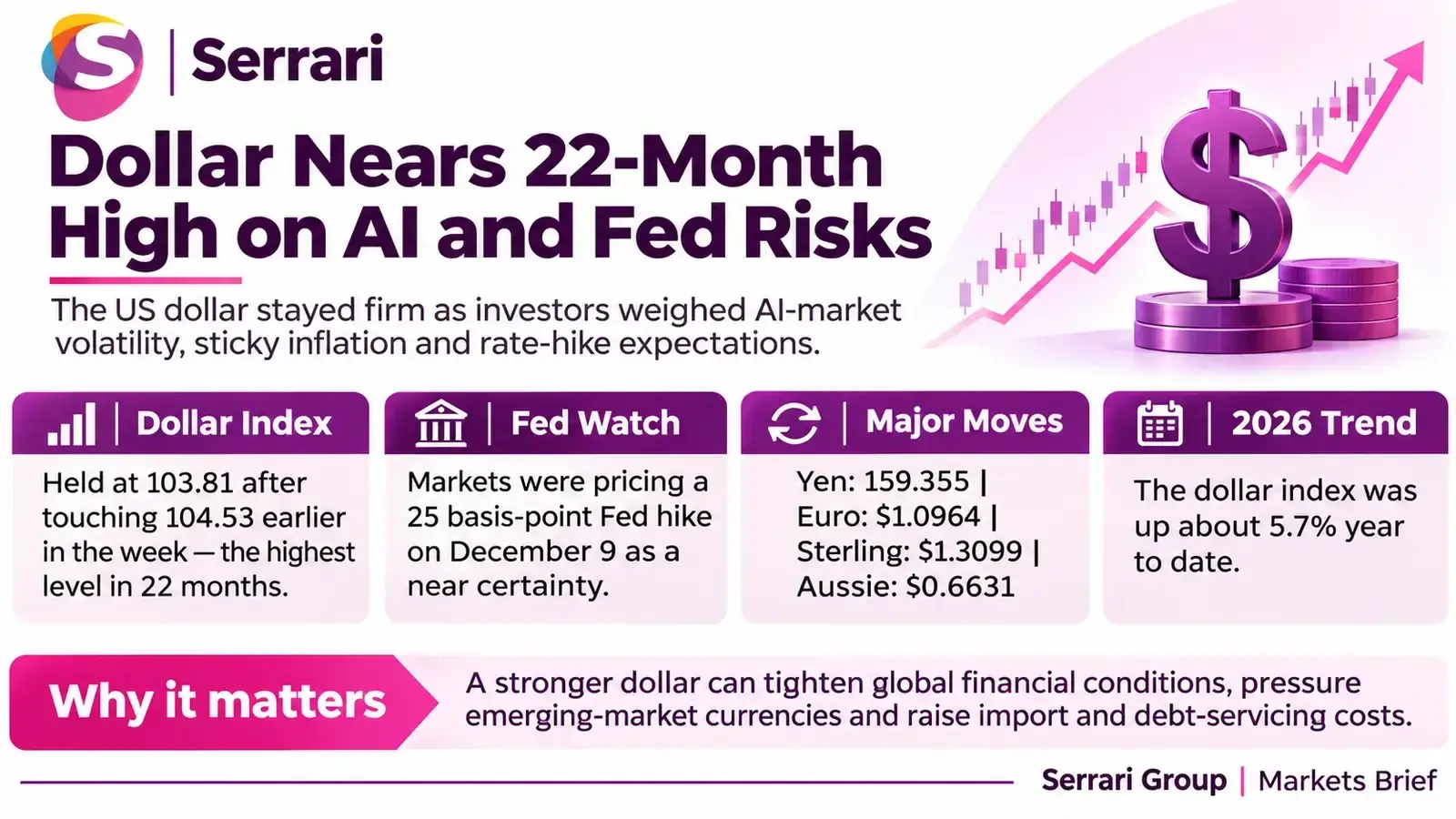
The US dollar remained close to a 22-month high on Friday, November 27, 2026, as uncertainty surrounding artificial intelligence investments and growing expectations of further Federal Reserve monetary tightening supported demand for the currency. With the dollar index trading at 103.81 and recording gains of approximately 5.7% since the beginning of the year, investors are reassessing the outlook for global interest rates, technology valuations and international capital flows. The dollar’s resilience has wider implications for emerging markets, international trade, corporate financing and governments servicing foreign currency debt, particularly as expectations of higher US borrowing costs extend into 2027.
Key Overview
- The US dollar index traded at 103.81 after reaching a 22-month high of 104.53 earlier in the week.
- The dollar index has appreciated approximately 5.7% since the beginning of 2026.
- Financial markets are pricing in a strong likelihood of a 25-basis-point Federal Reserve interest rate increase on December 9.
- Persistent US inflation and stronger-than-expected economic growth are reinforcing expectations of further monetary tightening.
- Volatility surrounding artificial intelligence stocks is influencing international capital flows and demand for defensive assets.
- Risk-sensitive currencies, including the Australian dollar and Mexican peso, remain vulnerable to renewed equity market weakness.
- Emerging economies face potential increases in external debt servicing costs and imported inflation.
Dollar Strength Reflects a Changing Global Investment Environment
The US dollar’s ability to remain near its recent peak reflects a significant reassessment of global monetary policy expectations and investor confidence. During Friday’s Asian trading session, the dollar index held at 103.81, following its advance to 104.53 on Monday, its strongest level in nearly 22 months.
Although the index surrendered some of those gains during the week, its broader appreciation indicates that investors continue to find relative value in dollar-denominated assets amid uncertainty elsewhere.
The greenback traded at approximately 159.355 Japanese yen and 0.83455 Swiss francs, while the euro stood at $1.0964 and the British pound traded around $1.3099. The Australian dollar remained under pressure at $0.6631 after reaching a one-year low of $0.6559 earlier in the week.
These movements occurred against the backdrop of reduced trading activity following the US Thanksgiving holiday. Lower market liquidity can amplify price movements because fewer participants are available to absorb large transactions.
However, the dollar’s strength extends beyond temporary holiday trading conditions. Expectations of higher US interest rates, resilient economic activity and uncertainty surrounding global equity valuations have created an environment in which investors have multiple reasons to maintain exposure to the American currency.
The combination is particularly important because it challenges expectations that the dollar would weaken as the global economy moved towards more accommodative monetary conditions.
Why Artificial Intelligence Volatility Is Influencing Currency Markets
Artificial intelligence has increasingly become a macroeconomic force rather than an isolated technology investment theme.
Significant spending on semiconductor manufacturing, data centres, cloud computing infrastructure and advanced AI systems has attracted international capital into American financial markets. Foreign investors purchasing US equities and financing American infrastructure projects can generate additional demand for dollars.
The relationship between AI investment and dollar strength also extends to monetary policy, as infrastructure expenditure supports economic activity while potentially contributing to inflationary pressures through increased demand for electricity, equipment, construction services and skilled labour.
However, concerns surrounding the sustainability of technology valuations have introduced another dimension to currency markets.
Investors are increasingly questioning whether the enormous capital expenditure commitments associated with artificial intelligence will generate sufficient commercial returns to justify prevailing valuations.
When technology stocks experience sharp declines, portfolio managers may reduce exposure to speculative investments and increase holdings of cash or more defensive securities. Given the dollar’s central position in international finance, this adjustment can support demand for the currency.
The resulting environment creates an unusual dynamic. Strong AI investment can support the dollar through economic expansion and foreign capital inflows, while weakness in AI equities can also support it through defensive positioning.
Nevertheless, this relationship has limits. A prolonged technology downturn that significantly damages American economic growth could eventually reduce expectations of higher interest rates and undermine the currency.
The immediate question for investors is whether the current volatility represents a temporary correction in technology valuations or the beginning of a broader reassessment of AI profitability.
Context is everything. Stay ahead of shifting trends with today’s market updates, and uncover emerging opportunities using the Serrari Group Market Index and Marketplace. Then, take control of your own financial future by exploring our Money & Life Reset Transformation Blueprint ™ to build stronger habits, create better systems, and design a path toward lasting wealth.
Federal Reserve Rate Hike Expectations Reinforce Dollar Demand
Monetary policy remains one of the most important foundations of the dollar’s recent performance.
Interest rate traders are anticipating a quarter-percentage-point increase at the Federal Reserve’s December meeting, with the possibility of another increase around April 2027.
The central bank’s December monetary policy meeting is scheduled for December 8–9, making it a critical event for financial markets before the end of the year.
Market expectations are derived partly from federal funds futures pricing, which provides an indication of how investors assess the likelihood of different monetary policy decisions.
Higher American interest rates can increase the relative attractiveness of US Treasury securities, money market instruments and other dollar-denominated fixed-income investments. International investors seeking competitive returns may consequently increase their exposure to American assets.
This creates additional demand for dollars, particularly when other major central banks are maintaining lower interest rates or considering monetary easing.
The October Federal Reserve meeting minutes had already indicated that surveyed market participants anticipated further monetary tightening, demonstrating that expectations of higher borrowing costs were developing before the latest foreign exchange movements.
However, investors must distinguish between a strong market expectation and an actual policy decision. The Federal Reserve retains the ability to adjust its approach depending on inflation, employment, economic growth and financial stability developments.
Because a December rate increase is already widely anticipated, the central bank’s guidance concerning its 2027 policy trajectory could ultimately prove more influential for the dollar than the immediate decision itself.
Persistent Inflation Complicates the Federal Reserve’s Policy Outlook
The dollar’s resilience has also been reinforced by recent American economic indicators suggesting that inflationary pressures have not sufficiently subsided to justify monetary easing.
Stronger-than-anticipated core personal consumption expenditures inflation and an upward revision to third-quarter economic growth have strengthened the argument for maintaining restrictive monetary conditions.
Meanwhile, the Federal Reserve’s November Beige Book assessment highlights an uneven economic environment in which businesses continue to encounter cost pressures despite differences in economic performance across regions and industries.
This distinction matters because persistent inflation alongside resilient economic demand presents policymakers with a difficult balancing act.
Reducing borrowing costs prematurely could encourage additional consumption and investment, potentially prolonging inflation. Conversely, excessive monetary tightening could weaken employment, increase corporate financing costs and undermine sectors already experiencing financial pressure.
For currency markets, persistent inflation becomes supportive of the dollar when investors believe the central bank will respond through higher interest rates.
However, inflation itself does not automatically strengthen a currency. If price increases undermine confidence in purchasing power or policymakers’ credibility, the longer-term consequences may become negative.
The current dollar performance therefore reflects confidence in the Federal Reserve’s willingness to confront inflation rather than confidence that higher inflation is inherently beneficial to the American economy.
Emerging Markets Face Renewed Financial Pressure
The dollar’s appreciation carries considerable consequences beyond the United States, particularly for emerging and developing economies.
Many governments and corporations borrow internationally in dollars while generating revenues primarily in domestic currencies. When their currencies weaken against the dollar, the local currency cost of servicing those obligations increases.
Research examining the international spillovers of dollar appreciation found that a 10% increase in the dollar associated with global financial forces was linked to a 1.9% decline in emerging-market economic output after one year.
These historical findings illustrate the scale of potential financial transmission rather than providing a direct forecast for the current dollar rally.
For African economies, including Kenya, sustained dollar strength can complicate external debt management, increase the domestic currency cost of imported products and influence monetary policy decisions.
Fuel, machinery, pharmaceutical products and industrial inputs are frequently priced or financed in dollars. Import-dependent businesses may face narrowing profit margins if they cannot pass higher costs to consumers.
Governments could also encounter greater pressure on public finances where foreign currency obligations account for a substantial portion of outstanding debt.
However, the effects will differ across countries depending on foreign exchange reserves, export earnings, remittance inflows, external debt composition and domestic monetary conditions.
Dollar strength against major international currencies does not necessarily translate into an equivalent depreciation of the Kenyan shilling or other African currencies.
Can the Dollar Sustain Its Momentum Into 2027?
Despite its strong performance during 2026, the dollar faces several potential constraints as investors prepare for the coming year.
A significant proportion of anticipated monetary tightening may already be reflected in currency valuations. Consequently, further appreciation could require stronger economic data or a more aggressive Federal Reserve policy outlook than investors currently anticipate.
A recovery in technology stocks could also encourage investors to rebuild exposure to emerging-market assets and risk-sensitive currencies, reducing defensive dollar demand.
Additional uncertainty surrounds the longer-term consequences of high American borrowing costs. Companies refinancing existing debt may encounter increased interest expenses, while households could experience further pressure through mortgage rates and consumer credit costs.
If restrictive monetary policy eventually produces a meaningful slowdown in economic activity, expectations of future interest rate reductions could re-emerge.
Nevertheless, the dollar continues to benefit from its importance in international trade, financial markets and reserve management.
Further research into global dollar cycles demonstrates how international demand for defensive assets can transmit financial pressures across emerging economies, reinforcing the currency’s importance during periods of uncertainty.
The immediate outlook therefore depends on three interconnected developments: the performance of AI-related equities, the persistence of American inflation and the Federal Reserve’s assessment of future monetary policy.
The dollar’s proximity to a 22-month high is ultimately a reflection of a global economy confronting competing forces. Technological investment is supporting growth, persistent inflation is sustaining expectations of higher borrowing costs, and financial market uncertainty is encouraging defensive positioning.
For international businesses, governments and investors, the implications extend beyond daily exchange rate movements. A sustained period of dollar strength could reshape financing conditions, trade competitiveness and investment flows well into 2027.
Sources: Reuters / Axios / Federal Reserve / CME Group / International Monetary Fund
Your financial future isn’t something you wait for—it’s something you build.
The real question is: when do you begin?
Move beyond simply staying informed.
Navigate the markets with clarity—track trends through the Serrari Group Market Index, uncover opportunities in the Serrari Marketplace, and build practical knowledge with our Curated Wealth Builder Platform.
Stay connected to what truly matters.
Get daily insights on macro trends and financial movements across Kenya, Africa, and global markets—delivered through the Serrari Newsletter.
Growth opens doors.
Advance your career through professional programs including ACCA, HESI A2, ATI TEAS 7 , HESI EXIT , NCLEX – RN and NCLEX – PN, Financial Literacy!🌟—designed to move you forward with confidence.
See where money is flowing—clearly and in real time.
Track Money Market Funds, Treasury Bills, Treasury Bonds, Green Bonds, and Fixed Deposits, alongside global and African indexes, key economic indicators, and the evolving Crypto and stablecoin landscape—all within Serrari’s Market Index.