US investment-grade corporate bond issuance reached a record $1.88 trillion through November 4, 2026, surpassing the previous annual record of $1.86 trillion set in 2020. The increase is largely driven by major technology companies borrowing to finance artificial intelligence (AI) infrastructure, including data centres and computing capacity. Amazon, Alphabet, Microsoft, Meta and Oracle collectively raised more than $370.7 billion through bond sales, representing roughly one-fifth of total issuance. Although investor demand remains strong, rising borrowing costs and uncertainty over how quickly AI investments will generate profits are increasing concerns about corporate debt sustainability.
Key Takeaways
- US investment-grade corporate bond issuance reached $1.88 trillion through November 4, exceeding the previous record of $1.86 trillion set in 2020.
- The total represents an 18.7% increase from a year earlier.
- The number of bond offerings fell approximately 4% to 1,084, while average deal size increased to around $1.7 billion.
- Five major technology companies — Amazon, Alphabet, Microsoft, Meta and Oracle — raised more than $370.7 billion.
- Apple also entered the bond market with a planned $7.5 billion seven-part dollar bond offering.
- Rising interest costs and uncertainty over AI profitability are creating concerns about the growing debt burden.
- Goldman Sachs expects bond issuance to finance 35% of hyperscalers’ capital expenditure in 2027.
Why Has US Corporate Bond Issuance Reached a Record $1.88 Trillion?
US investment-grade corporate bond issuance has climbed to $1.88 trillion through November 4, 2026, surpassing the previous annual record of $1.86 trillion raised in 2020.
The earlier record was established during the COVID-19 pandemic, when companies raised substantial amounts of debt to strengthen their cash positions amid economic uncertainty and near-zero interest rates.
This year’s increase has a different driver: the growing financing requirements of major technology companies investing in artificial intelligence.
Companies are borrowing heavily to support the infrastructure needed to develop and operate AI systems, including data centres and computing capacity.
The total issuance represents an 18.7% increase from a year earlier. However, the number of offerings declined by approximately 4% to 1,084.
This means companies are raising more money through fewer, larger transactions. The average bond offering increased to roughly $1.7 billion, compared with around $1.4 billion a year earlier.
The trend suggests that a relatively small number of large borrowers are playing a significant role in pushing the corporate bond market to new records.
How Much Are Big Tech Companies Borrowing to Finance AI?
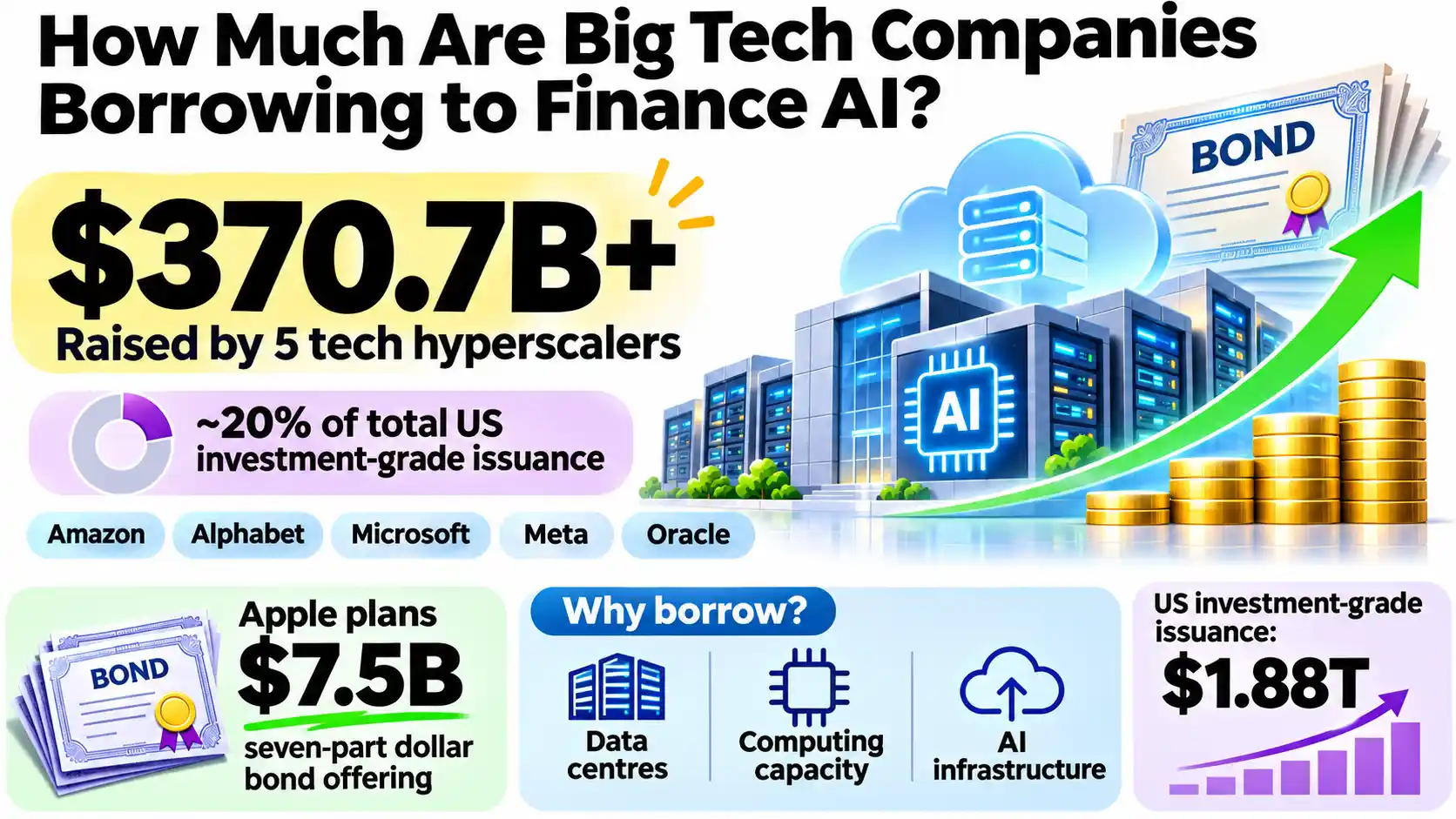
Major technology companies are among the largest borrowers in the US investment-grade bond market.
Amazon and Alphabet topped the list of companies raising money through bond sales this year. Together with Meta Platforms, Microsoft and Oracle, the five hyperscalers raised more than $370.7 billion.
That represents approximately one-fifth of all US investment-grade corporate bond issuance so far this year.
Apple has also joined the borrowing wave. The iPhone maker is seeking approximately $7.5 billion through a seven-part US-dollar bond offering.
These companies are investing heavily in the infrastructure required to support the expansion of AI services. This includes data centres, computing systems and other technology infrastructure.
The scale of their borrowing reflects how expensive the competition to develop and deploy AI has become.
For hyperscalers, raising money through bonds provides access to large amounts of capital without relying entirely on existing cash reserves. However, it also creates future interest and repayment obligations.
Why Are Investors Still Buying Big Tech’s AI Debt?
Despite the scale of borrowing, investor demand for technology companies’ bonds remains strong.
Victoria Fernandez, chief market strategist and fixed-income portfolio manager at Crossmark Global Investments, said:
“The market has absorbed the AI issuance and it is evident from the oversubscribed nature of the deals.”
She also noted that AI companies do not appear to be slowing down in their borrowing across US-dollar and euro bond markets.
Oversubscribed bond offerings indicate that investor demand exceeds the amount of debt being offered for sale.
This suggests that investors remain willing to provide financing to major technology companies despite the increasing volume of AI-related borrowing.
Several factors may support this demand, including the financial scale of major technology companies and investor expectations that AI-related infrastructure will generate future business opportunities.
However, strong demand for bonds does not automatically mean that the underlying investments will deliver sufficient returns. Investors still need to consider whether future cash flows will cover interest payments and principal repayments.
Could Rising Interest Rates Make AI Borrowing More Expensive?
One of the main concerns surrounding the borrowing surge is the prospect of higher interest rates.
When borrowing costs rise, companies issuing new debt may have to offer higher yields to attract investors. Existing debt can also become more expensive to refinance when it matures.
This creates a challenge for companies undertaking large AI investments because the infrastructure requires substantial upfront spending, while the financial returns may take years to materialise.
The concern is not simply how much technology companies are borrowing, but whether their AI businesses will generate enough revenue and profits to justify the investment.
The cost of insuring against corporate default has already increased for some of the largest AI investors.
Oracle’s five-year credit default swap (CDS) spread reached a record 325.45 basis points in October.
Amazon, Alphabet, Nvidia and Meta also recorded increases in their default-insurance costs, although their levels remained below Oracle’s.
A higher CDS spread generally indicates that investors perceive greater credit risk and demand more compensation for protecting against a potential default.
These movements do not mean that the companies are expected to default. However, they show that credit markets are paying closer attention to the financial risks associated with the AI investment boom.
Context is everything. Stay ahead of shifting trends with today’s market updates, and uncover emerging opportunities using the Serrari Group Market Index and Marketplace. Then, take control of your own financial future by exploring our Money & Life Reset Transformation Blueprint ™ to build stronger habits, create better systems, and design a path toward lasting wealth.
Why Is Oracle Facing Greater Credit Market Pressure?
Oracle has emerged as one of the companies attracting particular attention from credit investors.
Its five-year CDS spread reached a record 325.45 basis points in October, significantly highlighting concerns about the cost of insuring its debt against default.
The wider issue is the scale of investment required to expand AI infrastructure and the uncertainty surrounding how quickly those investments will generate sufficient returns.
As technology companies commit more capital to data centres and computing infrastructure, their borrowing requirements can increase alongside their financial obligations.
If AI-related revenue grows more slowly than expected, companies may face pressure to service their debt while continuing to fund expansion.
Oracle’s CDS movement illustrates how credit markets can begin pricing in these concerns even while investors continue purchasing new corporate bonds.
Could AI Regulation and Delayed Returns Slow Future Bond Issuance?
The risks surrounding AI borrowing extend beyond interest rates and corporate profitability.
The Democratic sweep in the US midterm elections has also raised concerns about potentially tougher AI regulation and a possible slowdown in data-centre construction.
Changes in regulation could affect how companies develop, deploy and commercialise AI technologies. Delays to data-centre projects could also affect the timing and scale of infrastructure spending.
Goldman Sachs analysts have identified delayed AI monetisation and growing purchase commitments as important risks to future debt issuance.
AI monetisation refers to the ability of companies to turn AI investments into revenue and profits.
This is a central issue because companies are committing substantial capital to infrastructure before the full financial benefits are clear.
If AI services generate revenue more slowly than anticipated, companies may need to borrow for longer or reconsider the pace of their expansion.
Goldman Sachs expects 35% of hyperscalers’ capital expenditure to be funded through bond issuance in 2027, broadly in line with this year’s level.
This suggests that bond markets are likely to remain an important source of financing for AI infrastructure in the near term.
The Bigger Picture: Why Does This Matter Now?
The record $1.88 trillion in US investment-grade bond issuance reflects a major shift in corporate borrowing, with artificial intelligence becoming an increasingly important driver of demand for capital.
For technology companies, bond markets provide the financing needed to expand infrastructure and compete in a rapidly developing industry.
For investors, the strong demand for these bonds demonstrates continued confidence in major technology borrowers. However, rising credit default insurance costs and uncertainty over AI profitability show that the risks are also receiving greater attention.
The central question is whether the financial returns from AI will grow quickly enough to justify the scale of investment and debt being accumulated.
If AI adoption translates into sustainable revenue and profits, the borrowing could support long-term business growth. If returns fall short or take longer to materialise, companies could face higher financing costs and greater pressure on their balance sheets.
As AI investment continues, the corporate bond market will remain an important indicator of how investors assess the opportunities and risks behind the technology boom.
Frequently Asked Questions
1. How much did US companies raise through investment-grade corporate bonds in 2026?
US investment-grade corporate bond issuance reached $1.88 trillion through November 4, 2026, surpassing the previous annual record of $1.86 trillion set in 2020.
2. Which technology companies are borrowing the most to finance AI?
Amazon and Alphabet were among the largest corporate bond issuers. Together with Microsoft, Meta Platforms and Oracle, the five hyperscalers raised more than $370.7 billion.
3. Why are investors concerned about Big Tech’s AI borrowing?
Investors are assessing whether AI investments will generate profits quickly enough to cover growing interest and debt obligations. Higher borrowing costs and increased default-insurance spreads are adding to these concerns.
4. How much of hyperscalers’ capital expenditure will be financed through bonds in 2027?
Goldman Sachs expects approximately 35% of hyperscalers’ capital expenditure to be funded through bond issuance in 2027, broadly in line with this year’s level.
Your financial future isn’t something you wait for—it’s something you build.
The real question is: when do you begin?
Move beyond simply staying informed.
Navigate the markets with clarity—track trends through the Serrari Group Market Index, uncover opportunities in the Serrari Marketplace, and build practical knowledge with our Curated Wealth Builder Platform.
Stay connected to what truly matters.
Get daily insights on macro trends and financial movements across Kenya, Africa, and global markets—delivered through the Serrari Newsletter.
Growth opens doors.
Advance your career through professional programs including ACCA, HESI A2, ATI TEAS 7 , HESI EXIT , NCLEX – RN and NCLEX – PN, Financial Literacy!🌟—designed to move you forward with confidence.
See where money is flowing—clearly and in real time.
Track Money Market Funds, Treasury Bills, Treasury Bonds, Green Bonds, and Fixed Deposits, alongside global and African indexes, key economic indicators, and the evolving Crypto and stablecoin landscape—all within Serrari’s Market Index.