The Central Bank of Nigeria (CBN) has introduced new regulations requiring foreign-currency stablecoin issuers to establish Nigerian-incorporated entities, obtain local licences and maintain at least ₦15 billion in paid-up capital. Effective November 5, 2026, the rules also introduce reserve requirements, stricter monitoring of peer-to-peer transactions and penalties for unlicensed virtual asset activities. The changes raise compliance requirements for stablecoin providers operating in Nigeria and strengthen the central bank’s oversight of digital assets used for payments and foreign exchange.
Key Takeaways
- Foreign-currency stablecoin issuers must maintain at least ₦15 billion in paid-up capital.
- Naira-backed stablecoin issuers face a minimum capital requirement of ₦10 billion.
- Foreign issuers must establish Nigerian-incorporated entities and obtain a CBN licence.
- Peer-to-peer stablecoin transactions involving naira conversions will face additional foreign exchange controls and BVN verification.
- Algorithmic stablecoins that lack adequate reserve backing or enforceable redemption rights are prohibited.
- Non-compliance can attract a minimum ₦100 million fine, plus ₦1 million for every day an offence continues.
Why Has Nigeria Introduced Stricter Stablecoin Regulations?
The Central Bank of Nigeria introduced the new regulations to bring stablecoins and other virtual asset activities under a more formal supervisory framework.
Effective November 5, 2026, the rules cover stablecoin issuance, custody, transfers, settlement and peer-to-peer transactions. They also establish requirements for licensing, capital, consumer protection, cybersecurity, anti-money laundering controls and regulatory reporting.
The central bank says the framework is intended to “promote responsible innovation while protecting the integrity of the financial system.”
The move comes as stablecoins become increasingly relevant to digital payments and foreign-currency transactions. Dollar-backed tokens, for example, allow users to hold and transfer digital representations of foreign-currency value.
However, their use can also create regulatory challenges, particularly where transactions involve converting between the naira and foreign currencies.
By bringing these activities under its supervision, the CBN is seeking greater visibility over how stablecoins operate within Nigeria’s financial system and foreign exchange market.
What Does the ₦15 Billion Capital Requirement Mean for Foreign Stablecoin Issuers?
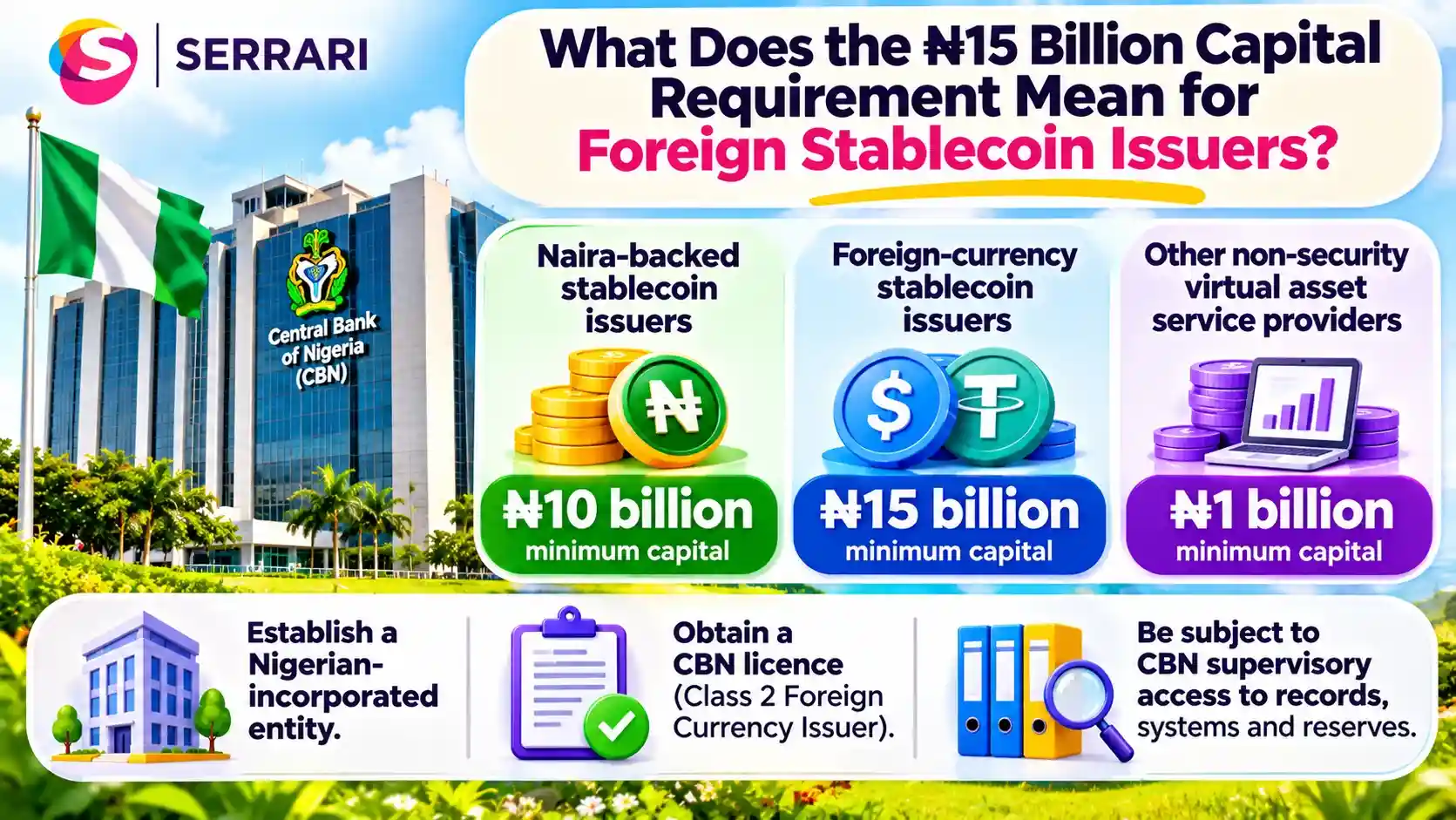
One of the most significant changes is the introduction of minimum capital requirements based on the currency to which a stablecoin is linked.
Category
Minimum paid-up capital
Naira-backed stablecoin issuers
₦10 billion
Foreign-currency stablecoin issuers
₦15 billion
Other non-security virtual asset service providers
₦1 billion
This means foreign-currency stablecoin issuers, including providers of dollar-pegged tokens such as USDT and USDC, face a substantial financial requirement before accessing the Nigerian market.
The rules also require foreign issuers to establish locally incorporated entities and obtain a Class 2 Foreign Currency Issuer Licence.
Under Section 11.1, foreign companies can no longer rely solely on licences or regulatory approvals obtained in other jurisdictions.
The Nigerian entities must remain responsible for compliance, even when operating within international corporate groups. The CBN will also have supervisory access to their records, systems, reserve arrangements and relevant group information.
Why does this matter?
The capital requirement raises the cost of entering and operating in Nigeria. Smaller issuers may find it harder to meet the threshold, while established providers may need to restructure their operations to comply.
It also gives the regulator a stronger framework for supervising companies whose stablecoins are used by Nigerian customers.
How Will the New Rules Affect Peer-to-Peer Stablecoin Trading?
The regulations also bring peer-to-peer transactions involving foreign-currency stablecoins under Nigeria’s formal foreign exchange framework.
Providers must obtain express CBN approval before facilitating conversions between the naira and foreign-currency stablecoins.
The rules further require the naira portion of approved transactions to be settled through, or reported to, an authorised dealer designated by the CBN.
In addition, peer-to-peer trading will face BVN verification requirements, linking transactions to users’ Bank Verification Numbers.
The CBN has clarified that approval to provide peer-to-peer services does not automatically grant permission to conduct foreign exchange business or establish an alternative foreign exchange market.
Operators are also prohibited from splitting, structuring or routing transactions through multiple channels to avoid regulatory limits, reporting requirements, foreign exchange controls or anti-money laundering checks.
The bigger implication is that stablecoin trading will have less room to operate outside established financial oversight. Platforms facilitating naira-to-dollar stablecoin conversions will need to meet additional approval, verification and reporting obligations.
What Reserve Requirements Must Stablecoin Issuers Meet?
Beyond capital requirements, the CBN has introduced rules governing how stablecoins must be backed.
Issuers must maintain reserves corresponding to the outstanding tokens, with one-to-one backing, daily reserve checks and a prohibition on issuing tokens before the corresponding reserves are in place. The framework also requires an additional reserve buffer of at least 2%.
For naira-backed stablecoins, the rules introduce an additional requirement: at least 20% of the total reserve pool must be held as a cash deposit with the CBN in a dedicated Reserve Deposit Account.
The funds cannot be withdrawn without prior written consent from the central bank. The CBN will also have real-time visibility over the account, which will not earn interest.
This 20% deposit requirement does not apply to foreign-currency stablecoin issuers, whose operational liquidity is governed by separate provisions.
The regulations also prohibit issuers from paying interest, yields, dividends or other financial benefits simply for holding stablecoins.
Importantly, the CBN clarifies that stablecoins are not bank deposits and are not covered by deposit insurance from the Nigeria Deposit Insurance Corporation.
These provisions are intended to strengthen reserve transparency and reduce the risk of stablecoins being issued without sufficient backing.
Context is everything. Stay ahead of shifting trends with today’s market updates, and uncover emerging opportunities using the Serrari Group Market Index and Marketplace. Then, take control of your own financial future by exploring our Money & Life Reset Transformation Blueprint ™ to build stronger habits, create better systems, and design a path toward lasting wealth.
Could Large Stablecoins Face Additional Regulatory Scrutiny?
Yes. The CBN has introduced a systemic stablecoin category for tokens whose size or adoption could create wider implications for Nigeria’s financial system.
A stablecoin may qualify for systemic designation if its naira-equivalent circulating supply exceeds ₦500 billion every day for 30 consecutive days, or if it is held or used by more than five million people in Nigeria.
The regulator may also consider transaction volumes, transaction values, the concentration of Nigerian users and the proportion of a stablecoin’s activity attributable to the Nigerian market.
Once a token is designated as systemic, the CBN may impose enhanced supervisory requirements.
This is significant because a stablecoin used by millions of people or handling substantial transaction volumes could become more closely connected to the country’s payment and financial systems.
The additional oversight gives the regulator a mechanism to respond if the growth of a particular token creates risks beyond individual users and issuers.
What Happens to Existing Stablecoin and Virtual Asset Providers?
Companies already operating in Nigeria will have to adjust to the new framework.
The regulations provide the following transition requirements:
- Within 30 days: Existing regulated virtual asset service providers must register with the CBN.
- Within 60 days: They must begin submitting supervisory reports.
- Within 180 days: They must apply for the appropriate licences.
The rules also state that operators that fail to submit applications within the required period must cease operations until they obtain the necessary authorisation. Companies seeking to continue operating while applications are being reviewed will need explicit regulatory permission.
However, the framework does not specify exactly when the 180-day licensing application period begins, so operators will need to pay attention to further regulatory clarification.
The CBN has also introduced financial penalties for non-compliance. Unlicensed virtual asset activities attract a minimum fine of ₦100 million, with an additional ₦1 million for every day the violation continues.
Other breaches involving capital, reserves, liquidity and anti-money laundering requirements can attract substantial financial penalties, while fraudulent conduct may result in a minimum ₦500 million fine and possible criminal prosecution.
How Will the New Rules Affect Nigeria’s Wider Crypto Market?
The regulations establish a clearer division of responsibilities between Nigeria’s financial regulators.
The CBN will oversee non-security virtual assets used for payments, settlement and foreign exchange activities. Meanwhile, the Securities and Exchange Commission (SEC) will retain responsibility for security virtual assets, securities, investment contracts and other capital-market products.
This means businesses operating across both categories may need to comply with requirements from more than one regulator. Capital requirements imposed by the SEC or other regulators will apply separately from the CBN’s requirements.
The new framework also follows the CBN’s August 2026 launch of a regulatory sandbox cohort that included a dedicated track for stablecoin and virtual asset companies.
Together, these developments suggest that Nigeria is moving towards a more structured approach to digital asset regulation rather than treating all crypto-related activities in the same way.
Why Does This Matter Now?
Nigeria’s new stablecoin regulations could reshape how foreign digital asset providers access one of Africa’s important financial markets.
For stablecoin issuers, the immediate challenge is meeting the capital, licensing, reserve and local incorporation requirements. For trading platforms, additional BVN checks and foreign exchange approvals could change how peer-to-peer transactions are facilitated.
Users may benefit from stronger oversight, clearer accountability and more formal reserve requirements. However, the higher compliance costs could also make market entry more difficult for smaller providers.
The wider question is how the rules will affect access to dollar-backed digital assets, particularly for individuals and businesses that use stablecoins to transfer or hold foreign-currency value.
Ultimately, the CBN is attempting to balance digital financial innovation with control over the country’s financial and foreign exchange systems. How effectively it achieves that balance will become clearer as providers adapt to the new requirements.
Frequently Asked Questions
1. What is the new CBN stablecoin regulation in Nigeria?
It is a regulatory framework effective November 5, 2026, requiring stablecoin issuers and virtual asset service providers to meet licensing, capital, reserve, consumer protection and reporting requirements.
2. How much capital must foreign stablecoin issuers hold in Nigeria?
Foreign-currency stablecoin issuers must maintain at least ₦15 billion in paid-up capital. Naira-backed stablecoin issuers must maintain at least ₦10 billion.
3. Will the new rules affect USDT and USDC in Nigeria?
The regulations cover foreign-currency stablecoin issuers, including providers of dollar-pegged tokens such as USDT and USDC. Their access to the Nigerian market will be subject to local incorporation, licensing and other applicable requirements.
4. Are stablecoins considered bank deposits in Nigeria?
No. The CBN states that stablecoins are not bank deposits and are not covered by deposit insurance from the Nigeria Deposit Insurance Corporation. Stablecoin issuers are also prohibited from paying holders interest simply for retaining their tokens.
Your financial future isn’t something you wait for—it’s something you build.
The real question is: when do you begin?
Move beyond simply staying informed.
Navigate the markets with clarity—track trends through the Serrari Group Market Index, uncover opportunities in the Serrari Marketplace, and build practical knowledge with our Curated Wealth Builder Platform.
Stay connected to what truly matters.
Get daily insights on macro trends and financial movements across Kenya, Africa, and global markets—delivered through the Serrari Newsletter.
Growth opens doors.
Advance your career through professional programs including ACCA, HESI A2, ATI TEAS 7 , HESI EXIT , NCLEX – RN and NCLEX – PN, Financial Literacy!🌟—designed to move you forward with confidence.
See where money is flowing—clearly and in real time.
Track Money Market Funds, Treasury Bills, Treasury Bonds, Green Bonds, and Fixed Deposits, alongside global and African indexes, key economic indicators, and the evolving Crypto and stablecoin landscape—all within Serrari’s Market Index.