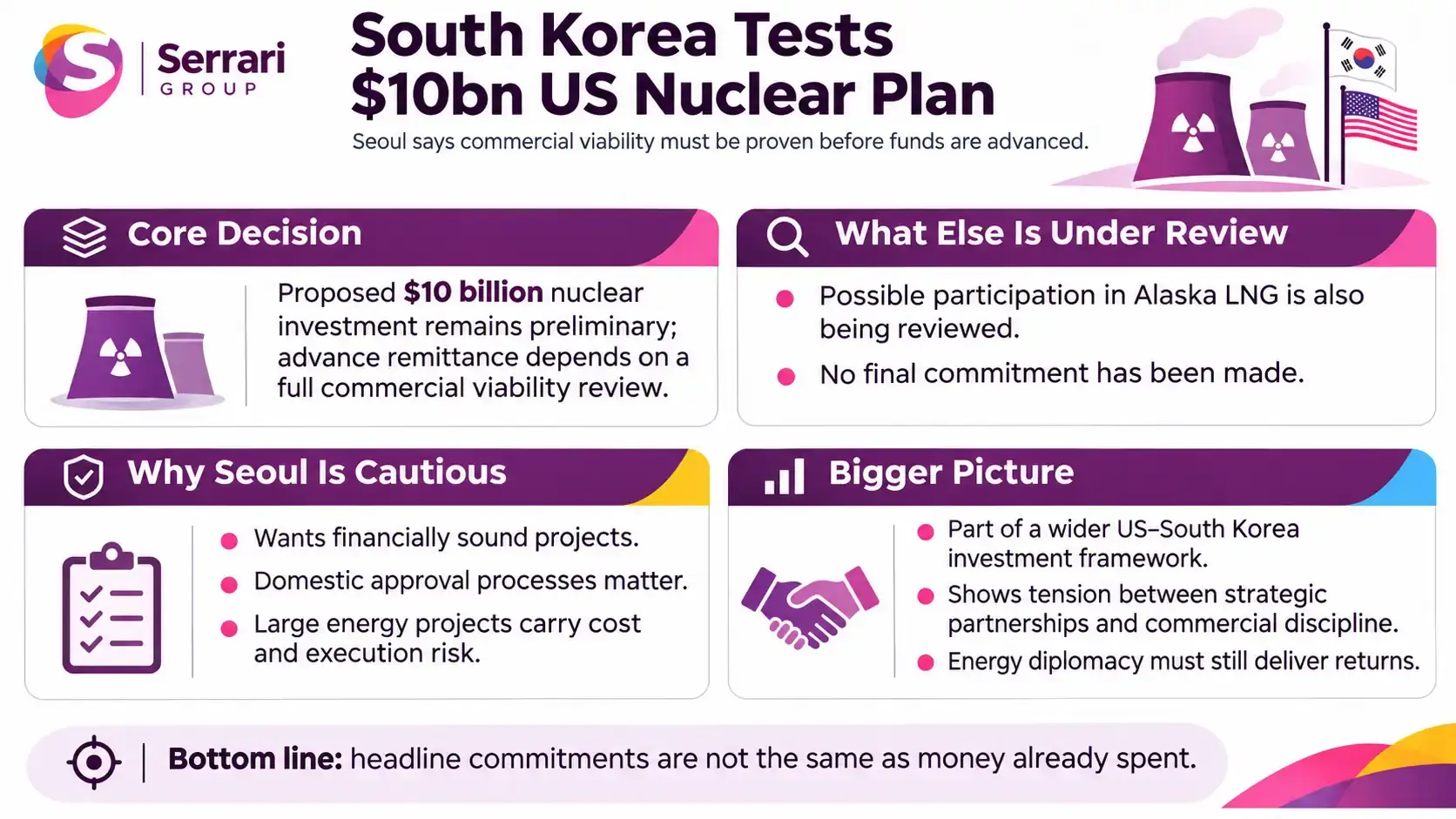
South Korea has made clear that a proposed $10 billion advance payment for nuclear power development in the United States will not proceed without a rigorous commercial feasibility assessment and completion of domestic procedures. Finance Minister Lee Hyoung-il told lawmakers on November 9, 2026, that the transfer remains preliminary, while Industry Vice Minister Park Dong-il said Seoul has likewise made no final decision on investing in Alaska’s liquefied natural gas (LNG) project. The caution is consequential because these are not isolated energy deals: they sit within a $350 billion US–South Korea investment framework negotiated alongside tariff arrangements. Seoul is trying to honour its diplomatic and trade commitments without exposing public-backed funds to projects whose costs, returns and contractual risks are not yet sufficiently established.
Key Overview
- $10 billion remains conditional: Seoul has not authorised the proposed nuclear advance remittance; commercial feasibility must first be established.
- A larger trade bargain is at stake: The amount forms part of a $350 billion investment commitment, comprising $200 billion in strategic investments and $150 billion in shipbuilding cooperation.
- Domestic oversight matters: South Korean officials have linked individual investment decisions to legal processes and National Assembly requirements.
- Project details remain unsettled: The bilateral nuclear framework does not yet constitute approval of specific reactor sites, construction timetables or financing structures.
- Alaska LNG remains undecided: Seoul is examining the project’s commercial prospects without committing to participate.
- The wider question: Both governments must reconcile strategic energy cooperation with the financial returns and risks expected of major infrastructure investments.
Why Seoul Is Holding Back the $10 Billion Nuclear Payment
The immediate decision reflects a practical distinction between endorsing an energy partnership and transferring billions of dollars into a specific project. In remarks to a parliamentary committee, Finance Minister Lee Hyoung-il said on November 9 that a planned $10 billion advance payment would undergo a complete review of business feasibility. He described the remittance as being at a preliminary stage, not as an approved expenditure.
That clarification addresses a central risk in large cross-border investment arrangements: political announcements can precede the commercial information needed to make a prudent financing decision. For nuclear plants, that information includes the proposed location, permitting timetable, construction costs, technology arrangements, financing terms, future electricity demand and the credibility of expected revenues. The original announcement does not disclose a finished evaluation of these factors, and it would be premature to treat the proposed payment as money already committed to an individual reactor.
South Korea has already defined a threshold for these investments. Under implementing rules adopted in June, a commercially reasonable project must be expected to generate enough revenue over its agreed life to cover both principal and interest costs. That requirement provides a clearer test than strategic importance alone: an infrastructure project can strengthen diplomatic ties and still be financially unattractive if development costs or revenue assumptions do not hold up.
The government’s position also reflects accountability at home. At an October parliamentary hearing, Lee said any advance payment depended on commercial checks and completion of domestic legal procedures, including the National Assembly process. The November statement therefore reinforces an existing condition rather than introducing an entirely new obstacle.
How the $350 Billion US–South Korea Deal Changes the Stakes
The nuclear proposal has become politically sensitive because it belongs to a much bigger economic bargain. According to a congressional assessment of bilateral trade, the two countries announced a strategic trade and investment agreement in November 2025 that combined tariff adjustments with $350 billion in South Korean investment commitments. Of this, $200 billion was designated for strategic US industries and $150 billion for shipbuilding-related cooperation.
The arrangement was designed partly to ease trade tensions. South Korean industries, particularly automobiles, had faced uncertainty from US tariff policy. The revised framework reduced certain tariffs to 15%, creating an incentive for Seoul to demonstrate progress on investment while safeguarding exporters’ access to a major market. But agreeing a headline amount is not the same as choosing projects capable of repaying the money invested.
That tension explains why commercial scrutiny matters now. Washington wants tangible investment, industrial capacity and energy infrastructure. Seoul wants investment terms that make financial sense and do not undermine its own fiscal or industrial interests. If the parties move too quickly, poorly structured projects could produce losses or political backlash. If they move too slowly, disagreements over implementation could revive trade friction.
The framework already includes an initial project. In its October 1 strategic investment announcement, South Korea identified a Texas gas-fired power development, a bilateral nuclear programme and an Alaska LNG proposal as three areas of cooperation. Yet the government explicitly distinguished between progressing the Texas project and continuing to assess the nuclear and Alaskan initiatives. The difference is critical: the existence of a shared plan does not establish that every component has cleared investment approval.
Context is everything. Stay ahead of shifting trends with today’s market updates, and uncover emerging opportunities using the Serrari Group Market Index and Marketplace. Then, take control of your own financial future by exploring our Money & Life Reset Transformation Blueprint ™ to build stronger habits, create better systems, and design a path toward lasting wealth.
Why Nuclear Power Is Attractive but Financially Difficult
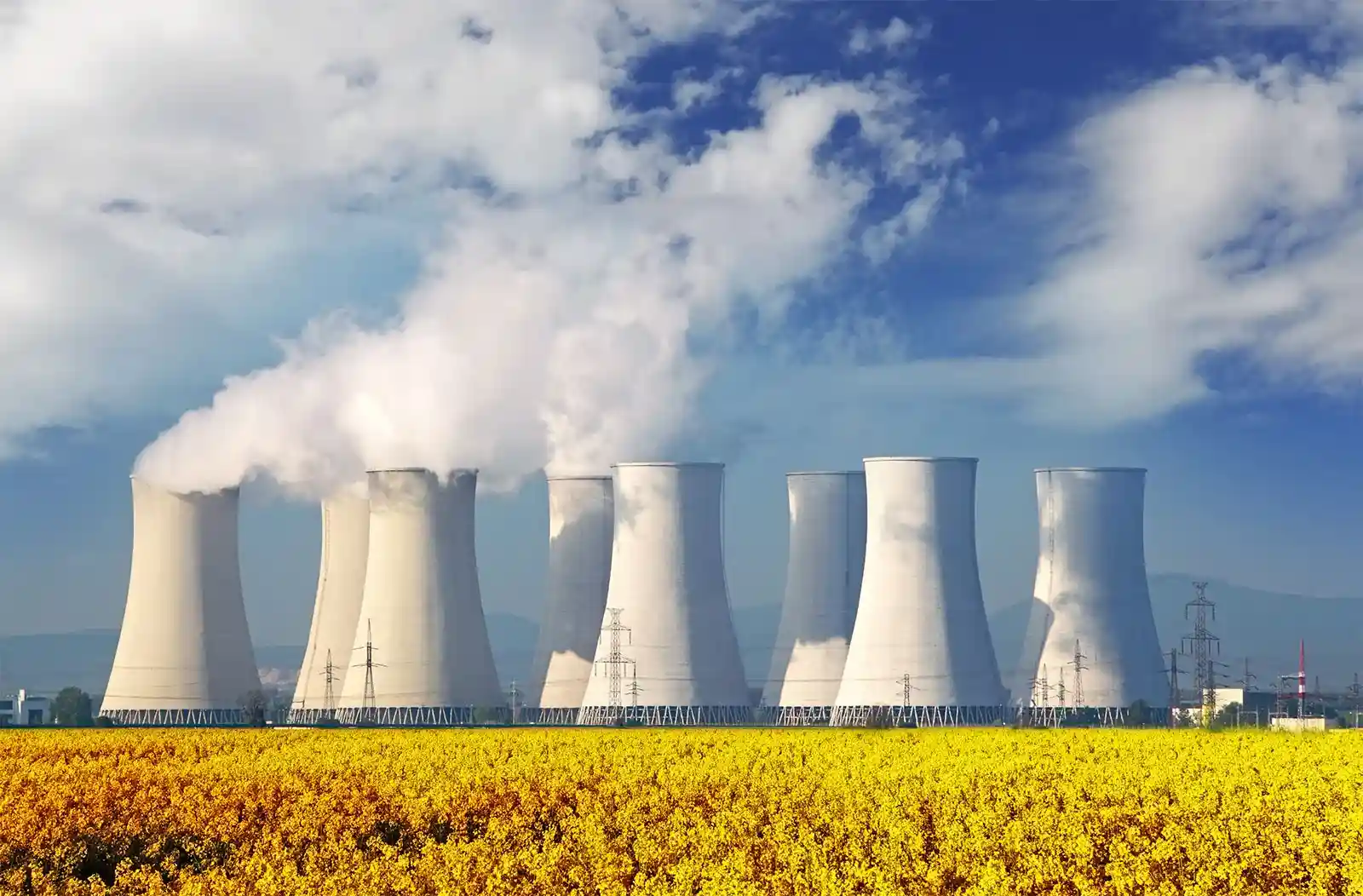
Nuclear development offers the United States an opportunity to add large amounts of electricity generation that can operate independently of weather conditions. That matters as power-hungry data centres, advanced manufacturing and electrification place new demands on the grid. For South Korean engineering and nuclear companies, cooperation may create opportunities in equipment manufacturing, construction, services and long-term technical support.
But nuclear projects are capital-intensive, slow to develop and exposed to substantial execution risk. Delays in approvals, labour shortages, changes in construction specifications or higher borrowing costs can weaken expected returns long before the first unit begins generating electricity. Unlike a factory that can expand output in stages, a large reactor may require extensive spending before meaningful operating revenue arrives.
Reports on the evolving nuclear investment framework have described ambitions involving multiple reactors, but those concepts should not be confused with approved construction contracts. The government’s published position is that individual locations, project structures and schedules remain to be developed and assessed.
Commercial viability will consequently depend on more than demand forecasts. Investors need clarity over who bears construction overruns, whether electricity can be sold under durable agreements, how risks are shared among contractors and operators, and what happens if completion takes longer than planned. These are not reasons to reject nuclear power outright. They are reasons to resist transferring an enormous advance before the expected investment returns can be assessed credibly.
Why Alaska LNG Faces the Same Commercial Test
The proposed Alaska LNG development creates another example of strategic ambition confronting infrastructure economics. Industry Vice Minister Park Dong-il said Seoul would closely examine any proposed participation, but stressed that no investment decision had been finalised.
The project envisages transporting natural gas from northern Alaska through a long pipeline to southern Alaska, where LNG facilities could process gas for export. Its attraction is understandable: additional North American gas supplies could diversify import options for Asian customers while generating construction activity and potential export revenue in the United States.
Yet LNG economics are highly sensitive to the upfront cost of pipelines and terminals, shipping expenses, long-term gas demand and competition from other producers. A project may strengthen energy security while still failing a commercial test if its delivered gas is too expensive or buyers will not sign sufficiently durable contracts. There is also a timing risk: infrastructure built for demand many years ahead must remain competitive as energy systems and climate policies evolve.
For South Korea, a large LNG importing country with sophisticated industrial users, the decision involves balancing supply diversification against financing exposure. A commitment that looks attractive diplomatically may offer poor value if market prices or construction costs move against the project. The government’s insistence on a review therefore protects room to negotiate or decline participation rather than treating Alaska LNG as an unavoidable obligation.
What the Delay Means for Investors, Energy Firms and Trade Relations
For US developers and contractors, Seoul’s position means the prospective South Korean funding cannot yet be counted as available cash. Project sponsors will need to advance more detailed proposals, demonstrate expected returns and resolve contractual issues if they want the remittance to proceed. The scrutiny could delay commitments in the short term, but it could also reduce the likelihood that financially fragile projects fail later.
For South Korean companies, the outcome is mixed. A successful agreement could open a substantial pipeline of engineering, equipment and investment opportunities. An unfavourable assessment could prevent costly exposure. Either way, project selection will matter more than the size of the headline pledge when measuring the commercial benefits of the bilateral partnership.
The broader diplomatic implications are similarly balanced. Seoul’s restraint should not automatically be interpreted as withdrawal from the investment agreement. The trade relationship remains deeply interconnected, with substantial manufacturing trade, cross-border investment and security cooperation. At the same time, differences over funding schedules and profitability can create pressure when one government prioritises rapid delivery and the other emphasises economic justification.
The key development to watch is therefore not another investment headline, but evidence of completed feasibility studies, approved financing arrangements, parliamentary compliance and specific projects reaching binding commitments. The distinction between proposed and executed investment will be especially important for companies hoping to receive contracts and for policymakers citing the deal as proof of stronger energy security.
The Bigger Picture: Energy Diplomacy Must Still Deliver Returns
South Korea’s $10 billion nuclear payment review illustrates a wider challenge in global industrial policy. Governments increasingly use large investment packages to secure trade access, deepen strategic alliances and support energy infrastructure. Yet publicly backed money cannot be treated as risk-free simply because a project serves geopolitical interests.
The immediate effect of Seoul’s decision is uncertainty over the timing of the nuclear remittance and possible Alaska LNG participation. The longer-term significance is the standard that South Korea is seeking to apply: strategic cooperation must be supported by commercially defensible projects and domestic accountability. If that standard is maintained, the result could be a smaller or slower investment pipeline, but potentially one with stronger financial foundations. For both allies, the real test will be turning diplomatic commitments into projects that can be built, operated and financed on sustainable terms.
Sources: Reuters / Ministry of Economy and Finance of South Korea / Congressional Research Service / ChosunBiz / Korea JoongAng Daily / Pipeline & Gas Journal
Your financial future isn’t something you wait for—it’s something you build.
The real question is: when do you begin?
Move beyond simply staying informed.
Navigate the markets with clarity—track trends through the Serrari Group Market Index, uncover opportunities in the Serrari Marketplace, and build practical knowledge with our Curated Wealth Builder Platform.
Stay connected to what truly matters.
Get daily insights on macro trends and financial movements across Kenya, Africa, and global markets—delivered through the Serrari Newsletter.
Growth opens doors.
Advance your career through professional programs including ACCA, HESI A2, ATI TEAS 7 , HESI EXIT , NCLEX – RN and NCLEX – PN, Financial Literacy!🌟—designed to move you forward with confidence.
See where money is flowing—clearly and in real time.
Track Money Market Funds, Treasury Bills, Treasury Bonds, Green Bonds, and Fixed Deposits, alongside global and African indexes, key economic indicators, and the evolving Crypto and stablecoin landscape—all within Serrari’s Market Index.