The UK government is reportedly considering reducing its 2030 zero-emission vehicle (ZEV) sales target from 80% to approximately 60%, while extending compliance flexibilities for automakers until 2034. The potential adjustment comes as car manufacturers struggle to meet existing requirements amid weaker-than-expected consumer demand and supply chain challenges. Battery-electric vehicles accounted for 26.6% of UK new car sales in the first ten months of 2026, below the 33% target. While a lower target could ease pressure on manufacturers, it has raised concerns about investment certainty, charging infrastructure development and the country’s progress towards its 2035 zero-emission vehicle ambition. The government has not yet confirmed a final decision.
Key Takeaways
- The UK government is reportedly considering reducing its 2030 ZEV sales target from 80% to approximately 60%.
- Compliance flexibilities for automakers could be extended until 2034.
- Battery-electric vehicles accounted for 26.6% of new car sales in the first ten months of 2026, below the 33% target.
- Carmakers argue that weak consumer demand and supply chain disruptions are making existing targets difficult to achieve.
- Charging infrastructure investors warn that weakening the mandate could put £1.7 billion in investment at risk.
- The government maintains its commitment to ensuring all new cars and vans sold are zero-emission by 2035.
- No final decision on the proposed changes has been announced.
Why Is the UK Considering Cutting Its 2030 EV Sales Target?
The UK government is reportedly preparing to reduce its 2030 zero-emission vehicle sales target from 80% to around 60%, easing the requirements facing car manufacturers.
The proposed change would affect the ZEV mandate, introduced in 2024 to gradually increase the proportion of new vehicles sold that produce zero tailpipe emissions.
Under the existing framework, the targets require zero-emission vehicles to account for:
Year
Required share of new car sales
2026
33%
2027
38%
2028
52%
2029
66%
2030
80%
2035
100%
The reported proposal would lower the 2030 requirement to approximately 60% and extend compliance flexibilities until 2034.
The potential adjustment follows concerns from automakers that the pace of the transition is moving faster than actual consumer demand and the industry’s ability to meet the requirements.
However, the government has not confirmed the proposed reduction. A spokesperson said “no decisions have been taken”, while reiterating its commitment to ensuring all new cars and vans sold are zero-emission by 2035.
Why Are Carmakers Struggling to Meet the Existing EV Targets?
The main challenge is the gap between the required share of zero-emission vehicle sales and what consumers are currently buying.
According to the Society of Motor Manufacturers and Traders (SMMT), battery-electric vehicles accounted for 26.6% of new car sales year to date, compared with the 33% target for the year.
Although the share represents a record level of electric vehicle sales, it remains below the regulatory requirement.
Automakers have pointed to two major challenges:
- Weak consumer demand: Electric vehicle sales are not increasing quickly enough to match the pace required by the mandate.
- Supply chain disruptions: Challenges affecting the availability and delivery of components are making it harder for manufacturers to meet production and sales requirements.
SMMT Chief Executive Mike Hawes said: “The gap between demand and mandated targets continues to widen.”
The association has therefore called for meaningful changes to the requirements, arguing that the existing trajectory could put jobs and investment under pressure.
For manufacturers, the issue is not necessarily opposition to electrification. Rather, they argue that the transition needs to reflect the pace at which consumers are adopting electric vehicles and the industry’s ability to supply them.
How Would a Reduction to 60% Affect the EV Transition?
Reducing the 2030 target from 80% to approximately 60% would give manufacturers more room to adjust their vehicle sales strategies.
The change would also affect the trajectory towards 2030, not just the final target.
Under the existing schedule, the required share rises from 38% in 2027, and then to 52% in 2028, followed by further increases to 66% in 2029 and 80% in 2030.
A lower endpoint could therefore result in a less demanding increase in the years leading up to 2030.
The proposed extension of compliance flexibilities until 2034 would provide additional time for manufacturers to meet their obligations.
Existing flexibilities already allow automakers to offset some shortfalls through mechanisms such as hybrid vehicle sales and borrowing against future electric vehicle volumes.
Combining a lower target with extended flexibilities could provide manufacturers with greater flexibility as they respond to changing market conditions.
However, the potential benefit for automakers comes with a trade-off: a less demanding mandate could also reduce the pressure driving the expansion of electric vehicle production, sales and supporting infrastructure.
Could the Proposed Changes Put EV Charging Infrastructure Investment at Risk?
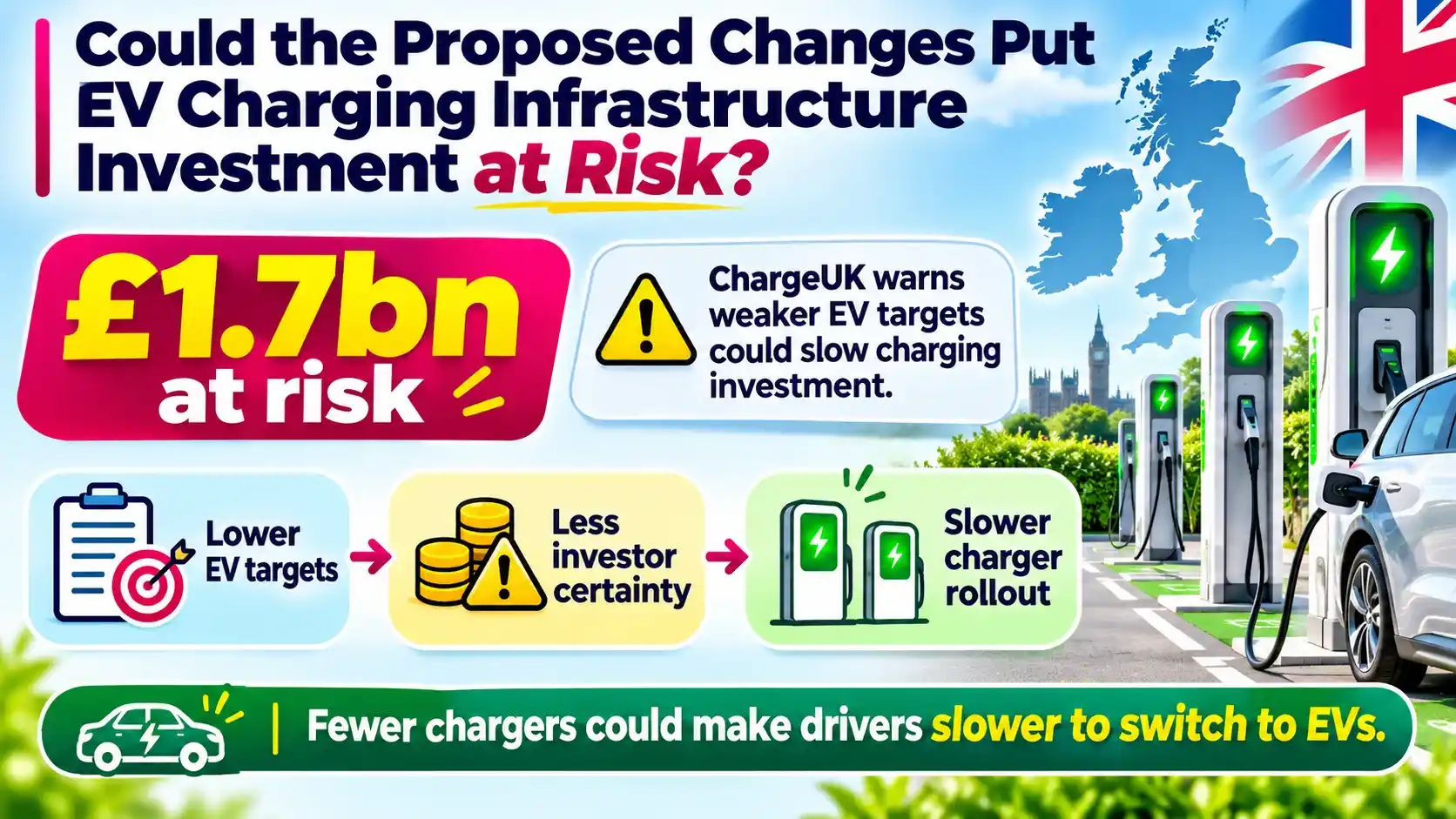
One of the biggest concerns surrounding the proposed reduction is its potential impact on investment in electric vehicle charging infrastructure.
Charging network operators rely partly on expectations of future electric vehicle adoption when deciding where and how much to invest in charging stations.
If the government reduces the sales targets, investors may become less certain about the speed at which demand for public charging will grow.
Shane Brennan, Chief Executive of ChargeUK, warned that “Weakening the mandate puts £1.7bn of charging infrastructure at risk and all the associated jobs and supply chain spending that goes with it.”
The concern is that a weaker mandate could slow investment in charging networks, potentially making it harder for drivers to access reliable charging facilities.
This creates a challenge for the wider EV transition. Consumers may be reluctant to purchase electric vehicles if charging infrastructure is inadequate, while investors may hesitate to expand charging networks if they expect slower EV adoption.
The relationship works in both directions: vehicle adoption supports charging investment, while accessible charging infrastructure can encourage more people to switch to electric vehicles.
A reduction in the mandate could therefore affect businesses beyond the traditional automotive industry.
Context is everything. Stay ahead of shifting trends with today’s market updates, and uncover emerging opportunities using the Serrari Group Market Index and Marketplace. Then, take control of your own financial future by exploring our Money & Life Reset Transformation Blueprint ™ to build stronger habits, create better systems, and design a path toward lasting wealth.
Why Could Tesla and Other EV Manufacturers Lose From a Weaker Mandate?
The proposed changes could also affect manufacturers that sell zero-emission vehicles and generate revenue through regulatory compliance credits.
Under the ZEV mandate, automakers that exceed their required zero-emission vehicle sales levels can benefit from compliance mechanisms that allow other manufacturers to address shortfalls.
Companies such as Tesla and Leapmotor, which focus on electric vehicles, can benefit from selling compliance credits to manufacturers struggling to meet their targets.
A lower mandate could reduce the number of credits required by manufacturers falling short of their obligations.
This could shrink the market for compliance credits and reduce a potential source of revenue for companies that have surplus credits.
The wider implication is that weakening the mandate could affect not only traditional carmakers but also businesses whose commercial models benefit from stricter zero-emission vehicle requirements.
It could also create uncertainty for electric vehicle manufacturers considering investments in UK production and market expansion.
What Does the Proposed Change Mean for the UK’s 2035 EV Target?
Despite the reported possibility of reducing the 2030 target, the government maintains its commitment to ensuring that all new cars and vans sold are zero-emission by 2035.
This distinction is important because the proposed adjustment concerns the interim sales trajectory rather than an announced cancellation of the longer-term ambition.
However, reducing the 2030 requirement could make the path towards the 2035 target less demanding in the short term.
The policy also comes at a politically sensitive time, with the UK preparing to champion electrification internationally at COP31 in Türkiye.
The ZEV mandate is expected to deliver nearly 14% of the emissions reductions the UK has pledged between 2028 and 2032, making it a significant part of the country’s climate policy.
Changing the mandate could therefore affect expectations around the UK’s transport emissions reduction pathway.
It also raises questions about whether the government can maintain a consistent policy direction while responding to pressure from automakers and concerns about consumer demand.
Why Are Investors Concerned About Another Change to the ZEV Mandate?
The reported proposal would mark the third change to the policy in three years, raising concerns about long-term investment certainty.
Automotive manufacturers, charging network operators and infrastructure developers make investment decisions based on expectations about future vehicle demand and government policy.
When targets are repeatedly revised, businesses may find it harder to assess the long-term commercial outlook.
For example, charging companies investing in new stations need confidence that electric vehicle adoption will continue to grow. Manufacturers planning new production facilities also need predictable regulations to justify capital expenditure.
ChargeUK has warned that another change could undermine investor confidence, particularly among businesses that have already committed capital to support the transition.
The concern extends beyond the immediate reduction in sales targets. It is about whether businesses can rely on the government’s future commitments when planning investments that may take several years to generate returns.
The Bigger Picture: Why Does This Matter Now?
The UK’s proposed adjustment highlights the challenge governments face when climate ambitions move faster than consumer adoption and industry readiness.
On one side, automakers are calling for targets that reflect current market conditions, arguing that weak demand and supply chain difficulties make existing requirements difficult to achieve.
On the other, charging network operators and electric vehicle businesses warn that weakening the mandate could undermine the investment needed to make electrification more accessible.
The debate is therefore not simply about whether the UK should adopt electric vehicles. It is about how quickly the transition should happen and what policies can support it without creating uncertainty for businesses and consumers.
A lower 2030 target could provide short-term relief for automakers, but it may also weaken incentives for investment in charging infrastructure and electric vehicle production.
Ultimately, the success of the UK’s transition will depend on more than regulatory targets. Consumer demand, affordable vehicles, reliable charging infrastructure, manufacturing capacity and consistent government policy will all play important roles.
For now, the proposed reduction remains unconfirmed, and the government’s final decision will determine how the UK balances industry pressures with its longer-term zero-emission ambitions.
Frequently Asked Questions
1. What is the UK’s proposed new electric vehicle target for 2030?
The UK government is reportedly considering reducing the zero-emission vehicle sales target from 80% to approximately 60%. However, no final decision has been announced.
2. What is the current UK zero-emission vehicle sales target for 2026?
The current target requires zero-emission vehicles to account for 33% of new car sales in 2026. Battery-electric vehicles represented 26.6% of new car sales in the first ten months of the year.
3. Will the UK abandon its 2035 zero-emission vehicle target?
The government has reiterated its commitment to ensuring that all new cars and vans sold are zero-emission by 2035. The reported proposal concerns the interim 2030 target and compliance flexibilities.
4. How could reducing the ZEV mandate affect charging infrastructure investment?
A lower target could weaken expectations of future electric vehicle adoption, potentially affecting investment decisions by charging network operators. ChargeUK has warned that £1.7 billion in charging infrastructure investment could be at risk.
Your financial future isn’t something you wait for—it’s something you build.
The real question is: when do you begin?
Move beyond simply staying informed.
Navigate the markets with clarity—track trends through the Serrari Group Market Index, uncover opportunities in the Serrari Marketplace, and build practical knowledge with our Curated Wealth Builder Platform.
Stay connected to what truly matters.
Get daily insights on macro trends and financial movements across Kenya, Africa, and global markets—delivered through the Serrari Newsletter.
Growth opens doors.
Advance your career through professional programs including ACCA, HESI A2, ATI TEAS 7 , HESI EXIT , NCLEX – RN and NCLEX – PN, Financial Literacy!🌟—designed to move you forward with confidence.
See where money is flowing—clearly and in real time.
Track Money Market Funds, Treasury Bills, Treasury Bonds, Green Bonds, and Fixed Deposits, alongside global and African indexes, key economic indicators, and the evolving Crypto and stablecoin landscape—all within Serrari’s Market Index.