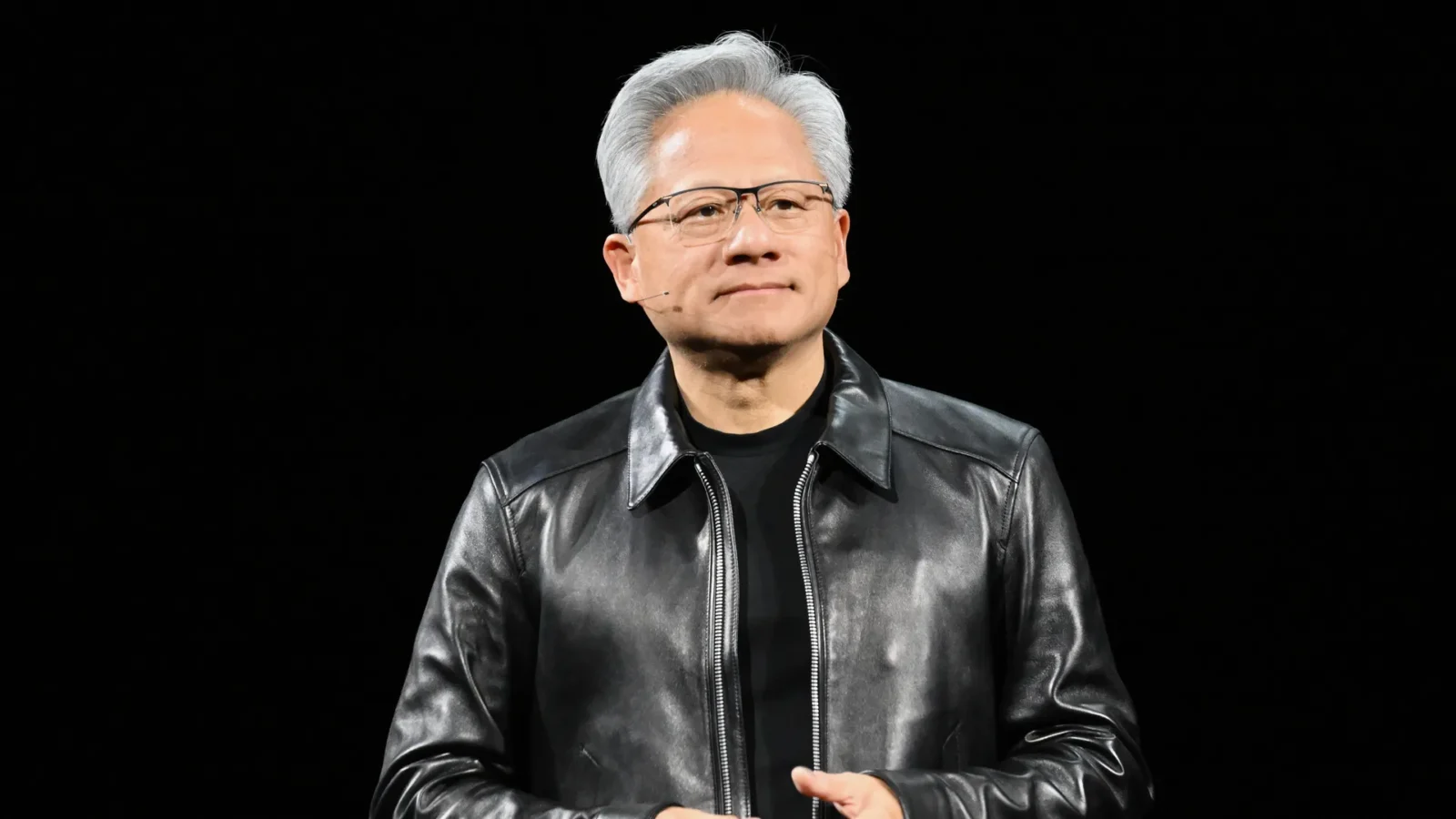
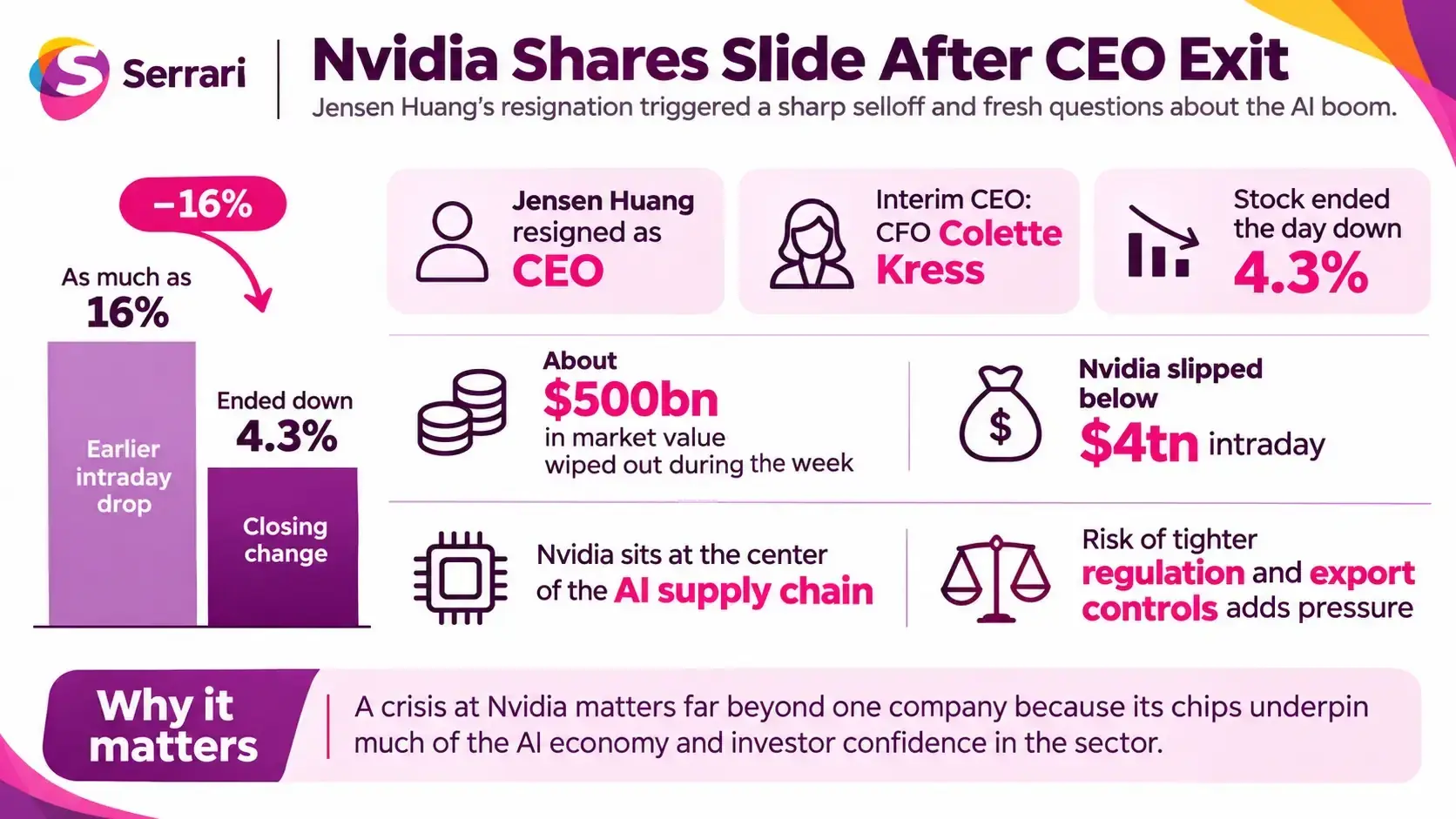
Nvidia shares fell 4.3% on November 12, 2026, after co-founder Jensen Huang resigned as chief executive amid reports of personal relationships that triggered corporate governance and national security scrutiny. The chipmaker named longtime finance chief Colette Kress interim CEO, but the abrupt change rattled investors already questioning whether extraordinary spending on artificial intelligence can continue delivering returns. Nvidia’s importance to AI infrastructure meant the shock extended beyond one company, contributing to losses across major US stock indexes ahead of crucial earnings and a closely watched AI-sector public offering.
Key Overview
- Leadership shock: Huang resigned as Nvidia’s president, CEO and director, and CFO Colette Kress took charge on an interim basis.
- Market reaction: Nvidia closed 4.3% lower at $166.19 after a much sharper intraday decline, while the S&P 500, Nasdaq and Dow each lost roughly 0.4%.
- Governance questions: Reports of Huang’s personal relationships and allegations involving suspected foreign intelligence activity prompted an independent board investigation; no compromise of company secrets has been established.
- AI exposure: Nvidia’s data-center business generated $89 billion in its latest reported quarter, showing how much of the industry’s infrastructure expansion relies on its products.
- Next tests: Investors face a permanent CEO search, Nvidia’s November 17 earnings release and Anthropic’s planned market debut.
Why Jensen Huang’s Sudden Exit Triggered a Sell-Off
Nvidia’s leadership crisis reached a turning point when its board accepted Huang’s resignation, effective immediately. In a regulatory filing dated November 12, the company confirmed that the board had accepted his departure on November 11 and appointed Colette Kress as interim chief executive. The speed of the transition left investors reassessing the company without the executive who had led it since its founding in 1993.
The departure followed reports about Huang’s extramarital relationships, including an alleged connection with a businesswoman suspected by US intelligence authorities of links to Chinese espionage. Those are allegations, not established findings of wrongdoing or proof that Nvidia’s technology was compromised. Huang had apologized publicly for infidelity, while Nvidia’s board previously said it had no reason to believe national security or company secrets had been compromised.
Nevertheless, the possibility of foreign intelligence exposure elevated the episode from a private conduct controversy into a potential corporate-security issue. Nvidia’s independent directors commissioned an external investigation to examine the matter. Investors must now distinguish between reputational damage, potential governance failures and any substantiated legal or national security consequences that could emerge from that review.
The immediate financial response was severe. Nvidia shares touched sharply lower levels early in Thursday’s trading before recovering part of their losses to close at $166.19, down 4.3%. The reversal suggested investors were unwilling to assume the business had suddenly lost its technological advantages, but equally unwilling to ignore uncertainty surrounding leadership and regulation.
For shareholders, the larger issue is whether Nvidia can preserve confidence in its product roadmap, major customer relationships and capital-allocation decisions during a change in leadership. When a company’s valuation reflects years of anticipated growth, even a temporary increase in uncertainty can substantially affect what investors are willing to pay for its earnings.
Why Nvidia’s Problems Spread Across Wall Street
Nvidia is not simply another large technology company. It supplies the high-performance processors and computing systems that developers, cloud providers and AI laboratories depend on to train and operate advanced models. Its stock also carries significant weight in major US indexes, making company-specific declines capable of influencing diversified portfolios.
Thursday’s session reflected that influence. The S&P 500 declined 0.35%, the Nasdaq dropped 0.39% and the Dow lost 0.36%, despite gains in parts of the energy sector. These comparatively modest index declines contrasted with Nvidia’s sharp opening plunge, demonstrating both the company’s systemic market importance and the capacity of other sectors to cushion a concentrated shock.
The vulnerability comes from years in which AI-linked companies have driven a substantial share of market enthusiasm. Investors increasingly treat spending by hyperscale cloud operators, model developers, data-center builders and chip suppliers as a connected investment cycle. Doubts about one central supplier can therefore prompt broader questions about projected infrastructure demand and future profitability.
That does not mean Huang’s resignation immediately disrupts chip deliveries or makes AI spending uneconomic. Nvidia’s board said its operations, customer commitments and product roadmap should continue without interruption. But market prices reflect expectations as well as current performance. Investors are assessing the risk that a leadership transition could slow decisions, complicate relationships or intensify scrutiny precisely when execution is unusually important.
Context is everything. Stay ahead of shifting trends with today’s market updates, and uncover emerging opportunities using the Serrari Group Market Index and Marketplace. Then, take control of your own financial future by exploring our Money & Life Reset Transformation Blueprint ™ to build stronger habits, create better systems, and design a path toward lasting wealth.
The Governance Crisis Meets US-China Chip Tensions
The timing creates another risk because advanced semiconductors sit at the center of competition between Washington and Beijing. US controls on exports of sophisticated computing technology are intended to constrain access that could support military or other sensitive applications. Allegations of foreign intelligence activity involving the head of Nvidia therefore attract attention far beyond conventional corporate governance.
Any suggestion that restricted technology reached prohibited customers would require evidence and proper investigation. Nvidia has not established that Huang’s reported relationships resulted in leaked secrets or export-control violations. Still, the episode could make policymakers more cautious about indirect access to American chips through overseas cloud services and third-party intermediaries.
This matters commercially because compliance rules can shape where Nvidia sells its most advanced products and how customers access computing capacity. Its latest quarterly financial outlook assumed no data-center compute revenue from China, illustrating how geopolitical restrictions already influence revenue planning. Additional controls could raise compliance costs, narrow potential markets or affect clients’ purchasing decisions even if the company’s core technology remains in demand.
For the broader AI sector, the central question is whether governments can protect national security without creating bottlenecks that slow legitimate innovation. The outcome will depend on the facts established by investigations and any subsequent policy changes, rather than on allegations alone.
Can Nvidia Maintain Its Momentum Without Huang?
Huang’s departure is particularly consequential because his leadership was closely associated with Nvidia’s transformation from a graphics-chip specialist into a dominant supplier of AI computing infrastructure. He helped steer a strategy spanning hardware, software and networking, while becoming a prominent public advocate for increasingly large AI systems.
Yet the company’s latest financial performance suggests a business with substantial institutional depth. For the quarter ended July 26, Nvidia reported revenue of $96.2 billion, up 106% year on year. Data-center revenue reached $89 billion, up 117%, while the company forecast approximately $108 billion in revenue for the following quarter. Those figures explain why markets are weighing leadership risk against exceptionally strong demand rather than assuming an immediate operational collapse.
Kress, who has served as chief financial officer since 2013, brings experience managing Nvidia’s finances through its expansion. The company also installed Harvey Jones as its first chair and announced that it would consider internal and external candidates for a permanent CEO. These steps provide continuity, although they do not resolve questions about who will set long-term strategy or how authority will be divided during the transition.
Investors will watch whether top engineering leaders remain, whether flagship product launches stay on schedule and whether major customers continue signing long-term commitments. The next earnings report, scheduled for November 17, will also test management’s ability to communicate consistently about demand, margins and the business outlook without Huang as its central spokesperson.
Why the Shock Comes at a Critical Moment for AI Investment
The crisis coincides with a major test of investor appetite for AI businesses. Anthropic is preparing for a potential November 19 public-market debut, with a proposed valuation reaching roughly $1.4 trillion on a fully diluted basis. Its offering is significant because investors must decide how much to pay for rapid AI revenue growth alongside enormous future computing obligations.
That tension runs through the entire sector. Developers require more computing power to train and serve increasingly capable models; cloud companies build the infrastructure; Nvidia supplies much of the enabling technology. However, high capital spending must eventually produce sustainable revenue and profits for customers and investors. A leadership crisis at Nvidia does not settle that debate, but it may make investors less tolerant of ambitious valuations unsupported by clear returns.
The spillover can extend to retirement funds, index-tracking investments and companies financing data centers. When valuations decline, raising equity becomes more expensive and confidence can weaken across related businesses. Conversely, continued customer spending and strong product execution could help distinguish a temporary governance shock from a lasting slowdown in AI investment.
The key distinction is between short-term market turbulence and long-term industry fundamentals. Nvidia’s products remain embedded in major computing plans, while alternative chipmakers and cloud providers continue competing for share. The next few weeks should offer clearer evidence about whether this episode changes actual purchasing decisions or mainly alters the risk premium attached to AI stocks.
What Happens Next for Nvidia and the AI Economy?
Three developments will determine whether Thursday’s sell-off becomes a prolonged reassessment: the findings of the independent investigation, the credibility of Nvidia’s permanent leadership selection and evidence that customers continue investing at the expected pace. New export restrictions could add another material variable, but their likelihood and scope remain uncertain.
For investors, Nvidia’s November 12 decline is a reminder that extraordinary growth does not eliminate leadership, political or valuation risks. A company can deliver record revenue and still experience a major share-price shock when confidence in its governance is tested.
The bigger question is not whether the AI revolution can survive one chief executive’s departure. It is whether the industry’s most important businesses can build resilient institutions, comply with increasingly complex rules and demonstrate returns on the hundreds of billions committed to computing infrastructure. Nvidia’s transition will now serve as an unusually visible test of all three.
Sources
NVIDIA / U.S. Securities and Exchange Commission / Reuters / Associated Press / CBS News
Your financial future isn’t something you wait for—it’s something you build.
The real question is: when do you begin?
Move beyond simply staying informed.
Navigate the markets with clarity—track trends through the Serrari Group Market Index, uncover opportunities in the Serrari Marketplace, and build practical knowledge with our Curated Wealth Builder Platform.
Stay connected to what truly matters.
Get daily insights on macro trends and financial movements across Kenya, Africa, and global markets—delivered through the Serrari Newsletter.
Growth opens doors.
Advance your career through professional programs including ACCA, HESI A2, ATI TEAS 7 , HESI EXIT , NCLEX – RN and NCLEX – PN, Financial Literacy!🌟—designed to move you forward with confidence.
See where money is flowing—clearly and in real time.
Track Money Market Funds, Treasury Bills, Treasury Bonds, Green Bonds, and Fixed Deposits, alongside global and African indexes, key economic indicators, and the evolving Crypto and stablecoin landscape—all within Serrari’s Market Index.