Türkiye’s Treasury has raised €1.25 billion through an eight-year euro-denominated green bond maturing in 2034. The transaction, finalised on November 19, 2026, attracted orders exceeding three times the issue size from approximately 150 investor accounts. The bond carries a coupon rate of 5.850% and an investor yield of 6.125%. The issuance marks Türkiye’s third ESG bond transaction in international capital markets and its second ESG bond issuance in 2026. Following the transaction, the country’s international capital market fundraising for 2026 reached US$13.6 billion.
Key Takeaways
- Türkiye’s Treasury raised €1.25 billion through a green bond maturing in 2034.
- The eight-year bond carries a coupon rate of 5.850% and an investor yield of 6.125%.
- Investor orders exceeded three times the amount offered, with approximately 150 accounts participating.
- UK investors received the largest allocation at 43%, followed by US investors at 26%.
- The transaction marks Türkiye’s third ESG bond issuance in international capital markets and its second in 2026.
- Türkiye’s total funds raised from international capital markets in 2026 reached US$13.6 billion following the issuance.
Türkiye Raises €1.25 Billion Through International Green Bond Issuance
Türkiye has raised 1.25 billion euros from international investors through the issuance of a euro-denominated green bond maturing in 2034, adding to its borrowing activity in international capital markets.
The Treasury and Finance Ministry announced the transaction on November 19, 2026. The eight-year bond was issued with a nominal amount of €1.25 billion, providing the government with funding through the international debt market.
The transaction marks the Treasury’s third ESG (Environmental, Social, Governance) bond issuance in the international capital markets and its second ESG bond issuance in 2026, said the ministry in a statement on Nov. 19.
Green bonds are debt instruments used to raise capital for projects and activities with environmental benefits. Governments, companies and other institutions can issue them to attract investors interested in financing environmental objectives while receiving returns through interest payments.
For Türkiye, the latest transaction represents another step in its use of ESG-labelled debt instruments to access international financing.
The issuance also comes amid continued government borrowing activity. Following the transaction, the amount of funds raised by Türkiye from international capital markets during 2026 reached US$13.6 billion.
Understanding the Bond’s Coupon Rate and Investor Yield
The eight-year green bond carries a coupon rate of 5.850% and a yield to investors of 6.125%.
Although these two figures are closely related, they describe different aspects of a bond’s return.
The coupon rate of 5.850 percent represents the annual interest rate calculated against the bond’s nominal value. It determines the interest payments investors receive, based on the bond’s face value and payment terms.
The investor yield of 6.125 percent, on the other hand, reflects the return investors can expect based on the price they pay for the bond and its contractual cash flows, including interest and repayment at maturity.
The difference between the coupon rate and the yield indicates that the bond’s market pricing is relevant when calculating the investor’s overall return. A bond can trade above or below its nominal value, causing its yield to differ from its coupon rate.
For investors, the distinction is important because the coupon alone does not necessarily represent the full return from purchasing a bond in the market.
The bond’s 2034 maturity means investors are lending money to Türkiye’s Treasury over an eight-year period, subject to the bond’s terms and conditions.
Strong Investor Demand Exceeds Three Times the Issue Size
The issuance attracted orders exceeding three times the actual amount offered, demonstrating substantial demand from international investors.
According to the Treasury and Finance Ministry, approximately 150 investor accounts participated in the transaction.
The strong order book indicates that investors submitted demand for more than the €1.25 billion ultimately issued. This allowed Türkiye to complete the transaction at its targeted nominal amount while attracting interest from a broad group of international accounts.
Investor demand is an important consideration in sovereign bond issuance because it helps governments assess market appetite for their debt. A heavily oversubscribed transaction can indicate that investors are willing to allocate capital to the issuer at the offered pricing and terms.
However, oversubscription does not automatically mean that every investor receives the amount requested. Final allocations depend on the issuer’s decisions and the distribution of the bond among participating accounts.
The participation of approximately 150 accounts also shows that the issuance attracted interest from multiple investors rather than relying on a single large buyer.
Context is everything. Stay ahead of shifting trends with today’s market updates, and uncover emerging opportunities using the Serrari Group Market Index and Marketplace. Then, take control of your own financial future by exploring our Money & Life Reset Transformation Blueprint ™ to build stronger habits, create better systems, and design a path toward lasting wealth.
UK and US Investors Receive the Largest Allocations
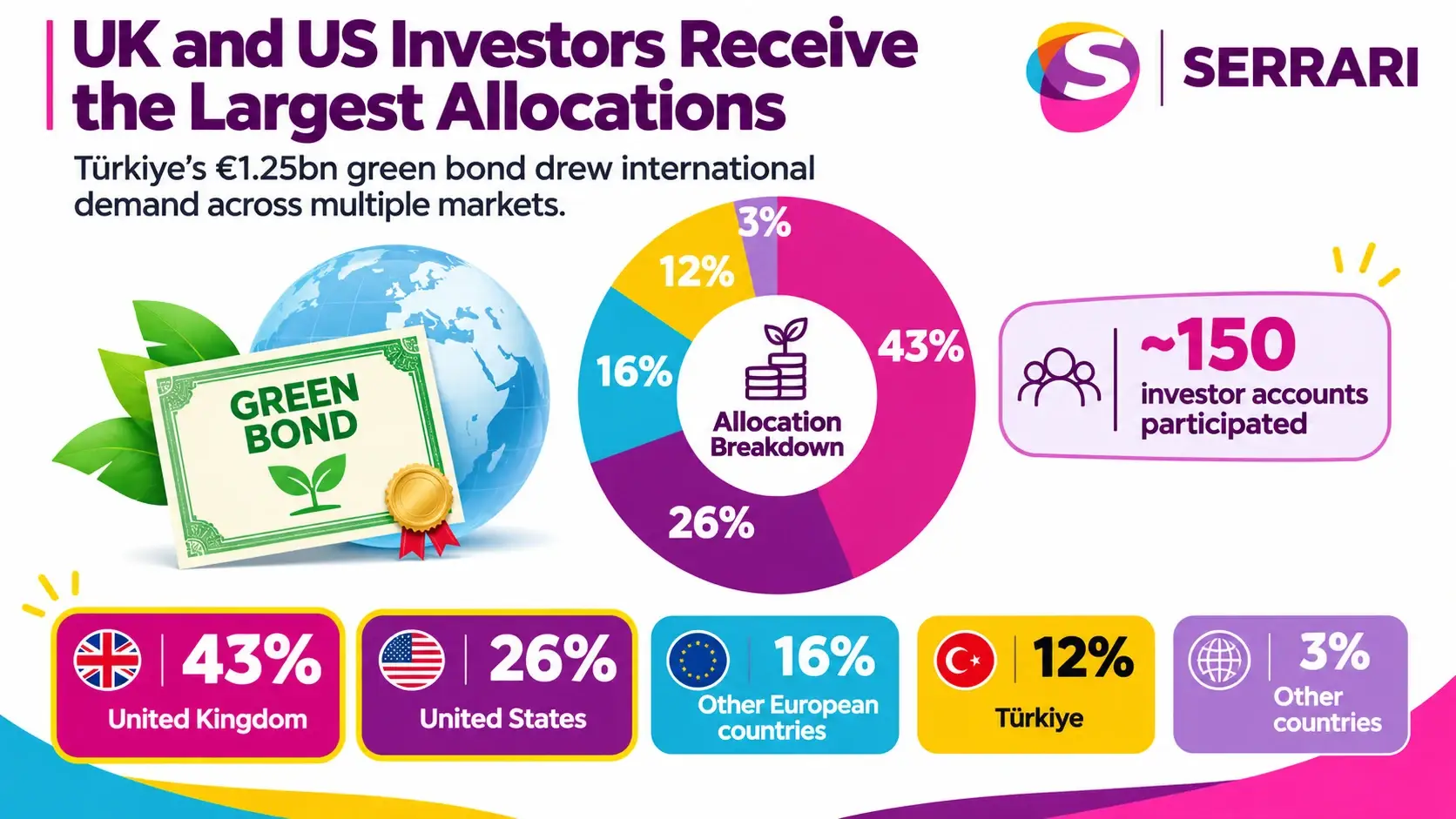
The green bond attracted investors from several international markets, with the United Kingdom and the United States accounting for the largest shares of the allocation.
The distribution was as follows:
Investor location
Allocation
United Kingdom
43%
United States
26%
Other European countries
16%
Türkiye
12%
Other countries
3%
Total
100%
UK investors received 43% of the issuance, making them the largest investor group. US investors accounted for another 26%, while investors in other European countries received 16%.
Domestic investors in Türkiye accounted for 12%, with the remaining 3% allocated to investors in other countries.
The geographical distribution demonstrates the international reach of the transaction and the participation of investors across different markets.
The relatively large allocations to UK and US investors also highlight the importance of international institutional capital in sovereign bond markets. Governments seeking to raise funds abroad often engage investors across financial centres to broaden demand for their debt.
For Türkiye, attracting investors from several regions provides access to a wider international funding base.
Türkiye Continues Its ESG Bond Issuance Programme
The latest transaction is part of Türkiye’s broader use of ESG-labelled bonds in international capital markets.
The Treasury and Finance Ministry described the issuance as the country’s third ESG bond transaction in international capital markets and its second ESG bond issuance during 2026.
ESG bonds are debt instruments associated with environmental, social or governance objectives. Green bonds are a specific category focused on environmental purposes, while social bonds support social projects and sustainability bonds can combine environmental and social objectives.
Governments can use these instruments to attract investors who consider environmental and sustainability-related factors when making investment decisions.
For issuers, ESG-labelled bonds can also provide another route to international financing. Their use requires clear communication about the intended purpose of the funds and the relevant reporting arrangements.
However, the supplied announcement does not identify the specific environmental projects or spending categories that will receive proceeds from this €1.25 billion issuance. The precise allocation of funds should therefore not be assumed from the green bond label alone.
The transaction nevertheless adds to Türkiye’s record of accessing international capital markets through ESG-labelled debt.
Banks Involved in the Transaction
Türkiye’s Treasury and Finance Ministry appointed four international financial institutions to manage the euro-denominated ESG bond transaction.
The banks were:
- Bank of America
- BBVA
- Deutsche Bank
- JP Morgan
These institutions were mandated for the issuance, supporting the process of bringing the bond to international investors.
Banks involved in sovereign bond transactions can assist with structuring, pricing, investor engagement and distribution. Their participation helps connect government issuers with institutional investors across international financial markets.
The involvement of four major financial institutions also reflects the cross-border nature of the transaction, which was denominated in euros and attracted investors from the UK, US, Europe, Türkiye and other markets.
The Bigger Picture: Green Bonds and Sovereign Financing
Türkiye’s latest issuance highlights how governments are using international debt markets to raise capital while expanding their participation in sustainable finance.
Green bonds have become an important financing instrument for governments and companies seeking to connect borrowing with environmental objectives. They allow issuers to access investors who are interested in both financial returns and the environmental purpose associated with the funds.
For governments, issuing green bonds can help diversify funding sources and broaden access to international investors. For investors, these instruments provide exposure to sovereign debt while offering an environmental financing framework.
However, the green label alone does not establish the environmental impact of a bond. Investors also need information about how proceeds are allocated, the projects supported and the reporting used to assess outcomes.
Türkiye’s €1.25 billion transaction therefore illustrates both the financing opportunity and the importance of transparency in sustainable debt markets.
The country’s total international capital market fundraising reaching US$13.6 billion in 2026 also provides context for the transaction. The green bond is one component of its wider international borrowing activity, rather than a separate measure of the country’s total debt.
Why Does This Matter Now?
The transaction comes as sustainable finance continues to provide governments with additional ways to access international capital.
Türkiye’s ability to attract orders exceeding three times the bond’s issue size demonstrates demand for the latest issuance under its ESG financing programme. The participation of approximately 150 accounts also reflects interest across multiple investor markets.
For international investors, the bond offers exposure to Türkiye’s sovereign debt through a euro-denominated instrument with an eight-year maturity. Its coupon and yield provide two important measures for assessing the bond’s financial characteristics.
For the wider green finance market, the issuance highlights the continued role of sovereign borrowers in developing ESG-labelled debt markets.
At the same time, the environmental credibility of green bonds depends on how proceeds are used and whether issuers provide sufficient information to demonstrate that financing supports the stated objectives.
Outlook
Türkiye’s €1.25 billion green bond issuance adds another transaction to its international ESG financing programme and increases its total international capital market fundraising for 2026 to US$13.6 billion.
The bond’s strong order book, international investor participation and eight-year maturity demonstrate the Treasury’s continued access to euro-denominated financing.
Going forward, attention will also turn to how the proceeds are allocated and whether the government provides reporting on the environmental activities financed through the issuance.
For investors, the bond’s performance will depend on factors including Türkiye’s credit risk, market interest rates, currency considerations and the broader economic environment.
The transaction reinforces the role of green bonds in sovereign financing, while highlighting the importance of transparency and accountability in ensuring that environmental financing commitments translate into measurable outcomes.
Frequently Asked Questions
1. How much did Türkiye raise through its latest green bond issuance?
Türkiye’s Treasury raised €1.25 billion through a euro-denominated green bond maturing in 2034.
2. What is the coupon rate and yield of Türkiye’s 2034 green bond?
The bond has a coupon rate of 5.850% and an investor yield of 6.125%. The coupon determines interest payments based on the bond’s nominal value, while the yield reflects the return based on its purchase price and cash flows.
3. How strong was investor demand for the bond?
The issuance attracted orders exceeding three times its €1.25 billion size from approximately 150 investor accounts.
4. How much has Türkiye raised from international capital markets in 2026?
Following the green bond transaction, Türkiye’s funds raised from international capital markets during 2026 reached US$13.6 billion.
Your financial future isn’t something you wait for—it’s something you build.
The real question is: when do you begin?
Move beyond simply staying informed.
Navigate the markets with clarity—track trends through the Serrari Group Market Index, uncover opportunities in the Serrari Marketplace, and build practical knowledge with our Curated Wealth Builder Platform.
Stay connected to what truly matters.
Get daily insights on macro trends and financial movements across Kenya, Africa, and global markets—delivered through the Serrari Newsletter.
Growth opens doors.
Advance your career through professional programs including ACCA, HESI A2, ATI TEAS 7 , HESI EXIT , NCLEX – RN and NCLEX – PN, Financial Literacy!🌟—designed to move you forward with confidence.
See where money is flowing—clearly and in real time.
Track Money Market Funds, Treasury Bills, Treasury Bonds, Green Bonds, and Fixed Deposits, alongside global and African indexes, key economic indicators, and the evolving Crypto and stablecoin landscape—all within Serrari’s Market Index.