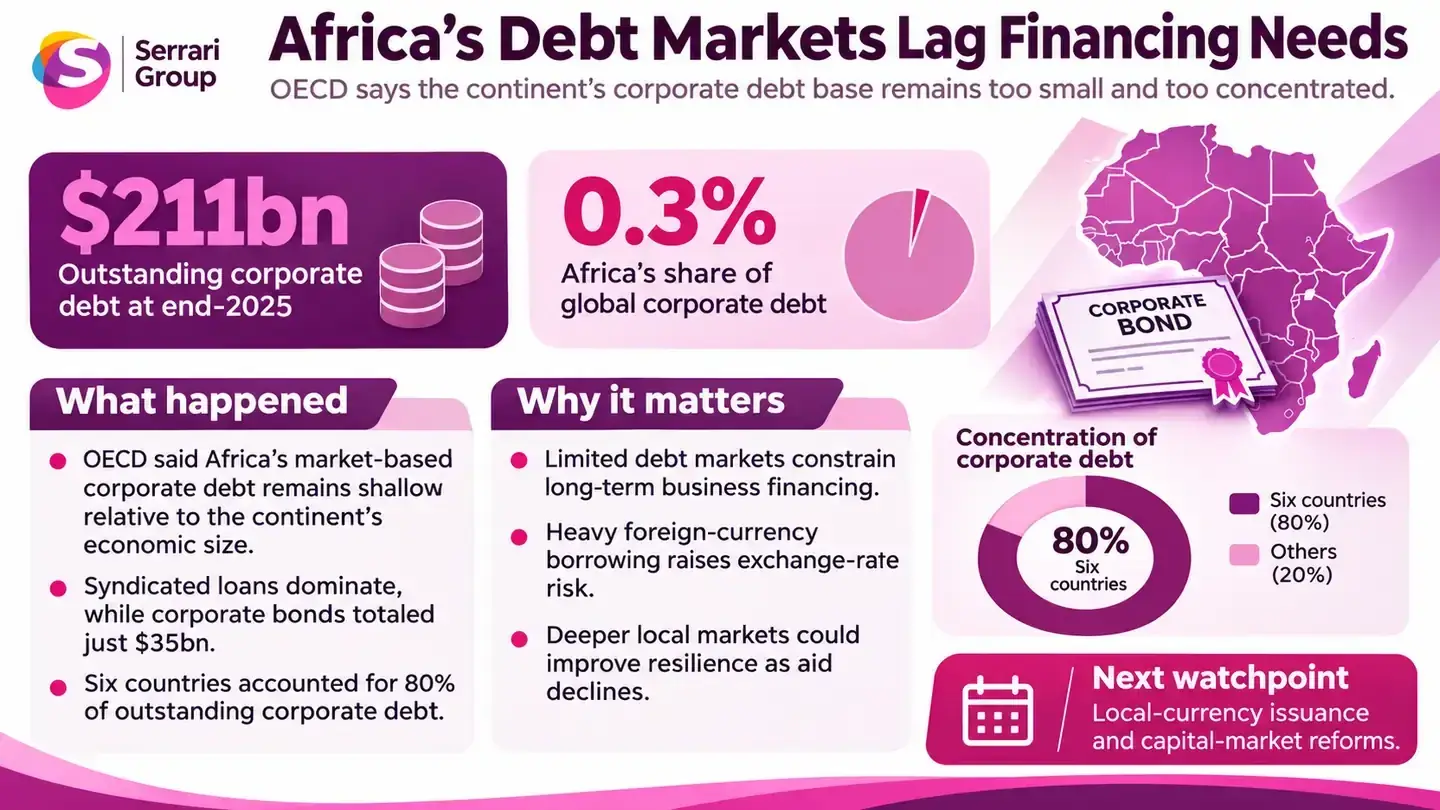
Africa’s corporate debt market remains strikingly small compared with the continent’s economic weight, leaving businesses dependent on bank financing and vulnerable to currency and global funding shocks. The Organisation for Economic Co-operation and Development (OECD) estimates that outstanding corporate debt across bonds, syndicated loans and private credit reached just $211 billion at the end of 2025, while corporate bonds accounted for only $35 billion. Its Africa Capital Markets Report 2026, published on November 6, warns that without stronger institutions, deeper domestic investor pools and more local-currency financing, Africa will struggle to turn savings into the long-term investment needed for industrial expansion and economic resilience.
Key Overview
- Africa held just 0.3% of global outstanding corporate debt in 2025 despite accounting for 2.7% of global GDP.
- Syndicated loans represented 81% of the continent’s $211 billion corporate debt market, while corporate bonds totalled only $35 billion.
- Only 20 corporate bonds were issued across Africa in 2025, including 17 from financial companies.
- Six countries accounted for 80% of outstanding corporate debt, highlighting the continent’s uneven access to market funding.
- Just 17% of corporate debt issuance was denominated in local currencies, exposing borrowers to exchange-rate risks.
- African equity market capitalisation rose 49% in 2025, but the rally was concentrated and delivered relatively few new listings.
Why Africa’s Corporate Debt Market Remains So Small
The OECD’s assessment of corporate borrowing reveals a structural mismatch: Africa produces 2.7% of global economic output but accounts for only 0.3% of outstanding corporate debt worldwide. The continent’s contribution to formal debt markets is therefore far smaller than its contribution to economic activity.
This is not simply evidence that African companies prefer to borrow less. In many economies, businesses have few alternatives to traditional bank loans, retained earnings or financing from owners. Issuing bonds requires credible financial statements, predictable cash flows, legal safeguards and investors willing to commit money for years. Where these conditions are weak, even potentially productive businesses can struggle to secure affordable long-term capital.
The composition of debt illustrates the problem. Of the $211 billion outstanding at the end of 2025, syndicated loans—financing arranged by groups of lenders—represented 81%. Corporate bonds accounted for $35 billion, down 44% in inflation-adjusted terms from their 2015 peak, largely reflecting a contraction in South Africa’s market. Private credit fund assets under management reached $5.5 billion, up from $2.2 billion in 2020, but some of that capital had not yet been deployed.
Only 20 corporate bonds were issued across Africa in 2025, 17 by financial firms. This leaves non-financial businesses such as manufacturers, agricultural processors and logistics operators with limited access to a financing instrument that could match the long lives of factories, equipment and infrastructure.
How Currency Exposure Raises the Cost of Growth
The shortage of local-currency debt is particularly consequential. According to the report’s financing breakdown, only 17% of corporate debt issued in Africa during 2025 was denominated in domestic currencies. Much of the remainder exposes borrowers to exchange-rate movements.
A company earning revenue in shillings, naira or cedis but servicing dollar-denominated debt faces a mismatch. If its home currency depreciates, it needs more local-currency revenue to meet the same foreign-currency repayment. That pressure can reduce profits, delay investment and potentially increase prices for customers. Foreign-currency borrowing is not inherently inappropriate—exporters with dollar revenues may be naturally protected—but it can be dangerous when revenues and liabilities do not match.
Deeper domestic bond markets would give creditworthy companies another way to finance expansion without automatically taking on exchange-rate risk. They could also reduce reliance on overseas lenders that may cut exposure when international interest rates rise or global investors become more cautious.
That resilience matters now because successive external shocks have shown how quickly financial conditions can change. A broad investor base cannot eliminate those shocks, but it can prevent every business financing decision from depending on the willingness of foreign creditors to lend.
Context is everything. Stay ahead of shifting trends with today’s market updates, and uncover emerging opportunities using the Serrari Group Market Index and Marketplace. Then, take control of your own financial future by exploring our Money & Life Reset Transformation Blueprint ™ to build stronger habits, create better systems, and design a path toward lasting wealth.
Why Most African Countries Remain Outside the Market
The continental figures conceal substantial differences. Egypt, Mauritius, Morocco, Mozambique, Nigeria and South Africa accounted for 80% of outstanding corporate debt in 2025. South Africa alone represented approximately 30%, with $63 billion outstanding.
Such concentration reflects decades of uneven development in pension systems, financial regulation, legal enforcement and capital-market infrastructure. The OECD identifies regulatory quality, the rule of law, exchange-rate stability and pension-fund development as particularly important conditions for stronger corporate bond markets.
These relationships help explain why launching an exchange or simplifying bond paperwork is not enough. Investors need confidence that issuers will disclose accurate information, creditor rights can be enforced and inflation will not destroy the real value of future payments. Companies, meanwhile, need sufficiently large and reliable investor demand to justify the cost of issuing securities.
Government borrowing also shapes the market. Sovereign bonds provide benchmark yields against which corporate borrowing can be priced, but high government financing needs can draw banks and investment funds toward public debt instead of lending to private enterprises. More predictable sovereign issuance and credible fiscal management can help establish pricing benchmarks without overwhelming demand for corporate instruments.
The challenge for policymakers is therefore institutional as much as financial. The OECD advocates a broad approach to market reform, combining macroeconomic stability, transparent corporate governance and credible supervision with mechanisms that encourage long-term savings.
Equity Markets Are Rising, but Access Remains Concentrated
Africa’s stock markets tell a more optimistic story at first glance. Total listed market capitalisation increased 49% in 2025, compared with 20% across emerging markets and 21% globally. Yet the underlying equity-market data show that higher valuations of companies already listed drove most of the increase.
Only seven new companies listed on African exchanges in 2025, accounting for about 3% of the increase in market capitalisation. South Africa, Morocco, Egypt and Nigeria together represented 88% of the continent’s listed market value. In other words, rising share prices do not necessarily mean that a much broader range of African businesses can now raise capital from investors.
This distinction matters to households as well as corporations. Stronger markets can offer pension funds and savers diversified assets, while giving businesses equity funding that does not require fixed interest payments. But investors cannot diversify effectively if exchanges offer relatively few liquid, well-governed companies and trade is concentrated in a handful of markets.
State-Owned Companies and Pension Funds Could Unlock Capital
One possible source of new investment opportunities is the continent’s large pool of state-owned enterprises. The OECD’s analysis of public enterprises finds that listed large state-owned companies account for only 27% of the assets of such enterprises in Africa, compared with 45% across emerging markets.
This does not mean governments should sell public assets indiscriminately. Listing minority stakes or issuing corporate securities can increase disclosure, attract long-term capital and broaden investment options, but only where governance, valuations and public-interest safeguards are credible. Otherwise, privatisation can transfer valuable assets without developing durable markets.
Kenya’s 2026 Kenya Pipeline Company share sale offers an example of efforts to mobilise capital through public assets. The government confirmed the IPO’s closure in April and said proceeds would support its National Infrastructure Fund. Whether such transactions deepen the wider market depends on sustained investor participation and subsequent liquidity, not merely the success of an initial sale.
Domestic pension and insurance funds are another potential source of demand. Their long-term obligations can align with infrastructure and corporate bonds, provided investment rules, risk management and market transparency support prudent diversification. Expanding retirement savings would also help channel more domestic capital toward productive projects.
Why Shrinking Foreign Aid Makes Reform More Urgent
The financing gap is becoming harder to ignore as external assistance declines. Separate OECD aid projections estimate that bilateral net official development assistance to sub-Saharan Africa dropped 26.3% in 2025 and could decline a further 11.6% in 2026.
Corporate bond markets cannot directly replace grants for humanitarian relief, public health or basic services. Nevertheless, stronger private financing systems can support jobs, taxable economic activity and infrastructure investment, potentially reducing some governments’ dependence on external resources over time.
The broader message is that Africa needs more than rising share prices or occasional international borrowing windows. It needs functioning domestic markets that connect savings with enterprises capable of expanding production and employment. The $211 billion figure is therefore less a verdict on how much African companies can borrow than evidence of how much financial capacity remains undeveloped.
For investors and policymakers, the test will be whether reforms produce more local-currency issuance, wider participation beyond established corporate groups, stronger investor protections and a more diverse pipeline of credible securities. Without those changes, Africa risks remaining vulnerable to financing shocks even as its economies and capital requirements continue to grow.
Sources: OECD / Public Investment and Assets Management, Kenya
Your financial future isn’t something you wait for—it’s something you build.
The real question is: when do you begin?
Move beyond simply staying informed.
Navigate the markets with clarity—track trends through the Serrari Group Market Index, uncover opportunities in the Serrari Marketplace, and build practical knowledge with our Curated Wealth Builder Platform.
Stay connected to what truly matters.
Get daily insights on macro trends and financial movements across Kenya, Africa, and global markets—delivered through the Serrari Newsletter.
Growth opens doors.
Advance your career through professional programs including ACCA, HESI A2, ATI TEAS 7 , HESI EXIT , NCLEX – RN and NCLEX – PN, Financial Literacy!🌟—designed to move you forward with confidence.
See where money is flowing—clearly and in real time.
Track Money Market Funds, Treasury Bills, Treasury Bonds, Green Bonds, and Fixed Deposits, alongside global and African indexes, key economic indicators, and the evolving Crypto and stablecoin landscape—all within Serrari’s Market Index.