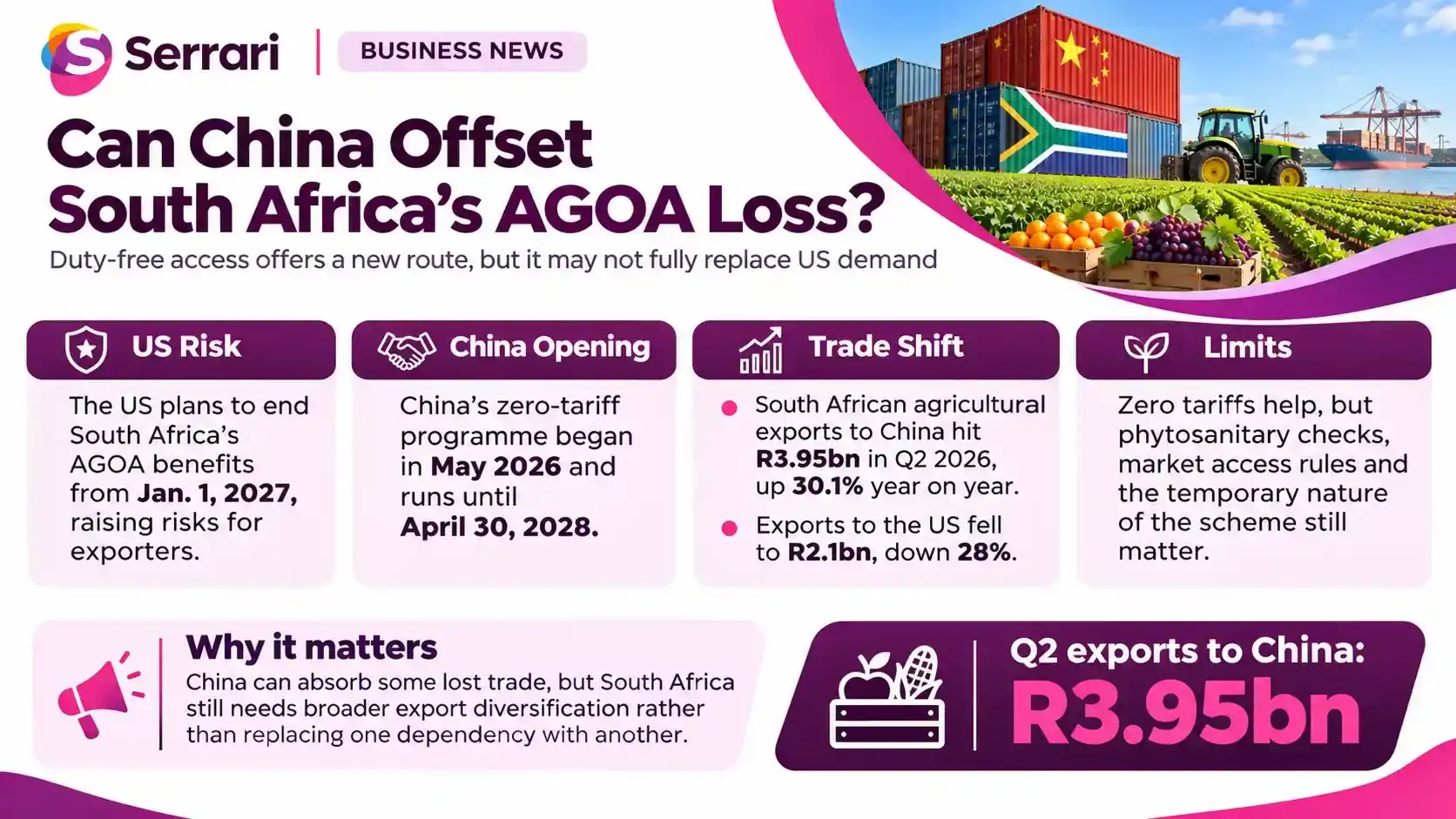
China’s temporary zero-tariff programme is providing South African agricultural exporters with an alternative just as the United States prepares to withdraw South Africa’s benefits under the African Growth and Opportunity Act (AGOA) on January 1, 2027. Agricultural shipments to China climbed 30.1% year on year to R3.95 billion in the second quarter of 2026, while exports to the US fell 28% to R2.1 billion. These contrasting trends make diversification urgent, but they do not establish that Chinese demand can replace every lost American sale. Tariff savings are meaningful; market access, prices, shipping costs, product preferences and the temporary nature of China’s offer will determine how much business can actually move.
Key Overview
- US market risk: Washington notified South Africa on November 2 of its intention to end AGOA eligibility from January 1, 2027; withdrawal was not yet effective as of November 11.
- Chinese opening: South African qualifying products gained zero-tariff treatment from May 1, 2026 through April 30, 2028, subject to origin rules and tariff-rate quotas on specified lines.
- Export divergence: Second-quarter agricultural exports to China reached R3.95 billion, up 30.1%, against R2.1 billion to the US, down 28%.
- Other alternatives: Exports to Vietnam rose 152.6% to R2.1 billion, and those to Saudi Arabia increased 90.1% to R1.65 billion during the same quarter.
- Critical limitation: Zero customs duties do not remove sanitary approvals, distribution barriers, currency exposure or the need to find paying buyers.
- Long-term uncertainty: China’s current arrangement is unilateral and temporary, while discussions on a potentially reciprocal successor could change the economic calculation.
Why AGOA’s Pending Withdrawal Has Accelerated the Search for Buyers
The immediate trigger is a change in American trade policy. On November 2, the US government notified South Africa of its intention to terminate its AGOA benefits on January 1, 2027, citing concerns about trade and investment barriers and broader eligibility criteria. South Africa’s government acknowledged the expected disruption to exporters, workers and production chains while promising engagement with affected companies.
AGOA gives eligible African products preferential access to the US, generally by removing duties that would otherwise apply. Its withdrawal would not prohibit South African produce from entering America. Instead, affected products would face applicable ordinary tariffs and any other relevant trade measures, making some shipments less competitive against suppliers enjoying more favourable treatment. The actual effect differs by product and depends on how much tariff relief each exporter previously used.
That distinction matters for farms and packhouses. An American buyer need not abandon South African citrus, wine or nuts entirely, but a higher landed cost could prompt a search for competing suppliers or pressure exporters to reduce their prices. Lower margins can flow back to growers, seasonal workers and logistics businesses. The strongest businesses may maintain customers; smaller exporters with limited pricing power could feel the greatest strain.
What China’s Zero-Tariff Offer Actually Changes
China’s temporary preference scheme took effect on May 1, 2026 and is scheduled to operate until April 30, 2028. China extended duty-free access to 20 African countries not already covered by the preferential treatment granted to 33 least-developed African partners. The result is a broader policy reaching 53 African countries with diplomatic relations with Beijing, rather than 53 newly admitted countries all starting from the same position.
For South Africa, eliminating tariffs improves the price competitiveness of eligible exports. Some goods had previously faced material duties, including reported rates of 20% on wine and 10% on macadamias. Removing such a duty can give an exporter more flexibility to lower prices, absorb transport costs or improve margins. But importers and distributors may capture part of the benefit, so the headline tariff reduction is not automatically an equivalent increase in the farmgate price.
Crucially, the measure is non-reciprocal: South Africa is not currently required by this scheme to reduce its own tariffs on Chinese imports. That limits immediate concerns that the programme itself could expose local producers to additional Chinese competition. The arrangement is nevertheless temporary, and a proposed longer-term China–Africa economic partnership involving reciprocal obligations could introduce a different balance of opportunities and domestic-market risks.
Nor does zero tariff mean unconditional entry. Exporters must meet origin requirements, secure certificates and comply with China’s food-safety and phytosanitary rules. The South African customs authority began issuing origin certificates in June, including a mechanism for eligible shipments cleared after the May start date. Some tariff lines remain subject to quotas, meaning preferential treatment applies only to qualifying quantities.
Does the Export Data Show China Can Replace the US?
The latest figures show real momentum but need careful interpretation. Analysis of second-quarter bilateral agricultural trade puts exports to China at R3.95 billion, 30.1% above the comparable 2025 quarter. US-bound agricultural exports declined 28% to R2.1 billion. On these figures, China was nearly twice as large a destination as America during the quarter.
Yet the comparison does not prove that the Chinese tariff change caused the entire increase. The programme began in May, two-thirds of the way into the April–June quarter. Crop harvest timing, prices, exchange rates, orders arranged months earlier and access approvals can all influence trade flows. The US decline also preceded the announced January 2027 AGOA withdrawal, so it cannot be attributed to that future withdrawal alone.
The broader sector was expanding rather than simply shifting shipments from one buyer to another. An industry agricultural trade assessment estimated second-quarter exports at approximately $4.12 billion, up 9.1% year on year, with a trade surplus of about $2.14 billion. Different agricultural product baskets and data conventions can produce different aggregate totals, so these sector figures should not be mechanically combined with the bilateral rand amounts.
There is a useful diversification signal beyond China. Vietnam bought approximately R2.1 billion of South African agricultural products during the quarter, a rise of 152.6%, while Saudi Arabia purchased R1.65 billion, up 90.1%. This suggests exporters have several growing destinations rather than one prospective substitute. Spreading sales among markets also reduces the risk that a sudden policy change in a single country disrupts an entire export season.
Context is everything. Stay ahead of shifting trends with today’s market updates, and uncover emerging opportunities using the Serrari Group Market Index and Marketplace. Then, take control of your own financial future by exploring our Money & Life Reset Transformation Blueprint ™ to build stronger habits, create better systems, and design a path toward lasting wealth.
Which Agricultural Products Stand to Benefit Most?
The opportunity is strongest where South Africa already has export capacity and a product for which Chinese importers see demand. In 2025, China represented approximately 4.6% of the country’s agricultural export value, ranking seventh among destinations in the cited trade analysis. Nuts, wool and macadamias featured prominently, alongside citrus, deciduous fruit, wine, beef and grapes.
Macadamias and wine are especially interesting because tariff reductions can be economically significant where consumers or importers have competing suppliers. Citrus and fresh fruit, meanwhile, depend heavily on cold-chain reliability and access protocols. Even when an importer pays no customs duty, spoilage, delays, container costs and port congestion can erase much of the pricing advantage.
China’s market also differs from the United States in consumer tastes, distribution networks, packaging requirements and established retail relationships. A shipment rejected on quality or regulatory grounds cannot be rescued by a zero tariff. Businesses may therefore need to invest in marketing, traceability, certification and product adaptation rather than expect existing American orders simply to be redirected eastward.
The employment implications extend beyond farms. Packhouses, trucking companies, inspection services, port operators and food processors depend on export volumes. A sustained increase in orders can support investment and jobs, but only if producers can achieve commercially viable prices after transport and compliance expenses.
Why Two Years of Preferential Access May Not Be Enough
The programme’s April 2028 expiry is a strategic concern. Establishing new buyers can require years of promotional spending, repeated shipments and investments in processing or orchards. A farmer considering expansion needs a longer planning horizon than a temporary tariff concession offers, particularly when crop production and capital equipment have multiyear lifecycles.
South Africa’s trade authorities have already emphasised the need to convert Chinese access into durable contracts, while negotiations toward a more permanent arrangement continue. Exporters should examine whether any successor agreement preserves the tariff advantage and whether reciprocal concessions affect domestic producers. Until terms are negotiated, neither permanent duty-free access nor a specific future tariff can be assumed.
Overdependence on China would also reproduce the vulnerability that diversification is meant to solve. Large buyers have considerable bargaining power, while policy, consumer demand and currency changes can alter export economics rapidly. European, African and Middle Eastern markets remain important components of a resilient strategy even if China becomes a much larger destination.
The Bigger Picture: Diversification Is More Than Replacing One Market
China’s tariff programme arrives at a time when trade preferences are becoming instruments of diplomatic and industrial policy. The US move against South Africa underscores how access once treated as relatively stable can become uncertain. China’s unilateral offer provides an opening, but it also strengthens Beijing’s role in African supply chains and commercial relationships.
For South African agriculture, the practical response is to diversify products and destinations while improving competitiveness at home. Reliable ports, faster sanitary approvals, traceable supply chains and stronger links between growers and exporters will matter whether the customer is in Shanghai, Rotterdam, Dubai or New York.
The most meaningful test will come after January 1, 2027, if the announced AGOA withdrawal takes effect. Policymakers should then compare actual US export losses with sustained growth in China and other markets, broken down by product, volume, price and employment. A favourable aggregate export figure could otherwise conceal severe losses for individual producers.
China can absorb some business that South Africa might lose in the US, and the early trade data make that possibility credible. But it is too soon to claim a one-for-one replacement. The durable opportunity lies in building a wider network of profitable markets, not exchanging dependence on Washington’s preferences for dependence on Beijing’s.
Sources: South African Revenue Service / Office of the United States Trade Representative / South African Government / China’s Ministry of Finance / Bizcommunity / AgriSA / Agricultural Business Chamber / SAnews
Your financial future isn’t something you wait for—it’s something you build.
The real question is: when do you begin?
Move beyond simply staying informed.
Navigate the markets with clarity—track trends through the Serrari Group Market Index, uncover opportunities in the Serrari Marketplace, and build practical knowledge with our Curated Wealth Builder Platform.
Stay connected to what truly matters.
Get daily insights on macro trends and financial movements across Kenya, Africa, and global markets—delivered through the Serrari Newsletter.
Growth opens doors.
Advance your career through professional programs including ACCA, HESI A2, ATI TEAS 7 , HESI EXIT , NCLEX – RN and NCLEX – PN, Financial Literacy!🌟—designed to move you forward with confidence.
See where money is flowing—clearly and in real time.
Track Money Market Funds, Treasury Bills, Treasury Bonds, Green Bonds, and Fixed Deposits, alongside global and African indexes, key economic indicators, and the evolving Crypto and stablecoin landscape—all within Serrari’s Market Index.