Türkiye has signed a $1.6 billion climate financing agreement with the Asian Infrastructure Investment Bank (AIIB) to support renewable energy, industrial decarbonisation and climate-resilient development. Signed on 12 November 2026 on the sidelines of COP31 in Antalya, the Türkiye Climate Action Acceleration Program will support regulatory and institutional reforms intended to mobilise public and private investment in low-carbon development. Key energy-related measures include plans to operationalise an emissions trading system, establish a green finance regulatory framework and license 1,800 megawatts of wind and solar capacity by early 2027. The programme also supports Türkiye’s Climate Law and its target of achieving net-zero emissions by 2053. With the country estimating that it needs an additional $68 billion in climate investment by 2030, approximately half expected from private sources, the agreement aims to help create the conditions for greater private-sector participation.
Key Takeaways
- Türkiye has signed a $1.6 billion climate financing agreement with AIIB.
- The programme focuses on sustainable finance, industrial decarbonisation and climate resilience.
- Türkiye plans to operationalise an emissions trading system and establish a green finance regulatory framework.
- The programme targets licensing 1,800 megawatts of wind and solar capacity by early 2027.
- Türkiye estimates that it needs an additional $68 billion in climate investment by 2030, with approximately half expected from private sources.
- The agreement supports the country’s Climate Law and its target of achieving net-zero emissions by 2053.
- Its success will depend on implementing the planned reforms and translating financing into actual investment and projects.
Türkiye Secures $1.6 Billion AIIB Agreement to Support Climate and Energy Investment
Türkiye has signed a $1.6 billion climate financing agreement with the Asian Infrastructure Investment Bank (AIIB), seeking to accelerate low-carbon investment and strengthen the regulatory framework needed to attract private capital.
The agreement was signed on 12 November 2026 on the sidelines of COP31 in Antalya. It supports the Türkiye Climate Action Acceleration Program, which focuses on three areas: sustainable finance, industrial decarbonisation and climate resilience.
Rather than concentrating exclusively on financing individual projects, the programme will also support the institutional and regulatory reforms needed to mobilise public and private investment.
For the energy sector, this includes strengthening the framework for renewable energy development, reducing emissions across energy and industrial activities, and creating financial regulations that encourage investment in climate-friendly projects.
The programme also supports Türkiye’s efforts to implement its Climate Law and advance its target of achieving net-zero emissions by 2053.
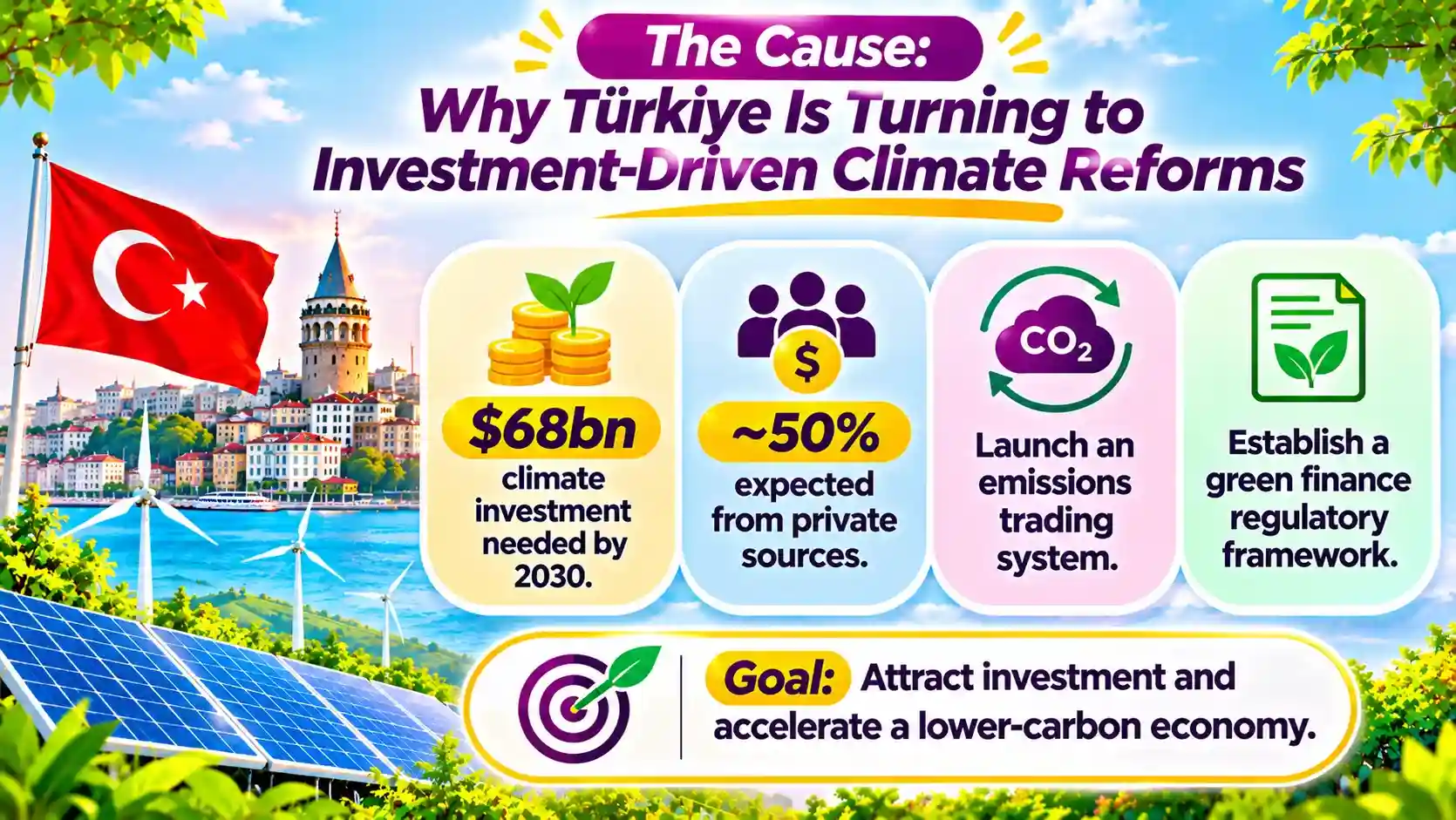
The agreement comes as Türkiye estimates that it requires an additional $68 billion in climate investment by 2030, with approximately half expected to come from private sources.
This creates a significant financing challenge. Public funding and development bank support alone may not be sufficient to meet the country’s investment requirements. Türkiye therefore needs policies and financial systems that can encourage businesses and private investors to participate.
The Cause: Why Türkiye Is Turning to Investment-Driven Climate Reforms
The financing agreement comes against the backdrop of Türkiye’s substantial climate investment requirements and its efforts to advance the transition towards a lower-carbon economy.
The country estimates that it needs an additional $68 billion in climate investment by 2030. Approximately half of this amount is expected to come from private sources.
Attracting that investment requires more than making funding available. Investors also need predictable regulations, clear financing rules and institutions capable of implementing climate policies.
This is why the AIIB programme places emphasis on regulatory and institutional reform alongside financing.
One of the planned measures is to operationalise an emissions trading system (ETS). An ETS is a market-based mechanism through which companies can buy and sell emissions allowances within a regulated system.
By establishing a carbon market, Türkiye aims to introduce a clearer framework for managing emissions and encouraging businesses to consider the cost of their carbon output.
The programme also supports the development of a green finance regulatory framework. This is intended to provide greater clarity around which investments qualify for green financing and help direct capital towards climate-friendly activities.
For investors, these reforms matter because they can reduce uncertainty around the rules governing low-carbon projects.
Twangar Kazmi, Senior Climate Change and Development Policy Specialist at the United Nations Development Programme (UNDP) Islamabad, said the agreement reflected a broader shift in climate financing towards institutional reforms and the integration of climate objectives into economic decision-making.
He noted that decisions affecting emissions and climate resilience were increasingly linked to finance ministries, financial regulators, provincial administrations and other government institutions rather than being confined to environmental departments.
“For investors, the detail of those reforms is what counts,” he said.
Kazmi added that an operational emissions trading system and green finance framework would provide greater clarity on carbon pricing and the types of investments eligible for green financing.
The underlying issue is that climate investment depends not only on the availability of capital, but also on whether investors have confidence in the regulatory and institutional environment in which they operate.
Renewable Energy: Türkiye Targets 1,800MW of Wind and Solar Capacity
One of the programme’s specific energy-related targets is to license 1,800 megawatts of wind and solar capacity by early 2027.
This target places renewable energy development among the key areas through which Türkiye intends to advance its climate objectives.
Wind and solar projects require investment in generation facilities and supporting infrastructure. Licensing capacity is an important step towards development, although it does not mean that the full 1,800MW will already be operational or generating electricity by early 2027.
The target therefore represents planned capacity licensing rather than confirmed completed installations.
The programme also aims to reduce emissions across the energy, industry and transport sectors through stronger regulations and sectoral planning.
For energy investors and project developers, the regulatory reforms could be particularly important. Clearer investment rules and green finance frameworks may help create a more predictable environment for developing renewable energy projects.
However, the supplied information does not identify specific wind or solar projects, their locations, expected investment costs or construction schedules.
The next important development will be whether the licensing target translates into financed projects and additional renewable electricity generation.
Industrial Decarbonisation and the Emissions Trading System
Industrial decarbonisation is another major component of the Türkiye Climate Action Acceleration Program.
Industries that rely on energy-intensive production processes face the challenge of reducing emissions while maintaining economic activity and competitiveness.
The programme aims to support emissions reductions across industrial activities through stronger regulations and sectoral planning.
The planned emissions trading system is an important part of this approach.
Under an ETS, regulated businesses operate within an emissions allowance framework. Companies that reduce their emissions may have different options from those that exceed their allocated allowances, depending on the system’s design.
For businesses, the introduction of such a system could make emissions management a more direct part of financial and operational planning.
Kazmi highlighted that investors need clarity on carbon pricing and the investments that qualify for green financing.
This is important because businesses are more likely to make long-term investment decisions when they understand the regulatory requirements and financial implications of reducing emissions.
However, the supplied sources do not provide the proposed emissions trading system’s final design, its coverage, allowance allocation rules or implementation date.
Its effectiveness will therefore depend on how the system is developed and enforced.
Context is everything. Stay ahead of shifting trends with today’s market updates, and uncover emerging opportunities using the Serrari Group Market Index and Marketplace. Then, take control of your own financial future by exploring our Money & Life Reset Transformation Blueprint ™ to build stronger habits, create better systems, and design a path toward lasting wealth.
Green Finance: Creating Conditions for Private Investment
The development of a green finance regulatory framework is another central part of the agreement.
Green finance refers to financial products and investment arrangements that support projects with environmental benefits, including renewable energy, energy efficiency and other low-carbon activities.
For Türkiye, the objective is to create a framework that can encourage investment in climate-friendly projects and support the mobilisation of private capital.
The need is significant. The country estimates that it requires an additional $68 billion in climate investment by 2030, with approximately half expected to come from private sources.
The AIIB agreement is intended to support the reforms needed to attract some of this investment.
Dr M. Aman Ullah, Senior Advisor for Punjab Sustainable Development Goals at UNDP, said multilateral development banks could help address climate investment gaps by providing long-term financing, technical assistance and policy support to encourage private-sector participation.
He stressed that predictable regulatory frameworks, stronger institutional capacity and effective climate governance were essential for attracting investment in renewable energy and sustainable infrastructure.
This highlights the role of development banks beyond providing loans. Their financing and technical support can help countries strengthen the systems needed to make projects more attractive to private investors.
However, the $1.6 billion agreement should not be interpreted as confirmation that the full amount has already been disbursed or that it will automatically generate additional private investment. The supplied sources do not provide a detailed disbursement schedule or a breakdown of the financing by project.
Climate Resilience: Supporting Agriculture and Carbon Sinks
Although energy and industrial decarbonisation are central to the investment agenda, the programme also includes climate adaptation and resilience measures.
Türkiye plans to help 225,000 farmers in water-stressed areas shift towards less water-intensive crops by 2028.
It also aims to designate 50,000 hectares as carbon sinks.
These measures address climate-related pressures beyond the energy sector. Changes in agricultural practices are intended to support adaptation to water stress, while carbon sinks can contribute to the removal or storage of carbon dioxide.
The inclusion of these targets reflects the programme’s wider approach: combining emissions reduction with measures to strengthen resilience to climate impacts.
Kazmi emphasised that concessional financing is particularly important for developing economies, especially for adaptation initiatives such as water security and resilient public services.
These projects can provide substantial public benefits but may generate limited direct revenue, making them less attractive to conventional private financing.
The programme therefore needs to consider how public and development finance can support activities that are important for resilience but may not generate immediate commercial returns.
The Impact: What the Agreement Could Mean for Energy Investors and Businesses
The agreement could have implications for renewable energy developers, industrial companies, financial institutions and investors considering climate-related opportunities in Türkiye.
For renewable energy developers, the planned licensing of 1,800MW of wind and solar capacity creates a target to watch. Its practical value will depend on whether the capacity progresses into projects with financing, construction plans and grid connections.
For industrial businesses, the planned emissions trading system could introduce new considerations into investment and operational decisions.
For financial institutions, the green finance regulatory framework could provide greater clarity on eligible climate investments and support the development of financing products for low-carbon projects.
For private investors, the reforms could help improve the investment environment by making climate-related rules and priorities more predictable.
However, these benefits are not guaranteed. Kazmi stressed that implementation remains a major challenge, requiring reliable data, adequate budgets, institutional capacity and coordination.
Dr Aman Ullah also highlighted the importance of ensuring that climate investments generate productive employment, strengthen local industries and protect vulnerable communities.
This means the success of the programme should not be measured only by the amount of financing secured. It should also be assessed through the projects developed, emissions reductions achieved, investment mobilised and economic benefits delivered.
The Bigger Picture: Development Banks Are Helping Mobilise Private Climate Capital
The Türkiye-AIIB agreement reflects a broader shift in climate finance towards using public and development finance to attract private investment.
Multilateral development banks can play a role in addressing financing gaps by providing long-term funding, technical assistance and support for policy reforms.
However, financing individual projects is only one part of the challenge. Countries also need institutions, regulations and financial systems that allow climate investments to move from policy plans to implementation.
This is particularly relevant for renewable energy and industrial decarbonisation, where projects can require substantial upfront capital and long-term regulatory certainty.
The agreement also illustrates how climate objectives are becoming more closely linked to economic and financial decision-making.
As Kazmi observed, decisions affecting emissions and resilience increasingly involve finance ministries, regulators and other government institutions rather than environmental departments alone.
The wider significance is that climate investment is increasingly being treated as an economic development and financing issue, not only an environmental policy priority.
Why Does This Matter Now?
Türkiye’s $68 billion additional climate investment requirement by 2030 makes the ability to attract private capital particularly important.
The $1.6 billion AIIB agreement provides financing and policy support, but the country’s wider investment needs mean that additional sources of capital will be necessary.
The planned emissions trading system and green finance regulatory framework are therefore important because they could help establish the conditions under which private investors participate in renewable energy and industrial decarbonisation.
The 1,800MW wind and solar licensing target by early 2027 also provides a near-term milestone against which progress can be assessed.
For energy businesses and investors, the developments to watch include the operationalisation of the emissions trading system, the introduction of green finance regulations and the progression of planned renewable energy capacity into actual projects.
For Türkiye, the challenge is moving from financing commitments and policy reforms to implementation.
The agreement matters now because the country has a defined investment requirement, a 2053 net-zero target and specific near-term programme milestones. Whether these ambitions translate into measurable progress will depend on the strength of implementation.
Outlook
The Türkiye Climate Action Acceleration Program will support sustainable finance, industrial decarbonisation and climate resilience, with energy-related priorities including renewable energy development, emissions management and investment in low-carbon activities.
The next developments to watch are the operationalisation of the emissions trading system, the creation of the green finance regulatory framework and progress towards licensing 1,800MW of wind and solar capacity by early 2027.
The programme’s longer-term success will depend on whether these reforms create an environment capable of attracting private capital and supporting the development of actual projects.
Reliable emissions data, institutional capacity, adequate budgets and coordination across government will also be essential.
For now, the agreement represents an important financing and policy step towards Türkiye’s climate and energy transition ambitions. Its ultimate value will be determined by the investment it mobilises and the measurable emissions and resilience outcomes it delivers.
Frequently Asked Questions
1. What is the Türkiye-AIIB climate financing agreement?
It is a $1.6 billion financing agreement signed on 12 November 2026 to support Türkiye’s Climate Action Acceleration Program, which focuses on sustainable finance, industrial decarbonisation and climate resilience.
2. How much renewable energy capacity does Türkiye plan to license?
The programme includes plans to license 1,800MW of wind and solar capacity by early 2027. This is a licensing target, not confirmation that the capacity will all be operational by that date.
3. Why is Türkiye developing an emissions trading system?
The system is intended to strengthen emissions management and provide greater clarity on carbon pricing, helping businesses and investors account for emissions in their decisions.
4. How much additional climate investment does Türkiye need by 2030?
Türkiye estimates that it requires an additional $68 billion in climate investment by 2030, with approximately half expected to come from private sources.
Your financial future isn’t something you wait for—it’s something you build.
The real question is: when do you begin?
Move beyond simply staying informed.
Navigate the markets with clarity—track trends through the Serrari Group Market Index, uncover opportunities in the Serrari Marketplace, and build practical knowledge with our Curated Wealth Builder Platform.
Stay connected to what truly matters.
Get daily insights on macro trends and financial movements across Kenya, Africa, and global markets—delivered through the Serrari Newsletter.
Growth opens doors.
Advance your career through professional programs including ACCA, HESI A2, ATI TEAS 7 , HESI EXIT , NCLEX – RN and NCLEX – PN, Financial Literacy!🌟—designed to move you forward with confidence.
See where money is flowing—clearly and in real time.
Track Money Market Funds, Treasury Bills, Treasury Bonds, Green Bonds, and Fixed Deposits, alongside global and African indexes, key economic indicators, and the evolving Crypto and stablecoin landscape—all within Serrari’s Market Index.