The International Monetary Fund (IMF) has urged Kenya to introduce enforceable Financial Action Task Force (FATF) Travel Rule requirements for cryptocurrency platforms. The proposed rules would require exchanges and other virtual asset service providers to collect, verify and securely share identifying information about people sending and receiving digital assets. The recommendations aim to strengthen anti-money laundering controls as Kenya works towards removal from the FATF grey list by April 2027. However, they also raise questions about financial privacy, personal data protection and the cost of compliance for crypto businesses.
Key Takeaways
- The IMF wants Kenya to enforce the FATF Travel Rule for cryptocurrency transactions involving regulated platforms.
- Platforms would collect and share customer names, national ID numbers, physical addresses, account references and wallet addresses.
- Kenya already requires crypto businesses to identify customers, but the IMF says enforceable information-sharing obligations are missing.
- The recommendations come as Kenya targets removal from the FATF grey list by April 2027.
- Stronger oversight could help investigate suspicious transactions but may increase compliance costs and raise concerns about customer privacy.
Why Does the IMF Want Kenya to Share Cryptocurrency Customer Data?
The International Monetary Fund (IMF) wants Kenya to strengthen its cryptocurrency regulations by requiring exchanges and other virtual asset service providers (VASPs) to share identifying information about customers involved in crypto transactions.
In a technical assistance report dated November 6, 2026, the IMF identified weaknesses in Kenya’s implementation of the Financial Action Task Force’s Travel Rule, an international requirement designed to improve transparency in financial transactions.
The IMF stated that “a significant gap exists” in Kenya’s implementation of international information-sharing requirements for cryptocurrency transactions.
The proposed rules would require platforms to collect, verify and securely transmit information about both the sender and recipient whenever covered cryptocurrency transfers take place.
This information would include names, physical addresses, national identification numbers, account references and cryptocurrency wallet addresses.
For example, when someone transfers cryptocurrency from one regulated exchange to another, the sending platform would be required to provide the relevant customer information to the receiving platform. This would help the receiving institution identify the parties involved, screen transactions against sanctions lists and assess potentially suspicious activity.
The IMF wants Kenya to incorporate these obligations into its Virtual Asset Service Providers regulations or another appropriate legal instrument without delay.
The objective is to make it more difficult for criminals to use digital assets to move illicit funds without leaving identifiable information that financial authorities can investigate.
What Is the FATF Travel Rule, and How Would It Change Crypto Transactions?
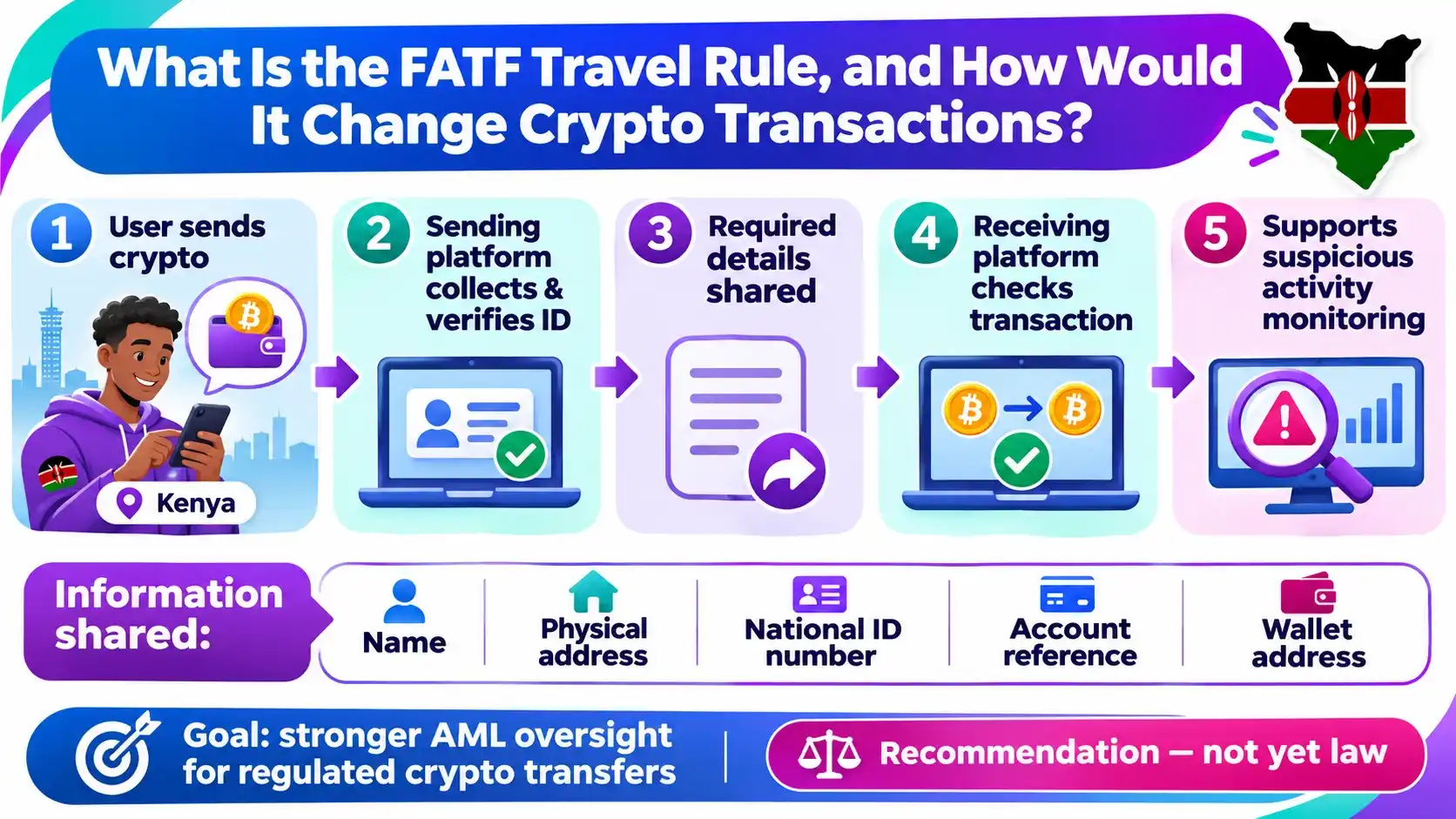
The FATF Travel Rule is a requirement for covered financial institutions and virtual asset service providers to collect and transmit identifying information about the people involved in certain financial transfers.
In simple terms, it means that cryptocurrency platforms would no longer only process a transfer using wallet addresses. They would also have to exchange information identifying the people behind the transaction.
Consider a Kenyan customer sending cryptocurrency from one regulated exchange to another. Under the proposed requirements, the sending exchange would collect the customer’s identity details and transmit the required information to the receiving platform. The receiving institution could then use those details for compliance checks and transaction monitoring.
This represents an important change from simply keeping customer records.
Kenya’s existing framework already requires licensed cryptocurrency businesses to identify customers and maintain records. However, the IMF is calling for an additional obligation: sharing that information between institutions as transactions take place, rather than relying mainly on records that regulators can request later.
The information obtained through these procedures would also support suspicious transaction reporting to the Financial Reporting Centre (FRC), Kenya’s financial intelligence agency.
The recommendation therefore seeks to strengthen the ability of authorities to follow suspicious financial activity across different cryptocurrency platforms.
Why Is Kenya Facing Additional Cryptocurrency Compliance Pressure?
Kenya’s cryptocurrency sector has grown rapidly, creating a stronger need for regulatory oversight.
Kenyans transferred approximately KES 740 billion (approximately $5.7 billion) for the year ending June 2026, according to figures attributed to Chainalysis in the supplied reporting. This places Kenya among Africa’s largest cryptocurrency markets, behind South Africa and Nigeria.
Stablecoins account for a significant share of local digital asset activity. These are cryptocurrencies designed to maintain a relatively stable value, usually by being pegged to a currency such as the US dollar.
Their usefulness in cross-border payments, remittances and transactions involving imported goods has contributed to their popularity.
However, the growth of digital asset transactions also presents challenges for financial authorities. Cryptocurrency can move across platforms and borders, making it difficult to identify the individuals behind suspicious transfers when institutions do not share sufficient information.
Kenya is also under pressure to address weaknesses in its anti-money laundering and counter-terrorism financing framework.
The country has remained on the FATF grey list since February 2024. The list identifies jurisdictions under increased monitoring because of strategic deficiencies in their efforts to combat money laundering and terrorism financing.
Kenya is targeting removal from the list by April 2027. However, that outcome depends on the country’s progress in implementing the required reforms and FATF’s assessment of those efforts.
The IMF’s latest recommendation therefore comes at a time when Kenya is expected to demonstrate stronger financial supervision and more effective controls over emerging financial services.
Has Kenya Already Introduced Cryptocurrency Regulations?
Yes. Kenya is not starting from scratch.
The country introduced the Virtual Asset Service Providers Act in October 2025, establishing a legal framework for regulating cryptocurrency businesses. The legislation took effect in November 2025.
It assigns supervisory responsibilities to the Central Bank of Kenya (CBK) and the Capital Markets Authority (CMA), depending on the nature of the services offered.
The CBK oversees payment-related services and certain stablecoin activities, while the CMA regulates exchanges, brokers and investment-related providers.
The existing framework requires licensed businesses to identify customers and maintain relevant transaction records. However, the IMF argues that these measures do not fully address the need for enforceable information-sharing between platforms.
The IMF’s recommendation is therefore not simply about introducing customer identification. It is about extending existing requirements so that information can move between regulated institutions when covered cryptocurrency transfers occur.
Kenyan regulators have also been exploring technology to strengthen oversight. The CMA has been preparing blockchain monitoring software capable of tracking transactions across more than 20 networks, with the aim of helping identify suspicious wallet activity and trace transfers across blockchains.
Together, these developments point towards a more closely supervised cryptocurrency market.
Context is everything. Stay ahead of shifting trends with today’s market updates, and uncover emerging opportunities using the Serrari Group Market Index and Marketplace. Then, take control of your own financial future by exploring our Money & Life Reset Transformation Blueprint ™ to build stronger habits, create better systems, and design a path toward lasting wealth.
What Could the New Rules Mean for Crypto Users and Businesses?
If Kenya adopts the IMF’s recommendations, cryptocurrency exchanges and other covered service providers would face additional compliance responsibilities.
Platforms may need to upgrade their identity verification systems, establish secure information-sharing arrangements and strengthen transaction monitoring processes.
These changes could increase operating costs, particularly for smaller cryptocurrency businesses that may not have the same compliance resources as larger exchanges.
For users, the effect could be more visible during transfers between regulated platforms. Customers may be required to provide additional identification information, while transactions could involve more verification checks.
This may introduce friction into a market where some users value cryptocurrency for the speed and convenience of digital payments and cross-border transfers.
There is also a potential investment consideration. Higher compliance costs could affect the attractiveness of Kenya’s cryptocurrency market to some foreign businesses and investors, particularly if regulatory implementation becomes expensive or difficult to navigate.
However, stronger compliance requirements could also improve confidence in the market by making it harder for regulated platforms to facilitate suspicious transactions without appropriate checks.
The impact will depend on how the rules are designed, how consistently they are enforced and whether compliance requirements remain practical for businesses and customers.
Does the IMF’s Proposal Raise Concerns About Financial Privacy?
One of the most important questions surrounding the proposed Travel Rule requirements is how much personal financial information cryptocurrency platforms would collect and share.
Cryptocurrencies such as Bitcoin operate through public blockchain networks where transactions can be viewed using wallet addresses. However, these addresses do not automatically reveal the real-world identities of the people controlling them.
This is commonly described as pseudonymity: transactions are visible, but the identity behind a wallet address is not necessarily known.
The proposed Travel Rule requirements would narrow that gap wherever regulated platforms are involved. By linking customer identification details to wallet addresses and transaction records, exchanges would become important identity checkpoints within the cryptocurrency system.
This could make it easier for authorities to trace suspicious funds and investigate possible financial crime.
At the same time, it raises questions about how personal information will be stored, who will have access to it, how long it will be retained and what safeguards will prevent misuse or unauthorised disclosure.
Kenya’s Data Protection Act, 2019, provides a legal framework governing the collection, processing and protection of personal information. How the proposed information-sharing requirements interact with data protection obligations will therefore be an important consideration during implementation.
The challenge is to strengthen financial crime prevention without creating unnecessary exposure of customers’ sensitive financial information.
The Bigger Picture
The IMF’s recommendation reflects a wider shift towards bringing cryptocurrency activity closer to the compliance standards applied to traditional financial institutions.
As digital assets become increasingly important in payments, remittances and investment activity, regulators are seeking ways to identify the people and institutions involved in transactions.
For Kenya, this creates an important balancing act. The country wants to develop its digital financial services sector while demonstrating that it can effectively manage risks associated with money laundering, terrorism financing and financial crime.
The proposed Travel Rule requirements could strengthen oversight, but their implementation will also influence the operating environment for exchanges, businesses and everyday cryptocurrency users.
Why Does This Matter Now?
Kenya is working towards its April 2027 target for removal from the FATF grey list, making improvements to its anti-money laundering framework particularly important.
The IMF’s recommendations add another compliance issue for regulators to address as the country develops its cryptocurrency licensing and supervision framework.
For crypto businesses, the immediate question is whether Kenya will incorporate the Travel Rule into its regulations and what systems will be required to comply.
For users, the bigger concern is how additional identity checks will affect transaction convenience and the privacy of personal financial information.
The proposal is currently a recommendation, not an enacted new legal requirement. The next development to watch is how the CBK, CMA and other relevant authorities respond and whether they introduce enforceable information-sharing obligations.
Frequently Asked Questions
1. What is the IMF asking Kenya to do about cryptocurrency?
The IMF wants Kenya to introduce enforceable FATF Travel Rule requirements requiring cryptocurrency platforms to collect, verify and share identifying information about the senders and recipients of covered digital asset transfers.
2. What information would cryptocurrency platforms be required to share?
The proposed requirements include customer names, physical addresses, national identification numbers, account references and cryptocurrency wallet addresses.
3. Why does Kenya need to implement the FATF Travel Rule?
The requirements are intended to strengthen anti-money laundering and counter-terrorism financing controls by making it easier to identify parties involved in cryptocurrency transactions. They also form part of wider efforts to address FATF-identified deficiencies as Kenya seeks removal from the grey list.
4. Will the IMF’s recommendations immediately affect Kenyan cryptocurrency users?
No. The recommendations are not automatically law. Their effect will depend on whether Kenyan authorities incorporate the requirements into the country’s cryptocurrency regulatory framework and how they implement them.
Your financial future isn’t something you wait for—it’s something you build.
The real question is: when do you begin?
Move beyond simply staying informed.
Navigate the markets with clarity—track trends through the Serrari Group Market Index, uncover opportunities in the Serrari Marketplace, and build practical knowledge with our Curated Wealth Builder Platform.
Stay connected to what truly matters.
Get daily insights on macro trends and financial movements across Kenya, Africa, and global markets—delivered through the Serrari Newsletter.
Growth opens doors.
Advance your career through professional programs including ACCA, HESI A2, ATI TEAS 7 , HESI EXIT , NCLEX – RN and NCLEX – PN, Financial Literacy!🌟—designed to move you forward with confidence.
See where money is flowing—clearly and in real time.
Track Money Market Funds, Treasury Bills, Treasury Bonds, Green Bonds, and Fixed Deposits, alongside global and African indexes, key economic indicators, and the evolving Crypto and stablecoin landscape—all within Serrari’s Market Index.