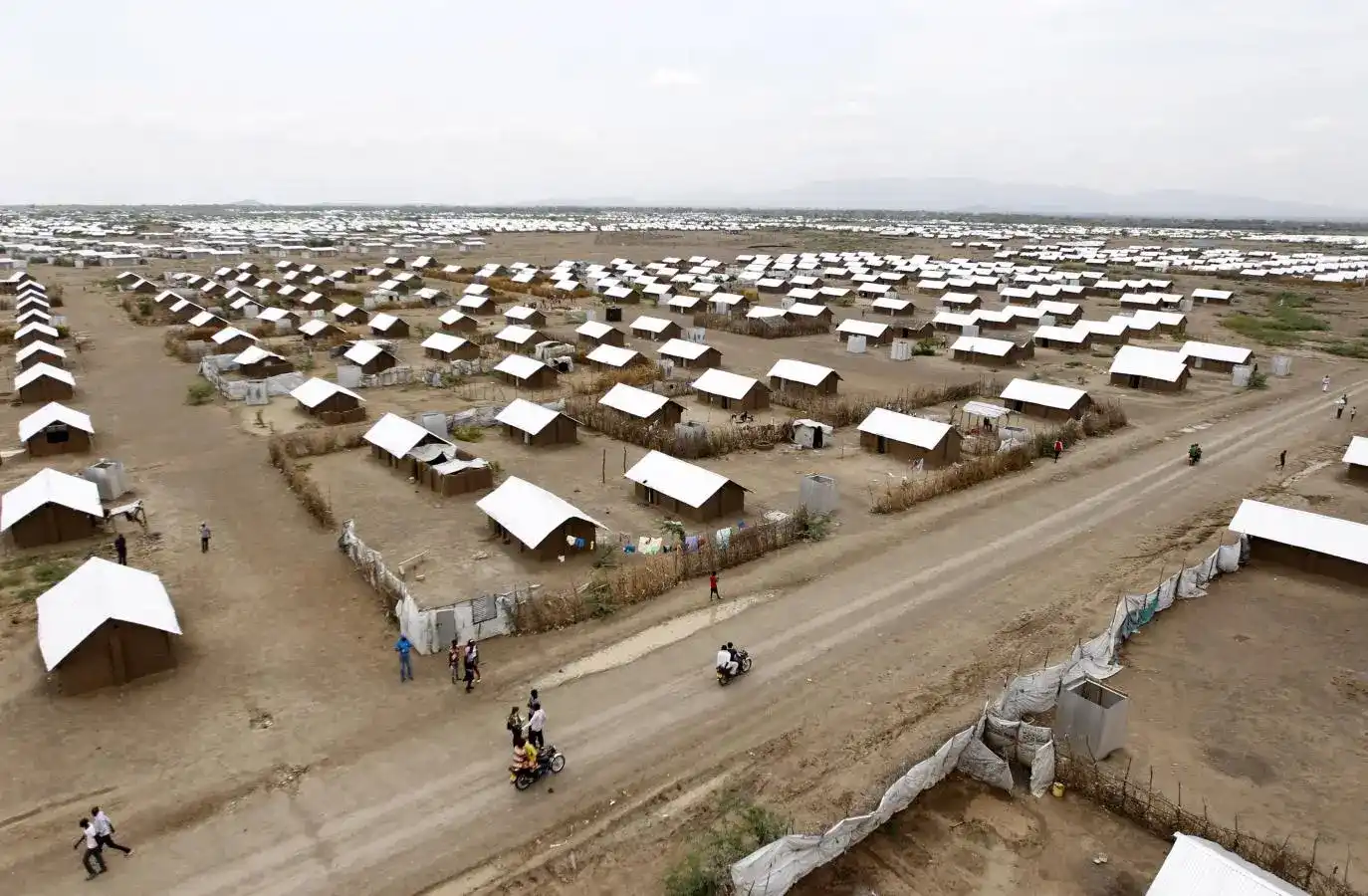
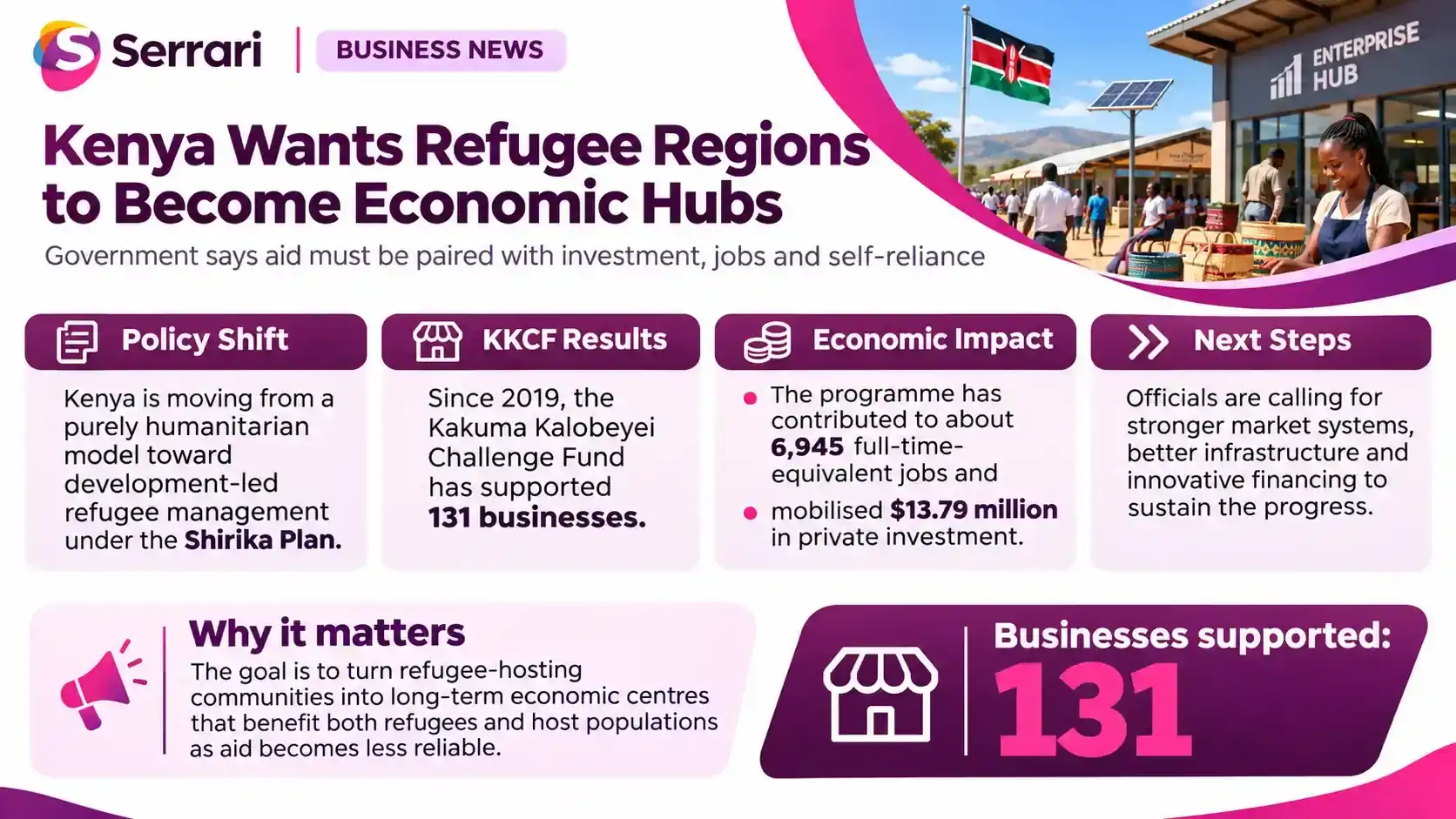
Kenya is seeking to transform refugee-hosting regions from centres of humanitarian assistance into economies capable of attracting investment, supporting businesses and creating jobs. Interior Cabinet Secretary Kipchumba Murkomen renewed that ambition at the Kakuma Kalobeyei Challenge Fund conference on November 10, citing 131 businesses supported, approximately 6,945 full-time-equivalent jobs contributed and $13.79 million in private investment mobilised since 2019. The strategy builds on the Shirika Plan launched in March 2025. Its urgency comes from declining humanitarian funding, weak employment and decades of pressure on communities hosting displaced people. Yet private capital will not deliver self-reliance automatically: investors need viable customers, infrastructure and clear rules, while vulnerable households still require essential protection.
Key Overview
- Policy shift: Kenya wants development investment to complement—not abruptly replace—humanitarian assistance in refugee-hosting areas.
- Reported programme results: The Kakuma Kalobeyei Challenge Fund has supported 131 businesses, contributed to around 6,945 full-time-equivalent jobs and mobilised $13.79 million in private investment, according to figures presented by the Interior Cabinet Secretary.
- National framework: The Shirika Plan, launched on March 28, 2025, promotes integrated services and economic participation for refugees and host communities.
- Why now: Falling aid and scarce employment threaten household incomes and local businesses that depend on refugee spending.
- Investment opportunities: Energy, financial services, logistics, agriculture, retail and skills development could serve customers across refugee and host communities.
- Unresolved obstacles: Access to work, mobility, credit, land, public services and markets will determine whether enterprises survive beyond donor funding.
Why Kenya Is Moving Beyond the Traditional Refugee-Camp Model
Kenya’s latest policy push reflects a structural problem with relying primarily on emergency assistance to sustain communities where displacement has lasted decades. Food distributions, healthcare and shelter can save lives, but they do not by themselves create the employment, infrastructure or commercial activity that households need for long-term financial independence.
At the November 10 conference in Nairobi, Murkomen urged businesses to view refugee-hosting areas as emerging investment markets rather than places suitable only for short-term development programmes. The distinction matters because an economy dependent on grants can contract abruptly when donor budgets fall. Shops lose customers when food or cash assistance is cut, transport providers lose trips, and informal workers lose income even if they are not direct recipients of aid.
The Shirika Plan launched in March 2025 proposes a different approach: integrate refugees into national and county systems while supporting the Kenyan communities that host them. Its agenda covers education, health, skills, livelihoods, environmental management and longer-term solutions. This is not simply an effort to relabel camps as towns. It requires actual access to jobs, public services and business opportunities.
The policy also responds to uneven development. Turkana and Garissa, home to major refugee populations, have long faced difficulties involving infrastructure, water, employment and access to markets. Building businesses there could strengthen both refugee livelihoods and neighbouring Kenyan economies, rather than creating separate systems whose benefits end at the boundaries of a settlement.
Aid Cuts Make Employment an Urgent Economic Priority
The case for change is supported by recent household research tracking refugees and host communities between 2022–23 and 2024. Employment among camp-based refugees fell from about 13% to 7%, while employment among urban refugees declined from roughly 50% to 37%. In communities adjacent to camps, employment also remained weak, slipping from approximately 35% to 33%.
These estimates describe the survey periods, not a new November 2026 employment count. Nevertheless, they reveal why the funding environment is dangerous: aid was still responsible for much of camp-based refugee household income in 2024, meaning reduced assistance could depress local spending before replacement jobs existed.
That creates a feedback loop. A refugee household buying fewer groceries reduces income for traders, who in turn purchase less from wholesalers and may cut labour. The consequences spread to host-community suppliers and service providers. More businesses are therefore needed not merely to provide individual refugees with jobs, but to rebuild demand across interconnected local markets.
However, policymakers cannot assume entrepreneurship will substitute for food, healthcare or protection overnight. People facing illness, disability, displacement trauma or other vulnerabilities may be unable to earn sufficient income even in a stronger local economy. Economic inclusion and humanitarian safeguards must proceed together, especially while the transition remains incomplete.
What the Kakuma Kalobeyei Challenge Fund Has Achieved
The sixth programme conference provided an opportunity to assess whether refugee-hosting areas can attract commercial investment. Murkomen reported that since 2019 the challenge fund had supported 131 businesses, contributed to about 6,945 full-time-equivalent jobs and mobilised $13.79 million in private investment.
Those figures offer evidence of activity, but each measures something different. A supported business is not necessarily a profitable, independent enterprise; mobilised investment is not the same as recurring sales; and full-time-equivalent jobs represent a measure of labour input, not necessarily 6,945 separate permanent positions held continuously. Public reporting should distinguish direct from indirect employment, jobs retained from jobs newly created, and funding commitments from actual disbursements.
The programme’s logic is to reduce obstacles that discourage firms from entering an unfamiliar and relatively underserved market. Funding and technical support can help companies test products, develop distribution networks or extend essential services. The longer-term aim is for participating businesses to earn enough customer revenue to continue operating when grant support ends.
There is an economic basis for that strategy. Earlier market research in Kakuma identified thousands of refugee-run enterprises and a substantial consumer market. These findings are historical estimates, not the current market size, but they help counter the assumption that displaced communities are economically inactive. The central challenge is converting existing entrepreneurship and demand into businesses that can grow, hire and trade beyond the settlements.
Context is everything. Stay ahead of shifting trends with today’s market updates, and uncover emerging opportunities using the Serrari Group Market Index and Marketplace. Then, take control of your own financial future by exploring our Money & Life Reset Transformation Blueprint ™ to build stronger habits, create better systems, and design a path toward lasting wealth.
Why Investors Still Face High Costs and Uncertainty
For a private investor, potential demand is only one consideration. Electricity reliability, water, roads, storage facilities and affordable connectivity determine whether a business can operate competitively. In remote areas, logistics costs can erode margins on groceries, building materials and manufactured goods. A viable solar-energy business, for instance, needs customers able to pay over time as well as equipment, maintenance and working capital.
Rules governing identity documentation, movement, work and financial services are just as consequential. The 2021 refugee legal framework and subsequent reforms provide routes toward economic inclusion, but the practical ability to open accounts, travel to customers, obtain permits and enforce contracts determines whether those rights translate into enterprise growth.
Some progress is visible. An April 2026 implementation update describes improved access to identification and mobile-money services and a $20 million facility involving a financial institution and a development-finance partner to support refugee entrepreneurs. Yet the same broader agenda makes clear that banking access and financial inclusion still require further work.
Investors must also consider that small businesses cannot indefinitely borrow against uncertain donor-funded demand. Access to credit should be paired with reliable purchasing power, commercial mentorship, transparent pricing and the opportunity to sell to customers outside the refugee settlements. Otherwise, financing can leave entrepreneurs indebted without creating sustainable firms.
Why Host Communities Must Share in the Benefits
An investment model that visibly benefits only refugees could generate resentment in areas where local Kenyan residents also experience severe poverty and inadequate public services. The Shirika Plan therefore emphasises shared infrastructure and opportunities, including schools, health services, water systems and employment. Supporting host-community enterprises can expand supply chains and reduce the perception that assistance is allocated at the expense of surrounding villages.
For example, improved cold storage or roads could help both refugee retailers and Turkana farmers sell produce. Renewable-energy investments could serve households, schools and businesses in the same local market. Skills programmes could train refugees and host-community youth for employers facing genuine labour shortages. These are potential benefits rather than established outcomes of any particular announced project.
Shared gains also depend on fair access. Procurement rules, transparent hiring practices and consultation with local residents can prevent powerful intermediaries from capturing most of the value. Women, young people and smaller enterprises need realistic opportunities to participate, while land and environmental safeguards are essential where livelihoods already face climate stress.
How the Shirika Plan Fits a Wider Development Shift
Kenya’s approach reflects a wider move toward development-oriented responses to long-running displacement. The underlying premise is that refugee-hosting areas should be included in public planning and investment, rather than treated indefinitely as parallel humanitarian systems. A three-year implementation partnership announced in February 2026 focuses on institutional capacity, improved energy access and livelihood skills for refugees and hosts alike.
But successful integration is not measured by the number of workshops, grants or strategy documents. More useful indicators include businesses still trading after support ends, income earned from paying customers, employment lasting beyond individual projects, functioning infrastructure and improved access to essential services. Measuring outcomes separately for refugees and host communities can reveal whether progress is broadly shared.
For government, the stakes include regional development, social stability and more effective use of scarce public and donor resources. For investors, successful projects could open markets that have long been overlooked. For affected households, the difference is between surviving successive aid reductions and gaining realistic ways to earn, save and plan for the future.
The key question is therefore not whether Kakuma and Kalobeyei contain economic potential. Existing businesses and the challenge fund’s reported results indicate that they do. It is whether Kenya can remove the barriers that prevent that potential from becoming lasting commercial activity while maintaining protection for those who cannot yet support themselves. That will determine whether the transition produces genuine economic hubs or merely changes the language used to describe longstanding hardship.
Sources: Kenya Broadcasting Corporation / Department of Refugee Services / World Bank / Kakuma Kalobeyei Challenge Fund / United Nations High Commissioner for Refugees
Your financial future isn’t something you wait for—it’s something you build.
The real question is: when do you begin?
Move beyond simply staying informed.
Navigate the markets with clarity—track trends through the Serrari Group Market Index, uncover opportunities in the Serrari Marketplace, and build practical knowledge with our Curated Wealth Builder Platform.
Stay connected to what truly matters.
Get daily insights on macro trends and financial movements across Kenya, Africa, and global markets—delivered through the Serrari Newsletter.
Growth opens doors.
Advance your career through professional programs including ACCA, HESI A2, ATI TEAS 7 , HESI EXIT , NCLEX – RN and NCLEX – PN, Financial Literacy!🌟—designed to move you forward with confidence.
See where money is flowing—clearly and in real time.
Track Money Market Funds, Treasury Bills, Treasury Bonds, Green Bonds, and Fixed Deposits, alongside global and African indexes, key economic indicators, and the evolving Crypto and stablecoin landscape—all within Serrari’s Market Index.