




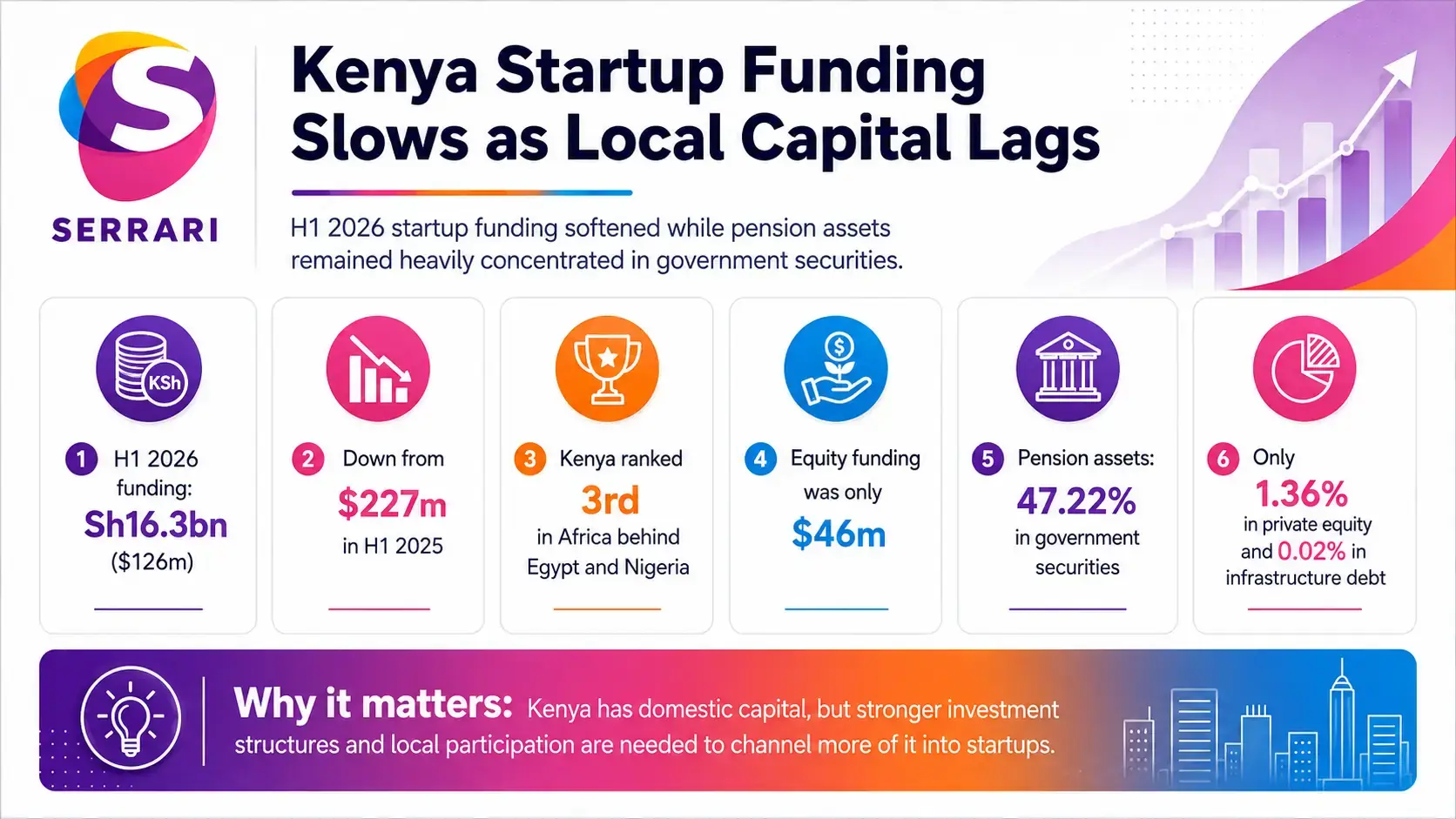
Kenyan startups raised about Sh16.3 billion ($126 million) in the first half of 2026, leaving the country third among Africa’s major startup-funding destinations behind Egypt and Nigeria. The performance represents a sharp retreat from Kenya’s first-half 2025 funding levels as investors became more selective and capital became increasingly concentrated in fewer large transactions.
Data from Africa’s H1 2026 funding tracker show Egypt attracted $327 million, Nigeria $254 million, Kenya $126 million and South Africa $83 million. Kenya’s position remains significant, but the funding slowdown is renewing debate over why the country’s large pools of domestic institutional capital remain only lightly exposed to private equity, venture capital and infrastructure financing.
Key Overview
- Kenyan startups raised $126 million, approximately Sh16.3 billion, in H1 2026.
- Kenya ranked third in Africa, behind Egypt at $327 million and Nigeria at $254 million.
- Equity financing accounted for only $46 million of Kenya’s H1 total.
- Africa-wide startup funding reached $1.36 billion, about 6% below H1 2025.
- Kenyan pension assets reached Sh3.167 trillion by June 2026.
- Government securities represented 47.22% of pension assets, compared with 1.36% in private equity and only 0.02% in infrastructure debt.
Kenya Remains a Major Market Despite Funding Retreat
Kenya retained its place among Africa’s largest startup ecosystems during the first six months of 2026, but the country’s funding performance weakened substantially.
The same funding tracker recorded $227 million for Kenyan startups in H1 2025, compared with $126 million this year. That represents a decline of approximately 44.5% in dollar terms, making the slowdown considerably larger than some recent reports have suggested.
Kenya also slipped when only equity investment is considered. During H1 2026, Nigerian startups raised $214 million in equity and Egyptian companies $183 million, while South Africa attracted $66 million and Kenya only $46 million.
The figures come amid a wider change in African venture investing. Across the continent, startups raised $1.36 billion in H1 2026, compared with $1.44 billion during the same period in 2025. More importantly, the number of ventures raising meaningful rounds declined, indicating that investors are concentrating capital into fewer businesses rather than broadly increasing risk exposure.
Context is everything. Stay ahead of shifting trends with today’s market updates, and uncover emerging opportunities using the Serrari Group Market Index and Marketplace. Then, take control of your own financial future by exploring our Money & Life Reset Transformation Blueprint ™ to build stronger habits, create better systems, and design a path toward lasting wealth.
Kenya Has Capital, but Little Reaches Private Markets
The funding slowdown has intensified scrutiny of Kenya’s domestic institutional-investment market. Kenya’s retirement-benefits sector held Sh3.167 trillion in assets by June 2026, after growing 12.66% from December 2025.
Yet official pension allocation data show that 47.22% of pension assets remained invested in government securities. Private equity accounted for only 1.36%, while infrastructure debt represented just 0.02%.
Those allocations remain far below their permitted ceilings. Pension schemes can allocate up to 10% to private equity and up to 10% to infrastructure debt instruments, suggesting regulatory headroom exists for substantially greater private-market exposure.
The challenge is not simply persuading pension funds to allocate more money. Institutional investors require well-structured opportunities, robust governance, predictable returns, credible valuations and appropriate mechanisms for managing liquidity and risk.
Investment Banks Could Help Close the Funding Gap
The role of financial advisers and investment banks has consequently become more important as startups seek larger and more sophisticated pools of capital.
At the 10th Annual Private Capital Conference, investors, fund managers, institutional allocators, policymakers and business leaders examined ways of mobilising more domestic capital and creating investable opportunities across East Africa. The conference placed particular emphasis on local capital, private credit, venture funding, infrastructure and viable exit pathways.
For startups, reaching institutional investors often requires more than a compelling growth story. Businesses must demonstrate credible financial reporting, suitable governance structures, realistic valuations, clear use of proceeds and an identifiable route through which investors can eventually realise returns.
Investment banks can help bridge this gap through capital raising, transaction structuring, valuations, due diligence and preparing companies for larger institutional transactions.
Unlocking Pension Capital Will Require Better Structures
The contrast between Kenya’s Sh3.167 trillion pension industry and the relatively small amount invested in private equity highlights a broader financing challenge.
Greater pension-fund participation could provide local businesses with longer-term capital while reducing dependence on foreign venture investors whose allocation decisions can change rapidly with global interest rates and risk sentiment. However, directing more institutional money toward startups will require safeguards appropriate to pension beneficiaries.
Guarantees, blended-finance structures, professionally managed funds and other forms of credit enhancement could help absorb selected risks and make private-market opportunities more suitable for institutional investors.
Kenya’s startup ecosystem therefore faces two interconnected challenges: rebuilding the flow of venture capital while creating stronger channels through which domestic savings can finance productive businesses. The capital exists, but converting it into sustainable startup and growth-company financing will depend increasingly on investment readiness, institutional structures and credible pathways to returns.
Sources: Africa: The Big Deal / Retirement Benefits Authority / East Africa Venture Capital Association / Eastleigh Voice / The Star
Your financial future isn’t something you wait for—it’s something you build.
The real question is: when do you begin?
Move beyond simply staying informed.
Navigate the markets with clarity—track trends through the Serrari Group Market Index, uncover opportunities in the Serrari Marketplace, and build practical knowledge with our Curated Wealth Builder Platform.
Stay connected to what truly matters.
Get daily insights on macro trends and financial movements across Kenya, Africa, and global markets—delivered through the Serrari Newsletter.
Growth opens doors.
Advance your career through professional programs including ACCA, HESI A2, ATI TEAS 7 , HESI EXIT , NCLEX – RN and NCLEX – PN, Financial Literacy!🌟—designed to move you forward with confidence.
See where money is flowing—clearly and in real time.
Track Money Market Funds, Treasury Bills, Treasury Bonds, Green Bonds, and Fixed Deposits, alongside global and African indexes, key economic indicators, and the evolving Crypto and stablecoin landscape—all within Serrari’s Market Index.




















Comments are closed.