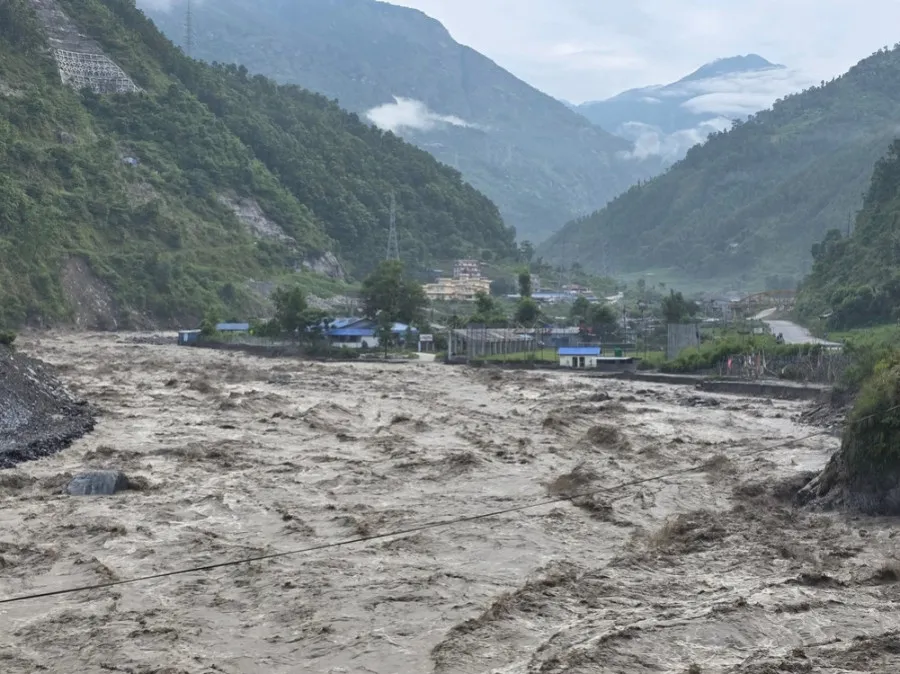
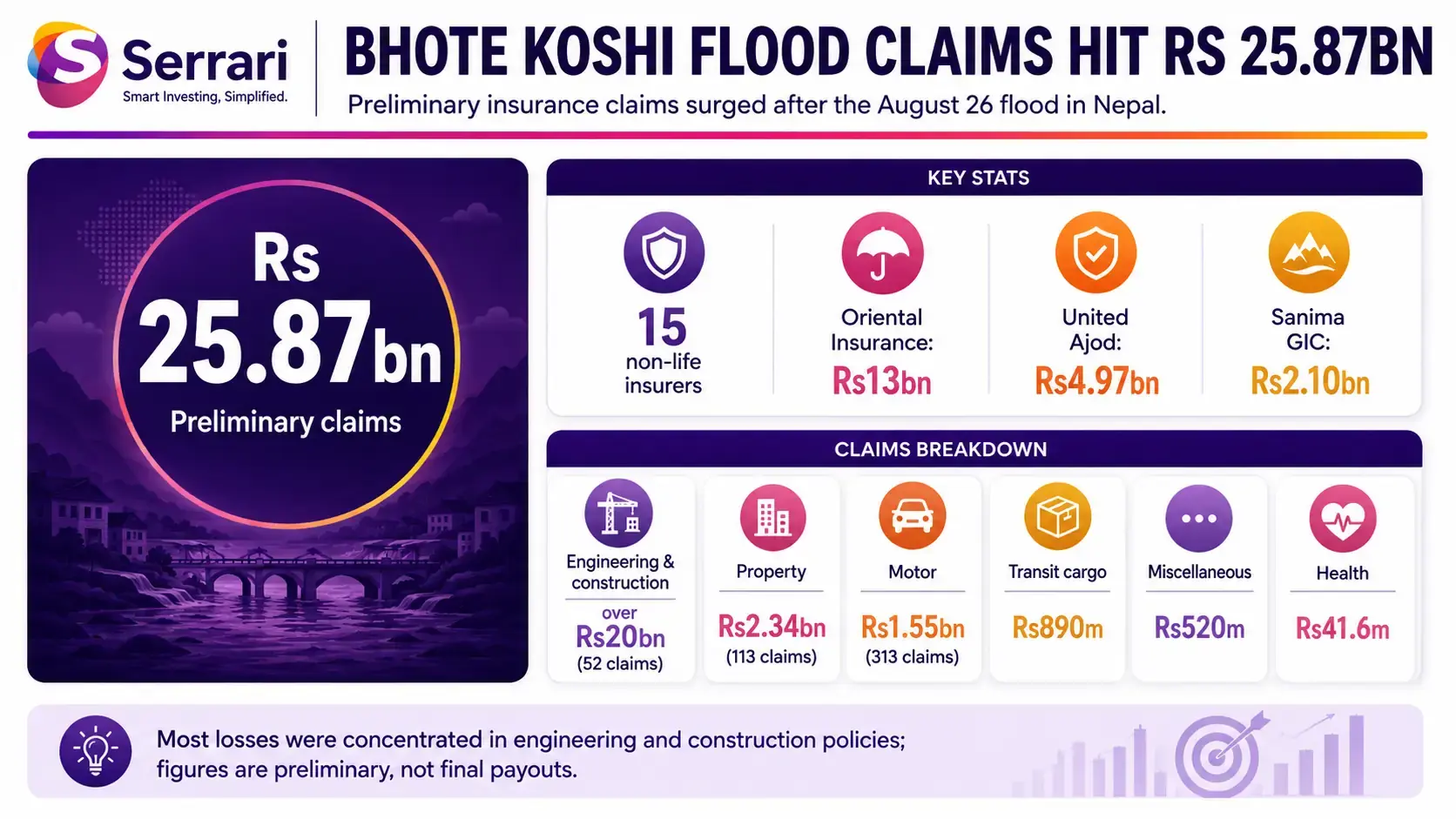
Insurance claims linked to Nepal’s devastating August 26 Bhote Koshi flood reached Rs 25.87 billion by August 31, placing significant pressure on the country’s non-life insurance industry. According to preliminary claims data, 15 insurers had received filings spanning engineering projects, property, vehicles, cargo, miscellaneous risks and health-related losses within days of the disaster.
The largest financial exposure is concentrated in engineering and construction policies, reflecting the extensive damage caused to infrastructure and hydropower facilities along the Bhote Koshi-Trishuli corridor. Because the figures represent claims lodged or preliminary loss estimates rather than final settlements, the eventual insured loss could change as assessments and verification continue.
Key Overview
- Total preliminary insurance claims: Rs 25.87 billion
- Non-life insurers receiving claims: 15
- Oriental Insurance claims: Rs 13 billion
- United Ajod claims: Rs 4.97 billion
- Engineering and construction claims: More than Rs 20 billion
- Property claims: Rs 2.34 billion
- Motor claims: Rs 1.55 billion
- Transit cargo claims: Rs 890 million
Engineering Losses Dominate Insurance Exposure
Engineering and construction policies have absorbed the largest share of the disaster losses. Fifty-two claims under the category exceeded Rs 20 billion, meaning infrastructure-related losses alone represented more than three-quarters of the total preliminary insurance claims recorded by August 31.
The concentration reflects the flood’s impact on major infrastructure. At least 13 hydropower projects suffered direct damage in Rasuwa and Nuwakot, with power facilities, construction sites and related infrastructure caught in the flood corridor.
A preliminary government estimate separately placed overall infrastructure damage from the disaster at around Rs 200 billion, although that estimate covers wider physical destruction and should not be interpreted as an insured-loss figure.
The difference is important: much of the economic damage from a natural disaster may be uninsured, underinsured or covered under policies subject to limits, exclusions and deductibles.
Claims Are Highly Concentrated Among Major Insurers
Oriental Insurance received eight preliminary claims worth Rs 13 billion, representing just over 50% of the Rs 25.87 billion industry total.
United Ajod followed with Rs 4.97 billion, while Sanima GIC recorded Rs 2.10 billion, Siddharth Premier Rs 1.88 billion and Shikhar Insurance Rs 1.87 billion. Together, these five insurers accounted for about Rs 23.82 billion, or roughly 92% of the reported preliminary claims.
The remaining claims were distributed among Himalayan Everest, Neco, Sagarmatha Lumbini, Nepal Insurance, IGI Prudential, NLG, Prabhu, Rastriya Beema, National Insurance and Nepal Micro Insurance.
Such concentration means the financial impact will vary significantly across insurers depending on their exposure to major projects and the extent to which risks have been transferred to reinsurers.
Context is everything. Stay ahead of shifting trends with today’s market updates, and uncover emerging opportunities using the Serrari Group Market Index and Marketplace. Then, take control of your own financial future by exploring our Money & Life Reset Transformation Blueprint ™ to build stronger habits, create better systems, and design a path toward lasting wealth.
Property and Motor Losses Add to the Bill
Beyond major infrastructure, households and businesses are also generating a significant volume of claims.
Property insurance recorded 113 claims totalling Rs 2.34 billion, while insurers received 313 motor claims valued at approximately Rs 1.55 billion.
Transit cargo losses reached Rs 890 million and miscellaneous insurance claims stood at Rs 520 million. Health insurance claims associated with the disaster were comparatively smaller at Rs 41.6 million.
Damage has extended across settlements, commercial assets and transport infrastructure along the affected river system. In the banking sector alone, the flood caused an estimated Rs 600 million in physical damage to branches operating in affected areas, illustrating how widely the disaster disrupted economic activity.
Flood Exposes Nepal’s Infrastructure Risk
The August 26 disaster struck after a sudden surge moved through the Bhote Koshi and downstream river systems. A preliminary technical assessment indicated that a temporary blockage upstream in Tibet formed a body of water that later released, producing a powerful flood wave through the Bhote Koshi, Trishuli and Narayani corridors.
The event damaged settlements, roads, bridges, power facilities and commercial infrastructure while triggering extensive search, rescue and reconstruction efforts.
For Nepal’s insurance sector, the Rs 25.87 billion in early claims highlights the increasing financial significance of catastrophe exposure, particularly where large infrastructure projects are concentrated in flood- and landslide-prone areas.
The final insurance cost will depend on loss assessments, policy terms, deductibles, coverage limits and reinsurance arrangements. With claims reported only five days after the flood, the current total should therefore be viewed as an early measure of insured exposure rather than the disaster’s final insurance bill.
Sources: Nepal Insurance Authority / Nepal News / OnlineKhabar English
Your financial future isn’t something you wait for—it’s something you build.
The real question is: when do you begin?
Move beyond simply staying informed.
Navigate the markets with clarity—track trends through the Serrari Group Market Index, uncover opportunities in the Serrari Marketplace, and build practical knowledge with our Curated Wealth Builder Platform.
Stay connected to what truly matters.
Get daily insights on macro trends and financial movements across Kenya, Africa, and global markets—delivered through the Serrari Newsletter.
Growth opens doors.
Advance your career through professional programs including ACCA, HESI A2, ATI TEAS 7 , HESI EXIT , NCLEX – RN and NCLEX – PN, Financial Literacy!🌟—designed to move you forward with confidence.
See where money is flowing—clearly and in real time.
Track Money Market Funds, Treasury Bills, Treasury Bonds, Green Bonds, and Fixed Deposits, alongside global and African indexes, key economic indicators, and the evolving Crypto and stablecoin landscape—all within Serrari’s Market Index.