Western Union and MoneyGram are expanding into stablecoins as digital payment networks challenge traditional money transfers. Western Union’s USDPT operates on Solana, while MoneyGram’s MGUSD uses Stellar. Both aim to strengthen their payment infrastructure, improve transfer efficiency and respond to pressure on remittance fees.
Key Overview
- Western Union introduced its dollar-pegged USDPT stablecoin and digital wallet and card services.
- MoneyGram launched MGUSD, with services reported in Colombia and El Salvador and plans for wider Latin American expansion.
- Stablecoins offer an alternative to conventional cross-border transfers, potentially reducing settlement times and costs.
- The companies face the challenge of making their digital currencies accessible, interoperable and useful to everyday customers.
Remittance Giants Turn to Stablecoins
Western Union and MoneyGram are adopting blockchain-based payments as they face competition from cryptocurrency networks and other digital money-transfer providers. Their new stablecoins are designed to bring dollar-denominated digital payments into established remittance services.
Western Union launched its dollar-pegged stablecoin, USDPT, alongside digital wallet and card services. MoneyGram has introduced its own token, MGUSD, and expanded its services from Colombia to El Salvador, with plans to reach more markets across Latin America.
The two businesses are pursuing different blockchain strategies. Western Union’s USDPT runs on Solana and is issued by Anchorage Digital Bank. MoneyGram’s MGUSD operates on the Stellar network through Bridge, a stablecoin infrastructure company owned by Stripe.
Why the Companies Are Making the Move
Stablecoins are digital tokens designed to maintain a stable value against an asset such as the US dollar. They can support faster digital transfers and may reduce some of the costs associated with conventional cross-border payments.
The potential savings matter in a remittance industry where transfer fees remain a concern. The average cost of sending a $200 remittance at 6.35% through traditional channels illustrates the expense customers can face when sending relatively small amounts internationally.
Stablecoin activity is also growing. Payment volume reached $401 billion from January through August this year, an increase of 42% year on year. Cross-border stablecoin transaction volume rose 64% in 2025 to $135 billion.
For established remittance companies, developing their own stablecoins could help them control more of the payment process, rather than losing customers to cryptocurrency-based alternatives. It may also give them greater flexibility over settlement and fees within their own networks.
Different Approaches to Digital Money
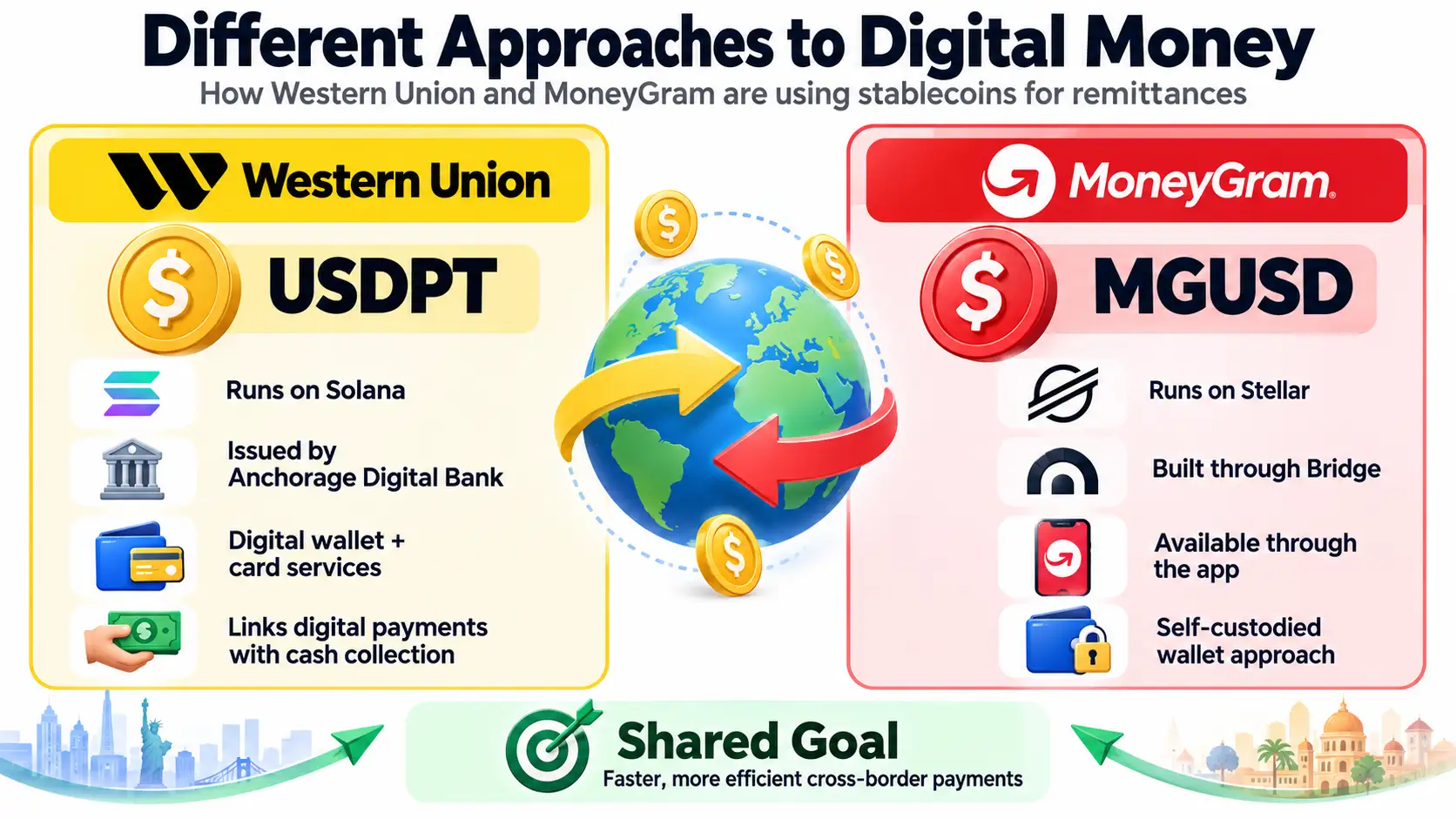
Western Union is developing USDPT alongside its wider digital-asset infrastructure. Its strategy includes connecting digital payments with cash collection, which remains important for customers who want recipients to collect money physically rather than maintain a digital wallet.
MoneyGram’s MGUSD offers another model, with the token available through its app and a self-custodied wallet approach. This could appeal to users who want to hold dollar-denominated digital funds and access them without always visiting a physical agent location.
Both approaches seek to connect blockchain payments with existing customer networks. Their success, however, will depend on how easily customers can access the services, convert digital dollars into local currency and use them across different markets.
Context is everything. Stay ahead of shifting trends with today’s market updates, and uncover emerging opportunities using the Serrari Group Market Index and Marketplace. Then, take control of your own financial future by exploring our Money & Life Reset Transformation Blueprint ™ to build stronger habits, create better systems, and design a path toward lasting wealth.
Competition and Adoption Challenges
The shift comes as traditional remittance providers face pressure on customer activity and profitability. Western Union’s monthly active app users fell 10% in September compared with a year earlier, while MoneyGram’s declined 9%. Wise recorded a 9% increase over the same period.
Yet launching a stablecoin does not automatically guarantee lower costs or wider adoption. Customers need clear information about fees, access, wallet security and how digital balances can be redeemed. Regulatory requirements and local payment conditions may also affect where the services can operate.
Interoperability is another challenge. If numerous stablecoins operate on separate networks without easy ways to transfer value between them, customers could encounter some of the same friction they experience with traditional payment systems.
Outlook
Western Union and MoneyGram are positioning stablecoins as part of their future remittance infrastructure rather than treating blockchain as a separate experiment. Their ability to compete will depend on whether these services provide a clear advantage in cost, speed and convenience while remaining accessible to people who still rely on cash.
For customers, the key measure will be the total cost and reliability of sending and receiving money—not simply whether a transfer uses a stablecoin. The companies’ expansion plans will show whether their established networks can turn digital-dollar technology into a practical alternative for cross-border payments.
FAQs
1. What are Western Union and MoneyGram launching?
Western Union has introduced USDPT, a US dollar-pegged stablecoin, while MoneyGram has launched MGUSD, its own dollar-denominated digital token.
2. What is the difference between USDPT and MGUSD?
USDPT runs on Solana and is issued by Anchorage Digital Bank. MGUSD operates on Stellar through Bridge, a Stripe-owned stablecoin infrastructure company.
3. Why are remittance companies adopting stablecoins?
They are seeking faster settlement, potentially lower transfer costs and greater control over payment infrastructure as digital competitors put pressure on traditional remittance services.
4. Will stablecoins make international transfers cheaper?
They may reduce some costs, but the final price depends on service fees, conversion charges, cash-out costs and the availability of the stablecoin in the sender’s and recipient’s markets.
Your financial future isn’t something you wait for—it’s something you build.
The real question is: when do you begin?
Move beyond simply staying informed.
Navigate the markets with clarity—track trends through the Serrari Group Market Index, uncover opportunities in the Serrari Marketplace, and build practical knowledge with our Curated Wealth Builder Platform.
Stay connected to what truly matters.
Get daily insights on macro trends and financial movements across Kenya, Africa, and global markets—delivered through the Serrari Newsletter.
Growth opens doors.
Advance your career through professional programs including ACCA, HESI A2, ATI TEAS 7 , HESI EXIT , NCLEX – RN and NCLEX – PN, Financial Literacy!🌟—designed to move you forward with confidence.
See where money is flowing—clearly and in real time.
Track Money Market Funds, Treasury Bills, Treasury Bonds, Green Bonds, and Fixed Deposits, alongside global and African indexes, key economic indicators, and the evolving Crypto and stablecoin landscape—all within Serrari’s Market Index.