
Uber is eliminating about 3,300 jobs worldwide, equivalent to roughly 10% of its workforce, in its biggest round of layoffs since the pandemic. The restructuring will reduce management layers, consolidate fragmented teams and concentrate more employees in major operating hubs as the company redirects resources toward ride-hailing, delivery and autonomous vehicles.
Chief executive Dara Khosrowshahi said in a message sent to employees that Uber’s rapid expansion over the past five years had created more layers, coordination and fragmented ownership. The company says the changes are intended to make decision-making faster while creating additional capacity for future investment.
Key Overview
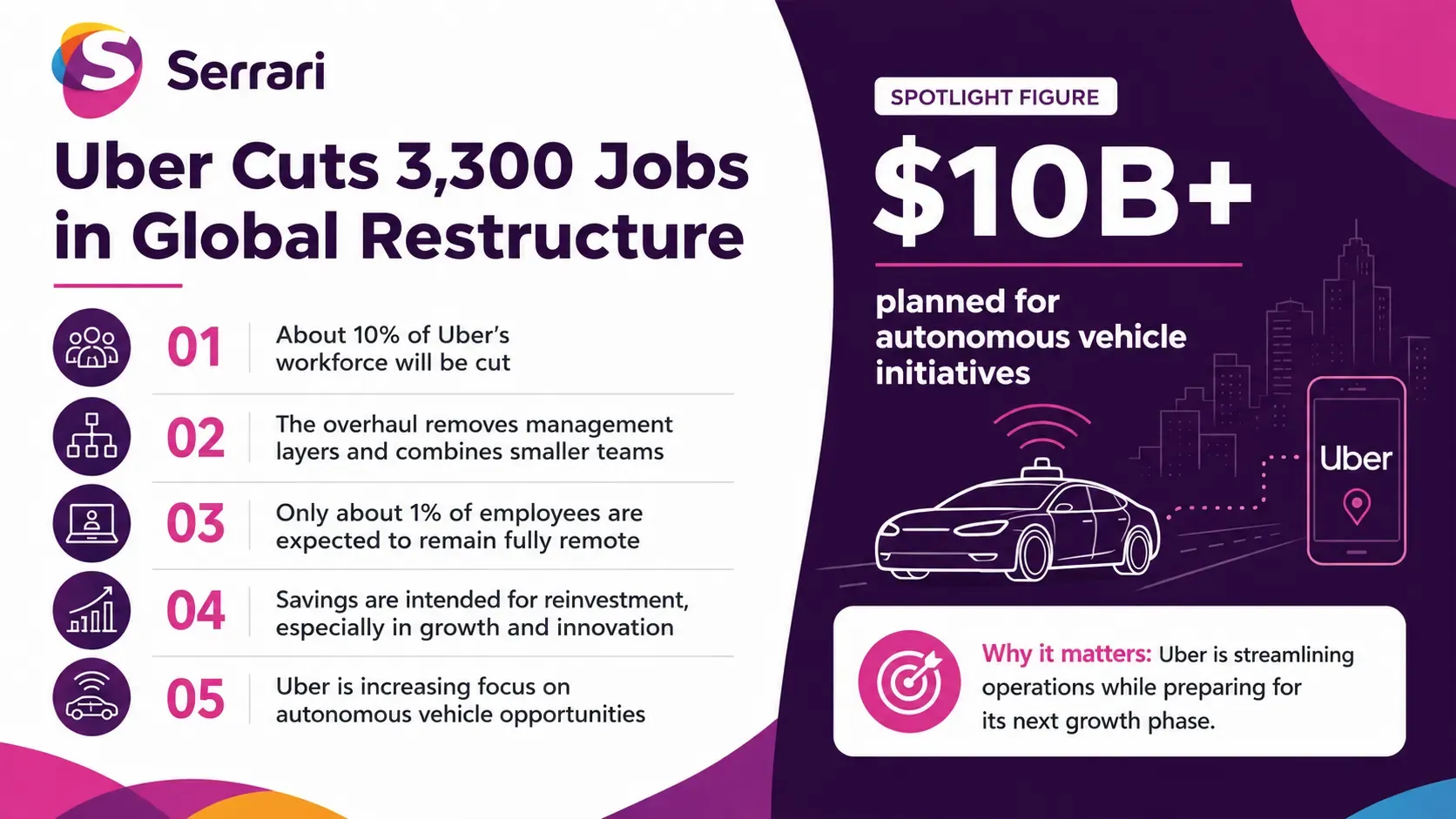
- Uber is cutting approximately 3,300 jobs, representing about 10% of its workforce.
- The restructuring is the company’s largest workforce reduction since May 2020.
- Employees sitting seven or more organizational layers below the CEO will be reduced by 20%.
- Uber is cutting the number of small management teams with only one or two reports by nearly 50%.
- Only about 1% of employees will remain fully remote under its revised location strategy.
- Uber plans to commit more than $10 billion to autonomous-vehicle initiatives over the coming years.
- One analyst estimate suggests the restructuring could generate about $1.75 billion in savings, although Uber plans to reinvest savings in growth and innovation.
Uber Targets Management Layers and Small Teams
The restructuring goes considerably further than a conventional headcount reduction. Uber is redesigning how teams are organized, with the company seeking to reduce internal coordination and give managers broader responsibilities.
As part of the overhaul, Uber has reduced employees seven or more layers from the CEO by 20% and cut the number of “micro-teams” with only one or two direct reports by nearly half.
The company is also combining teams where separate structures have created duplication. Its restaurant, retail and direct-delivery operations will be brought together under more unified leadership at global, regional and country levels. Core Services Engineering and Science teams are also being combined.
Khosrowshahi said Uber’s top line has nearly tripled over the past five-plus years as the company expanded into new products and businesses. That growth, however, brought organizational complexity that management now believes is slowing decisions.
The layoffs affect both managerial and non-managerial positions, and the exact geographical distribution has not been disclosed. Employees affected by the restructuring have already been notified in most markets, while countries with specific employment processes will follow local requirements.
Context is everything. Stay ahead of shifting trends with today’s market updates, and uncover emerging opportunities using the Serrari Group Market Index and Marketplace. Then, take control of your own financial future by exploring our Money & Life Reset Transformation Blueprint ™ to build stronger habits, create better systems, and design a path toward lasting wealth.
Office Strategy Tightens as Remote Roles Disappear
Uber is also significantly changing where its employees work. Global teams will increasingly be concentrated in major hubs such as San Francisco and New York, while regional, local and technology teams will be organized around designated locations.
The company is asking most fully remote employees to move to offices, with only approximately 1% of roles expected to remain remote. Uber will maintain its existing hybrid requirement for employees to spend three days each week in the office.
The shift reflects management’s view that teams work more effectively when managers and employees are physically located together, particularly for workers earlier in their careers.
It also means the restructuring is not simply a cost-cutting exercise. Uber is simultaneously changing its organizational hierarchy, team composition and geographical footprint as it attempts to operate with fewer layers.
Robotaxis Become Central to Uber’s Investment Strategy
Autonomous vehicles are becoming one of the biggest strategic questions facing Uber. Driverless ride operators could eventually compete directly with the traditional marketplace model that connects human drivers with passengers.
Uber has consequently positioned itself as a distribution and commercialization platform for autonomous-vehicle companies rather than attempting to develop the entire technology internally. The company recently confirmed plans to commit more than $10 billion across equity investments, infrastructure and vehicle commitments over the coming years.
Its autonomous strategy includes partnerships with developers and investment in fleet operations, charging, vehicle financing and supporting infrastructure. Uber has said its ambition is to become a leading platform through which autonomous vehicles reach paying customers.
Khosrowshahi specifically said savings from the restructuring will be reinvested in growth and innovation rather than treated solely as reductions in operating expenditure.
Analysts are nevertheless examining the financial impact. One estimate puts potential savings at approximately $1.75 billion, although the ultimate earnings benefit could be smaller if much of that money is redirected into new initiatives.
Cuts Come Despite Strong Business Growth
The restructuring does not follow a collapse in Uber’s core operations. Its most recent quarterly results showed revenue of $14.2 billion, while gross bookings reached $58 billion during the second quarter of 2026.
Trips increased 18% year over year to 3.9 billion, while the company generated GAAP operating income of $1.9 billion. Trailing 12-month free cash flow also exceeded $10 billion for the first time, giving the company substantial financial capacity to fund new investments.
That performance makes the restructuring different from Uber’s pandemic-era layoffs, when collapsing ride demand forced the company to eliminate about 6,700 positions in May 2020.
This time, management is cutting staff while the underlying business continues to expand. Uber shares rose nearly 2% following the announcement, indicating an initially positive investor response to plans for a leaner operating structure.
The bigger test will be whether Uber can reduce bureaucracy without slowing product development while simultaneously managing greater competition in delivery and the accelerating transition toward autonomous transportation.
Sources: Uber / Reuters / Bloomberg / Uber Investor Relations / U.S. Securities and Exchange Commission / The Wall Street Journal
Your financial future isn’t something you wait for—it’s something you build.
The real question is: when do you begin?
Move beyond simply staying informed.
Navigate the markets with clarity—track trends through the Serrari Group Market Index, uncover opportunities in the Serrari Marketplace, and build practical knowledge with our Curated Wealth Builder Platform.
Stay connected to what truly matters.
Get daily insights on macro trends and financial movements across Kenya, Africa, and global markets—delivered through the Serrari Newsletter.
Growth opens doors.
Advance your career through professional programs including ACCA, HESI A2, ATI TEAS 7 , HESI EXIT , NCLEX – RN and NCLEX – PN, Financial Literacy!🌟—designed to move you forward with confidence.
See where money is flowing—clearly and in real time.
Track Money Market Funds, Treasury Bills, Treasury Bonds, Green Bonds, and Fixed Deposits, alongside global and African indexes, key economic indicators, and the evolving Crypto and stablecoin landscape—all within Serrari’s Market Index.