Zinc has broken to its highest level in four years as tight nearby supply collides with depleted Western inventories and weaker mine output. LME cash zinc reached US$4,107 per tonne on August 27 before easing to US$4,070 on August 28, still roughly 55% above its mid-2025 trough near US$2,650.
The price rally is only part of the story. For many zinc miners, profitability is also being transformed by silver, lead and other by-products whose rising value can offset a large share of mine costs. That combination — higher zinc prices and stronger by-product credits — is materially changing cost curves across the sector.
Key Overview
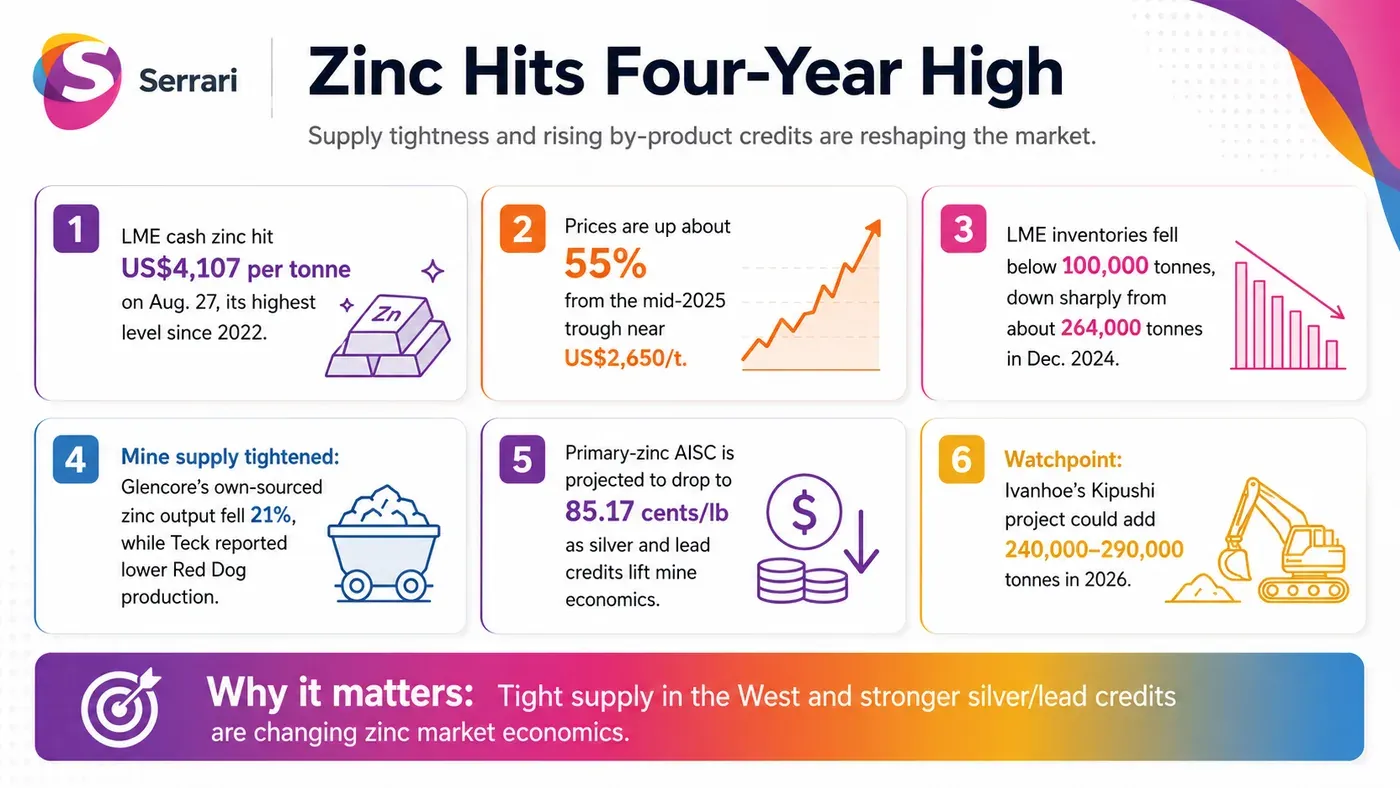
- LME cash zinc hit US$4,107 per tonne on August 27, its highest level since 2022.
- LME warehouse stocks were below 100,000 tonnes in late August, versus a December 2024 monthly average of about 264,000 tonnes.
- Glencore’s own-sourced zinc production fell 21% year-on-year in the first half of 2026, while Teck reported lower first-quarter zinc output at Red Dog because of lower grades.
- Primary-zinc AISC is projected to fall 6.4% in 2026 to 85.17 cents per pound, driven mainly by by-product credits and treatment-charge dynamics rather than broad productivity gains.
- Ivanhoe Mines continues to guide for 240,000 to 290,000 tonnes of zinc in concentrate from Kipushi in 2026, offering one of the clearest sources of new supply.
Western Inventory Drain Drives the Zinc Squeeze
The strongest signal is the gap between metal available for immediate delivery and future supply. LME cash zinc reached US$4,107 per tonne on August 27, while three-month zinc stood at US$3,890, creating a steep backwardation that reflects buyers paying a premium for metal now.
LME inventories have fallen sharply from late-2024 levels. December 2024 stocks averaged roughly 264,000 tonnes, while late-August 2026 inventories were around 95,000 to 98,000 tonnes. At the same time, Chinese inventories have moved in the opposite direction, prompting exports that could help relieve pressure in London.
That distinction matters because the squeeze is not simply a story of global refined zinc disappearing. A Q3 market outlook citing the latest ILZSG forecast points to a relatively small 19,000-tonne refined zinc deficit for 2026. The more acute problem is the concentration of tightness in LME-deliverable metal and in zinc concentrate, where historically low treatment charges are squeezing smelter margins.
Mine supply has also disappointed. Glencore reported first-half own-sourced zinc production of 365,600 tonnes, down 21% from a year earlier, mainly because of Lady Loretta’s end of mine life, lower zinc grades at Antamina and the Kidd disposal. Teck’s Red Dog mine produced 106,200 tonnes in the first quarter, down 10,600 tonnes year-on-year as grades declined according to plan.
Context is everything. Stay ahead of shifting trends with today’s market updates, and uncover emerging opportunities using the Serrari Group Market Index and Marketplace. Then, take control of your own financial future by exploring our Money & Life Reset Transformation Blueprint ™ to build stronger habits, create better systems, and design a path toward lasting wealth.
Silver and Lead Credits Rewrite Mine Economics
Zinc mining is rarely a single-metal business. Many deposits also contain silver, lead, copper, germanium and other valuable metals, meaning revenue from these by-products can be credited against the cost of producing zinc.
That effect has become unusually powerful in 2026. Global primary-zinc AISC is projected to fall 6.4% to 85.17 cents per pound from 91.01 cents in 2025. The change is being driven primarily by stronger by-product credits and treatment-charge dynamics, not broad improvements in mining productivity.
Silver is the biggest swing factor for many polymetallic mines. With its 2026 consensus forecast at US$73.35 per ounce and lead near US$2,000 per tonne, the value of secondary metals can dramatically reduce reported zinc costs. In an illustrative 100,000-tonne zinc mine, stronger silver and lead credits would exceed US$200 million of site costs and push reported net zinc costs below zero.
For investors, that means two zinc producers with similar headline zinc output can have very different margin profiles. Mines with high silver or lead exposure may sit far lower on the cost curve and remain profitable through weaker zinc-price cycles, while mines without meaningful by-products remain much more exposed to zinc alone.
New Supply Could Cap the Rally
Higher prices should eventually encourage more output, but major mine projects take time to ramp up. One important near-term source is Ivanhoe Mines’ Kipushi operation in the Democratic Republic of Congo, which maintains 2026 guidance of 240,000 to 290,000 tonnes of zinc in concentrate after producing 203,168 tonnes in 2025.
If Kipushi and other planned supply additions perform as expected, concentrate availability should improve and treatment charges could recover. That would ease part of the pressure now supporting zinc prices.
For now, however, the market remains unusually sensitive to warehouse flows, mine disruptions and smelter economics. The investment case has also become more complex: zinc prices matter, but the strongest producers may increasingly be those whose silver, lead and critical-mineral credits generate the greatest protection against operating costs.
Sources: Investing News Network / Westmetall / Reuters / S&P Global Market Intelligence / Glencore / Teck Resources / Ivanhoe Mines / Sucden Financial
Your financial future isn’t something you wait for—it’s something you build.
The real question is: when do you begin?
Move beyond simply staying informed.
Navigate the markets with clarity—track trends through the Serrari Group Market Index, uncover opportunities in the Serrari Marketplace, and build practical knowledge with our Curated Wealth Builder Platform.
Stay connected to what truly matters.
Get daily insights on macro trends and financial movements across Kenya, Africa, and global markets—delivered through the Serrari Newsletter.
Growth opens doors.
Advance your career through professional programs including ACCA, HESI A2, ATI TEAS 7 , HESI EXIT , NCLEX – RN and NCLEX – PN, Financial Literacy!🌟—designed to move you forward with confidence.
See where money is flowing—clearly and in real time.
Track Money Market Funds, Treasury Bills, Treasury Bonds, Green Bonds, and Fixed Deposits, alongside global and African indexes, key economic indicators, and the evolving Crypto and stablecoin landscape—all within Serrari’s Market Index.