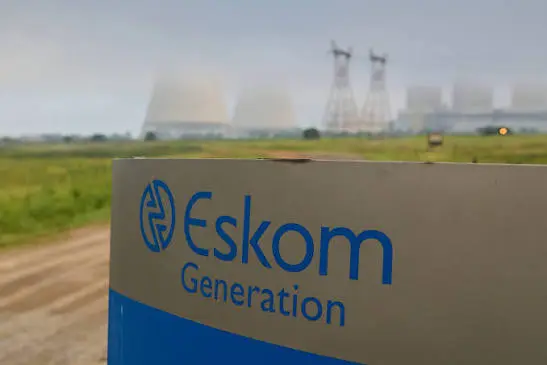
South Africa’s power utility has delivered a second consecutive annual profit, with profit after tax more than doubling to R30.3 billion in the year ended March 2026. The improvement reflects stronger generation performance, tighter cost control and higher regulated electricity prices. Eskom’s FY2026 results show revenue rose 4.1% to R354.7 billion even as electricity sales declined sharply.
The turnaround is therefore entering a more difficult phase. Eskom is producing electricity more reliably, but weaker industrial demand, customer self-generation and rapidly growing municipal arrears are eroding the revenue base needed to fund future infrastructure without continued state support.
Key Overview
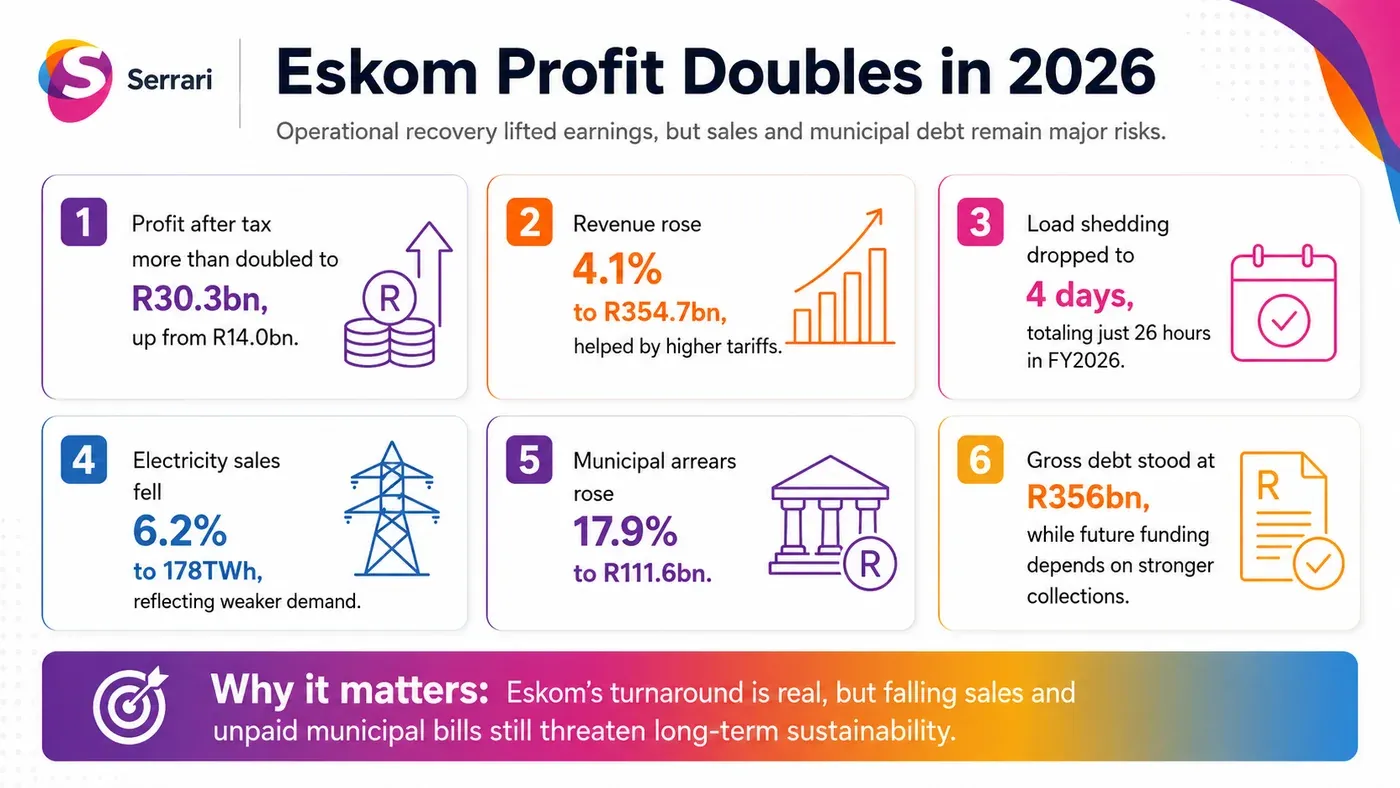
- Profit after tax increased to R30.3 billion from a restated R14.0 billion in FY2025, marking Eskom’s second consecutive profitable year.
- Electricity sales fell 6.2% to 178TWh, while industrial demand alone dropped 22.5%.
- Municipal arrears increased 17.9% to R111.6 billion at the end of March and had risen to about R119 billion by June 2026.
- Eskom experienced only four days of load shedding during FY2026, totalling 26 hours, as generation reliability improved substantially.
- Debt securities and borrowings stood at R356 billion at year-end before falling to approximately R320 billion by June following major debt repayments.
Operational Recovery Pushes Eskom Back Into Profit
Eskom’s profit recovery is closely tied to a significant improvement in the performance of its generation fleet. The utility recorded only four days of load shedding during the financial year, compared with 13 days in the previous year and dramatically below the crisis levels seen in 2024.
Better plant availability also reduced dependence on expensive emergency generation. Spending linked to Eskom-owned and independent open-cycle gas turbines fell by a combined R10.6 billion as diesel-intensive generation was used less frequently.
Higher tariffs provided another major boost. The 12.74% increase for direct customers helped lift revenue despite declining volumes, while Eskom’s EBITDA margin improved to 30.63% from a restated 28.75%.
However, the next financial year will receive a smaller pricing boost. The average tariff increase fell to 8.76% for direct customers from April 2026, increasing the importance of maintaining sales volumes and keeping operating costs under control.
Falling Electricity Sales Create a New Challenge
The most striking weakness in the results is that Eskom is selling less power even as electricity supply becomes more dependable. Sales volumes fell 6.2% to 178TWh, with industrial consumption declining by 9.7TWh, or 22.5%, during the year.
The decline reflects weak industrial activity, greater energy efficiency, embedded generation and customers increasingly producing or sourcing their own electricity. Eskom estimates that these structural changes could leave the system with 2GW to 3GW of surplus capacity over the next few years, creating a reversal from the capacity shortages that previously drove load shedding.
Another pressure is the Mozal aluminium smelter in Mozambique. After power-supply negotiations failed, the energy-intensive operation was placed under care and maintenance in 2026, removing a significant electricity customer and adding to Eskom’s current-year sales pressure.
Context is everything. Stay ahead of shifting trends with today’s market updates, and uncover emerging opportunities using the Serrari Group Market Index and Marketplace. Then, take control of your own financial future by exploring our Money & Life Reset Transformation Blueprint ™ to build stronger habits, create better systems, and design a path toward lasting wealth.
Municipal Debt Is Now the Biggest Financial Risk
Municipal arrears remain the clearest threat to Eskom’s longer-term financial independence. Outstanding municipal debt increased 17.9% to R111.6 billion at March 2026 and reached approximately R119 billion only three months later. Without effective intervention, Eskom projects arrears could rise as high as R358 billion by FY2031, potentially overwhelming the gains from improved operations.
The financial impact is already substantial. Eskom did not recognise R15.8 billion of revenue from municipal, metro and residential customers because of heightened collection risk. Municipalities and metropolitan authorities account for more than 40% of electricity sales, making persistent non-payment a structural rather than marginal problem.
Government interventions have supported Eskom’s recovery, including an R80 billion debt-relief payment received in March. That helped lift cash and cash equivalents to R124.9 billion before R38 billion was used to settle bonds maturing in April.
Profitability Must Now Become Self-Sustaining
Eskom plans to reinvest its improved earnings into a major capital programme, with planned investment of R343 billion over five years and annual capital expenditure expected to exceed R70 billion from FY2029.
But the utility’s ability to fund that programme independently will depend less on headline profit and more on whether it can stabilise electricity demand, collect money already billed and keep generation costs under control.
With South Africa’s municipal elections set for November 4, the financial health and service-delivery failures of local authorities are likely to remain politically prominent. Eskom has largely solved the immediate electricity-supply crisis, but fixing the payment crisis may prove to be the harder part of its turnaround.
Sources: Eskom / Reuters / National Treasury / Electoral Commission of South Africa
Your financial future isn’t something you wait for—it’s something you build.
The real question is: when do you begin?
Move beyond simply staying informed.
Navigate the markets with clarity—track trends through the Serrari Group Market Index, uncover opportunities in the Serrari Marketplace, and build practical knowledge with our Curated Wealth Builder Platform.
Stay connected to what truly matters.
Get daily insights on macro trends and financial movements across Kenya, Africa, and global markets—delivered through the Serrari Newsletter.
Growth opens doors.
Advance your career through professional programs including ACCA, HESI A2, ATI TEAS 7 , HESI EXIT , NCLEX – RN and NCLEX – PN, Financial Literacy!🌟—designed to move you forward with confidence.
See where money is flowing—clearly and in real time.
Track Money Market Funds, Treasury Bills, Treasury Bonds, Green Bonds, and Fixed Deposits, alongside global and African indexes, key economic indicators, and the evolving Crypto and stablecoin landscape—all within Serrari’s Market Index.