
The Japan 2-year JGB auction recorded its weakest demand since 2016 as investors increasingly positioned for tighter Bank of Japan monetary policy. The auction’s bid-to-cover ratio dropped to 2.97 from 3.63 previously and remained well below the 12-month average of 3.74. The tail widened sharply to 0.034 from 0.007, indicating weaker bidding conditions. At the same time, overnight index swaps priced an approximately 84% probability of a Bank of Japan rate hike in September.
Key Overview
Demand for Japan’s two-year government debt weakened significantly, reflecting growing uncertainty around short-term interest rates. The bid-to-cover ratio fell to 2.97, while the wider auction tail suggested investors demanded greater compensation to hold the securities. Because two-year JGBs are particularly sensitive to expectations for monetary policy, the results reinforce signs that bond investors are preparing for another potential Bank of Japan rate increase.
Japan 2-Year JGB Auction Shows Weaker Demand
Demand at the latest Japan 2-year JGB auction weakened considerably as investors increased expectations that the Bank of Japan could tighten monetary policy as early as September.
The bid-to-cover ratio came in at 2.97, down from 3.63 at the previous auction.
It was also substantially below the 12-month average of 3.74.
The bid-to-cover ratio measures the value of bids submitted relative to the amount of bonds available. Although a ratio above one means the auction received more bids than securities offered, a significant decline can indicate weakening investor appetite.
The latest result therefore points to a noticeable deterioration in bond auction demand.
Auction Tail Widens Sharply to 0.034
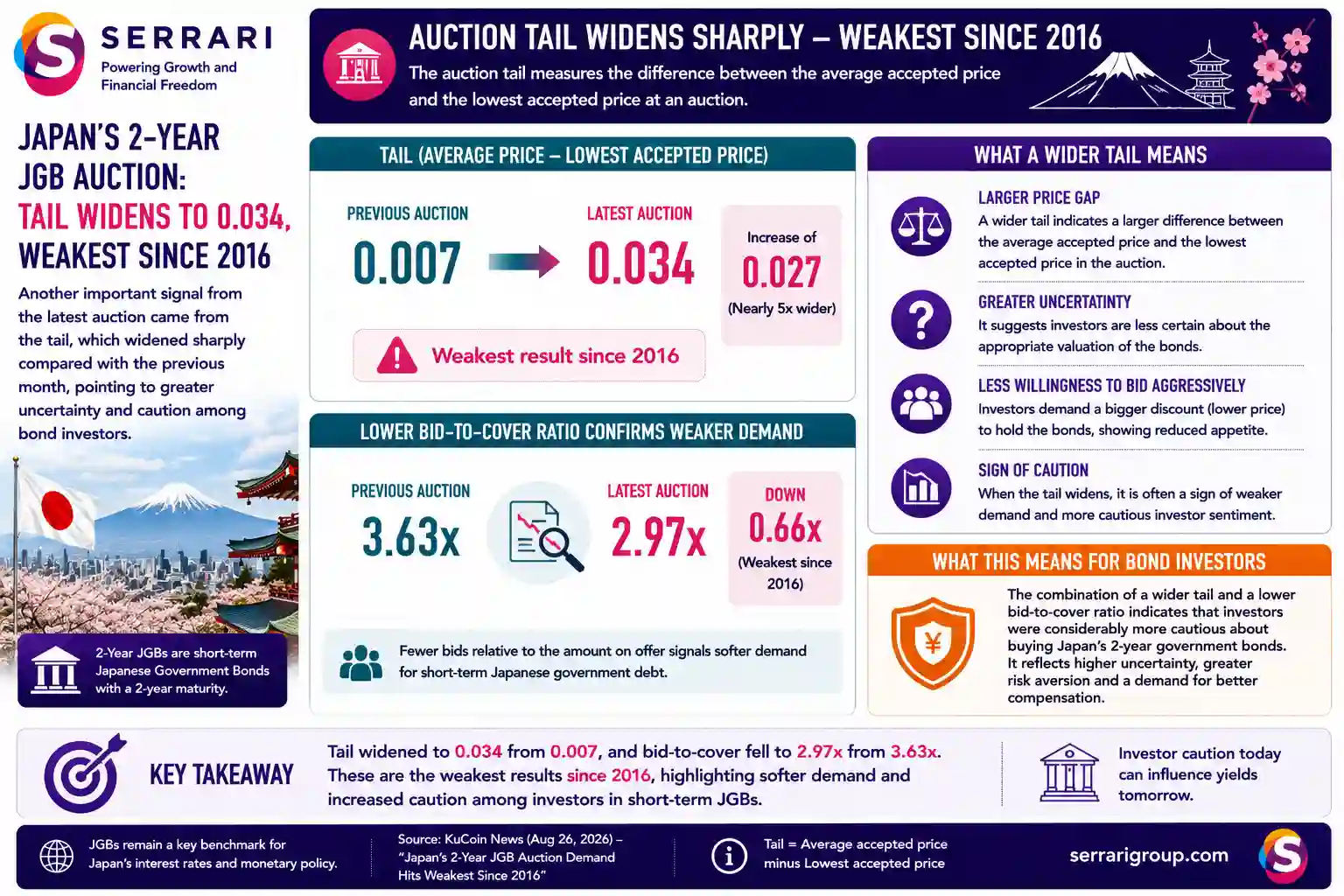
Another important signal came from the auction’s tail.
The tail widened to 0.034, compared with just 0.007 at the previous month’s auction, marking the weakest result since 2016.
A wider tail generally indicates a larger difference between the average accepted price and the lowest accepted price at an auction.
For bond investors, a widening tail can suggest greater uncertainty about valuation and less willingness to aggressively bid for the securities being offered.
Combined with the lower bid-to-cover ratio, the latest figures suggest investors were considerably more cautious about buying short-term Japanese government debt.
Bank of Japan Rate Expectations Pressure Short-Term Bonds
The weaker auction comes as expectations for higher Japan interest rates continue to build.
Overnight index swaps indicate an approximately 84% probability of a September rate hike, suggesting financial markets increasingly expect further monetary tightening.
That outlook is particularly important for two-year government bonds.
Shorter-maturity securities tend to be highly sensitive to changes in expected central bank policy because their yields closely reflect the interest-rate path investors anticipate over the coming years.
When investors expect the Bank of Japan to raise rates, newly issued bonds in the future may offer higher yields. That can make existing lower-yielding securities less attractive, pushing their prices lower and yields higher.
As a result, investors participating in current auctions may demand more attractive yields before committing capital.
Context is everything. Stay ahead of shifting trends with today’s market updates and uncover emerging opportunities using the Serrari Group Market Index and Marketplace. Then, take control of your own financial future by exploring our Money & Life Reset Transformation Blueprint ™ to build stronger habits, create better systems, and design a path toward lasting wealth.
Japanese Bond Market Adjusts to Tightening Risks
For years, Japan’s bond market operated under extraordinarily accommodative monetary conditions.
The Bank of Japan maintained ultra-low interest rates and implemented policies designed to suppress borrowing costs and support economic activity.
A shift toward higher rates changes the environment for the Japanese bond market.
Investors must increasingly consider whether buying a bond today is attractive if monetary tightening could produce higher yields in the near future.
That uncertainty can be particularly visible in short-dated sovereign bonds, where central bank expectations have a greater immediate impact on pricing.
The latest two-year auction provides another indication that markets are adjusting to this changing interest-rate environment.
Government Bond Yields Could Remain Sensitive
Expectations surrounding the September policy decision could continue influencing government bond yields.
If investors become more confident that the Bank of Japan will raise rates, short-term JGB yields could face further upward pressure as markets adjust to a higher policy-rate path.
Conversely, weaker economic data, lower inflation or signals from policymakers that tightening could be delayed might reduce expectations for an immediate increase.
That makes upcoming economic releases and central bank communication particularly important for Japan’s fixed income market.
Investors will be looking for evidence that either confirms or challenges the probability currently reflected in overnight index swaps.
Why Weak Auction Demand Matters
Government bond auctions provide useful information about how investors perceive interest-rate and sovereign-debt risks.
Weak demand does not necessarily indicate concerns about the government’s ability to borrow.
Instead, in this case, the result appears closely connected to uncertainty over the future level of interest rates.
Investors may remain willing to purchase Japanese sovereign bonds, but they could demand higher yields if they believe monetary policy is moving toward tighter conditions.
The difference matters because persistent increases in government borrowing costs can eventually affect the wider economy, influencing corporate financing, lending rates and investment decisions.
September BoJ Decision Becomes Key Market Focus
Attention is now likely to remain concentrated on the Bank of Japan’s September policy decision.
With markets pricing a high probability of tightening, the central bank’s communication could produce significant movements across JGB yields.
If policymakers deliver the rate increase investors increasingly expect, attention will quickly shift toward whether additional tightening could follow.
If the Bank of Japan leaves rates unchanged, meanwhile, investors will examine its guidance for clues about when the next move might occur.
Either scenario could create further volatility across short-term Japanese debt.
For now, the weak Japan 2-year JGB auction provides a clear indication that investors are becoming more cautious about locking money into short-term government securities while the country’s interest-rate outlook is shifting.
FAQs
What happened at the latest Japan 2-year JGB auction?
The auction recorded a bid-to-cover ratio of 2.97, down from 3.63 previously and below the 12-month average of 3.74. The auction tail also widened sharply to 0.034 from 0.007, indicating significantly weaker demand.
Why did demand for two-year Japanese government bonds weaken?
Rising expectations for a Bank of Japan interest rate increase appear to be weighing on demand. Investors may be reluctant to aggressively purchase current bonds if they expect higher rates and potentially more attractive yields in the near future.
What is the probability of a Bank of Japan rate hike in September?
Overnight index swaps indicate that markets are pricing approximately an 84% probability of a September rate increase. Market-implied probabilities can change quickly as economic data and central bank communication evolve.
How could a Bank of Japan rate hike affect JGBs?
A rate increase would generally put upward pressure on shorter-term government bond yields and downward pressure on existing bond prices. Two-year JGBs can be particularly sensitive because their valuations closely reflect expectations for the near-term path of monetary policy.
Your financial future isn’t something you wait for—it’s something you build.
The real question is: when do you begin?
Move beyond simply staying informed.
Navigate the markets with clarity—track trends through the Serrari Group Market Index, uncover opportunities in the Serrari Marketplace, and build practical knowledge with our Curated Wealth Builder Platform.
Stay connected to what truly matters.
Get daily insights on macro trends and financial movements across Kenya, Africa, and global markets—delivered through the Serrari Newsletter.
Growth opens doors.
Advance your career through professional programs including ACCA, HESI A2, ATI TEAS 7 , HESI EXIT , NCLEX – RN and NCLEX – PN, Financial Literacy!🌟—designed to move you forward with confidence.
See where money is flowing—clearly and in real time.
Track Money Market Funds, Treasury Bills, Treasury Bonds, Green Bonds, and Fixed Deposits, alongside global and African indexes, key economic indicators, and the evolving Crypto and stablecoin landscape—all within Serrari’s Market Index.