Ethiopia climate insurance is set to expand through up to €4 million in financing from EIB Global, the development arm of the European Investment Bank. The funding will support the World Food Programme in developing and expanding climate-risk microinsurance for approximately 210,000 smallholder farmers. The programme will provide financial protection against crop and livestock losses caused by droughts, floods and other weather-related disasters while strengthening climate resilience in Ethiopia’s agriculture-dependent rural economy.
Key Overview
The European Investment Bank (EIB) financing will support tailored agricultural insurance products for around 210,000 farmers. The initiative addresses Ethiopia’s extremely low insurance penetration and the country’s heavy reliance on rain-fed agriculture. It also complements a €110 million EIB credit line supporting the third phase of Ethiopia’s Rural Financial Intermediation Programme, linking insurance protection with broader efforts to improve access to agricultural finance.
Ethiopia Climate Insurance Targets 210,000 Farmers
Ethiopia is preparing to significantly expand access to climate insurance for smallholder farmers through a new financing agreement backed by the European Investment Bank.
EIB Global will provide up to €4 million to the World Food Programme to support the development and rollout of insurance products designed specifically for agricultural communities exposed to extreme weather.
Announced on August 25, 2026, the programme is expected to reach approximately 210,000 smallholder farmers.
The products will provide coverage against crop and livestock losses associated with drought, flooding and other natural disasters.
For Ethiopia, where millions of households depend directly on agriculture for their livelihoods, expanding insurance could provide an important financial buffer when adverse weather disrupts production and household income.
Agriculture Remains Highly Exposed to Climate Risk
The programme addresses a significant vulnerability within Ethiopia’s economy.
Agriculture contributes approximately 32% of GDP, employs around 64% of the workforce and generates about 79% of exports, according to a UNDP assessment.
Yet much of the country’s agricultural production remains dependent on rainfall.
That leaves farmers exposed to drought, floods, irregular rainfall, pests, diseases and other shocks that can sharply reduce production.
Climate change can amplify those vulnerabilities by making weather patterns more unpredictable and increasing the severity or frequency of certain extreme events.
For a smallholder farmer operating without adequate savings or insurance, a single failed season can affect not only income but also the ability to purchase inputs for the next planting cycle.
That is where agricultural insurance can play an important role.
Ethiopia’s Agricultural Insurance Gap Remains Wide
Despite the scale of agricultural activity, insurance coverage remains exceptionally limited.
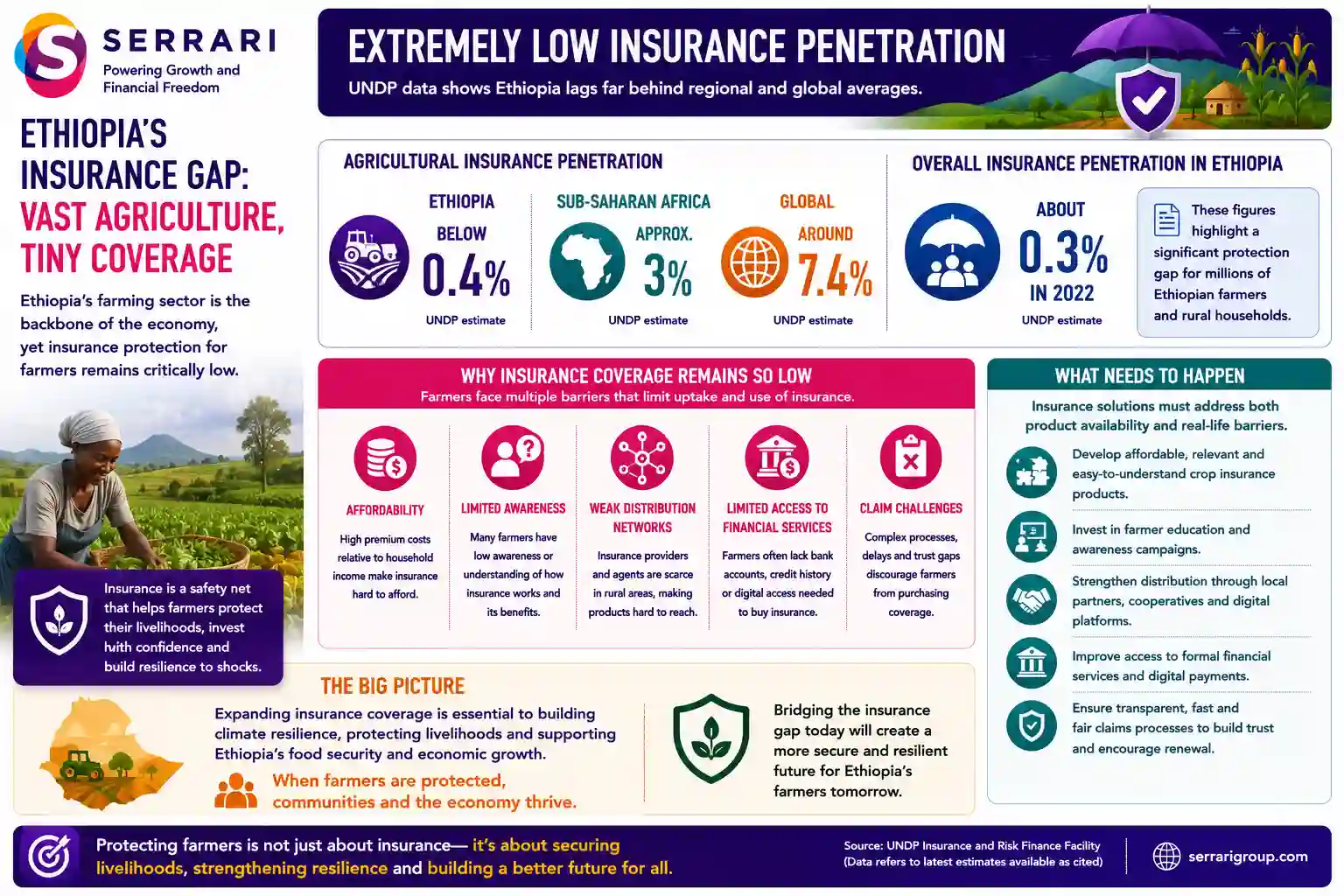
UNDP estimates agricultural insurance penetration in Ethiopia at below 0.4%, compared with approximately 3% across sub-Saharan Africa and around 7.4% globally.
The country’s overall insurance penetration is similarly low. UNDP estimated it at about 0.3% in 2022.
Those figures demonstrate that the challenge extends beyond simply introducing new crop insurance products.
Farmers may face affordability constraints, limited awareness of insurance, weak distribution networks and difficulties accessing formal financial services.
Insurance programmes therefore need to address both product availability and the practical barriers preventing rural households from purchasing and using coverage.
Context is everything. Stay ahead of shifting trends with today’s market updates and uncover emerging opportunities using the Serrari Group Market Index and Marketplace. Then, take control of your own financial future by exploring our Money & Life Reset Transformation Blueprint ™ to build stronger habits, create better systems, and design a path toward lasting wealth.
WFP Builds on Earlier Index Insurance Programmes
The World Food Programme already has experience providing weather-related insurance in Ethiopia.
Its Satellite Index Insurance for Pastoralists programme was launched in 2018 and had expanded to 11 woredas by 2021, reaching more than 28,000 households.
The programme combined insurance protection with financial literacy and other measures intended to strengthen household resilience.
Index-based insurance differs from conventional insurance because payments can be triggered by predetermined indicators, such as rainfall levels or vegetation conditions, rather than requiring individual assessment of every loss.
This approach can reduce administrative costs and make insurance more practical in geographically dispersed rural communities.
The new initiative is considerably larger.
Reaching approximately 210,000 farmers would test whether climate-risk insurance can move beyond relatively small programmes and become a more scalable component of Ethiopia’s agricultural financial system.
€4 Million Grant Connects With Larger EIB Financing
The €4 million financing does not operate in isolation.
It complements a much larger €110 million EIB credit line supporting the third phase of Ethiopia’s Rural Financial Intermediation Programme, or RUFIP III.
That financing is channelled through the Development Bank of Ethiopia and subsequently provided to eligible rural financial institutions.
These include microfinance institutions and rural savings and credit cooperatives.
The relationship between the programmes is important.
Providing farmers with access to credit without adequate protection against climate shocks can create additional financial vulnerability. A drought or flood can destroy the agricultural output that was expected to generate the income needed to repay a loan.
Combining agricultural finance with insurance could therefore help farmers and lenders manage these risks more effectively.
Climate Insurance Could Strengthen Access to Finance
Better insurance coverage could potentially deliver benefits beyond compensation following disasters.
Farmers protected against significant losses may represent lower credit risks for financial institutions, potentially supporting broader access to agricultural lending.
Insurance can also reduce the need for households to sell productive assets, livestock or other investments following severe weather events.
However, insurance alone cannot eliminate agricultural risk.
Product design will be critical. Premiums must remain affordable, coverage needs to reflect the risks farmers actually face, and payment mechanisms must be reliable.
Index-based products also carry basic risk—the possibility that a farmer suffers a genuine loss but the index does not reach the threshold required to trigger compensation.
The success of the programme will therefore depend on how effectively these limitations are managed.
Building Climate Resilience in Rural Ethiopia
The EIB-backed programme forms part of a wider effort to improve climate resilience while strengthening financial inclusion.
EIB Global operates as the development arm of the European Investment Bank, the financing institution of the European Union.
The initiative also aligns with the EU’s broader Global Gateway strategy, which seeks to mobilise public and private investment for infrastructure and development projects internationally.
For Ethiopia, however, the immediate significance is much more local.
Expanding financial protection to 210,000 farmers could help households manage increasingly unpredictable agricultural conditions while testing whether insurance can become a larger part of the country’s rural financial system.
FAQs
What is the Ethiopia climate insurance programme?
The programme is an EIB Global-backed initiative that will provide up to €4 million to the World Food Programme to develop and expand climate-risk microinsurance for approximately 210,000 smallholder farmers in Ethiopia.
What risks will the agricultural insurance cover?
The planned products will focus on crop and livestock losses associated with adverse weather and natural disasters, including droughts and floods. The objective is to provide farmers with financial protection when climate-related events disrupt agricultural production and income.
Why does Ethiopia need more climate insurance?
Agriculture employs roughly 64% of Ethiopia’s workforce but remains heavily dependent on rainfall and exposed to severe weather. Agricultural insurance penetration is estimated at below 0.4%, leaving most smallholder farmers without formal protection against major losses.
How does the €4 million programme relate to the €110 million EIB financing?
The insurance initiative complements the EIB’s €110 million financing for RUFIP III, which expands rural access to finance through the Development Bank of Ethiopia, microfinance institutions and savings and credit cooperatives. Together, the programmes aim to improve access to agricultural finance while helping farmers manage the climate risks that can affect their ability to repay loans.
Sources: Africa Sustainability Matters, All Africa, European Investment Bank, funds for NGOs
Your financial future isn’t something you wait for—it’s something you build.
The real question is: when do you begin?
Move beyond simply staying informed.
Navigate the markets with clarity—track trends through the Serrari Group Market Index, uncover opportunities in the Serrari Marketplace, and build practical knowledge with our Curated Wealth Builder Platform.
Stay connected to what truly matters.
Get daily insights on macro trends and financial movements across Kenya, Africa, and global markets—delivered through the Serrari Newsletter.
Growth opens doors.
Advance your career through professional programs including ACCA, HESI A2, ATI TEAS 7 , HESI EXIT , NCLEX – RN and NCLEX – PN, Financial Literacy!🌟—designed to move you forward with confidence.
See where money is flowing—clearly and in real time.
Track Money Market Funds, Treasury Bills, Treasury Bonds, Green Bonds, and Fixed Deposits, alongside global and African indexes, key economic indicators, and the evolving Crypto and stablecoin landscape—all within Serrari’s Market Index.