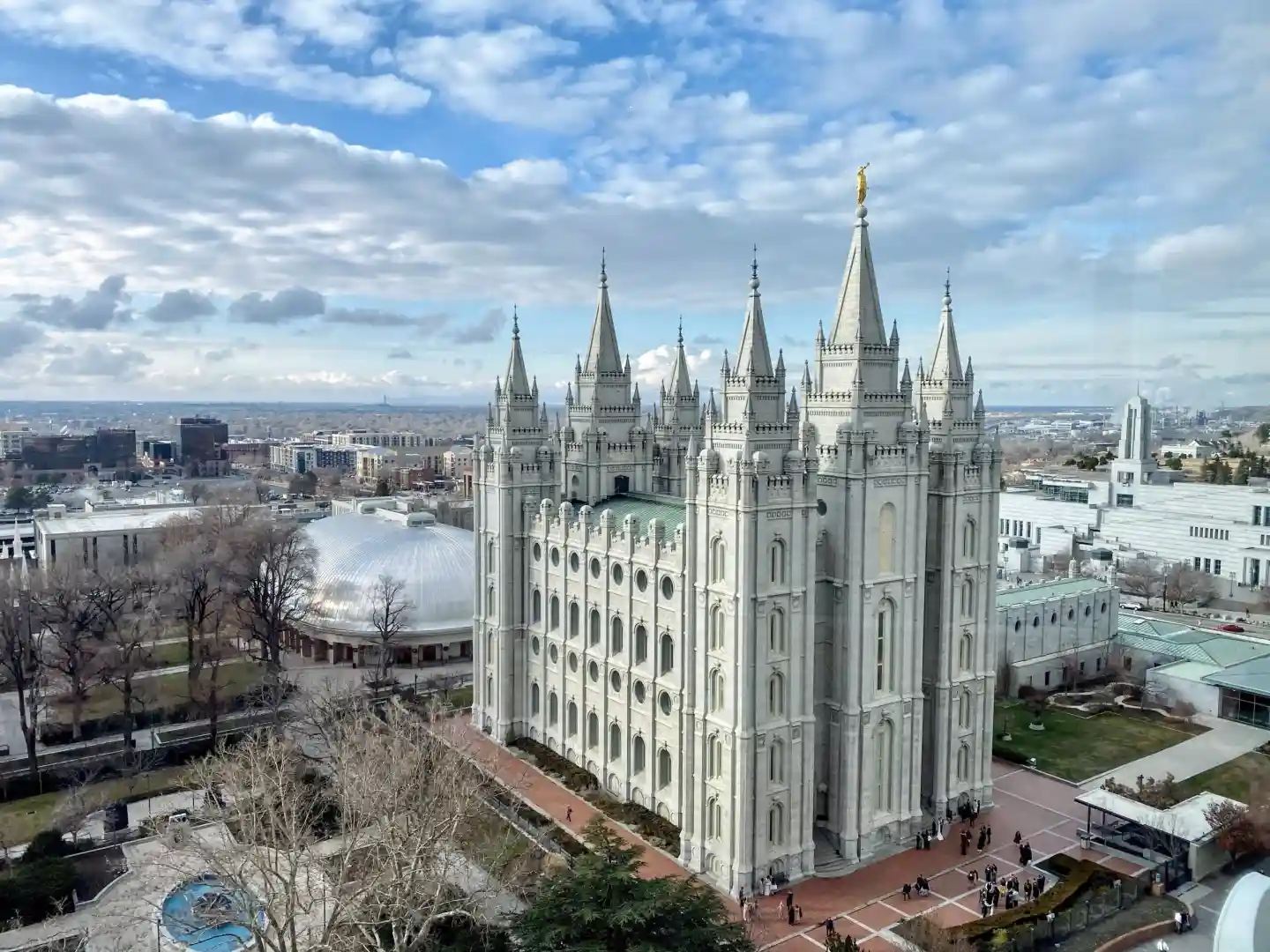
Mormon Church real estate activity is expanding across the United States as the Church of Jesus Christ of Latter-day Saints puts longtime land holdings to work through housing, commercial projects and master-planned communities. The church owns at least 2.4 million acres with an assessed value exceeding $20 billion, according to property records reviewed by Bloomberg. Major projects are underway or planned in Colorado, Florida, Texas and Arizona, reflecting a long-term approach to institutional real estate and land development.
Key Overview
The Church of Jesus Christ of Latter-day Saints has accumulated a substantial US property portfolio that includes farms, ranches, offices, apartments, hotels and development land. Its real estate affiliates have become more active in recent years, with transaction activity reportedly nearly doubling compared with the previous decade. Large developments include the 960-acre Tributary project in Colorado and Sunbridge in Florida, where plans ultimately call for more than 36,000 homes and commercial space.
Mormon Church Real Estate Strategy Shifts Toward Development
The Church of Jesus Christ of Latter-day Saints is becoming increasingly active in US property development, shifting parts of its extensive land portfolio from long-term holdings into large-scale residential and commercial communities.
According to Bloomberg, which reviewed property records compiled by real estate data company Reonomy, the church owns at least 2.4 million acres across the United States.
Those properties have an assessed value exceeding $20 billion, although assessed values do not necessarily represent what the properties could command if sold on the open market.
The portfolio includes agricultural land, ranches, offices, apartments, hotels and other forms of commercial real estate.
Rather than simply selling land accumulated over decades, church-related entities are increasingly developing some of those properties.
Property Reserve Steps Up Real Estate Development
Property Reserve, the church’s real estate investment and development arm, and a related affiliate have increased transaction activity considerably.
Under Ashley Powell, who took over leadership in 2017, the number of transactions has nearly doubled compared with the previous decade, according to Reonomy data cited by Bloomberg.
The strategy appears particularly focused on areas experiencing population and economic growth.
This approach allows longtime property investment holdings to be transformed into residential communities, retail developments and other income-producing assets rather than being disposed of through outright land sales.
Tributary Project Targets More Than 12,000 Residents
One major example of the church’s expanding real estate development activity is taking shape in Aurora, Colorado.
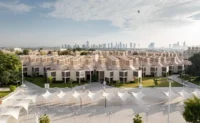
Property Reserve is developing Tributary, a master-planned community covering approximately 960 acres near Denver International Airport.
The development is expected to provide housing for more than 12,000 people.
Plans extend well beyond residential properties. The tributary is designed to include retail facilities, parks, a school and a fire station, effectively creating a large mixed-use community rather than a conventional housing estate.
The project demonstrates how the church is using major land holdings to participate directly in urban expansion around growing US metropolitan areas.
Florida Project Could Deliver More Than 36,000 Homes
An even larger example can be found in Florida.
The church is involved in the Sunbridge development on land that was historically part of a much larger ranch holding.
Plans for the community ultimately include more than 36,000 homes, alongside commercial facilities and supporting infrastructure.
More than 1,400 homes have reportedly already been completed.
The scale of Sunbridge illustrates the potential value embedded in land acquired long before surrounding population growth increased demand for housing and commercial property.
Instead of maximizing returns through immediate sales, the land can be developed gradually over decades.
Context is everything. Stay ahead of shifting trends with today’s market updates and uncover emerging opportunities using the Serrari Group Market Index and Marketplace. Then, take control of your own financial future by exploring our Money & Life Reset Transformation Blueprint ™ to build stronger habits, create better systems, and design a path toward lasting wealth.
Texas and Arizona Land Holdings Move Toward Housing
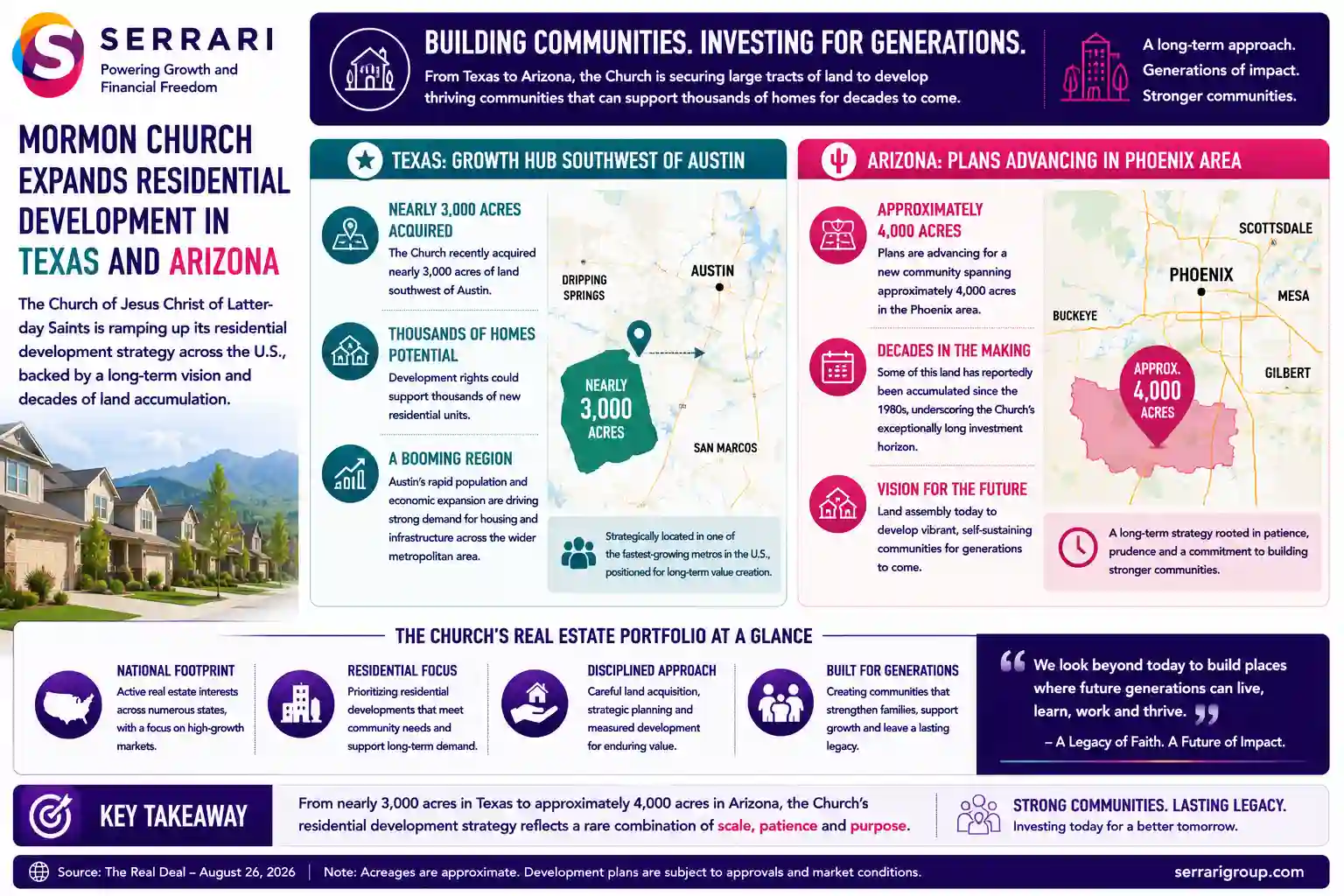
The church’s residential development strategy is also expanding in Texas and Arizona.
It recently acquired nearly 3,000 acres southwest of Austin and obtained development rights that could support thousands of homes.
Austin’s rapid population and economic expansion has created considerable demand for housing and infrastructure around the wider metropolitan region, making large undeveloped sites potentially valuable for long-term development.
In the Phoenix area, meanwhile, plans are advancing for a community covering approximately 4,000 acres.
Some of that land has reportedly been accumulated since the 1980s, highlighting the unusually long investment horizon behind the church’s broader real estate portfolio.
Long-Term Holding Defines the Property Strategy
One feature distinguishes the church’s strategy from many conventional property investors: time.
Real estate developers and private investment firms often measure projects against investment periods lasting several years or perhaps a few decades.
Church-related entities can potentially operate with a much longer horizon.
Clint Beaty, executive vice president at Tavistock Development, told Bloomberg that while his organization considered planning 25 to 30 years into the future to be long term, the church’s approach could stretch closer to a century.
That long horizon can provide significant flexibility.
Land does not necessarily have to be developed during weak market conditions simply to meet an investment fund’s exit deadline. Instead, development can potentially follow population growth, infrastructure expansion and changing local demand.
Broader Institutional Real Estate Holdings
Real estate forms only one part of the church’s wider asset base.
Its property interests reportedly include farms, ranches, offices, apartments and hotels held through various entities.
Separately, nonprofit investment manager Ensign Peak Advisors held more than $60 billion in publicly listed securities as of the end of June, according to Bloomberg.
The combination of securities and physical assets illustrates a highly diversified institutional investment structure.
Within that portfolio, land has particular characteristics. Unlike publicly traded investments, strategically located property can be held for decades before being converted into housing, retail or other developments.
Growing Role in the US Property Market
The church’s expansion does not mean it is becoming a conventional nationwide homebuilder. Its projects remain concentrated around specific land holdings and markets.
However, the sheer scale of those holdings means individual projects can materially influence local US property markets.
Communities capable of accommodating tens of thousands of residents require roads, schools, retail facilities, utilities and other infrastructure alongside housing.
That makes the church’s evolving strategy relevant not only to institutional real estate but also to broader debates around housing supply and urban development in rapidly growing US regions.
FAQs
How much real estate does the Mormon Church own?
The Church of Jesus Christ of Latter-day Saints owns at least 2.4 million acres of land in the United States, according to property records compiled by Reonomy and reviewed by Bloomberg. The holdings have an assessed value exceeding $20 billion.
What types of property does the Church of Jesus Christ of Latter-day Saints own?
Its broader property portfolio includes farms, ranches, offices, apartments, hotels and undeveloped land. Some longtime holdings are now being converted into large residential and mixed-use communities.
What are the Mormon Church’s biggest real estate developments?
Major projects include Tributary in Aurora, Colorado, designed to accommodate more than 12,000 residents, and Sunbridge in Florida, where long-term plans include more than 36,000 homes and commercial development. Projects are also progressing around Austin and Phoenix.
Why is the Mormon Church developing its land now?
Many properties have been held for decades while surrounding cities and populations expanded. Developing selected sites can convert previously undeveloped land into housing and commercial assets while maintaining the church’s characteristically long-term approach to property ownership.
Sources: The Real Deal Real Estate News, Chosun Biz, Omny Fm
Your financial future isn’t something you wait for—it’s something you build.
The real question is: when do you begin?
Move beyond simply staying informed.
Navigate the markets with clarity—track trends through the Serrari Group Market Index, uncover opportunities in the Serrari Marketplace, and build practical knowledge with our Curated Wealth Builder Platform.
Stay connected to what truly matters.
Get daily insights on macro trends and financial movements across Kenya, Africa, and global markets—delivered through the Serrari Newsletter.
Growth opens doors.
Advance your career through professional programs including ACCA, HESI A2, ATI TEAS 7 , HESI EXIT , NCLEX – RN and NCLEX – PN, Financial Literacy!🌟—designed to move you forward with confidence.
See where money is flowing—clearly and in real time.
Track Money Market Funds, Treasury Bills, Treasury Bonds, Green Bonds, and Fixed Deposits, alongside global and African indexes, key economic indicators, and the evolving Crypto and stablecoin landscape—all within Serrari’s Market Index.