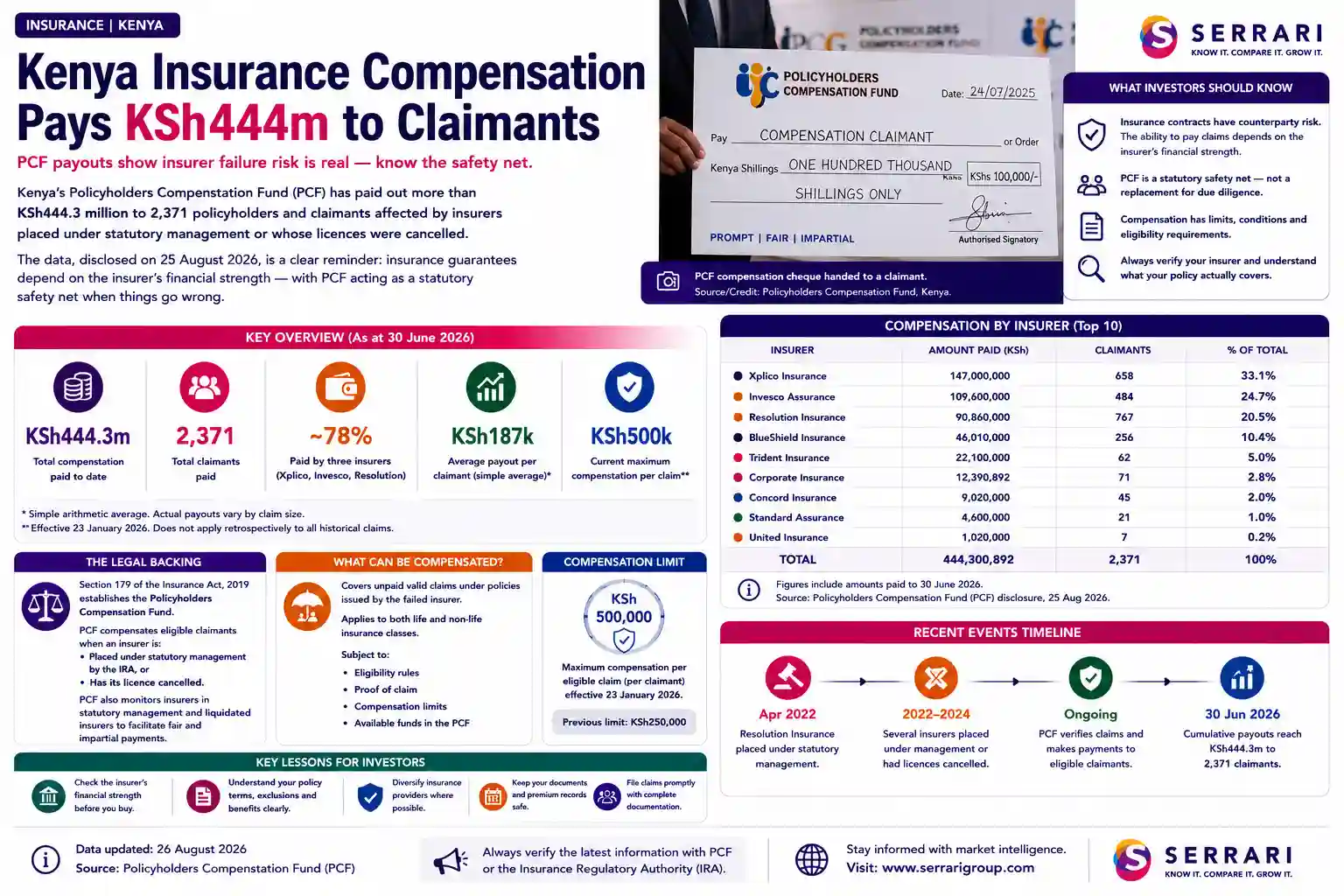
Insurer insolvency Kenya creates a distinction investors should understand between a contractual insurance benefit and statutory compensation after an insurer fails. Kenya’s Policyholders Compensation Fund has paid KSh444.3 million to 2,371 claimants as of June 30, 2026, with Xplico, Invesco and Resolution accounting for about 78% of the disclosed total. Section 179 of the Insurance Act establishes PCF to compensate eligible claimants when an insurer is placed under statutory management or its licence is cancelled. The compensation mechanism is a fallback rather than a replacement for insurer financial strength: eligibility, claim documentation and applicable compensation limits still matter. The current KSh500,000 maximum took effect only in January 2026, meaning investors should not assume every historical claimant in the cumulative dataset qualified for that amount.
Key Overview
- PCF says payouts reached KSh444m across 2,371 policyholders and claimants as of June 30, 2026.
- Xplico accounted for about KSh147 million paid to 658 claimants, the largest disclosed insurer-specific amount.
- Invesco accounted for approximately KSh109.6 million across 484 claimants, while Resolution accounted for KSh90.86 million across 767 claimants.
- Those three insurers alone account for approximately KSh347.46 million, or 78.2% of the reported cumulative payout.
- The simple arithmetic average across all 2,371 claimants is about KSh187,390, but this is not a standard entitlement or guaranteed payment.
- Kenya law establishes compensation fund under section 179 of the Insurance Act for claimants of insurers placed under a statutory manager or whose licences are cancelled.
- The maximum compensation was increased from KSh250,000 to KSh500,000 per eligible claim with effect from January 23, 2026, but that higher ceiling does not retrospectively describe every historical payout in the KSh444.3 million total.
KSh444 Million Shows the Safety Net in Practice
The cumulative headline is substantial, but the insurer-level breakdown gives the data more meaning.
Xplico policyholders and claimants received approximately KSh147 million across 658 claims, while Invesco accounted for KSh109.6 million across 484 claimants.
Resolution, which was placed under statutory management in April 2022, accounted for KSh90.86 million paid to 767 claimants.
BlueShield followed with KSh46.01 million across 256 claimants.
Smaller disclosed totals include:
- Concord Insurance — KSh9.02 million to 45 claimants
- Standard Assurance — KSh4.6 million to 21 claimants
- United Insurance — KSh1.02 million to seven claimants
- Trident Insurance — KSh22.1 million to 62 claimants
- Corporate Insurance — KSh12.39 million to 71 claimants
Together, Xplico, Invesco and Resolution represent about 78.2% of the KSh444.3 million cumulative amount.
That concentration shows how the failure of only a few insurers can create a significant pool of unpaid policy obligations requiring statutory intervention.
“Guaranteed” Still Depends on the Guarantor
This matters particularly when insurance products are marketed as guaranteed savings, guaranteed maturity or guaranteed income products.
A guarantee is only as strong as the institution promising it.
Insurance policy benefits are contractual obligations of the issuing insurer. If the insurer remains solvent and pays claims normally, PCF does not replace that contractual relationship.
The Fund becomes relevant after much more serious events.
Section 179 provides for compensation where an insurer has been placed under a manager appointed under the Insurance Act or where its licence has been cancelled. PCF’s statutory functions also extend to monitoring insurer risk profiles, participating in statutory management and liquidating insurers where ordered by a court.
For investors evaluating long-duration insurance products, that creates two separate layers:
Layer 1 — Insurer promise: the contractual maturity value, annuity, cash benefit or claim.
Layer 2 — Statutory fallback: compensation available under PCF rules if the insurer subsequently fails.
Those amounts need not be the same.
The Average Payout Needs Careful Interpretation
Dividing KSh444.3 million by 2,371 claimants gives a simple average of approximately KSh187,390 per claimant.
That number is useful descriptively, but it should not be treated as a typical PCF benefit.
Claim amounts differ. Policy classes differ. Historical compensation ceilings differ. Eligibility depends on the underlying policy and circumstances.
The regulations define an eligible Kenyan policy and require policyholders affected by an insurer placed under management or whose licence is cancelled to submit claims and supporting documentation.
The KSh187,390 average therefore tells investors something about the historical payout dataset, not what an individual claimant should expect to receive.
Context is everything. Stay ahead of shifting trends with today’s market updates, and uncover emerging opportunities using the Serrari Group Market Index and Marketplace. Then, take control of your own financial future by exploring our Money & Life Reset Transformation Blueprint ™ to build stronger habits, create better systems, and design a path toward lasting wealth.
The KSh500,000 Limit Does Not Explain the Historical Total
The compensation ceiling changed materially this year.
PCF raised compensation ceiling January from KSh250,000 to KSh500,000, effective January 23, 2026.
But PCF specifically says the enhanced threshold applies to policyholders and claimants of insurers that are placed under statutory management or whose licences are cancelled after the commencement of the notice.
That means Serrari should not apply the new ceiling retrospectively to older failures.
Xplico, for example, was placed under statutory management in December 2023. Invesco’s regulatory history also predates the new January 2026 ceiling.
The KSh444.3 million cumulative dataset therefore spans different periods and compensation regimes.
Recent Failures Show Counterparty Risk Is Current
Insurer distress is not purely historical.
On March 11, 2026, the Insurance Regulatory Authority placed Trident Insurance, KUSCCO Mutual Assurance and Corporate Insurance Company under statutory management.
The regulator said the three insurers had experienced continued deterioration in their financial positions and had failed to meet mandatory solvency requirements despite regulatory interventions.
PCF was appointed statutory manager effective that same day.
By June 30, the cumulative disclosure already included 62 Trident claimants receiving KSh22.1 million and 71 Corporate Insurance claimants receiving KSh12.39 million.
That makes insurer financial strength a current due-diligence question rather than a lesson confined to past collapses.
What Investors Should Check Before Buying Insurance Products
Investors considering savings-oriented, endowment, annuity or other long-duration insurance products should evaluate more than the projected maturity benefit.
The first check is the insurer itself.
Capital adequacy, solvency position, claims-payment record and regulatory status matter because the contractual return ultimately depends on the insurer remaining able to meet its obligations.
The second check is liquidity.
Long-duration policies can contain surrender penalties, reduced early cash values or waiting periods that make exiting difficult even when the insurer remains solvent.
Third, investors should understand what “guaranteed” refers to. A guaranteed contractual maturity amount is not the same thing as a government guarantee for the full policy value.
Finally, PCF protection should be viewed as a safety net, not a reason to ignore insurer credit quality.
Conclusion
Kenya’s KSh444.3 million compensation figure makes insurer counterparty risk measurable.
The Fund has compensated 2,371 claimants, with Xplico, Invesco and Resolution accounting for roughly 78% of cumulative payouts.
That shows both sides of Kenya’s insurance-protection framework.
The statutory mechanism is functioning and provides a real fallback when insurers fail. But the existence of that fallback also demonstrates why investors need to assess who stands behind an insurance promise in the first place.
For long-term insurance products, the word “guaranteed” should therefore lead to another question:
Guaranteed by whom — and what happens if that institution cannot pay?
FAQs
How much has Kenya’s Policyholders Compensation Fund paid?
PCF reported cumulative compensation of KSh444,300,892 to 2,371 policyholders and claimants as of June 30, 2026. The figures cover multiple insurers that were placed under statutory management or whose licences were cancelled and should not be interpreted as KSh444 million paid during August alone.
Which failed insurers account for the largest compensation payouts?
Xplico accounts for approximately KSh147 million, Invesco about KSh109.6 million and Resolution KSh90.86 million. Together they represent approximately KSh347.46 million, or 78.2% of the cumulative total. BlueShield is next among the disclosed groups at KSh46.01 million.
Does every failed-insurer claimant receive KSh500,000?
No. KSh500,000 is the current maximum compensation payable on an eligible single claim under the revised framework, not an automatic payment to every claimant. The higher limit became effective on January 23, 2026 and applies under the conditions specified by PCF. Older insurer failures and claims may have been subject to the previous KSh250,000 ceiling.
Who qualifies to claim from PCF?
Kenya’s regulations provide that a policyholder holding an eligible Kenyan policy who suffers loss because the insurer has been placed under a statutory manager or its licence has been cancelled may make a compensation claim. Claimants must submit the required form and supporting documentation, while exclusions and other conditions remain applicable.
Does PCF protection mean insurer financial strength does not matter?
No. PCF is a statutory fallback after serious insurer distress; it does not replace the insurer’s ordinary obligation to pay policy benefits and claims. Compensation can be subject to eligibility conditions and statutory limits. Investors in long-duration insurance products should therefore still examine insurer solvency, claims-paying ability, regulatory status and policy terms before committing capital.
Sources: Kenya News Agency, Policyholders Compensation Fund, Kenya Law Insurance Act, Section 179, Policyholders Compensation Fund, Insurance Regulatory Authority
Your financial future isn’t something you wait for—it’s something you build.
The real question is: when do you begin?
Move beyond simply staying informed.
Navigate the markets with clarity—track trends through the Serrari Group Market Index, uncover opportunities in the Serrari Marketplace, and build practical knowledge with our Curated Wealth Builder Platform.
Stay connected to what truly matters.
Get daily insights on macro trends and financial movements across Kenya, Africa, and global markets—delivered through the Serrari Newsletter.
Growth opens doors.
Advance your career through professional programs including ACCA, HESI A2, ATI TEAS 7 , HESI EXIT , NCLEX – RN and NCLEX – PN, Financial Literacy!🌟—designed to move you forward with confidence.
See where money is flowing—clearly and in real time.
Track Money Market Funds, Treasury Bills, Treasury Bonds, Green Bonds, and Fixed Deposits, alongside global and African indexes, key economic indicators, and the evolving Crypto and stablecoin landscape—all within Serrari’s Market Index.