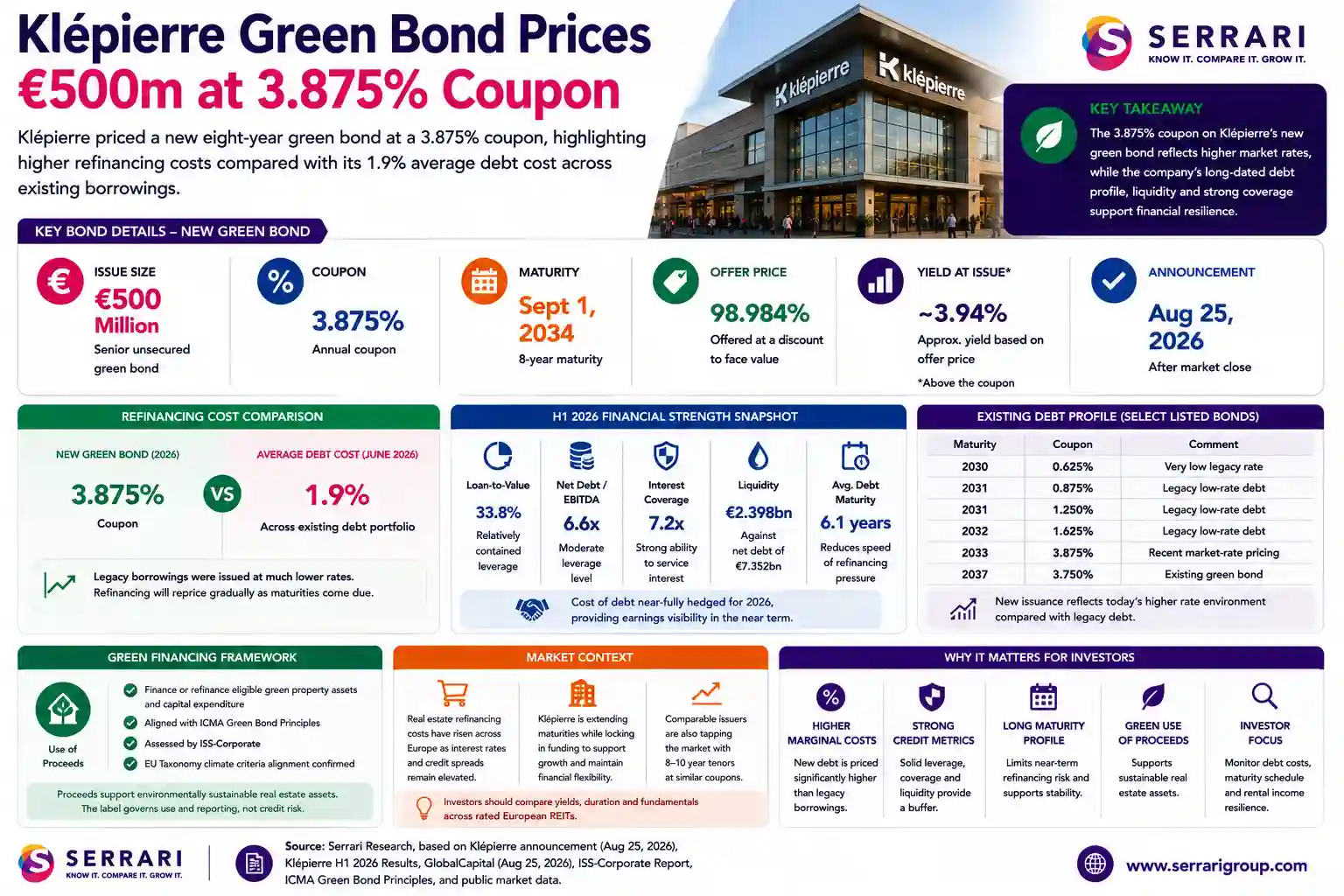
European REIT bonds are increasingly showing the impact of higher refinancing costs even for issuers with comparatively strong balance sheets. Klépierre’s new €500 million green bond carries a 3.875% coupon, compared with a 1.9% average cost across its existing debt portfolio. That does not mean Klépierre’s financing expense has suddenly doubled: the portfolio average contains legacy debt issued at much lower rates and will reprice only gradually as maturities are refinanced. Klépierre enters this refinancing cycle with 33.8% loan-to-value, 6.6x net debt/EBITDA, 7.2x interest coverage and €2.398 billion of liquidity. Investors must therefore assess both sides of the transaction — rising marginal borrowing costs and the financial capacity available to absorb them — while separately evaluating whether green-bond proceeds meet the issuer’s stated environmental criteria.
Key Overview
- Klépierre announced a €500 million eight-year green bond on August 25, 2026. The notes mature in September 2034 and carry a 3.875% annual coupon.
- The securities were offered at 98.984% of face value, with maturity on September 1, 2034.
- Klépierre’s existing debt portfolio carried an average cost of only 1.9% at June 2026 and an average maturity of 6.1 years.
- H1 leverage remained relatively contained at 33.8% LTV, 6.6x net debt/EBITDA and 7.2x interest coverage.
- Klépierre held €2.398 billion of liquidity against consolidated net debt of €7.352 billion.
- GlobalCapital reported that Klépierre and Groupe Bruxelles Lambert both used the eight-year euro market and paid small new-issue concessions.
- The bond is issued under Klépierre’s Green Financing Framework, which follows ICMA Green Bond Principles and permits proceeds to finance or refinance eligible green assets and capital expenditure.
A €500 Million Window Into Refinancing Costs
Klépierre announced the transaction after markets closed on August 25. The bond size totals €500 million and the bond carries 3.875 percent coupon.
The stabilisation notice adds further pricing detail: the offer price was 98.984 percent and the maturity falls September 1 2034. Because the bond was offered below par, its initial yield is above the stated coupon, reinforcing why coupon and actual investor yield should not be treated as identical measures.
For European property financing, however, the most revealing comparison sits elsewhere on Klépierre’s balance sheet.
The 1.9% Portfolio Average Is Legacy Pricing
At June 30, Klépierre’s average debt cost was 1.9%, supported by debt raised when euro interest rates and credit spreads were often substantially lower.
Its financing schedule shows the effect clearly. The company still has listed bonds carrying coupons of just 0.625% into 2030, 0.875% into 2031, 1.25% into 2031 and 1.625% into 2032.
Newer borrowing already looks different. A 2033 bond carries 3.875%, while Klépierre’s 2037 green bond carries 3.75%. That tells investors that today’s 3.875% transaction is not an isolated jump; it is part of a gradual repricing of the debt stack toward current market levels.
Klépierre also reported that first-half financing yielded 3.42 percent across €300 million of new funding with an average maturity of 8.2 years.
The correct conclusion is therefore not that financing costs have suddenly doubled. It is that REIT refinancing costs are materially above the rates embedded in Klépierre’s mature legacy debt portfolio.
The Balance Sheet Provides a Cushion
Higher marginal borrowing costs matter less when refinancing needs are manageable and interest coverage remains strong.
At H1, Klépierre reported net debt of €7.352 billion. Its net debt EBITDA stood 6.6x, while loan-to-value stood at 33.8% and interest coverage at 7.2x.
The company also had €2.398 billion of liquidity and an average debt maturity of 6.1 years.
That maturity profile matters because it slows the speed at which higher market yields reprice the entire liability base. Klépierre does not need to replace all of its 1.9%-average debt today.
Management also said its cost of debt was near-fully hedged for 2026.
For equity investors, that means rising bond-market costs are likely to appear progressively rather than as a single-step earnings shock.
Context is everything. Stay ahead of shifting trends with today’s market updates, and uncover emerging opportunities using the Serrari Group Market Index and Marketplace. Then, take control of your own financial future by exploring our Money & Life Reset Transformation Blueprint ™ to build stronger habits, create better systems, and design a path toward lasting wealth.
The Green Label Changes Use of Proceeds, Not Credit Risk
The new security is also a green real estate bond, but investors should separate that label from Klépierre’s ability to repay the debt.
Its Green Financing Framework permits green notes to finance or refinance eligible green property assets and capital expenditure. The framework follows ICMA green principles across use of proceeds, project selection, proceeds management and reporting.
ISS-Corporate reviewed the framework and confirmed alignment with ICMA Green Bond Principles and Green Loan Principles, while also assessing relevant EU Taxonomy climate criteria.
There is an important distinction after Philips’ EuGB transaction this week: Klépierre’s programme documentation explicitly states that its green notes are not being issued under the formal European Green Bond Regulation.
The Green Notes are not EuGBs. They instead comply with Klépierre’s own framework and the market-based Green Bond Principles.
That distinction matters for investors comparing products across the European green bond market.
Not Every Eligible Asset Is Necessarily Taxonomy-Aligned
Klépierre’s framework uses EU Taxonomy criteria for qualifying activities where applicable, but its base prospectus warns that eligible green assets and capex will not necessarily all satisfy the Taxonomy Regulation.
That makes post-issuance reporting important.
The company commits to annual allocation reporting while its green notes remain outstanding, including the size of the eligible green portfolio, unallocated proceeds, financing-versus-refinancing shares and the amount aligned with Taxonomy criteria.
Independent verification also covers allocation and impact reporting.
For investors, the environmental case therefore becomes increasingly measurable after issuance rather than ending with the green label itself.
Investors Still Demanded a New-Issue Concession
The bond-market backdrop also matters.
GlobalCapital reported that Klépierre and Groupe Bruxelles Lambert both targeted the eight-year euro maturity on August 25 and that both issuers paid small concessions.
A new-issue concession is the additional spread investors may demand to buy a fresh bond rather than comparable securities already trading in the secondary market.
The presence of a small concession is therefore useful evidence that even an issuer with strong credit metrics and an A-range profile must price new supply competitively.
Klépierre itself describes continued demand for its long-tenor bonds, but its public announcement does not disclose an order-book multiple. Serrari should therefore avoid describing the issue as heavily oversubscribed unless more detailed syndicate data become available.
Why Equity Investors Should Care Too
Higher refinancing rates affect more than bondholders.
Klépierre’s portfolio was valued at roughly €21.8 billion at June 30, while net rental income rose 4.4% and EBITDA increased 4.8% during H1.
Those operating gains currently help absorb slightly higher financial expenses.
But as lower-cost bonds mature over coming years, more of the liability base may eventually be refinanced closer to prevailing rates.
For REIT shareholders, the central question is therefore whether rental and cash-flow growth can remain strong enough to offset the gradual upward reset in interest expense.
That is the real significance of the new bond.
Conclusion
Klépierre’s €500 million green bond shows that even financially stronger European property companies are refinancing at borrowing costs materially above the rates embedded in their legacy debt portfolios.
The 3.875% coupon should not be compared mechanically with the company’s 1.9% average cost of debt. One is a marginal price on new eight-year funding; the other is a blended cost across years of existing financing.
Klépierre enters that refinancing cycle with relatively strong buffers: 33.8% LTV, 6.6x net debt/EBITDA, 7.2x interest coverage and more than €2 billion of liquidity.
For investors, the test is whether those buffers and continued rental growth can absorb progressively higher refinancing costs without materially weakening cash-flow growth.
FAQs
What are the main terms of the Klépierre Green Bond?
Klépierre announced a €500 million green bond on August 25, 2026. The fixed-rate notes carry a 3.875% annual coupon, were offered at 98.984% of face value and mature on September 1, 2034. Société Générale CIB is acting as stabilisation coordinator, with the stabilisation period expected to run from August 25 until no later than September 24.
Why is the new coupon so much higher than Klépierre’s 1.9% average debt cost?
The two figures measure different things. The 1.9% average represents Klépierre’s entire existing debt portfolio and includes financing raised years ago when euro rates were much lower. The 3.875% coupon applies only to the new 2034 issue. Klépierre still has bonds carrying coupons below 2% extending into the early 2030s, which keeps the blended portfolio cost well below today’s marginal refinancing rate.
Is this bond issued under the EU Green Bond Standard?
No. Klépierre’s base prospectus explicitly states that Green Notes under its programme are not issued under Regulation (EU) 2023/2631, the European Green Bond Regulation. They instead follow Klépierre’s Green Financing Framework, which is based on ICMA Green Bond Principles and has been reviewed by ISS-Corporate. This is therefore different from an officially designated EuGB.
What can Klépierre use the green-bond proceeds for?
An amount equivalent to the net proceeds can finance or refinance eligible green assets and capital expenditures identified under Klépierre’s Green Financing Framework. The framework is designed primarily around environmentally stronger buildings and related investments. The company must subsequently report how proceeds are allocated and distinguish financing from refinancing, while independent verification covers allocation and impact reporting.
Is Klépierre highly leveraged?
Klépierre’s leverage is meaningful, as is typical for a large property company, but its June 2026 credit ratios provide substantial headroom relative to contractual thresholds. Loan-to-value stood at 33.8%, net debt/EBITDA at 6.6x and interest coverage at 7.2x. Liquidity totalled €2.398 billion, while the average debt maturity was 6.1 years. Those metrics help reduce immediate refinancing pressure even as marginal borrowing costs rise.
Sources: Klépierre, Euronext, London Stock Exchange RNS / Société Générale, ISS-Corporate, GlobalCapital, GlobeNewswire
Your financial future isn’t something you wait for—it’s something you build.
The real question is: when do you begin?
Move beyond simply staying informed.
Navigate the markets with clarity—track trends through the Serrari Group Market Index, uncover opportunities in the Serrari Marketplace, and build practical knowledge with our Curated Wealth Builder Platform.
Stay connected to what truly matters.
Get daily insights on macro trends and financial movements across Kenya, Africa, and global markets—delivered through the Serrari Newsletter.
Growth opens doors.
Advance your career through professional programs including ACCA, HESI A2, ATI TEAS 7 , HESI EXIT , NCLEX – RN and NCLEX – PN, Financial Literacy!🌟—designed to move you forward with confidence.
See where money is flowing—clearly and in real time.
Track Money Market Funds, Treasury Bills, Treasury Bonds, Green Bonds, and Fixed Deposits, alongside global and African indexes, key economic indicators, and the evolving Crypto and stablecoin landscape—all within Serrari’s Market Index.