















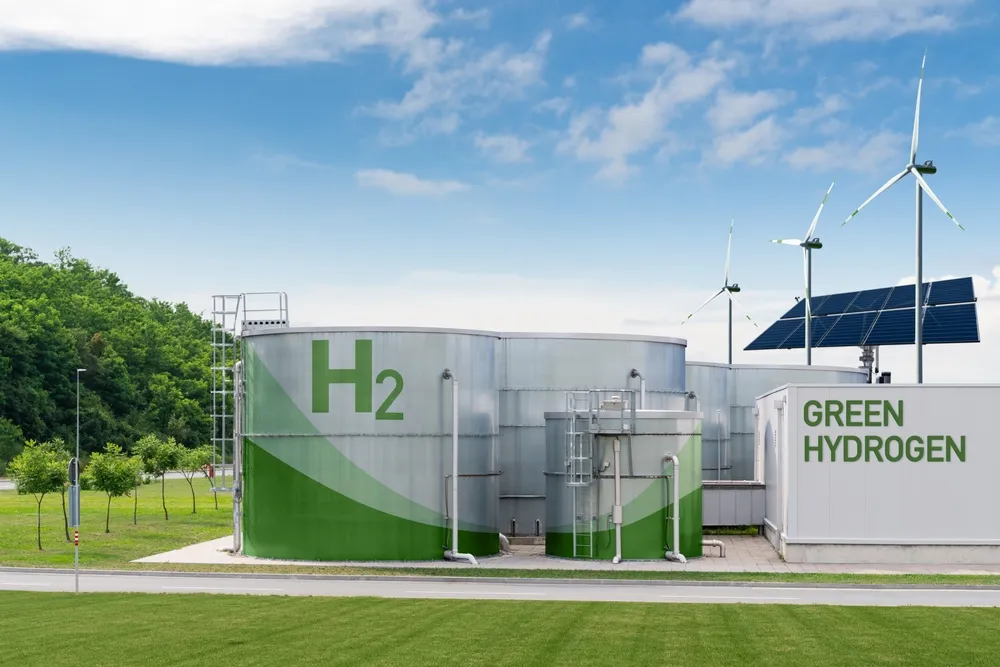
Namibia is using a relatively small but fully operational green hydrogen facility at Walvis Bay to demonstrate how renewable power, hydrogen production, storage and end-use can function within one industrial system.
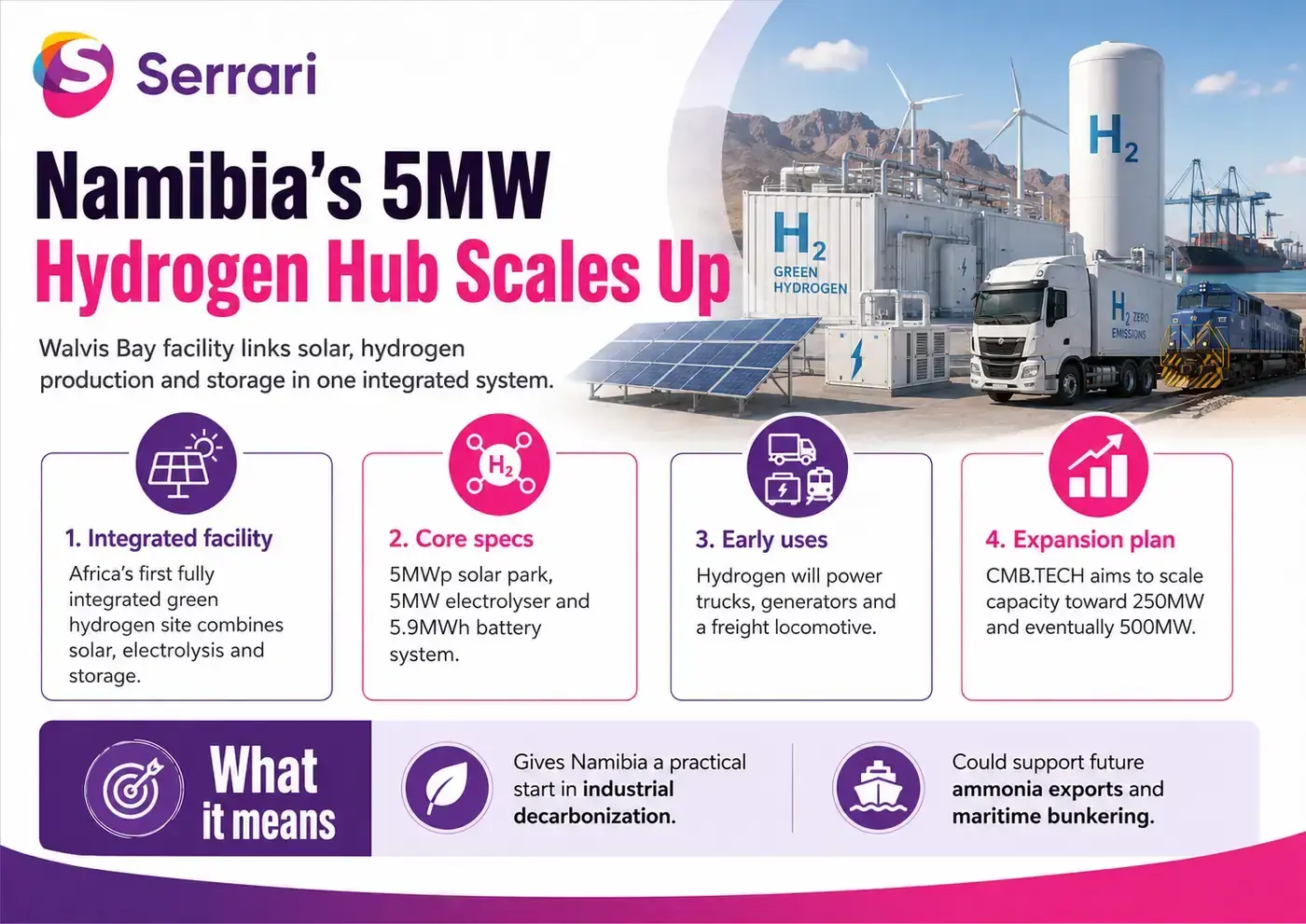
The Farm 58 project, described by CMB.TECH as Africa’s first integrated green hydrogen facility, combines a 5MWp solar park with a 5MW electrolyser and 5.9MWh battery energy storage system. It is designed to supply hydrogen for transport and industrial applications while building the technical expertise needed for much larger projects.
CMB.TECH’s longer-term ambition is to scale renewable capacity toward 250MW and eventually 500MW, while additional projects around Walvis Bay could connect hydrogen production with green ammonia, maritime bunkering and international energy exports.
Key Overview
- The facility combines 5MWp of solar capacity, a 5MW electrolyser and 5.9MWh of battery storage.
- Green hydrogen will serve trucks, industrial equipment, generators and rail applications.
- A hydrogen-powered freight locomotive is being developed for testing on Namibia’s rail network.
- The site’s Hydrogen Academy is helping train local drivers, technicians and scientists.
- CMB.TECH has outlined a long-term ambition to expand capacity toward 250MW and eventually 500MW.
- Separate plans for ammonia production and bunkering could connect Walvis Bay to future international green-fuel markets.
A Working Hydrogen System Rather Than a Concept
The significance of the Walvis Bay facility lies less in its current size than in the fact that several parts of the hydrogen value chain are already operating together.
The project’s 6.5-hectare solar installation supplies an off-grid hydrogen production unit, while batteries help balance variations in solar generation. An environmental assessment for the development confirms that hydrogen is produced using a 5MW proton exchange membrane electrolyser, which separates water into hydrogen and oxygen using renewable electricity.
That hydrogen can then be stored and distributed through the site’s refuelling infrastructure rather than depending on a future export market from the outset.
This addresses one of the central commercial challenges facing green hydrogen projects: securing reliable demand. Large projects can struggle to reach financing or construction when buyers are unwilling to commit to expensive new fuels before production begins.
At Walvis Bay, CMB.TECH is creating demand through its own industrial and transport applications, allowing the facility to function as what the company calls a “Living Lab” for a broader hydrogen economy.
Trucks and Rail Provide an Early Market
Transport provides one of the first practical uses for the hydrogen produced at Farm 58.
The facility is intended to support hydrogen-powered trucks, port equipment, railway applications and small vessels, creating several possible sources of local demand before large-scale export infrastructure is established.
Rail could become an important demonstration case. CMB.TECH has signed agreements involving TransNamib and Africa Global Logistics for a hydrogen-powered heavy-duty locomotive, with the company’s 2025 annual report outlining deployment on the Walvis Bay-Windhoek corridor.
The locomotive uses dual-fuel technology rather than relying exclusively on hydrogen. Testing is intended to determine whether existing diesel locomotives can be adapted to consume locally produced hydrogen, potentially reducing fuel imports and emissions without immediately replacing entire locomotive fleets.
That approach could make hydrogen more commercially practical in the near term because it uses existing industrial assets while a larger hydrogen supply chain is still developing.
Context is everything. Stay ahead of shifting trends with today’s market updates, and uncover emerging opportunities using the Serrari Group Market Index and Marketplace. Then, take control of your own financial future by exploring our Money & Life Reset Transformation Blueprint ™ to build stronger habits, create better systems, and design a path toward lasting wealth.
Namibia Builds Skills Alongside Infrastructure
The facility is also being used to develop a domestic technical workforce.
An on-site Hydrogen Academy provides practical training for drivers, scientists and technicians who will be required to operate hydrogen production, storage and refuelling systems. The project currently employs 25 people, including 24 Namibians, with local staff receiving specialised training through the programme.
This skills component matters because Namibia’s wider hydrogen ambitions will require expertise extending beyond renewable-power construction. Engineers and technicians will be needed for electrolysers, storage systems, pipelines, ammonia plants, industrial safety and specialised transport equipment.
The facility therefore acts as both an energy project and a workforce-development platform, giving Namibia operational experience before substantially larger investments enter production.
Expansion Could Link Walvis Bay to Global Shipping
CMB.TECH is planning a much larger ecosystem around the initial demonstration project.
Company executives have outlined plans to expand the site’s renewable capacity from its current 5MW scale toward 250MW and eventually 500MW. However, this should be viewed as a long-term ambition rather than capacity already under construction.
More immediate regulatory plans include a proposed solar expansion from 5MWp to 100MWp, alongside additional battery capacity and ammonia-production infrastructure.
Beyond Farm 58, CMB.TECH is also developing an ammonia storage and bunkering terminal at Walvis Bay. Plans include a 55,000-tonne refrigerated ammonia storage tank and infrastructure connecting storage facilities to vessels at the port.
Green ammonia could give Namibia access to a much larger market because it can function as both a shipping fuel and an energy carrier for international trade.
From Demonstration Plant to Energy Export Hub
Namibia’s attraction as a hydrogen producer rests heavily on its renewable-energy resources. Strong solar irradiation and available land create the possibility of producing renewable electricity at the scale required for hydrogen and ammonia production.
The government is already positioning the country’s ports as potential green hydrogen export hubs, including cooperation intended to connect future Namibian supply with markets in north-western Europe.
Walvis Bay’s 5MW facility remains modest compared with the gigawatt-scale projects proposed elsewhere in Namibia. Its importance is instead as a working test of whether renewable generation, hydrogen production, transport demand, skills development and port infrastructure can grow together.
If those elements can be scaled commercially, Namibia could move beyond exporting conventional commodities and establish itself as a producer of low-carbon fuels for African industry, global shipping and international energy markets.
Sources: CMB.TECH / Namibia Green Hydrogen Programme / The Namibian / Environmental Compliance Consultancy / Ministry of Environment, Forestry and Tourism
Your financial future isn’t something you wait for—it’s something you build.
The real question is: when do you begin?
Move beyond simply staying informed.
Navigate the markets with clarity—track trends through the Serrari Group Market Index, uncover opportunities in the Serrari Marketplace, and build practical knowledge with our Curated Wealth Builder Platform.
Stay connected to what truly matters.
Get daily insights on macro trends and financial movements across Kenya, Africa, and global markets—delivered through the Serrari Newsletter.
Growth opens doors.
Advance your career through professional programs including ACCA, HESI A2, ATI TEAS 7 , HESI EXIT , NCLEX – RN and NCLEX – PN, Financial Literacy!🌟—designed to move you forward with confidence.
See where money is flowing—clearly and in real time.
Track Money Market Funds, Treasury Bills, Treasury Bonds, Green Bonds, and Fixed Deposits, alongside global and African indexes, key economic indicators, and the evolving Crypto and stablecoin landscape—all within Serrari’s Market Index.