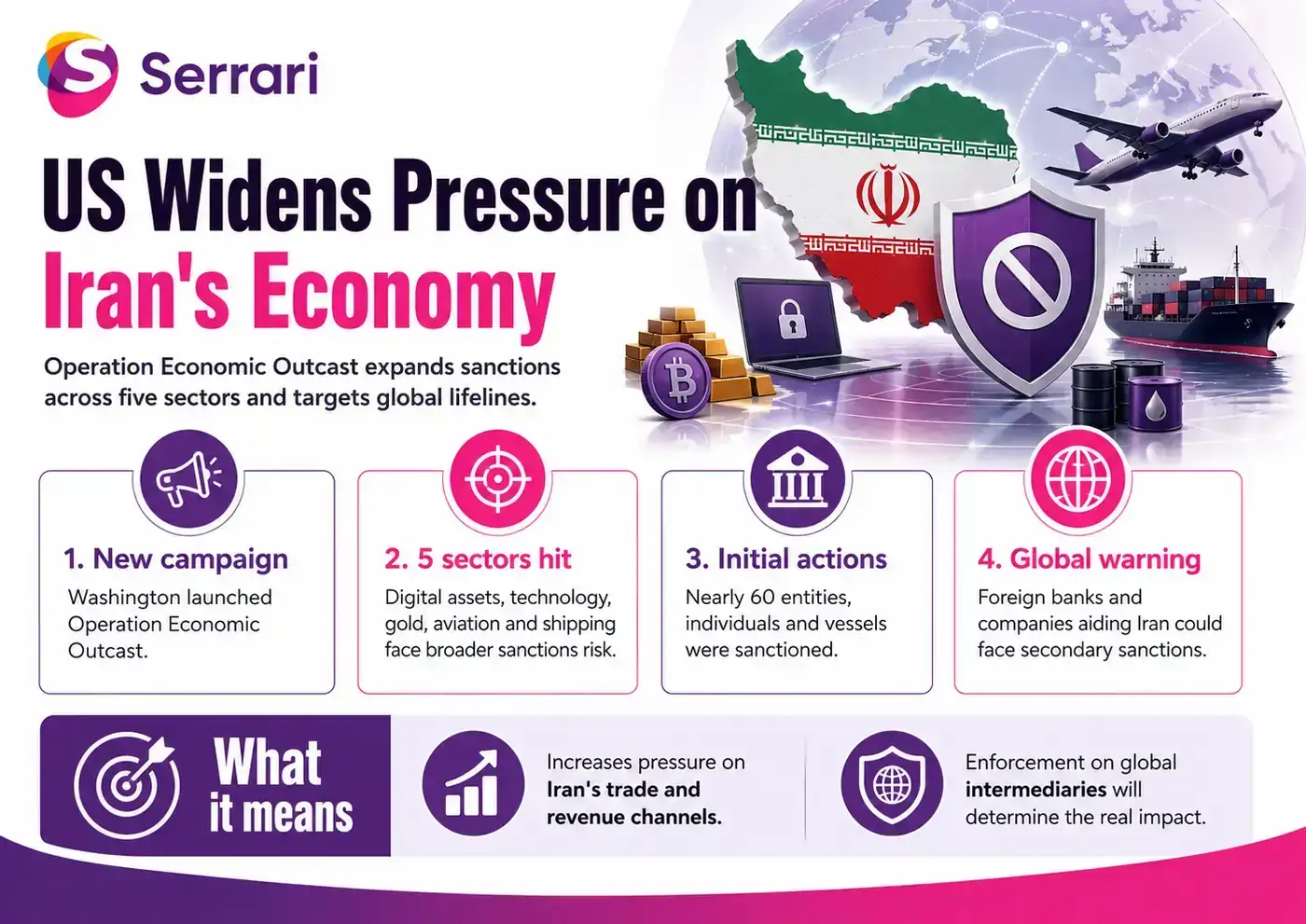
The United States has launched Operation Economic Outcast, a new campaign designed to deepen Iran’s financial isolation by broadening the activities that can expose foreign companies, financial institutions and individuals to U.S. sanctions.
The August 24 measures expand sanctions risk across digital assets, technology, gold, aviation and shipping while adding nearly 60 entities, individuals and vessels to sanctions lists. However, Washington stopped short of immediately imposing the most disruptive secondary penalties on Iran’s major trading partners, instead giving governments and businesses time to cut identified links.
The approach increases pressure not only on Tehran but also on international firms involved in oil payments, transport, financial intermediation and other activity that can convert Iranian trade into usable revenue.
Key Overview
- Operation Economic Outcast expands potential secondary sanctions exposure across five Iranian economic sectors.
- Nearly 60 entities, individuals and vessels were sanctioned in the opening round.
- Foreign banks and companies facilitating sanctions evasion or Iran-linked money flows could lose access to the U.S. financial system.
- China remains a central challenge because it has been Iran’s largest oil buyer for several years.
- Washington has not yet targeted major Chinese banks suspected of facilitating Iranian oil trade.
- Tehran has rejected the campaign and warned that it has economic and military options to retaliate.
Washington Broadens the Sanctions Net
The new campaign marks a shift from targeting individual sanctions-evasion networks toward creating wider legal exposure for companies operating in sectors Washington believes Iran uses to generate revenue or bypass restrictions.
Under five new sectoral determinations, U.S. authorities can sanction foreign persons operating in or providing support to Iran’s digital-asset, technology, gold, aviation and shipping sectors. The measures give enforcement agencies broader discretion to pursue intermediaries outside Iran rather than limiting pressure to Iranian companies themselves.
The initial package also targeted roughly 60 entities, people and vessels connected to activities ranging from oil-revenue generation to missile and nuclear procurement and cyber operations. Authorities additionally suspended several general licences that had permitted certain remittance transactions and Iranian access to parts of the U.S. cultural and academic system.
That combination makes the campaign potentially broader than a conventional designation round. Its strongest leverage comes from the threat that companies or financial institutions assisting Iran could eventually be excluded from the dollar-based financial system.
Secondary Sanctions Put Trading Partners on Notice
The immediate economic impact will depend on how aggressively Washington applies secondary sanctions.
Officials said countries will receive defined timelines to close Iran-related activity identified by the U.S., but those deadlines have not been publicly disclosed. The administration also avoided immediately imposing penalties on major foreign financial institutions, describing the period as an opportunity for companies and governments to change course.
China is the most consequential test. It has been Iran’s biggest oil buyer for years, and the U.S. has already targeted some Chinese refiners and shipping networks. Yet the opening Operation Economic Outcast package did not include major Chinese banks suspected of helping facilitate Iranian oil trade.
This restraint reduces the risk of an abrupt disruption to global finance, but it also raises questions about how far Washington is prepared to go if major trading partners resist. Beijing has said sanctions and pressure do not help resolve disputes and has pledged to protect its interests.
Context is everything. Stay ahead of shifting trends with today’s market updates, and uncover emerging opportunities using the Serrari Group Market Index and Marketplace. Then, take control of your own financial future by exploring our Money & Life Reset Transformation Blueprint ™ to build stronger habits, create better systems, and design a path toward lasting wealth.
Iran’s Economy Faces Growing Pressure
The sanctions arrive when Iran is already experiencing severe economic strain. The rial fell to a record market low of 2.02 million to the U.S. dollar on August 24, while high inflation and the regional conflict have driven up the cost of basic goods.
The currency weakness illustrates why Washington is also targeting gold and digital assets. Both can provide alternative stores of value or payment channels when access to conventional banking and hard currency becomes restricted.
Yet Iran has spent decades adapting to sanctions through front companies, alternative payment arrangements and a shadow fleet used to transport oil. That history means tougher legal authorities will not automatically translate into complete economic isolation unless enforcement reaches the intermediaries that continue enabling trade.
Tehran Warns of Retaliation as Markets Assess Risk
Iran has rejected the latest measures and signalled that it intends to resist rather than immediately change course. Its economy minister said the country was fully prepared for the new sanctions, while Iranian officials have threatened retaliation against American interests and critical energy routes if pressure escalates further.
The Strait of Hormuz remains Iran’s strongest economic leverage point. Disruption around the waterway has already constrained regional shipping and contributed to elevated global energy costs during the conflict.
Despite the aggressive branding of the new campaign, oil prices fell by more than $2 a barrel after the announcement as markets assessed the absence of immediate sanctions on major foreign banks. That reaction could change quickly if Washington follows through with penalties against institutions that process Iranian oil revenue.
Operation Economic Outcast therefore begins as both a sanctions programme and a warning. Its ultimate impact will depend less on the number of entities named in the first round than on whether the United States is willing to impose meaningful costs on the foreign banks, shipping companies, technology providers and commodity traders that keep Iran connected to the global economy.
Sources: U.S. Department of the Treasury / Reuters / Associated Press
Your financial future isn’t something you wait for—it’s something you build.
The real question is: when do you begin?
Move beyond simply staying informed.
Navigate the markets with clarity—track trends through the Serrari Group Market Index, uncover opportunities in the Serrari Marketplace, and build practical knowledge with our Curated Wealth Builder Platform.
Stay connected to what truly matters.
Get daily insights on macro trends and financial movements across Kenya, Africa, and global markets—delivered through the Serrari Newsletter.
Growth opens doors.
Advance your career through professional programs including ACCA, HESI A2, ATI TEAS 7 , HESI EXIT , NCLEX – RN and NCLEX – PN, Financial Literacy!🌟—designed to move you forward with confidence.
See where money is flowing—clearly and in real time.
Track Money Market Funds, Treasury Bills, Treasury Bonds, Green Bonds, and Fixed Deposits, alongside global and African indexes, key economic indicators, and the evolving Crypto and stablecoin landscape—all within Serrari’s Market Index.