




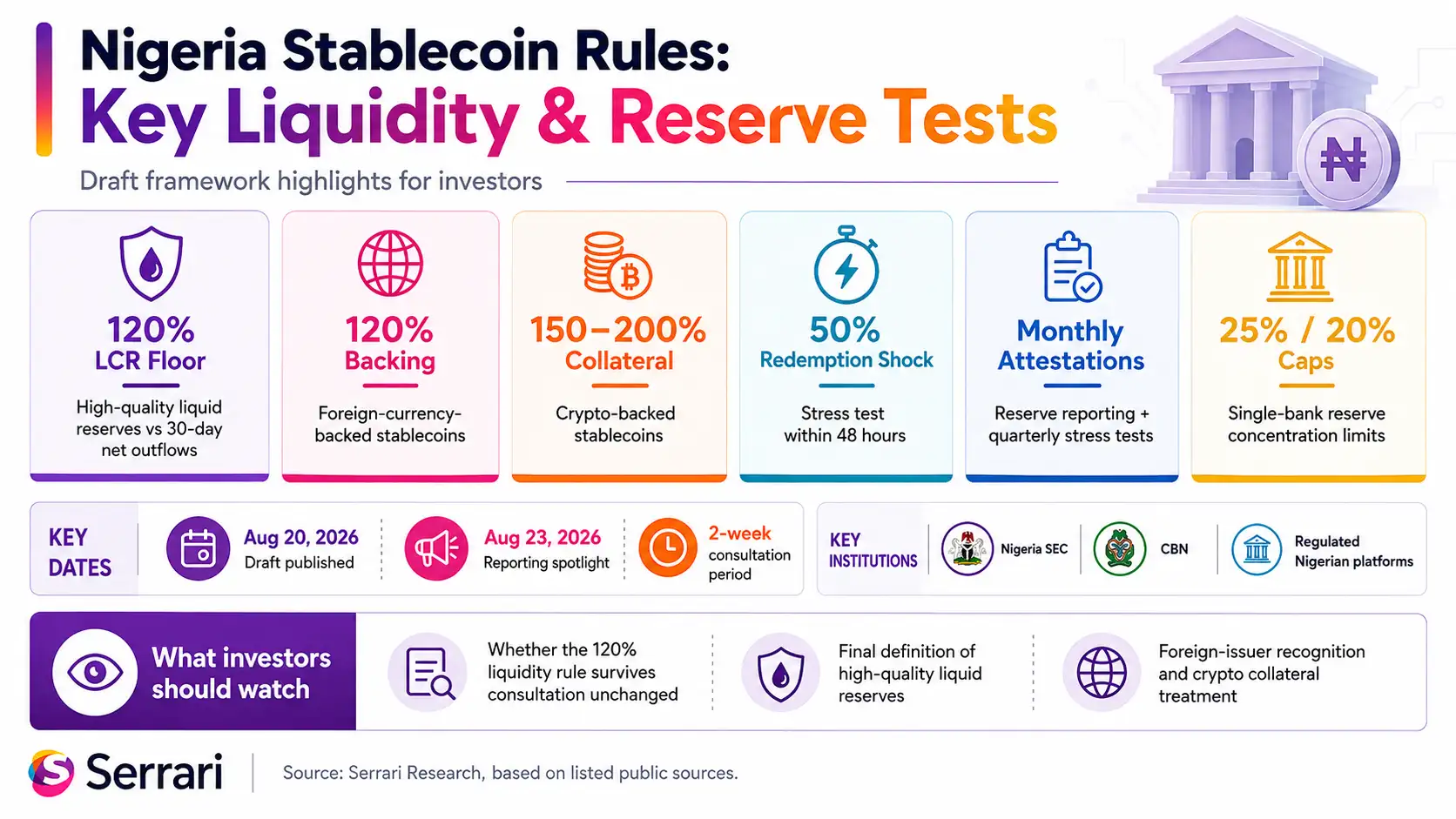
Nigeria stablecoin regulation is moving toward a prudential model focused on whether issuers can meet redemptions during periods of market stress. The SEC’s August 20, 2026 draft would require stablecoin issuers to maintain a minimum 120% Liquidity Coverage Ratio based on high-quality liquid reserves versus projected 30-day net redemption outflows. Foreign-currency-backed stablecoins would require 120% backing, while crypto-backed stablecoins would face 150%–200% collateralisation. Issuers would also conduct quarterly stress tests, including a 50% redemption shock within 48 hours, publish or submit monthly reserve attestations, and comply with reserve concentration limits. Foreign-issued stablecoins would need SEC recognition for regulated Nigerian capital-market use. The proposal remains under consultation and would not replace separate CBN approvals required for payments, remittances, banking or foreign-exchange activity.
Key Overview
- The SEC published rules August 20, opening a two-week consultation period. The framework remains proposed rather than final regulation.
- Stablecoin issuers would maintain a minimum 120% Liquidity Coverage Ratio, based on high-quality liquid reserves relative to projected 30-day net redemption outflows.
- Foreign-currency-backed stablecoins would require 120% backing, while crypto-backed stablecoins would face 150%–200% collateralisation depending on reserve risk.
- Stress scenarios include 50% redemptions within 48 hours and a 30% crypto-market decline within 24 hours.
- Exposure to one Nigerian bank would be capped at 25% of reserves and one foreign bank at 20%.
- Foreign-issued stablecoins would require SEC recognition for regulated Nigerian capital-market use, but that recognition would not authorise CBN-regulated payments, banking, remittances or foreign-exchange activity.
Nigeria Stablecoin Rules Set 120% Liquidity Coverage Floor
Nigeria Puts Redemption Risk at the Centre
Nigeria’s Securities and Exchange Commission is proposing a stablecoin framework that puts redemption liquidity, reserve quality and counterparty risk at the centre of supervision.
The SEC published rules August 20, opening a two-week comment period. Detailed Nigerian reporting expanded on August 23, bringing the proposal firmly into today’s market-news cycle. The framework is still a consultation draft, not final regulation, and no adoption date has been announced.
For investors, the important question is not simply whether a stablecoin says it is fully backed. The harder question is whether reserves can be converted into cash quickly enough when holders want to redeem at the same time.
The 120% Liquidity Floor Is a Separate Test
The headline proposal is that stablecoin issuers need 120% liquidity through a minimum Liquidity Coverage Ratio. The SEC defines that ratio as high-quality liquid reserve assets divided by projected net redemption outflows over the next 30 days.
That requirement is separate from the backing ratio applied to different stablecoin structures. Naira-backed stablecoins would require at least 100% backing, while foreign-currency stablecoins require 120% backing. Separately, crypto-backed stablecoins require 150-200% collateral, depending on volatility, liquidity, concentration and collateral quality.
This distinction matters. A stablecoin could have enough assets on paper to cover its liabilities and still face difficulty if those assets cannot be sold quickly without a large loss. The proposed LCR therefore targets liquidity risk rather than only accounting solvency.
Stress Tests Are Built Around Redemptions
The SEC would also require stablecoin issuers to test severe but plausible shocks. One scenario assumes half of liabilities within 48-hours are redeemed. Another assumes crypto markets fall 30% daily, specifically a 30% decline within 24 hours.
Issuers would also need to model the failure or impairment of a reserve-holding institution, foreign-exchange devaluation or convertibility stress, and a local or global de-pegging event.
Under the draft, stress tests occur every quarter, with results filed within thirty days after quarter-end. The proposal further makes monthly reserve attestations become mandatory alongside quarterly financial statements and annual audited financial statements.
For holders, those disclosures could make it easier to distinguish a stablecoin that merely claims to be backed from one that regularly demonstrates how its reserves would behave under pressure.
Context is everything. Stay ahead of shifting trends with today’s market updates, and uncover emerging opportunities using the Serrari Group Market Index and Marketplace. Then, take control of your own financial future by exploring our Money & Life Reset Transformation Blueprint ™ to build stronger habits, create better systems, and design a path toward lasting wealth.
Reserve Quality Would Affect Regulatory Treatment
The proposal does not treat every reserve asset as equally safe.
Under the proposed schedule, CBN treasury bills carry 0% indicative risk weight. Short sovereign bonds carry 5% for Nigerian government debt maturing within one year, while investment-grade corporate bonds carry 20%. Bitcoin and Ether face substantially higher treatment: BTC and ETH carry 50-75% indicative risk weights.
That approach reinforces a core principle of stablecoin reserve requirements: reserve value and reserve liquidity are different things. Cash and short-dated sovereign instruments are generally easier to mobilise during redemptions than volatile digital assets.
The proposal also applies concentration limits. Nigerian bank exposure capped 25% of total reserves, while foreign bank exposure capped 20%. A single digital-asset custodian would also be limited to 20%, and one cryptoasset could not exceed 35% of total crypto collateral.
These limits are designed to prevent a supposedly diversified reserve pool from becoming dependent on one bank, custodian or cryptoasset.
Foreign Stablecoins Face a Recognition Gate
The rules could be particularly significant for foreign stablecoin issuers Nigeria is attempting to bring inside its regulatory perimeter.
Under the proposal, foreign stablecoins require SEC recognition before they could be listed, admitted for trading, custodied, settled, promoted or otherwise used by a Nigerian digital-asset exchange or another regulated platform.
The SEC recognition reviews reserve safeguards including the issuer’s home-country regulatory status, reserve quality and liquidity, custody and segregation arrangements, redemption rights, independent attestations, audited disclosures and market concentration. The regulator could also require a local representative and Nigeria-specific reserve, liquidity or redemption support.
That creates a regulatory gate between a stablecoin being globally available and being permitted for capital-market use through a regulated Nigerian platform.
SEC Recognition Would Not Mean Payment Approval
This is one of the most important boundaries in the proposal.
The draft makes clear that SEC recognition excludes payment permissions outside its capital-market remit. Recognition would cover listing, trading, custody, settlement or other capital-market activity, but would not authorise payment-system operation, remittances, foreign-exchange dealing, banking, deposit-taking, electronic-money issuance or stored-value activity.
Where a proposed use falls inside the Central Bank of Nigeria’s mandate, CBN approvals remain separately required before that activity begins.
That distinction prevents investors from interpreting SEC recognition as an all-purpose Nigerian licence. Nigeria crypto regulation is increasingly coordinated, but separate agencies still retain separate statutory responsibilities. Nigeria’s July virtual-assets coordination framework likewise left securities-related activities with the SEC while retaining separate regulatory mandates for other authorities.
What Investors Should Watch Next
The first question is whether the 120% liquidity coverage requirement survives consultation unchanged. Investors should also watch the final definition of high-quality liquid reserves, the treatment of crypto collateral, concentration limits and the information disclosed through stablecoin reserve attestations.
Foreign-issuer recognition will be another major test. The practical impact will depend on which stablecoins apply, how the SEC processes recognition and what Nigeria-specific reserve or liquidity conditions are imposed.
The comments due within two weeks of the August 20 exposure date. Until the SEC publishes final rules, the proposed ratios, stablecoin stress tests and recognition requirements should be treated as draft prudential standards rather than obligations already in force.
Conclusion
Nigeria’s draft framework tackles stablecoin risk where investors are most exposed: the ability to redeem during market stress.
The combination of a 120% liquidity floor, higher collateral requirements for riskier structures, quarterly stress tests, monthly reserve attestations, concentration limits and foreign-issuer recognition would create a demanding supervisory framework if adopted substantially as proposed.
It would not make stablecoins risk-free. But it would require issuers to show more clearly what backs their tokens, how liquid those reserves are, who holds them and whether redemptions can continue when market conditions deteriorate.
FAQs
What is Nigeria’s proposed 120% stablecoin liquidity ratio?
The proposed Liquidity Coverage Ratio would require stablecoin issuers to maintain high-quality liquid reserve assets equal to at least 120% of projected net redemption outflows over the following 30 days. The ratio is designed to assess whether issuers could meet unusually heavy redemptions without depending on illiquid assets or distressed sales. It is separate from the collateral backing ratios applied to individual stablecoin categories.
Does every Nigerian stablecoin need 120% reserve backing?
No. The draft differentiates between reserve backing and liquidity coverage. Naira-backed stablecoins would require at least 100% reserve backing, while foreign-currency-backed stablecoins would require 120%. Crypto-backed stablecoins would be over-collateralised by at least 150%, with the schedule allowing requirements of up to 200% depending on the quality and risk of the collateral. Separately, stablecoin issuers would face the 120% Liquidity Coverage Ratio.
What happens to foreign stablecoins under the proposal?
A foreign-issued stablecoin could not be listed, traded, custodied, settled, promoted or otherwise used on a Nigerian regulated capital-market platform unless the SEC recognises or authorises it. The recognition assessment could consider reserve quality, liquidity, custody, redemption rights, audits, attestations, home-country supervision and concentration risk. The SEC could additionally impose local representation, reserve or redemption-support requirements.
Does SEC recognition allow a stablecoin to be used for payments?
Not automatically. The proposal expressly limits SEC recognition to capital-market activities within the Commission’s regulatory remit. It would not amount to authorisation for payments, remittances, foreign-exchange dealing, banking, deposit-taking, electronic-money issuance or stored-value activity. Where those activities fall under the Central Bank of Nigeria or another competent authority, the relevant separate approval would still be necessary.
Why do the proposed stablecoin stress tests matter?
The tests focus on the conditions in which stablecoin weaknesses are most likely to emerge. Issuers would model a 50% redemption of outstanding liabilities within 48 hours, a 30% crypto-market decline within 24 hours, failure of a reserve-holding institution, foreign-exchange stress and a de-pegging event. Testing these scenarios quarterly could provide regulators and investors with more evidence about whether reserves would remain usable when market liquidity deteriorates.
Sources: Securities and Exchange Commission Nigeria, Gatekeepers News, Chronicle, Nairametrics
Your financial future isn’t something you wait for—it’s something you build.
The real question is: when do you begin?
Move beyond simply staying informed.
Navigate the markets with clarity—track trends through the Serrari Group Market Index, uncover opportunities in the Serrari Marketplace, and build practical knowledge with our Curated Wealth Builder Platform.
Stay connected to what truly matters.
Get daily insights on macro trends and financial movements across Kenya, Africa, and global markets—delivered through the Serrari Newsletter.
Growth opens doors.
Advance your career through professional programs including ACCA, HESI A2, ATI TEAS 7 , HESI EXIT , NCLEX – RN and NCLEX – PN, Financial Literacy!🌟—designed to move you forward with confidence.
See where money is flowing—clearly and in real time.
Track Money Market Funds, Treasury Bills, Treasury Bonds, Green Bonds, and Fixed Deposits, alongside global and African indexes, key economic indicators, and the evolving Crypto and stablecoin landscape—all within Serrari’s Market Index.





















Comments are closed.