
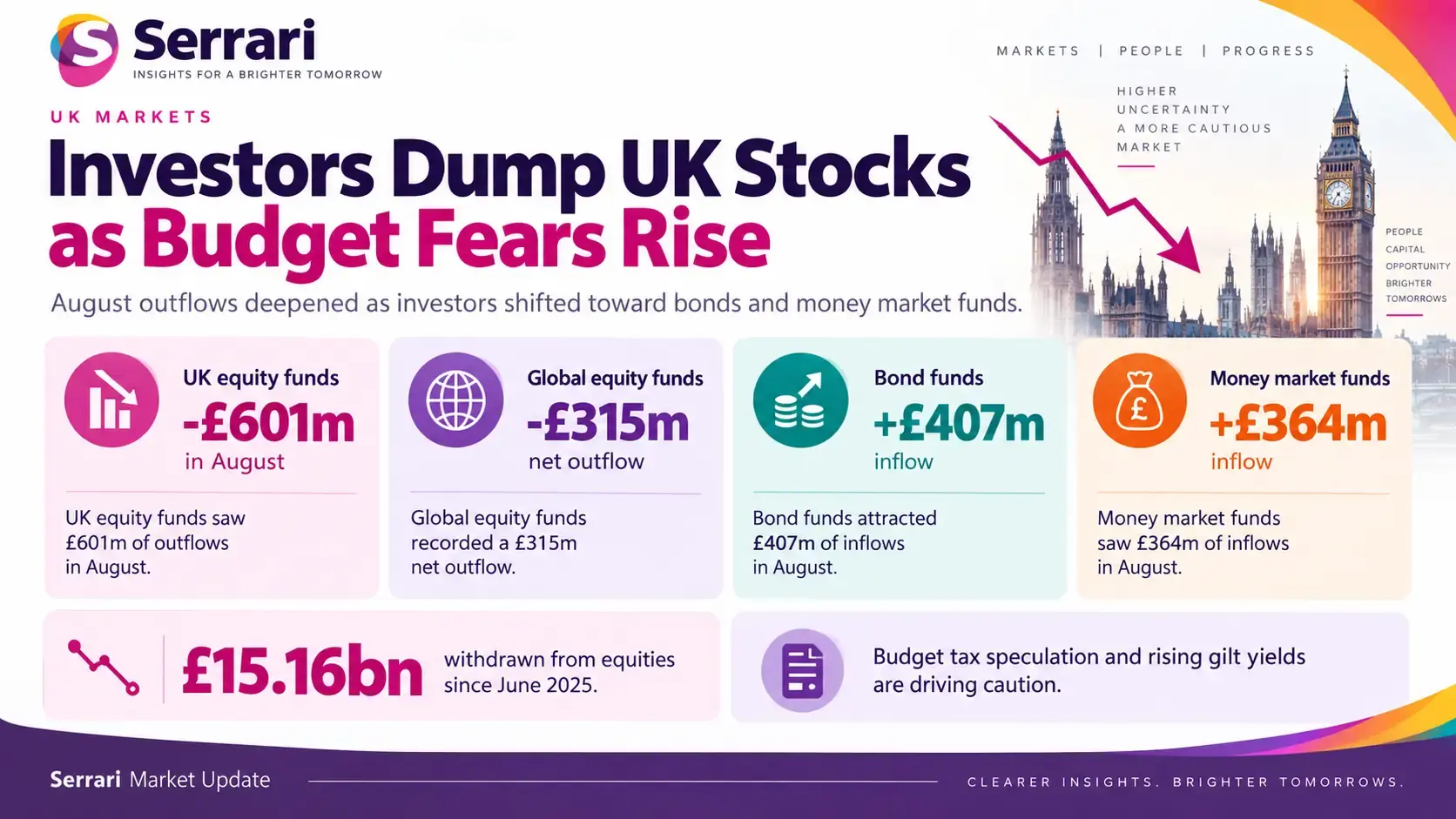
UK investors continued reducing exposure to equity funds in August 2026, with domestic stock funds suffering £601 million of net withdrawals. Equity funds overall recorded £315 million of net outflows, extending a prolonged period of investor caution even as the pace of selling slowed sharply from July.
The shift is increasingly favouring bonds and money market funds. Investors added £407 million to bond funds and £364 million to money market funds during August as higher yields, fiscal uncertainty and concern about possible tax changes made lower-volatility assets more attractive.
Key Overview
- UK equity funds recorded £601 million of net outflows in August.
- Equity funds overall lost a net £315 million during the month.
- Investors have withdrawn £15.16 billion from equity funds since June 2025.
- Bond funds attracted £407 million, their fourth consecutive month of net inflows.
- Money market funds received £364 million, their strongest inflow since November 2025.
- The UK Budget is scheduled for 28 October 2026, keeping tax and fiscal policy firmly in focus.
UK Equities Remain at the Centre of the Sell-Off
The August fund-flow data shows that UK-focused funds remained the main source of equity redemptions. European equity funds lost another £145 million, while North American funds recorded a small £3 million withdrawal. Overall equity outflows were much smaller than July’s £1.61 billion, but August still became the 14th month of net selling in the past 15.
That persistence matters. Since June 2025, investors have withdrawn £15.16 billion from equity funds, suggesting more than a short-lived reaction to one weak month in markets. Investors appear increasingly reluctant to add risk while uncertainty over taxation, government finances and high market valuations remains unresolved.
Budget speculation is particularly important because investors may bring transactions forward if they believe capital gains treatment, pension incentives or other wealth-related rules could change. Chancellor John Healey has declined to detail possible tax measures before the Budget, while maintaining that the government intends to follow its fiscal rules.
Bonds and Money Markets Absorb More Capital
The equity retreat has not translated into a wholesale exit from investments. Instead, capital is being redistributed toward assets that can offer income with less exposure to stock-market volatility.
Bond funds took in £407 million in August, marking a fourth successive month of positive flows. Money market funds attracted £364 million, roughly twice their recent monthly average and their strongest result since November 2025. Since equity withdrawals began in June 2025, bonds and money market funds together have absorbed about £8.7 billion.
Money market funds typically invest in high-quality, short-term instruments and are widely used for cash management. They can offer relatively quick access to money, although they are investments rather than guaranteed bank deposits. Bond funds can provide attractive income when yields are elevated, but their prices can still fall when interest rates rise and they also carry credit and liquidity risks.
Context is everything. Stay ahead of shifting trends with today’s market updates, and uncover emerging opportunities using the Serrari Group Market Index and Marketplace. Then, take control of your own financial future by exploring our Money & Life Reset Transformation Blueprint ™ to build stronger habits, create better systems, and design a path toward lasting wealth.
Rising Gilt Yields Add to the Budget Challenge
The rotation toward fixed income is occurring during an unusual period in UK bond markets. On 8 September, the government sold £4.25 billion of 30-year gilts at a yield of 5.8168%, the highest borrowing cost on a comparable syndicated sale since records began in 1998.
Higher yields can make bonds more appealing to income-seeking investors, but they also raise the government’s debt-servicing burden. That creates an uncomfortable trade-off ahead of the Budget: investors can access more competitive fixed-income returns at the same time that the Treasury faces greater pressure from those same borrowing costs.
The government entered the year with £23.6 billion of projected headroom against its main fiscal rule, but higher debt costs, inflation pressures and weaker growth assumptions have raised concern that the buffer could be substantially reduced.
What Investors Will Watch Next
The next major test will be the 28 October Budget. Any changes affecting capital gains, pensions, property or wealth could influence whether investors continue selling UK equity funds or begin rebuilding exposure.
For now, August’s flows point to caution rather than panic. Equity selling slowed materially from July, yet investors continued favouring assets offering income and perceived downside protection. If gilt yields remain elevated and fiscal uncertainty persists, bonds and money market funds may contiue competing strongly with equities for UK investor capital.
Sources
City A.M. / Calastone / Trustnet / Reuters / GOV.UK / Financial Conduct Authority
Your financial future isn’t something you wait for—it’s something you build.
The real question is: when do you begin?
Move beyond simply staying informed.
Navigate the markets with clarity—track trends through the Serrari Group Market Index, uncover opportunities in the Serrari Marketplace, and build practical knowledge with our Curated Wealth Builder Platform.
Stay connected to what truly matters.
Get daily insights on macro trends and financial movements across Kenya, Africa, and global markets—delivered through the Serrari Newsletter.
Growth opens doors.
Advance your career through professional programs including ACCA, HESI A2, ATI TEAS 7 , HESI EXIT , NCLEX – RN and NCLEX – PN, Financial Literacy!🌟—designed to move you forward with confidence.
See where money is flowing—clearly and in real time.
Track Money Market Funds, Treasury Bills, Treasury Bonds, Green Bonds, and Fixed Deposits, alongside global and African indexes, key economic indicators, and the evolving Crypto and stablecoin landscape—all within Serrari’s Market Index.