Nike will be removed from the S&P 100 later this month, marking another setback for the sportswear giant as chief executive Elliott Hill works to restore growth and rebuild investor confidence. The index change comes after a prolonged decline in Nike’s share price and amid an uneven recovery across its product categories and geographic markets.
The company is showing improvement in areas including running, wholesale and North America, but weakness in Nike Direct, digital sales and several international markets demonstrates that its broader turnaround is still incomplete.
Key Overview
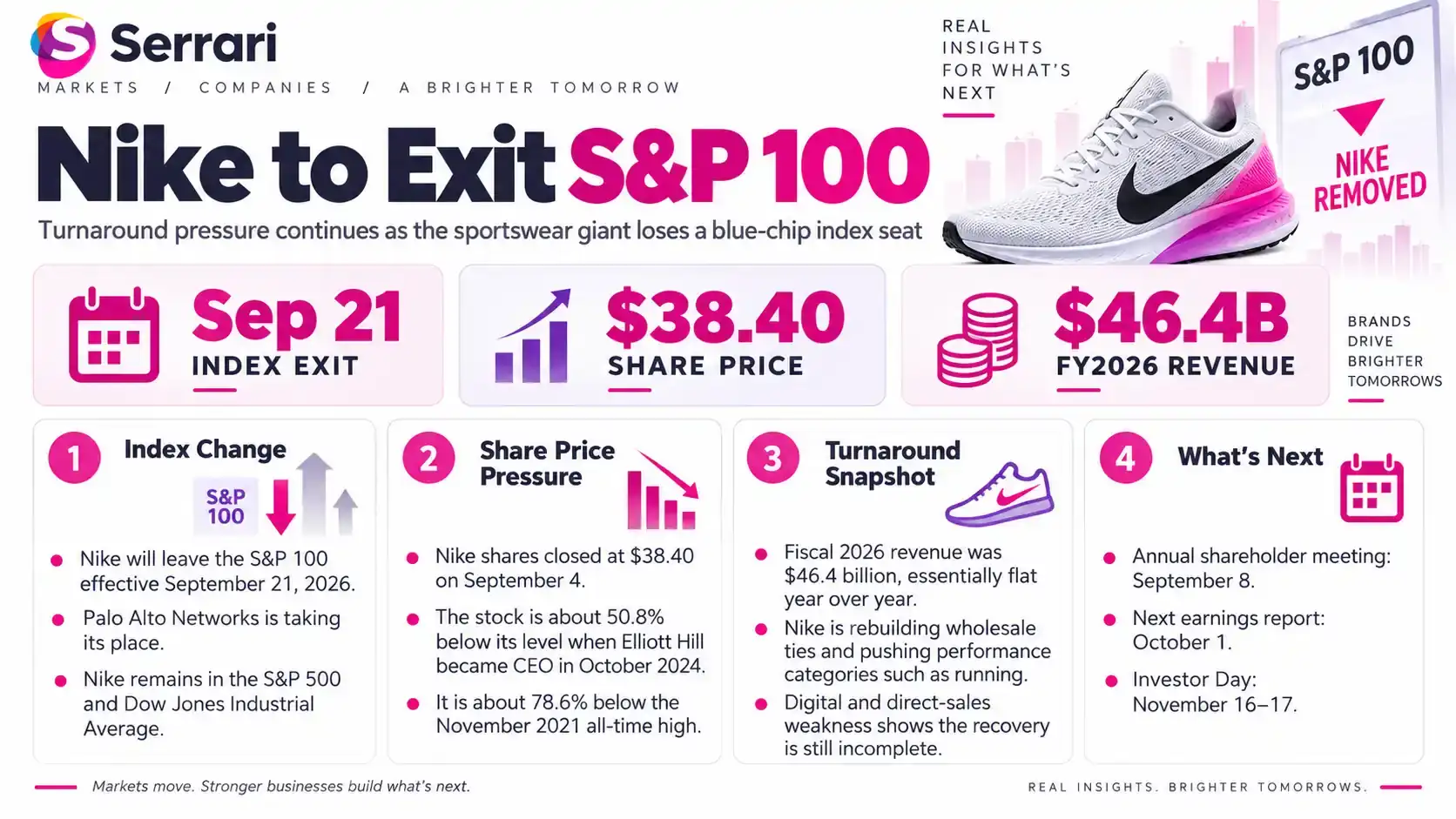
- Nike will leave the S&P 100 before trading opens on September 21, 2026, with Palo Alto Networks taking its place.
- The change is part of the September quarterly index rebalance and does not remove Nike from the S&P 500 or Dow Jones Industrial Average.
- Nike shares closed at $38.40 on September 4, around 50.8% below their level when Elliott Hill formally became CEO in October 2024.
- The stock is approximately 78.6% below its $179.10 intraday record high reached in November 2021.
- Fiscal 2026 revenue was $46.4 billion, essentially flat year over year, while Nike continues to rebuild its product portfolio and wholesale relationships.
- Nike’s next major tests include its fiscal 2027 first-quarter results on October 1 and Investor Day on November 16 and 17.
Nike Loses Its Place Among the S&P 100
Nike is set to be removed from the S&P 100 as part of a broad quarterly reshuffling of major U.S. equity indexes. The changes become effective before markets open on September 21, with cybersecurity company Palo Alto Networks replacing Nike in the index.
The S&P 100 represents 100 major U.S. blue-chip companies drawn from the broader S&P 500. Membership is designed to reflect some of the largest and most established companies across multiple sectors.
Nike’s removal therefore carries symbolic significance beyond routine index maintenance. Funds that specifically track the S&P 100 will need to adjust their portfolios around the rebalance, creating trading flows as Nike leaves and its replacement enters.
The decision does not mean Nike is disappearing from America’s major equity benchmarks. It remains a member of the broader S&P 500 and continues to be one of the 30 companies represented in the Dow Jones Industrial Average.
Context is everything. Stay ahead of shifting trends with today’s market updates, and uncover emerging opportunities using the Serrari Group Market Index and Marketplace. Then, take control of your own financial future by exploring our Money & Life Reset Transformation Blueprint ™ to build stronger habits, create better systems, and design a path toward lasting wealth.
Share Price Collapse Highlights Nike’s Challenge
The index change arrives after years of substantial shareholder losses. Nike shares closed at just $38.40 on September 4, the final U.S. trading session before the Labor Day holiday.
Elliott Hill formally became president and CEO on October 14, 2024. Nike closed at about $78.08 that day, meaning its shares have subsequently lost roughly 50.8% of their value.
The longer-term decline is even more dramatic. Nike reached an intraday record of $179.10 on November 5, 2021. Compared with the September 4, 2026 close, the stock has fallen roughly 78.6% from that peak.
The scale of that decline illustrates how sharply investor expectations have deteriorated as Nike has confronted weaker growth, changing consumer preferences and intensifying competition in running and athletic footwear.
Hill’s Turnaround Is Showing Uneven Progress
Hill inherited a business trying to reverse several strategic decisions made during the previous leadership era, including an aggressive shift toward direct-to-consumer distribution and heavy dependence on established lifestyle footwear franchises.
The company is now rebuilding relationships with wholesale retailers while attempting to increase the contribution of performance products and introduce new footwear rather than relying heavily on established retro styles.
There are signs that parts of the strategy are working. Nike reported fiscal 2026 revenue of $46.4 billion, essentially flat from the previous year on a reported basis, while wholesale revenue increased 6% for the full year.
Fourth-quarter Nike Brand revenue was also supported by growth in North America. However, Nike Direct revenue fell 7% during the quarter, including a 12% decline in Nike Brand Digital sales, showing that significant areas of the business remain under pressure.
Hill has acknowledged that recovery will not happen uniformly. Nike expects growth to expand beyond running into categories such as training and basketball, but Sportswear and Jordan streetwear are expected to remain negative during fiscal 2027 before potentially improving later in the year.
Investors Face Several Major Tests Ahead
Attention now turns toward a series of events that could provide clearer evidence of whether Nike’s recovery is gaining traction.
Nike is holding its 2026 annual shareholder meeting virtually on September 8, putting Hill before shareholders just days after the S&P 100 removal was announced.
The company will then release its first-quarter fiscal 2027 results on October 1, providing investors with another opportunity to assess revenue trends, margins, wholesale momentum and progress in performance categories.
Nike has also scheduled an Investor Day for November 16 and 17, when management is expected to provide a more detailed view of the next phase of its growth strategy.
Leaving the S&P 100 does not determine Nike’s long-term prospects, but it highlights just how far the company has fallen from the valuation and market standing it enjoyed at its 2021 peak. For Hill, restoring sustainable sales growth, product momentum and investor confidence will be critical if Nike is to regain that lost ground.
Sources: S&P Global / NIKE, Inc. / U.S. Securities and Exchange Commission / ChartExchange / Forbes / MarketBeat / OregonLive
Your financial future isn’t something you wait for—it’s something you build.
The real question is: when do you begin?
Move beyond simply staying informed.
Navigate the markets with clarity—track trends through the Serrari Group Market Index, uncover opportunities in the Serrari Marketplace, and build practical knowledge with our Curated Wealth Builder Platform.
Stay connected to what truly matters.
Get daily insights on macro trends and financial movements across Kenya, Africa, and global markets—delivered through the Serrari Newsletter.
Growth opens doors.
Advance your career through professional programs including ACCA, HESI A2, ATI TEAS 7 , HESI EXIT , NCLEX – RN and NCLEX – PN, Financial Literacy!🌟—designed to move you forward with confidence.
See where money is flowing—clearly and in real time.
Track Money Market Funds, Treasury Bills, Treasury Bonds, Green Bonds, and Fixed Deposits, alongside global and African indexes, key economic indicators, and the evolving Crypto and stablecoin landscape—all within Serrari’s Market Index.