Thailand is preparing a Climate Change Bill that could take effect in the third quarter of 2027. The proposed legislation would introduce carbon-pricing mechanisms, connect voluntary carbon credits with a mandatory emissions trading system and establish a Climate Fund to support businesses and communities through the transition. Officials warn that inadequate climate action could reduce Thailand’s GDP by as much as 14% by 2050.
Key Overview
- Thailand’s proposed Climate Change Bill could be enacted in Q3 2027.
- The World Bank estimates Thailand’s GDP could be 7-14% lower by 2050 without stronger adaptation.
- Thailand has moved its net-zero target from 2065 to 2050.
- NDC 2.0 targets a 30-40% emissions reduction by 2030 against business as usual.
- NDC 3.0 targets a 40% reduction by 2035 and requires at least THB2 trillion in investment.
- Thailand expects to require approximately US$7 billion in international financial support.
- The bill would introduce a carbon tax, mandatory ETS and a Climate Fund supporting a just transition.
Thailand Climate Change Bill Could Take Effect in 2027
Thailand is preparing a Climate Change Bill that could take effect in the third quarter of 2027, as officials warn that inadequate action to address climate risks could leave the economy facing losses equivalent to as much as 14% of GDP by 2050.
The proposed legislation would introduce carbon-pricing mechanisms, connect voluntary carbon credits with a mandatory emissions trading system and establish a Climate Fund to support businesses and communities through the transition.
Phirun Saiyasitpanich, director-general of the Department of Climate Change and Environment, outlined the plans at the Bangkok Business Summit 2026 during a panel discussion entitled “From Ambition to Execution: Policy Architecture and Low-Carbon Cities in Action”.
Phirun said climate change was no longer a distant environmental concern but an economic challenge directly affecting Thailand’s macroeconomic stability. The view that climate adaptation and emissions reduction were merely additional costs, separate from revenue and business growth, was changing fundamentally.
Economic Cost of Climate Inaction
Phirun highlighted the “cost of inaction”, citing a World Bank report estimating that Thailand’s GDP could be 7-14% lower by 2050 without stronger adaptation measures.
Taking action now was therefore not simply about environmental conservation, he said, but about protecting economic stability and employment. Reducing greenhouse-gas emissions would also be essential to maintaining Thailand’s competitiveness in the future global economy.
To provide clarity and predictability for investors in low-carbon technologies, Thailand has brought forward its net-zero greenhouse-gas emissions target by 15 years, from 2065 to 2050.
Phirun also referred to long-term plans to gradually phase out coal-fired power plants and increase the share of clean energy to 24% by 2050.
Thailand’s 2030 and 2035 Emissions Targets
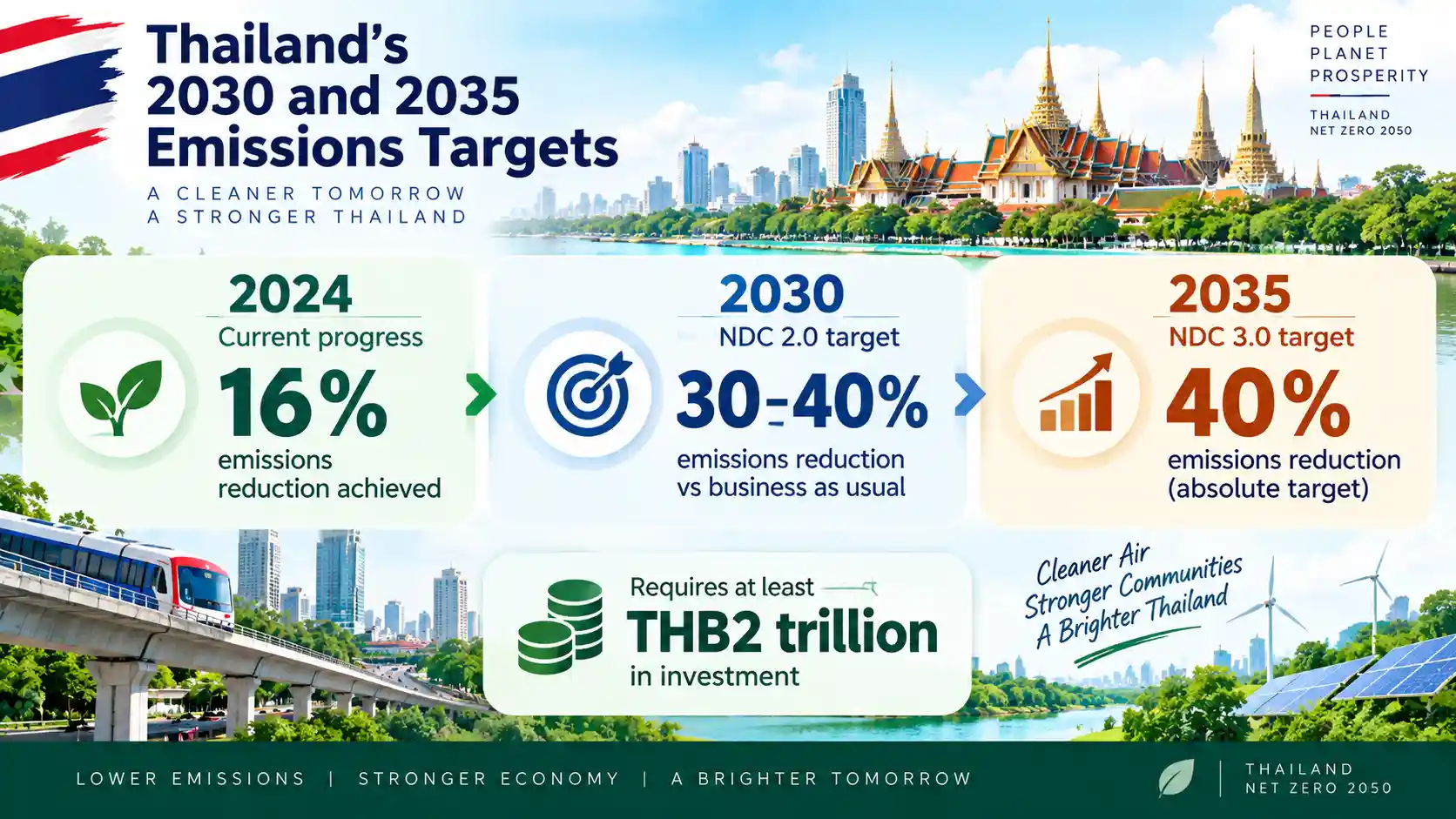
Although 2050 remains some way off, Phirun stressed that the immediate priority was Thailand’s NDC 2.0 commitment for 2030.
Under the nationally determined contribution, Thailand aims to reduce greenhouse-gas emissions by 30-40% compared with a business-as-usual scenario. The latest progress figure cited was a reduction of about 16% in 2024.
Phirun emphasised that the public and private sectors would need to work closely together to accelerate progress over the six-year period from that point to the 2030 deadline.
He described NDC 3.0 as a more ambitious approach, shifting from comparison with a business-as-usual projection to an absolute emissions-reduction target. The account of his remarks cited a 40% reduction by 2035.
Achieving the 2035 commitment would require investment of at least THB2 trillion, with financing expected from private-sector investment and government budgets. Climate change would therefore need to move from the margins to the centre of national fiscal policy.
International Climate Finance and Carbon Markets
Alongside domestic investment, Phirun said Thailand would require approximately US$7 billion in international financial support, including funding for projects that are not yet commercially viable.
Potential sources include the Green Climate Fund and cooperation under Article 6.2 of the Paris Agreement, which provides for the international transfer of emissions-reduction outcomes.
Phirun said Thailand had signed cooperation agreements with Switzerland, Singapore and Japan. The Bangkok electric-bus programme had already transferred carbon credits to Switzerland, while numerous other projects were being prepared.
Context is everything. Stay ahead of shifting trends with today’s market updates, and uncover emerging opportunities using the Serrari Group Market Index and Marketplace. Then, take control of your own financial future by exploring our Money & Life Reset Transformation Blueprint ™ to build stronger habits, create better systems, and design a path toward lasting wealth.
Climate Bill to Introduce Carbon Pricing
Phirun described the proposed Climate Change Act as an “economic blueprint” that would provide financial instruments to mobilise investment and regulate greenhouse-gas emissions.
Three principal mechanisms would be particularly important for businesses.
Carbon Tax
The bill would provide for upstream taxation of carbon-intensive products, including natural gas, coal and petroleum. The mechanism would help establish a standardised emissions database and provide direction for a minimum carbon price.
Emissions Trading System
An emissions trading system (ETS) would allocate emissions allowances to major emitters. Businesses exceeding their allocations would have to purchase additional allowances from other participants or use eligible carbon credits to offset excess emissions.
Linking Voluntary Credits With Mandatory Obligations
The proposed legislation would connect carbon credits to the ETS, allowing regulated businesses to use eligible credits to cover excess emissions, subject to a 15% limit.
The restriction is intended to prevent greenwashing and ensure that large companies invest in their own emissions-reduction technologies rather than relying solely on purchased credits.
Climate Fund to Support a Just Transition
The draft legislation would also establish a Climate Fund to support a “just transition”, recognising that carbon taxes and emissions trading could increase financial burdens and investment costs.
The fund would draw on revenue from the ETS, carbon-credit transaction fees and contributions associated with Thailand’s emissions cap, referred to as the “Thailand Cap”.
It would provide assistance through highly concessional loans, grants and equity investment. Support would extend from vulnerable small and medium-sized enterprises to large organisations seeking to invest in costly low-carbon technologies.
The fund would also assist communities in strengthening their capacity to adapt to climate change.
Phirun said the fund had been designed around a blended-finance model, under which financial institutions would be able to bid to work with the fund on financing packages that lower borrowing costs and make environmental investment projects more financially viable.
Climate Change Bill Moves Toward 2027 Enactment
The draft Climate Change Bill comprises 14 chapters and 205 sections.
Phirun said the working group was nearing completion of its review of Chapter 8 before moving to Chapter 9, which addresses the Thailand Taxonomy and its future development.
He expected the Council of State’s legal scrutiny to be completed and the bill to proceed through the House of Representatives, with enactment anticipated in the third quarter of 2027.
Outlook
The proposed legislation would introduce new emissions obligations, carbon-pricing mechanisms, carbon-credit rules and climate-financing arrangements for Thai businesses. Its proposed Climate Fund would also provide financing support for businesses and communities as Thailand works toward its 2030, 2035 and 2050 climate targets.
FAQs
1. When could Thailand’s Climate Change Bill take effect?
The legislation is anticipated to be enacted in the third quarter of 2027, subject to legal scrutiny and approval by the House of Representatives.
2. What would Thailand’s Climate Change Bill introduce?
The proposed bill would introduce a carbon tax, emissions trading system (ETS), carbon-credit mechanisms and a Climate Fund to support the climate transition.
3. What are Thailand’s emissions-reduction targets?
Thailand’s NDC 2.0 targets a 30-40% reduction by 2030 compared with business as usual, while NDC 3.0 cites a 40% reduction by 2035.
4. How much investment would Thailand need to meet its 2035 target?
Achieving the 2035 commitment would require at least THB2 trillion in investment, alongside approximately US$7 billion in international financial support.
Your financial future isn’t something you wait for—it’s something you build.
The real question is: when do you begin?
Move beyond simply staying informed.
Navigate the markets with clarity—track trends through the Serrari Group Market Index, uncover opportunities in the Serrari Marketplace, and build practical knowledge with our Curated Wealth Builder Platform.
Stay connected to what truly matters.
Get daily insights on macro trends and financial movements across Kenya, Africa, and global markets—delivered through the Serrari Newsletter.
Growth opens doors.
Advance your career through professional programs including ACCA, HESI A2, ATI TEAS 7 , HESI EXIT , NCLEX – RN and NCLEX – PN, Financial Literacy!🌟—designed to move you forward with confidence.
See where money is flowing—clearly and in real time.
Track Money Market Funds, Treasury Bills, Treasury Bonds, Green Bonds, and Fixed Deposits, alongside global and African indexes, key economic indicators, and the evolving Crypto and stablecoin landscape—all within Serrari’s Market Index.